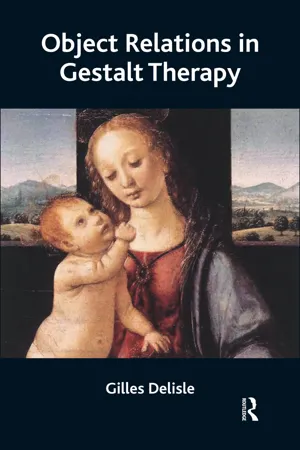
- 288 pages
- English
- ePUB (mobile friendly)
- Available on iOS & Android
eBook - ePub
Object Relations in Gestalt Therapy
About this book
This book focuses on the psychoanalytic theory of object relations in order to integrate certain pertinent elements of Fairbairn's theory of object relations, to achieve the proposed revision by Perls et al. of Gestalt therapy's theory of the Self.
Information
Part I
Historical Considerations
Chapter One
Fifty years of Gestalt therapy
After four editions of his book, Maddi (1989) finally includes Gestalt therapy in his comparative analysis of theories of the personality. Even then, he considers it a recent approach and cites only three references to Perls: (1) In and Out of the Garbage Pail (1969), considered by some to be a simple autobiographical essay (Clarckson & Mackewn, 1993; Stoehr, 1994); (2) Gestalt Therapy Verbatim (1969); and (3) Ego, Humor (sic!) and Aggression, which he cites as 1969, although Ego, Hunger and Aggression was published in 1942. One can only conclude that the theory of Gestalt therapy is relatively unknown, if a recognized specialist in the field of theories of the personality fails to cite the fundamental 1951 reference (Gestalt Ttherapy: Excitement and Growth in the Human Personality) and if other important authors (Drapela, 1987; Hall & Lindszey, 1957; Pervin, 1990) completely ignore the approach.
In spite of its limited visibility, Gestalt therapy has made important contributions to clinical thinking and practice (Bergin & Garfield, 1991). The major contribution of Gestalt is the holistic perspective, the idea that the interrelations between objects and persons are such that no situation can be reduced to the simple sum of its parts. Consequently, Gestalt defends the notion, relatively new at that time (Perls, 1942; 1947; Perls, Hefferline & Goodman, 1951) that the real, here-and-now relationship is as important as transference (Clarckson & MacKewn, 1993, p. 87). For Yontef (1993), psychoanalysis, in recent developments, has clearly integrated many elements borrowed from humanistic psychology and Gestalt therapy, including recognition of the importance of the real relationship. Certain ideas developed by Perls and by Perls et al. have certainly been assimilated, whether consciously or unconsciously, by thinkers in the psychodynamic tradition, sometimes even being announced as their own original discoveries (Burgalières, 1992; Miller, 1988, 1991).
A rapid analysis of the scientific and clinical literature over the last twenty1 years shows that innovative aspects of Gestalt therapy have been widely applied. As an example of a technical innovation, one can cite the well-known empty-chair technique, whose positive effects on interpersonal and intrapersonal blockages have been well documented (Clarke & Greenberg, 1986; Conoley, Conoley, McConnel & Kimzey, 1983; Goodman & Timko, 1976; Greenberg, 1980; Greenberg & Higgins, 1980; Greenberg, 1983;). The highly effective Gestalt dream analysis techniques have been widely appreciated (Alban & Groman, 1975; Dublin, 1976; Himelstein, 1984), while the “experiments”, not to be confused with acting-out (Ginger, 1984), stimulate insight and favour a fuller, more sustained presence on the part of the client (Greenberg & Kahn, 1978). Globally, Gestalt therapy techniques help to counter schizoid withdrawal, narcissistic injury, and regression (Zarcone, 1984). They encourage spontaneity and deeper consciousness of physical sensations and sharpen the here-and-now experience (Ginger, 1984).
Additionally, many researchers and clinicians have applied Gestalt therapy to a diverse set of clinical syndromes such as eating disorders (Meyer, 1991; Pearce, 1988), sexual disorders (Mosher, 1977; 1979a; 1878b), post-traumatic stress (Besyner, 1985; Crump, 1984), speech disorders (Kaplan & Kaplan, 1978), and alcoholism (Buchbinder, 1986). Gestalt therapy has been successful with these disorders, and has been considered by some to be applicable even to the treatment of psychotic disorders, notably allowing schizophrenics to improve their perceptual processes and their hold on reality (Dublin, 1973; Gagnon, 1981; Serok & Zemet, 1983).
In spite of these successful applications, weaknesses in the underlying theoretical structures of Gestalt therapy have been roundly criticized, beginning with charges of conceptual ambiguities (Cadwallader, 1984; Crocker, 1983; Dolliver, 1981; Enns, 1987; Feder, 1978; From, 1984; Masson, 1989; Peterson, 1977; Saner, 1984) and a lack of clear connections between theory and practice (Miller, 1985; Stoehr, 1992; 1994). These ambiguities, as well as the presence of inherent theoretical flaws, have been considered particularly troublesome in the long-term treatment of serious personality disorders (AQG, 1993; Yontef, 1988). Gestalt therapy has been accused of: (1) neglecting the interpersonal and the intersubjective (Cahalan, 1983; Hycner, 1985; Kovel, 1976; Lewis & Schilling, 1978); (2) underestimating the importance of unconscious processes in pathology (Bouchard, 1990; Bouchard & Derome, 1987; Davidove, 1991; Nevis, 1985); (3) not providing a satisfying conceptual framework for understanding the dynamics of transference and countertransference (Kovel, 1976; Tobin, 1982, 1983, 1985, 1990); and (4) considering cognitive processes as an obstacle to the body’s inherent wisdom (Becker, 1982; Kovel, 1976).
Many prominent Gestalt therapists consider that these weaknesses are at least partially attributable to the absence of any theory of psychic development. Adequate treatment of developmental pathways and issues would provide a basis for an integration leading to a coherent global theory (Breshgold, 1989; Breshgold & Zahm, 1992; Polster, 1987; Yontef, 1988).
These criticisms are not all valid, and even to the extent that some may be justifiable, there is nothing in them that is fatally embarrassing for Gestalt theory. Some of them have prompted debate,2 and while many proselytes of Gestalt continue to defend the theory of 1951 rather than develop it, our approach will be to develop the Gestalt theory of the Self, with a view to using the revised theory to attain a better understanding of the pathogenesis of personality disorders. Several influential American Gestalt therapists (Breshgold & Zahm, 1992; Tobin, 1982, 1990; Wheeler, 1991; Yontef, 1988) have called for this kind of revision, along the lines of making linkages between Gestalt therapy and contemporary psychoanalysis. Canadian Gestalt therapists have also contributed to the discussion: Burgalières (1991) remarking on the similarities between Cashdan’s (1988) synthesis of object relations thinking and the classical texts of Gestalt therapy, and Bouchard and Derome (1987), as well as Bouchard (1990), showing the deep affinities between the theory of the Self of Perls, Hefferline, and Goodman and Fairbairn’s theory of personality.
Gestalt therapy was created by psychoanalysts just after the Second World War, as a reaction to the rigidity of classical psychoanalysis (Yontef, 1988; 1993, p. 5). But it was not until 1951 that the theory was consolidated by the classical work of Perls, Hefferline, and Goodman, published in two parts: practical and theoretical. The theoretical text, written by Paul Goodman and based on a draft produced by Perls (Clarckson & MacKewn, 1993; L. Perls, 1993; Stoehr, 1994; Wysong & Rosenfeld, 1982), was a social-political critique of American conformity as well as a theory of the Self, this latter being inspired by the Field Theory of Lewin (1935) (Yontef, 1988). This remarkable combination of psychotherapy and socio-political criticism shows the clear influence of Paul Goodman’s anarchist and libertarian values. The work is a rare pearl, uniting as it does the personal and the social, the private and the political. But its very range, impressive as it may be, has the effect of diluting the precision of the psychological analyses and of limiting understanding of the dynamics of pathogenesis.
The authors who gave Gestalt therapy its initial impetus (Perls, 1942; Perls, Hefferline & Goodman, 1951) did so essentially by rejecting the Freudian theory of consciousness which holds that psychic life is the product of the actions of various drives, actions which lead to the establishment of a differentiated and conflicted psychic apparatus. Perls et al. attacked the underlying idea of an individual as a closed system and proposed instead a meta-psychology derived from Field Theory, holding that any study of human beings must have, as its starting point, the Field composed of the organism and the environment. In so doing, they, as others (Fairbairn, 1954; Sullivan, 1950a), proposed a radical alternative to the Freudian view of the psyche. The energy of psychic life is not some drive or other, but rather the configuration of the Field itself. This rupture with Freudian thinking extended to other theoretical points. Concerning psychic structures, practically nothing would remain other than terms like “Ego” and “Id” to describe non-reified functional processes activated during cycles of contact. The Self for Gestalt therapists is no longer seen as a fixed institution, simultaneously an archive and an experiential generator, but rather a spatial-temporal “event” that “happens” only when there is an excitation at the contact boundary. For Gestalt therapists, not only the Self but even the Field is unitary, with the consequence that, contrary to common understanding, the distinctions between body, mind, and external world are simply inevitable illusions (Perls, Hefferline & Goodman, 1951, p. 50).
As for dynamic interactions within the Self, in the usual psychoanalytic meaning of the word, for Perls et al. there simply aren’t any. If there is no structural differentiation within the psyche, then there cannot be entities participating in intra-psychic conflicts. One might see what could be described as an economic perspective, again in the psychoanalytic meaning of the word, in the contact cycle during which it goes from sensation to mobilization, action, toward a contact that “destroys the Figure”, permitting a return to withdrawal, a “state of equilibrium”. For most Gestalt therapists, this vision of the individual as a perfectly unified being, both physically and experientially, remains to this day as one of the richest and most convincing ideals of the ultimate goal of the therapeutic enterprise. Here, health is not defined as the simple absence of disease! However the analysis of pathology and its aetiology has been relatively neglected in the elaboration of Gestalt theory (Clarckson & MacKewn, 1993; Delisle, 1991; Yontef, 1988), and consequently today’s clinicians lack conceptual tools. For example, From (1984) holds that narcissism can be understood through the concept of confluence—a deficient Self-environment differentiation. For Yontef (1988), a formulation as vague as this is simply useless in the clinical setting, especially in the absence of published supporting evidence.
The theory of the Self put forth by Paul Goodman in 1951 does not adequately explain the loss of unity and continuity which, for Gestalt theory, lies at the heart of all psychopathology. This man of letters, philosopher, and idealistic sociologist, saw the relationship between the human being and the environment in such a way that health is a normal state inherent in the former, and pathology is a deviation induced by the latter.
During the fifty year history of Gestalt therapy, many Gestalt therapists have ventured into the waters of the theoretical analysis of pathology (Clarckson & MacKewn, 1993; Delisle, 1991; Yontef, 1988), and some have specifically reflected upon approaches to deeply pathological manifestations such as narcissistic personalities and borderline personalities (Bouchard, 1990; Bouchard & Derome, 1987; Greenberg, 1989; Staemmler, 1993; Yontef, 1988). All those who have undertaken these ad hoc theoretical analyses recognise that Gestalt therapy in itself does not provide a conceptual framework that can satisfactorily explain these pathologies. Consequently, we feel that it is pertinent to develop dialogue with the object relations theory of W. Ronald D. Fairbairn so that Gestalt therapy can grow beyond being simply a general description of health and the means to improve it, and become a true therapeutic system with a conceptual framework that permits clinicians to understand individual differences and treat patients. These developments could in turn permit a clarification of the structure of the psyche according to Gestalt therapy, opening the door, ultimately, to a Gestalt theory of development. But even before attaining this ultimate goal, the exchange between Gestalt and Fairbairn should rapidly permit better links between theory and clinical practice for today’s Gestalt therapist.
Our enterprise is thus an example of the integrative school of thought in psychotherapy, and more specifically of the so-called “unique” integration (Lecomte & Gastonguay, 1987). Although Gestalt therapy itself is historically a product of the integrative interest that continues today to inspire (Bouchard, 1985), Gestalt therapists remain wary of conceptual borrowing and technical eclecticism. Isadore From (1984) roundly condemned a simple-minded eclecticism that linked Gestalt therapy with just about anything, while at the same time implicitly recognizing the incomplete nature of the 1951 theory: “This theory and practice cannot be declared outdated by anyone without proof. Any developments of Gestalt therapy will be corollaries of this theory that needs to be developed” (1984, p. 141, cited by Bouchard & Derome, 1987). But where will these developments come from? For the reasons cited earlier, we find it pertinent to turn toward the theory of Fairbairn.
Product of another intellectual tradition, the theory of W.R.D. Fairbairn, underestimated and neglected during several decades, has returned to the forefront to throw considerable light on the development of personality as a function of early interpersonal relationships (Greenberg & Mitchell, 1983; Grotstein & Rinsley, 1994; Rubens, 1984). Distancing himself from classical psychoanalysis, Fairbairn proposes a radical paradigm shift in affirming that the libido is not essentially the search for pleasure, but instead the search for an object (1943; 1954, p. 31–33), that the Ego is present from birth and has its own energy (1954, p. 9), and that the Ego loses its original unity through processes of splitting and repression as a reaction to frustration.
As Bouchard and Derome (1987) have shown, Fairbairn and Goodman have parallel visions of the evolution of the Self. For both, the Ego/Self is unified at first, but loses this unity in an inevitable, pathological, but ultimately reversible process. In his most radical departure from classical psychoanalysis, Fairbairn holds that far from being the precondition for psychic growth, structural differentiation is a defensive and pathological developmental process (Rubens, 1984; 1994). For both Fairbairn and Goodman, the psyche is unified and has no need to become differentiated in order to develop in a healthy way. But afterwards, the accent falls in different places: Goodman fixes his attention on the processes implicated in global health, while Fairbairn turns to an explanation of the loss of the early unity of the consciousness, and of the ensuing pathology. Would a simple combination of the two suffice as a revision of the Gestalt theory of the Self leading to a new theory of psychotherapy? As we shall see in the following chapter, it is important to address several fundamental issues when one goes about the business of integrating theories in psychology.
Notes
1. It was only in 1973 that the APA finally recognized GT as an independent entity rather than as a simple extension of Gestalt psychology (Simkin, 1978).
2. For example, the debate opposing Yontef and Tobin in 1982 and 1983 on fundamental questions relating to the theory of the Self and on possible links with Self-psychology.
Chapter Two
Theorising and knowledge in psychology
According to Rennie, Phillips, and Quartaro (1988) there is a growing consensus to the effect that psychology has overestimated methodologically correct research to the detriment of thinking and creativity. As a result, theorising is less respected and known than trivial, busy-work empirical research (Bakan, 1967; Brandt, 1982; Endler, 1984; Gergen, 1982; Secord, 1982). In the same vein, Granger (1994) questions the indiscriminate use of the experimental method in clinical and social psychology, calling instead for an increased use of the potentially richer methods of observation and modelling. It should be pointed out that theorising is in no way easier than research. “(Theorising) demands a considerable effort of concentration, examination, and re-examination. It is the antithesis of casual reflection, lazy reading, and undisciplined speculation” (Gottfredson, 1983). Feyerabend (1975, p. 520) suggests that we all need a good dose of methodological anarchy to help us find new ideas!
What exactly is “theorising”? For Rychlak (1988, p. 250), we are speaking essentially of a series of two or more...
Table of contents
- Cover
- Half Title
- Title
- Copyright
- CONTENTS
- ABOUT THE AUTHOR
- ABOUT THE CONTRIBUTING AUTHORS
- INTRODUCTION
- PART I: HISTORICAL CONSIDERATIONS
- PART II: PROPOSITIONS FOR AN OBJECT RELATIONAL GESTALT THERAPY
- PART III: CASE STUDIES
- APPENDIX
- REFERENCES
- INDEX
Trusted by 375,005 students
Access to over 1.5 million titles for a fair monthly price.
Study more efficiently using our study tools.
Frequently asked questions
Yes, you can cancel anytime from the Subscription tab in your account settings on the Perlego website. Your subscription will stay active until the end of your current billing period. Learn how to cancel your subscription
No, books cannot be downloaded as external files, such as PDFs, for use outside of Perlego. However, you can download books within the Perlego app for offline reading on mobile or tablet. Learn how to download books offline
Perlego offers two plans: Essential and Complete
- Essential is ideal for learners and professionals who enjoy exploring a wide range of subjects. Access the Essential Library with 800,000+ trusted titles and best-sellers across business, personal growth, and the humanities. Includes unlimited reading time and Standard Read Aloud voice.
- Complete: Perfect for advanced learners and researchers needing full, unrestricted access. Unlock 1.5M+ books across hundreds of subjects, including academic and specialized titles. The Complete Plan also includes advanced features like Premium Read Aloud and Research Assistant.
We are an online textbook subscription service, where you can get access to an entire online library for less than the price of a single book per month. With over 1.5 million books across 990+ topics, we’ve got you covered! Learn about our mission
Look out for the read-aloud symbol on your next book to see if you can listen to it. The read-aloud tool reads text aloud for you, highlighting the text as it is being read. You can pause it, speed it up and slow it down. Learn more about Read Aloud
Yes! You can use the Perlego app on both iOS and Android devices to read anytime, anywhere — even offline. Perfect for commutes or when you’re on the go.
Please note we cannot support devices running on iOS 13 and Android 7 or earlier. Learn more about using the app
Please note we cannot support devices running on iOS 13 and Android 7 or earlier. Learn more about using the app
Yes, you can access Object Relations in Gestalt Therapy by Gilles Delisle in PDF and/or ePUB format, as well as other popular books in Psychology & History & Theory in Psychology. We have over 1.5 million books available in our catalogue for you to explore.