This volume is to help parents understand what their baby is likely to be feeling in the first year. It describes how the baby's sense of self develops, with intentionality, empathy and recognition of the self. It focuses on the baby's subjective experience of the world, viewing the baby as a subject in his or her own right, and in this way makes a unique contribution in the area of understanding the early non-verbal experiences of infants. Each of the authors featured has published papers and books for the academic and clinical communities; the present volumes, however, are specifically aimed at parents. The intent is not to convince but to inform the reader. Rather than offering solutions, we are describing, explaining and discussing the problems that parents meet while bringing up their children, from infancy through to adulthood.
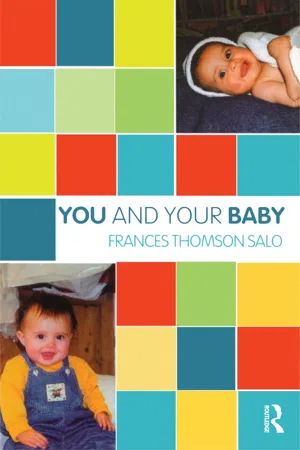
- 160 pages
- English
- ePUB (mobile friendly)
- Available on iOS & Android
eBook - ePub
You and Your Baby
About this book
Information
1
setting the scene
Babies want, more than anything else, to be enthusiastically enjoyed. That may seem an unexpected place to start, but it lies at the heart of how, as a psychoanalyst working with and observing babies and their families, I think about babies. Babies come into the world already knowing a lot, with a functioning mind primed to communicate and to learn quickly. Appreciating this is of fundamental importance for understanding babies.
This series of books was conceived partly as a resource for parents to gain some understanding of what their child is likely to be feeling. We cannot know exactly what a baby thinks and feels, but knowledge about how babies may experience their interaction with their parents is increasing exponentially. The great English paediatrician and psychoanalyst Donald Winnicott, who saw some 60,000 babies, believed that the answers to understanding their baby lay in the parents themselves. My hope is that understanding more about the exquisite capacities with which babies come into the world empowers their parents to feel that the answers are in them. Once we know how babies are capable at an early age of understanding and carrying out certain actions, we become, in turn, even more aware of their capacities. If parents can tune-in to how much their baby longs to connect with people, they might be fascinated to engage with and share their baby's fascination with them.
This book is for parents who are interested in understanding about their baby and about themselves. It is not a book with advice about physical and cognitive development (although I sometimes discuss this when it seems connected with a baby's emerging sense of self), nor is it about how to bring up babies. Rather, it is written in the belief that working out what to do follows more easily from understanding what babies are feeling and thinking.
The book brings together insights from working therapeutically with babies, children, and adults with those from infant research and from infant observation—long-term naturalistic observation of babies in their own homes. This kind of observation is undertaken as part of the training of child psychotherapists and psychoanalysts, and many helpful ways of knowing about babies have emerged as a result. I have drawn on some examples from observers for descriptions of babies' lives, although the examples cannot be comprehensive.
Writing as a clinician with nearly two decades' experience working with distressed babies and their families, I have attempted to integrate the different strands of knowledge in what I think is the most helpful way to understand babies. Understanding the attachment bond—the emotional relationship between babies and those who care for them—stems from observing behaviour. But this alone would not describe all the ways we have of thinking about a baby's mind. For that, we also need the fine-grained understanding that comes from seeing adults and children in psychoanalysis and psychotherapy. Having trained as a psychoanalyst and child psychotherapist, the most useful approach I have found in working with distressed infants and their families has been a distillation of a psychoanalytic approach and some of the findings from infant research.
I have focused on the baby's subjective experience of the world. If we put babies in central place, it follows that they are to be treated not as an object but as a subject in their own right. When we meet babies for the first time, we need to recognize and respect their subjectivity.
I have concentrated on the early months because they are often the hardest to understand. At times I may seem to speak for babies in a way that I cannot possibly know. Much of what a baby feels and thinks is preverbal, but we only have words to try to capture the essence of what we think the thoughts and feelings are. However, in the past, parents may have been silenced when academic psychology seemed to discount what parents intuitively felt they knew. Mothers talk to their babies as though they unconsciously feel that their babies understand them. The more we learn from neuroscientific research, the more likely it is that we are right to trust our intuition about what a baby feels.
I begin by describing some of the parents' feelings as they prepare for their baby; I then describe the beginning two months of their baby's life. What babies experience is presented first in terms of the three main ways in which the sense of self develops: intentionality; recognition of their own body and feelings and those of other people; and empathy. Parents may initially feel that ideas about the very young baby developing empathy may be a little far-fetched, but as some of these ideas are explored, parents usually find such ideas resonate for them, perhaps from a time when they themselves were babies. Chapters 3, 4, and 5 describe these strands of development taking place alongside one another, inextricably interconnected and unfolding in a chronological way from the second month onwards. In part II, I change the focus to look in more depth at how babies relate to their fathers, their siblings, and other people. The main achievements of the first year are also described, such as coping with separations, the development of thinking processes, the consolidation of self-esteem, and the development of concern for others. In the final part, I look briefly at what may happen when babies are ill or when unresolved emotional difficulties are revived for their parents.
I describe some of what parents' think and feel, as, particularly in the early months, there is such a reciprocal effect between their babies' minds and their own. While this book is more about understanding when development progresses well enough, I have indicated when there may be transient difficulties, to help parents think about the meaning of these for their babies and for them. When parents can be thoughtful about their babies, they are likely to have a sense of how to help with any difficulties that need attending to.
I have described babies who are cared for by their parents in a family home, whose development unfolds in an expectable way. Sometimes when I have referred to parents, it is implicit that this includes whoever is caring for the baby. I have not explored a baby's experience from the viewpoint of the different ways families are constituted nowadays. While there are also differences between cultures and how babies respond within their culture, these differences are probably smaller than might be expected, even when we compare patterns of childrearing in the Western world with those from cultures that do not emphasize individuality in the same way. Attachment theory, which underpins a considerable amount of current empirical research about babies, is not culturally specific, as it was originally derived in part from observations of mothers and babies in Uganda.
The ages given in the book are meant only as guides in capturing the achievements of the time periods. Because of what we now know about babies in their first year, it becomes hard to discuss a baby of this age without knowing precisely how old the baby is—the rate of development from the age of 1 day, to a week, to a month, to several months, to a year, is enormous.
It will be helpful when reading the subsequent chapters to have in mind die ideas outlined in the following sections.
Primary maternal preoccupation
Towards the end of pregnancy and in the first few weeks after a baby's birth, the emotional world of the mother primarily revolves around feelings and thoughts about her baby,1 In that dreamy, preoccupied state a mother loses herself, figuratively speaking, in order to get to know her baby. The mother of a 4-day-old baby said, stroking his forehead: "He is so beautiful. I sat here today for six hours, just looking at him." Babies need their mothers to help give them a sense of their bodies—where their bodies end and where others begin—a sense of their physical and emotional skin. A mother can be in touch with what her baby is feeling minute by minute, whereas other people are more outside this experience.
Primary maternal preoccupation lasts for several weeks after the birth of a baby. Mothers often talk about how, after the disorganization of the puerperium (the period between childbirth and the return of the altered anatomy, physiology, and biochemistry to the non-pregnant state), they feel that the identity they had before their baby's birth returns about two months after it. With a subsequent baby, the feelings may be just as intense, but a mother might not have the same amount of time to dwell on the new baby. Fathers may develop a preoccupation similar to the one that mothers develop. (One such father, who became forgetful about everyday matters, enquired whether there was a term to describe the fathers' condition, as there is for mothers'.)
When parents are able in pregnancy to integrate fantasies about their baby with those they have about their relationship as a couple, this has a positive effect on the quality of family interaction. Parents, particularly mothers, are faced with their tiny baby's total dependence on them; in some ways, this is hard, as very young babies have so few ways to give parents any feedback to reward them.
A baby's mind seeks meaning
Babies are born with brains already "on-line" and actively seeking to make meaning out of their experience. Their brains, in turn, are partially structured by their experiences, but that does not mean that everything is fixed once and for all in the first year. Rather, their experiences act as a template through which their brains filter all subsequent experience and one that is capable of being modified with different experiences.2 Babies who have strong relationships with those who care for them draw a resilience from this and remain open to subsequent experience.
Babies do not come into the world a blank slate; they come with their inherited potential. From the first moment, when they begin the process of coming to know themselves and discovering the outlines of their emerging self, they are acted on by the experiences they have. Their parents are simultaneously coming to know them and helping them know themselves.
Experiences in the first year are stored in the procedural memory system—the bodily memory system of ways-of-being with another person in the earliest years. These include the ways in which their parents comforted their distress. Memories in this system influence subsequent relationships, even though the memories are not subject to conscious recall. Many of the ways in which adults interact with babies come from procedural memory. If a baby experiences a traumatic event, the trauma is "remembered" by the body, which means that memories of difficult times are not completely lost but may show as a vulnerability. A baby who has been very frightened by an early experience usually retains traces of having been anxious.
Because babies attempt to make meaning out of everything, much of what they feel and do has meaning. We may not always understand their experience, but viewing babies in this way helps keep the focus on their actions and behaviour as purposeful rather than random or inexplicable.
The psychosomatic language
Babies have no way of communicating pain or distress apart from crying or other bodily ways, such as sleeping difficulties or feeding difficulties or other bodily upsets. As the psychosomatic language is the first language of a baby, disturbances for which there is no organic cause express babies' emotional pain or a pain shared with a parent. The more urgent psychosomatic presentations occur when babies feel they can no longer hold it together, as though an emotional skin is giving way. Some of these ways of expressing distress continue throughout life: an adolescent said that whenever she was stressed, her skin broke out in a rash. Let us look at the different kinds of anxiety a baby may feel.
Early anxieties
Anxiety evolves gradually, from the panic that newborns may experience to the more specific anxieties that children and adults experience. Sometimes newborns look frightened, as though they feel they might be dropped when they are passed though space, as they have no way of knowing that someone is holding them. The fear of falling into nothingness or being left alone forever is, for the baby, an anxiety about annihilation, an experience of "nameless dread".3 These very early anxieties may often be out of touch with reality. If adults experienced these anxieties and were to catastrophize, "What if this were to happen and this and this?", it would be easy to think they had lost touch with reality. As everyone has experienced such anxieties early in their life, these fears remain in our memories as a part that can lose touch with reality if they are re-evoked when caring for babies.
If babies or their parents are angry, this can create anxiety for the baby and disturb the smooth functioning of their relationship, Just as babies are angry at times about what they feel are deprivations in their relationship with their parents, so parents have many reasons for mixed feelings towards their baby and for being anxious about these feelings. The normal ambivalence in every relationship may cause them considerable grief.
The evolving anxieties that babies experience include fears of being separated from or abandoned by their parents, of being physically hurt, or of being disapproved of, shamed, and losing their parents' love. Conflicts between states of the self or conflict with the environment lead to anxiety and distress. Some babies feel very anxious about any change at all.
Babies respond to these early anxiety situations by trying to get rid of the bad feelings and discomfort. We think that they try self-protectively to split off the bad by imagining, "It's not in me, it's outside, and I only have good inside." They come to learn that some of what is good is outside, like their mother who comes to meet their needs, and some of what is bad and uncomfortable is inside. Babies need ways of protecting against anxiety, whether or not it is realistically based. Imagine an ongoing system in which a baby projects an idea or feeling outside, then takes it back, modified according to the reception it met in the outside world. This reality-testing helps to build up babies' inner world of mental representations of people who are important to diem.
A loving parent inside
The way parents love and care for their babies becomes part of how babies feel about themselves. The good experiences that they have in their first months help to build up a sense of loving, supportive internal parents as a life-long resource as well as an early sense of trust. Babies then have a sense that their parents are there for them and will love them unconditionally. Initially, to the baby it may feel like an actual presence accompanying him, before becoming more a way of looking after himself. Christina Noble, who suffered extreme abuse in her childhood after her mother died when she was 4 years old, was asked how she had the will to live, and she replied that it was due to her mother: "You see, I had love. I had a little, tiny foundation."4
The "good internal mother" is a representation, a way of thinking about the baby's experience of being mothered. When babies feel secure with a good mothering presence, they feel loving, hopeful, and creative. If a mother found it difficult to enjoy herself after the birth of her baby, she has refound an internal good mother once she begins to enjoy herself again. Mothers need mothers, and if a mother feels that she has not been deserted by her internal good mother, she will be tolerant of her mixed feelings towards herself and her baby and able to mother her baby better. She regains a perspective that she will not be stuck forever with infinitely depressing feelings. Caring and having fun are creative activities.
The concept of a good internal mother overlaps with the theory of secure attachment. The inner security described above is what most babies experience in their relationship with their parents. (There is more about this in chapter 7.)
Developing a sense of self
The developing self begins to emerge from the different experiences a baby has. A baby's self is his unique identity that exists over time and space and includes the...
Table of contents
- Cover
- Half Title
- Series Title
- Title
- Copyright
- Dedication
- Contents
- about the author
- acknowledgements
- series editor's foreword
- 1 setting the scene
- I a baby’s developing self
- II the tasks facing the developing self
- III the self in difficulty
- the search for ariadne's thread—the first year of life
- notes
- index
Trusted by 375,005 students
Access to over 1.5 million titles for a fair monthly price.
Study more efficiently using our study tools.
Frequently asked questions
Yes, you can cancel anytime from the Subscription tab in your account settings on the Perlego website. Your subscription will stay active until the end of your current billing period. Learn how to cancel your subscription
No, books cannot be downloaded as external files, such as PDFs, for use outside of Perlego. However, you can download books within the Perlego app for offline reading on mobile or tablet. Learn how to download books offline
Perlego offers two plans: Essential and Complete
- Essential is ideal for learners and professionals who enjoy exploring a wide range of subjects. Access the Essential Library with 800,000+ trusted titles and best-sellers across business, personal growth, and the humanities. Includes unlimited reading time and Standard Read Aloud voice.
- Complete: Perfect for advanced learners and researchers needing full, unrestricted access. Unlock 1.5M+ books across hundreds of subjects, including academic and specialized titles. The Complete Plan also includes advanced features like Premium Read Aloud and Research Assistant.
We are an online textbook subscription service, where you can get access to an entire online library for less than the price of a single book per month. With over 1.5 million books across 990+ topics, we’ve got you covered! Learn about our mission
Look out for the read-aloud symbol on your next book to see if you can listen to it. The read-aloud tool reads text aloud for you, highlighting the text as it is being read. You can pause it, speed it up and slow it down. Learn more about Read Aloud
Yes! You can use the Perlego app on both iOS and Android devices to read anytime, anywhere — even offline. Perfect for commutes or when you’re on the go.
Please note we cannot support devices running on iOS 13 and Android 7 or earlier. Learn more about using the app
Please note we cannot support devices running on iOS 13 and Android 7 or earlier. Learn more about using the app
Yes, you can access You and Your Baby by Frances Thomson-Salo in PDF and/or ePUB format, as well as other popular books in Psychology & Developmental Psychology. We have over 1.5 million books available in our catalogue for you to explore.