The Art of BART (the Bilateral Affective Reprocessing of Thoughts) is a practitioner's introduction to an innovative psychotherapy model that draws on and integrates well-proven therapies (such as EMDR, sensorimotor psychotherapy and CBT) and on the Indian chakra tradition and other historical beliefs. As a therapeutic approach it has particular relevance to those who are living with the consequences of a traumatic event and those who seek after peak performance in fields such as sport and the arts. The book introduces the reader to BART as a psychotherapy that can benefit patients with disorders such as anorexia nervosa and dissociative identity disorder, and those who have suffered a traumatic event. It also looks at the information processing of the mind-body at the levels of the gut heart and the gut brain, and it makes connections between the endocrine and immune systems and the chakras of Indian tradition.
eBook - ePub
The Art of BART
Bilateral Affective Reprocessing of Thoughts as a Dynamic Model for Psychotherapy
- 320 pages
- English
- ePUB (mobile friendly)
- Available on iOS & Android
eBook - ePub
The Art of BART
Bilateral Affective Reprocessing of Thoughts as a Dynamic Model for Psychotherapy
About this book
Information
Chapter One
Concept of intuition and introduction to BART psychotherapy for both therapy and peak performance
Introduction
During my childhood growing up in the area of Northern Ireland called South Armagh, I was only six when the “Troubles” started. We lived over a drapery shop on the main street in a rural village called Newtownhamilton. Soon, the region became known as bandit country and a large joint RUC–British Army base was established in the heart of the town less than one hundred metres from our house. In 1970, while leaving the kitchen, I was suddenly blown on to the floor by the force of an explosion, which had gone off without warning. What amazed me was the fact that I had no conscious awareness of what had happened. As I gingerly got up and realised the walls were still standing, I gradually came to comprehend what had happened. This was the first of over forty explosions, rocket attacks, shootings, and incendiary devices that the town’s residents experienced over the years. The personal nadir for our family was when my parents and some workmen were held hostage while the IRA planted booby-trap explosive devices in our house and hardware shop. The British Army, in a controlled explosion, later razed this to the ground while our whole family were evacuated. One week later, my older brother was over from England on holiday. While walking over the rubble, he spotted a wire. The alarm was raised, as he had just stumbled over an unexploded bomb. We were again evacuated while the army bomb disposal squad made the device safe.
I relate this to explain where my interest in trauma resolution came from. When I specialised as a child psychiatrist, I started to investigate and train in trauma-focused therapies. These included:
- Trauma-focused cognitive behaviour therapy. However, many of my patients were “unable to think” and in a state of speechless terror. They needed a different approach.
- Eye movement desensitisation and reprocessing therapy (EMDR). I became an EMDR Europe accredited consultant in 2008 when very few child and adolescent psychiatrists had trained in this approach. In 2013, I renewed my accreditation as a consultant in EMDR for a further five years. I found this technique very useful with my patients. However, children’s eye movements are immature and they are often unable to track across the midline. Therefore, I used tactile and auditory bilateral stimulation to good effect. However, part of the jigsaw was missing in relation to preverbal traumatic memories. This was partially addressed by attending training delivered by the wonderful paediatrician from California, Dr Joan Lovett, and summarised in her book, Small Wonders (1999). She recounts how she was several years recovering from a road traffic accident. This caused her to re-evaluate her life and dedicate her career to helping families with babies born prematurely and in incubators in neonatal intensive care, as well as other traumatised infants. I used this training, along with colleagues, to deliver a parental and infant mental health service in the National Health Service (NHS). However, it was clear to me that the instinctive responses of the body were not addressed by these techniques.
- I spent one year training in sensorimotor psychotherapy at the training institute based in Lincoln. This approach was developed by Ogden, Pain, and Minton, who authored the book Trauma and the Body: A Sensorimotor Approach to Psychotherapy (2006). During the practical sessions of the training, I realised that my sensorimotor trauma memory could be accessed as easily as my episodic and semantic memories and would lead to more effective psychotherapy when combined with the other techniques.
- This led to the dynamic model for psychotherapy and peak performance called “bilateral affective reprocessing of thoughts” (BART). It is a form of psychotherapy with universal application.
In this book, I will outline the art and science behind the technique. I started my life’s journey in 1962 and now, fifty years later, in the words of Victor Hugo, “There is nothing more powerful than an idea whose time has come”.
Background to BART for psychotherapy and peak performance
BART stands for bilateral affective reprocessing of thoughts. The first component represents various forms of bilateral stimulation from continuous auditory stimulation at the level of the mastoid processes, just behind each ear, to peripheral tactile stimulation using zappers applied at various frequencies. The second component represents access to the person’s affective experience. Third, in ways that will be explained, repeated iteration of emotions, sensations, and feelings are reprocessed so that, finally, new thoughts emerge (recognition). This allows the patient or client to strive psychotherapeutically towards peak performance, which is the ultimate goal or target of therapy.
The relationship between the patient or client and therapist depends a lot on intuition for its effectiveness in helping to establish a therapeutic alliance. Intuition derives from the Latin term intueor, which itself comes from intuitus, meaning to look upon, to contemplate, and tueor, I look (whence, tutor and tuition). This is a key goal of BART psychotherapy and its activation via bilateral cerebellar stimulation. It is also the mechanism whereby the mind perceives either the agreement or disagreement of several ideas. It is how we become aware of the truth of things immediately, without reasoning and deduction. In a “sense”, it is assumed in the body’s experience (the technique of BART psychotherapy is grounded in acknowledging this experience).
There is an increasing awareness of the need to move from chaos towards coherence in the lives of our patients and clients and this can be represented by an integration of gut, heart, and head-brains. Cohere comes from the Latin words co, “for” and hoero, “I stick together”. The organs of the body must stick together, that is, be in close contact, for information to flow freely and to form a connection or cohesive mass. In a coherent state, we optimise energetically, that is, emotionally, mentally, and physically. The heart, head, and gutbrains synchronise and operate efficiently when they are internally coherent. This is accelerated by BART psychotherapy when used both as a trauma therapy and for peak performance. In the body’s neural networks, about eighty-five to ninety per cent of neural fibres travel from the body to the brain, especially via the different components of the vagus nerve. These dominate our decision making, creativity, and emotional state. During traumatic stress, this information can be blocked anywhere along the affected neural pathway.
The basic premise underpinning the mechanism of action of BART psychotherapy is that information is processed in three ways:
- Reactively by the gut-brain.
- Emotionally by the heart-brain.
- Analytically by the head-brain (Figure 1).
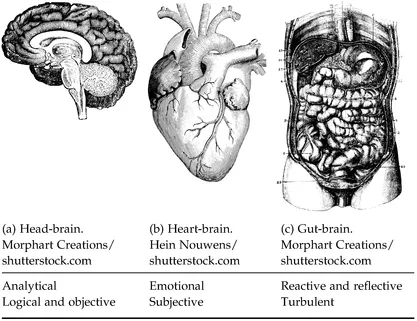
Figure 1. The physical brain, heart-brain, and gut-brain.
The human nervous systems can be conceptualised as the gutbrain, which first registers sensations and feelings as a “gut reaction or instinct”. This is followed by the heart-brain, or sympathetic and parasympathetic nervous system. These sensations are felt in the chest, and often relate to emotions of loss and delayed grief. The central and peripheral nervous systems work together to analyse this information, which leads to the production of thought and speech in the head-brain. This is the final stage of logical and objective thought and rational analysis. It is the linking of these separate processes that is unique to BART psychotherapy. For example, it is by recognition and inhibition of the sensation of butterflies in our stomach during reprocessing that we can ultimately achieve our objectives by engaging heart-brain and head-brain reprocessing capabilities.
The bilateral activation at the level of the mastoid processes resonates at the level of both cerebellums. This information appears to further access processing in the temporal, occipital, and parietal lobes. Finally, patients often report a tingling sensation in their frontal lobes. This appears to coincide with a release of energy from both the third eye and forehead chakras, correlating anatomically with the pituitary and hypothalamic glands. The techniques underlying this process are explained further in Chapter Eight.
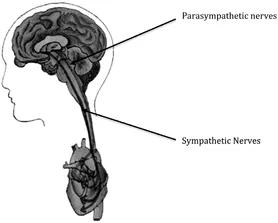
Figure 2. The heart–brain interaction and connections.
The anatomical connections in patients or clients can be illustrated as follows: connection between the cardiac nervous system (heartbrain) and the central nervous system (head-brain) (Figure 2). The local circuit neurons in the heart are involved in coding of long-term memory in the hippocampus. The heart’s functional memory via these heart neurons ensures that intuitive or heartfelt feelings are processed in the heart-brain. They also link directly with the gut-brain and headbrain networks. This builds on the widespread cultural belief that feelings registered at a heart level are as powerful if not more powerful than those of the gut-brain and head-brain.
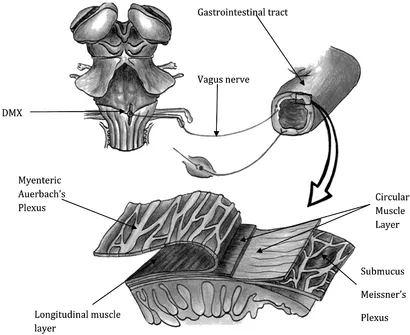
Figure 3. The gut connections with the brainstem.
Connections between the brain in the gastrointestinal tract (gutbrain) and the brainstem (head-brain) are illustrated (Figure 3). This is highly significant in anxiety resolution: there are layers of protection for the intrinsic neurones of gut plexuses from the contents of the gut mucosa. When the neural plexi afferents from and efferents to the head, gut, and heart are all connected, then maximal flow of information occurs. This appears to be possible using BART psychotherapy. The head-brain links up with the other systems via the sympathetic and parasympathetic nervous systems. The dorsal motor nucleus of the tenth cranial, or vagus, nerve has its origin in the brainstem and synapses in the muscle wall of the gastrointestinal tract (GIT). In Figure 3, the black arrow shows a magnified section of the GIT containing the intrinsic neurones of the gut plexus. There are longitudinal and circular muscle layers containing Meissner’s plexus in between them at the submucosa layer, which has only parasympathetic fibres. Auerbach’s plexus also lies between the circular and longitudinal layers at the muscularis propria layer and has both sympathetic and parasympathetic input from the central nervous system.
The enteric nervous system (ENS), or gut-brain, has thirty different neurotransmitters and ninety per cent of the body’s serotonin, as well as fifty per cent of its dopamine. It also has taste receptors which sense “sweetness” on the tongue and levels of glucose in the bloodstream. These taste receptors regulate insulin and are a good example of how the ENS really acts as our gut-brain and is capable of independent action. The processing of the gut instinct, or gut reaction, to incidents is a prerequisite for the BART therapeutic approach and is fully explained in Chapter Eight.
Research by Cryan and Dinan (2012a), reveals how the gut microbiota communicates with the CNS through neural, endocrine, and immune pathways. This provides scientific evidence for an influencing role in the regulation of anxiety, mood, cognition, and pain. The microbiota are integrated into the illustrated gut–brain axia and impact on the brain in states from satiety to stress.
A range of mechanisms have been proposed by which gut flora affect the CNS:
- Altering composition of the gut flora. They can compete for dietary ingredients such as growth substrates, they can produce vitamins, reduce inflammation, and stimulate innate immune responses. All these can change gut–brain signalling.
- Immune activation. The immune system interacts bidirectionally with the CNS. Also, indirectly, the gut flora affects the immune system, altering cytokine levels. These are both pro- and antiinflammatory and directly impact brain function.
- Vagus nerve. As illustrated below, this regulates bronchial constriction, heart rate, and gut motility. About eighty per cent of nerve fibres are sensory, conveying sensory information about the body organs to the CNS. Many of the effects of gut flora are dependent on vagal activity. The mechanisms of vagal afferent activation by gut microbiotica have yet to be elucidated.
- Metabolism of tryptophan. This essential amino acid is a precursor of serotonin. This metabolic pathway becomes dysregulated in many brain and gastrointestinal tract disorders. Two key enzymes involved in the metabolism are activated by inflammatory mediators and corticosteroids.
- Microbial metabolites. Gut flora are essential in the production of bile acids, choline, and short chain fatty acids. Complex carbohydrates are digested and fermented in the colon by gut microorganisms into neuroactive short chain fatty acids.
- Microbial neurometabolites. These neurotransmitters act on the enteric nervous system and may have anti-nociceptive properties.
- Bacterial cell wall sugars. These may modulate neural signalling or act on afferent axons.
Knowledge of all these mechanisms of interaction of the gut enteric nervous system on the central nervous system lends credence to my hypothesis that reprocessing of the gut’s emotional response can help to reduce a dysregulation of the gastrointestinal system. Also, continuing reprocessing of distressing sensations in relation to trauma at the level of the stomach can be signalled to the heart and brain via the vagus nerve. This will enable digestion and metabolism of these sensations at a cognitive level.
The vagus, or tenth, cranial nerve leaves the brainstem and tends to calm down all the organs of the body. The sympathetic nerves in red have the opposite effect and get the person ready to engage the “fight” response or mobilise the heart, lungs, and muscles for “flight” (Figure 4).
The five organs illustrated may represent the five stages of BART psychotherapy and peak performance. Thus:
- Activation of the gut instinct or gut reaction at level of root and sacral chakras.
- Stimulation of the pancreas with release of insulin and proposed direct link to anterior inferior and posterior inferior sections of insular cortex in cerebrum.
- Energising of heart chakra and heart organ with reprocessing of loss and grief.
- Inflation and deflation of lungs. This gives rise to the in and out breaths and helps stabilise any functional impairment due to anxiety and rapid breathing or panic attacks.
- Continuous bilateral stimulation of head-brain so that the patient or client can take on board all of the information reprocessed at lower bodily energy levels.
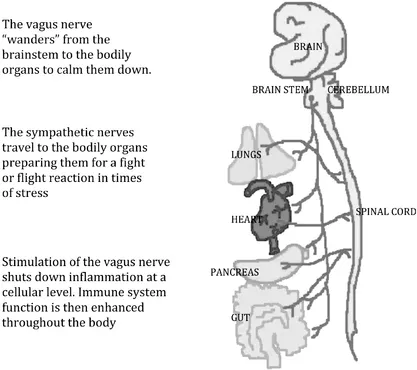
Figure 4. The path of the vagus nerve.
The techniques of BART psychotheraapy are designed to boost the immune and endocrine systems and allow for neuronal rewiring (Figure 5).
Both cerebral hemispheres and the gastrointestinal tract develop fr...
Table of contents
- Cover
- Half Title
- Title
- Copyright
- Contents
- Dedication
- ACKNOWLEDGEMENTS
- ABOUT THE AUTHOR
- PREFACE
- INTRODUCTION: The art of bilateral affective reprocessing of thoughts (BART): a dynamic model for psychotherapy and peak performance
- CHAPTER ONE Concept of intuition and introduction to BART psychotherapy for both therapy and peak performance
- CHAPTER TWO Activation of the chakras using BART psychotherapy and peak performance
- CHAPTER THREE Neurodevelopment of the head-brain, heart-brain, and gut-brain
- CHAPTER FOUR Vibrational frequencies related to accelerated information processing in patients or clients
- CHAPTER FIVE Proposals for BART psychotherapy with special populations and effects of abuse and neglect on the developing brains of the patient or client
- CHAPTER SIX The mystery of consciousness
- CHAPTER SEVEN Development of thought and the role of BART psychotherapy and peak performance in reprocessing thoughts
- CHAPTER EIGHT Guidelines for practitioners on conducting a BART psychotherapy session
- CHAPTER NINE Taking a trauma and developmental history
- CHAPTER TEN Influence of some research in trauma therapy by neurobiologists and how this has affected my development of the integrative approach of BART psychotherapy and peak performance
- CHAPTER ELEVEN Living in a hypothetical world dominated by the left hemisphere's perspective, and summary of the five stages of BART psychotherapy
- CHAPTER TWELVE Using BART for peak performance in sport, business, academia, and any pursuit where anticipatory anxiety impairs results
- CHAPTER THIRTEEN Template for comprehensive assessment of the patient or client prior to BART psychotherapy or peak performance, and use of the Hermann brain dominance instrument
- REFERENCES
- INDEX
Trusted by 375,005 students
Access to over 1.5 million titles for a fair monthly price.
Study more efficiently using our study tools.
Frequently asked questions
Yes, you can cancel anytime from the Subscription tab in your account settings on the Perlego website. Your subscription will stay active until the end of your current billing period. Learn how to cancel your subscription
No, books cannot be downloaded as external files, such as PDFs, for use outside of Perlego. However, you can download books within the Perlego app for offline reading on mobile or tablet. Learn how to download books offline
Perlego offers two plans: Essential and Complete
- Essential is ideal for learners and professionals who enjoy exploring a wide range of subjects. Access the Essential Library with 800,000+ trusted titles and best-sellers across business, personal growth, and the humanities. Includes unlimited reading time and Standard Read Aloud voice.
- Complete: Perfect for advanced learners and researchers needing full, unrestricted access. Unlock 1.5M+ books across hundreds of subjects, including academic and specialized titles. The Complete Plan also includes advanced features like Premium Read Aloud and Research Assistant.
We are an online textbook subscription service, where you can get access to an entire online library for less than the price of a single book per month. With over 1.5 million books across 990+ topics, we’ve got you covered! Learn about our mission
Look out for the read-aloud symbol on your next book to see if you can listen to it. The read-aloud tool reads text aloud for you, highlighting the text as it is being read. You can pause it, speed it up and slow it down. Learn more about Read Aloud
Yes! You can use the Perlego app on both iOS and Android devices to read anytime, anywhere — even offline. Perfect for commutes or when you’re on the go.
Please note we cannot support devices running on iOS 13 and Android 7 or earlier. Learn more about using the app
Please note we cannot support devices running on iOS 13 and Android 7 or earlier. Learn more about using the app
Yes, you can access The Art of BART by Arthur G. O'Malley in PDF and/or ePUB format, as well as other popular books in Psychology & History & Theory in Psychology. We have over 1.5 million books available in our catalogue for you to explore.