- 314 pages
- English
- ePUB (mobile friendly)
- Available on iOS & Android
eBook - ePub
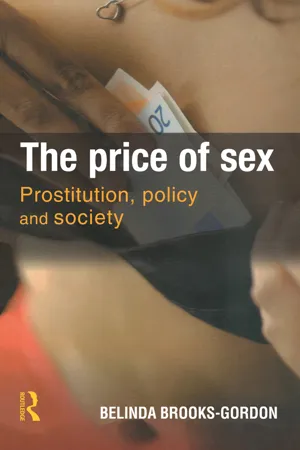
The Price of Sex
About this book
As a society we are buying more sex than ever before. Adult sex shops now take their place amongst retailers in the high street and lap dancing clubs compete for an increased share of the leisure economy; hotel chains offer sexually explicit films as part of their standard service, the party selling of adult toys to women in their homes has become a mainstream activity; and at the traditional end of the sexual service economy, prostitution has experienced new growth. Along with this has come new legal measures and attempts to regulate the sexual leisure economy, and far more comprehensive plans than ever before to regulate prostitution, in particular in the form of the new Sex Offences Act. This book seeks to address the range of issues and contemporary debates on the sex industry, including the demand by customers who buy sex, the policing of women who work in the street sex industry, and the violence that pervades prostitution. It shows how these issues have been addressed in policy terms, the problems that have emerged in this, and how a social policy might be formulated to minimize harm and enhance public understanding. Overall the book aims to provide a critical perspective on prostitution policies and the legal chaos and complexities that surround this.
Information
Chapter 1
How prostitution became a legal problem
Payment for sexual services remains at the centre of debates about sexuality, morality, and public order. More recently, it has again become part of a debate on immigration. The exchange of money for sex not surprisingly attracts wide interest amongst policy-makers and academics. However, most attention is given to exploring why women become sex workers or how they manage their involvement in it (for example, Sanders 2004; Home Office 2004; Phoenix 2004). Yet the sex work market also consists of clients and regulatory controls – generally carried out by the police. To focus only on sex workers leaves two sides of the commercial and regulatory triangle under-explored and under-theorised. At present, much debate on police and clients runs ahead of theoretical understanding or factual evidence about those who take part in commercial sexual transactions. This has implications for policy measures which may not only be ineffective, but may have unintended consequences. Investigations of commercial sex clients and their regulatory control is thus badly needed to inform policy and academic understanding.
This chapter outlines the background to contemporary prostitution policy by providing an outline of historical trends and shifts in moral, ideological, social and legal structures that relate to the buying and selling of sex. I show how perceptions of prostitution have changed historically for a number of reasons including changes to family structure, the workforce, and expectations of sexual relationships. I suggest that the overall socio-legal trend has become one of greater criminalisation of the client, and while greater understanding appears to be shown to the sex worker in a rhetoric of ‘vulnerability’, in effect the increasing criminalisation of the client has been to the detriment of the sex worker.
Prominent factors now include kerb-crawling and the stringent policing of it in some areas with its associated costs, the costs to the women, and to community relations in terms of social tension (Hubbard 1999). Narratives of sexual violence developed by the tabloid news media have been constantly re-used so that women working in prostitution are defined through a specific narrative of slavery and exploitation. ‘Exploitation’ however lacks definition in law and this has become even more of a problem in the Sexual Offences Act 2003. The issue of the vulnerability of women in prostitution is however an important one that cannot be reduced to ‘exploitation’ (however it is defined) and health workers and non-governmental organisations involved in HIV prevention have long concluded that sex workers are more at risk from client violence than they are from HIV (McKeganey and Barnard 1996) as do the women themselves (Sanders 2004). This chapter thus summarises the problems and issues around sex workers and their clients which led to the Sex Offences Review in 2000.
The chapter then examines the prevalence of prostitution within the wider context of the sexual leisure industry and the attempts to curtail prostitution and kerb-crawling through piecemeal and contradictory legislation, such as the Criminal Justice and Police Act 2001 which came into force before the end of the Review. It also explains why previous responses failed as they failed to take account of the reasons that impel women into prostitution, and failed to take account of who the men are or what psychosexual needs these men are trying to satisfy when buying commercial sex. The chapter thus provides the background and policy behind the legislative change in the provisions of the Sexual Offences Act 2003 and the Government Consultation Document Paying the Price in July 2004.
An historical overview
While there are some earlier historical accounts, it is only since Roman times that multiple records from differing sources have enabled us to understand attitudes to commercial sex; this period then becomes our starting point. Prostitution was an accepted part of life in the Roman Empire, and Roman scholars upheld a view that these men were protecting their marriages and those of their peers (Otis 1985). The idea is exemplified in the writings of Cato, who stipulated that ‘blessed be they as virtuous, who when they feel their virile members swollen in lust, visit a brothel than grind at some husband’s private mill’ (Burford 1976: 18). Leaving aside the misogynistic metaphor of a married woman as a man’s ‘private mill’, this is suggestive of the perceived righteousness of men who became the clients of prostitutes. These clients were ranked into a hierarchy, with the lowest economic classes such as slaves or soldiers visiting brothels, which catered specially for them (Bullough and Bullough 1987). Under Roman law, such men were not allowed to marry,1 and under such circumstances it seems unsurprising that the purchase of sex was neither stigmatised nor considered reprehensible for these men. While it would appear that the women who provided sex were, along with their families, considered ‘disgraced’ (Bullough and Bullough 1987: 31), their male clients were accepted and encouraged in classical societies.
By the Dark Ages, the power of the Church was held to be absolute, and historians suggest that prostitution became defined by promiscuity rather than payment (e.g. Karras 1996). It appears that there was no immorality connected to the buying or selling of sex, but that promiscuity or sexual licence was considered immoral, and thus needed to be controlled (Ringdal 2004). Alongside this, a double standard that privileges male sexual desire is apparent in the writing of Church ‘fathers’ such as St. Augustine, St. Jerome and St. Basil, who claimed it was not the man’s fault if he strayed sexually, but the woman’s fault, if he or she did (Bullough and Bullough 1987).2 This was because women, whom Medieval medical theory considered to be more lustful and to have a stronger sex drive than men, were expected to be more able to control any such sexual impulse. For men, on the other hand, a ‘hydraulic’ model of masculine sexuality seems to have dominated; a model in which ‘people believed that pressure builds up and has to be released through a safety valve (marriage or prostitution), or eventually the dam will burst and men will commit seduction, rape, adultery, and sodomy’ (Karras 1996: 6). St. Thomas Aquinas, for example, suggested that a man who wanted ‘unnatural’ (that is, non-procreative) sex acts should fulfil such desires with an already corrupt woman, rather than corrupt his wife. Whilst the sexual licence and freedom of women was regulated whether it was commercial or not, men were almost encouraged to engage in commercial sexual activities.3 In addition, there is little evidence to suggest any regulation of these men other than banning some groups of men from being clients. These groups of men included Turks, Moors and Jews,4 or certain employees banned by employers who feared their property would be stolen to pay for such pleasure.5
Throughout the Middle Ages, it is reported that towns began variously to regulate or outlaw commercial prostitution. Towns that outlawed prostitution either banished brothels to outside the town or punished the whores, there is no evidence to suggest that they punished any clients6 (Karras 1996). In towns like Southwark where legal brothels or stews existed, they were regulated for the customers’ protection. This was so that the men could not be compelled to purchase food or transport at inflated prices (Karras 1996).7 Prostitution continued to be considered an appropriate outlet for men who did not have access to women through marriage, and Otis (1985) suggests that prostitution became institutionalised because men not only married late, but also outnumbered women owing to the disproportionate mortality of women, especially among the poor. Norbert Elias (1994) illustrates the conventional approach towards the prostitute client in Medieval society by providing an example from the Colloquies of Erasmus. In this text, the conversation between client and prostitute is provided as reading matter in a children’s book on manners. Elias highlights the difference between Medieval manners and those of today by suggesting that ‘to an observer from modern times, it seems surprising that Erasmus in his Colloquies should speak at all to a child of prostitutes and the houses in which they live’ (1994: 144), but argues that this was a situation for which the Medieval boy child would be expected to learn specific manners. A further example concerns the Emperor Sigismund, who in 1443 publicly thanked the city magistrate at Bern for putting the brothel so freely at the disposal of himself and his attendants for three days (Elias 1994). In this way, it is possible to see what an everyday occurrence the purchase of sex appears to have been for Medieval men.
Who were the main clients? It is suggested by Karras (1996) that clients in England at this time were commonly apprentices, servants, foreign merchants travelling without their wives, and clergy8 and Rossiaud (1988) describes a similar clientele in Medieval France.9 From these two studies it appears that these men came from a broad spectrum of the population – a further indication that this practice was normalised across the community. Rossiaud also claims that visiting prostitutes or maintaining a concubine was acceptable so long as the man was free from ties, especially if the ‘common’ woman was from outside the village and therefore less likely to service his brothers and family (1988). Paying for sex only became an offence if the client was married, this was because he would be committing adultery (fornication) and thus breaking the sacrament that marriage became by the fifteenth century. Adultery was an arrestable offence, and like other sexual offences, was dealt with by the ecclesiastical courts under canon law.10 There were two other types of court that upheld law at this time: county courts and manorial courts, but neither of these was involved with regulating clients. The only other form of censure of male clients who were violent towards the women, was public humiliation, often by hoisting the coat of arms of a man who attacked a prostitute onto a pole in front of a public house. In Genoa, for instance, any customer who hit a prostitute was obliged to pay her medical expenses and pay damages to the manager for work-time lost because of injury (Otis 1985). Thus clients were only regulated when they committed an act of adultery or violence, and that these were limited to financial payment or humiliation for the harm done. The commercial sex client’s behaviour, otherwise, was sanctioned by law, religion and community norms. A transitory change in sexual morality seems to have occurred in the late Middle Ages, which subsequently influenced the way the purchaser of sex was regarded at the end of the fifteenth and throughout the sixteenth centuries. This moral climate is reflected in edicts from Reformation leaders and in the canons of the Council of Trent.11 Concubinage was condemned and laws were imposed against male adultery (Otis 1985). The city authorities in Puritan London enforced strict sexual morality and, while brothels apparently still existed, many such as those in Southwark were closed down by 1546. Although this move to close brothels in the sixteenth century was part of a general reaction against the sexual activity of young unmarried men,12 it was the prostitutes rather than their clients who were regularly punished by being whipped and pilloried (Briggs et al. 1996). The Counter-Reformation too, took a stand against youthful fornication and Otis argues that brothels were no longer considered as a necessary escapevalve for male sexual appetites, but as centres of evil where young men might learn of lust and corruption (1985). Thus the commercial client, even under conditions of prohibition, was seen as a weak soul to be saved from the depravity of women in brothels rather than as someone actively seeking their services.
The morality enforced on the male client nevertheless proved to be short-lived and, as Roberts reports, clients in late Elizabethan times outnumbered prostitutes especially in places like Southwark, where they are said to have ‘constantly roved the area in pursuit of pleasure’ (1993: 123). From 1640 onwards, Covent Garden was a popular haunt for clients ‘active’ beneath the arches of the Piazza in the centre, as were the new coffee houses that established themselves throughout the seventeenth century.13 By the 1700s, large numbers of unmarried men were a consequence of the tradition of the landed families to leave their wealth to the male heir, leaving less money for younger sons, many of whom had to forego marriage (Stone 1977). The purchase of commercial sexual services by such men was consequently looked upon benignly. They were not, however, the only client group, and married men also appeared to be frequent purchasers of sexual services according to noted diarists of the time – although it is hard to discern from historians such as Stone (1977) what the general attitudes towards married clients were, especially since the main examples given are such inveterate rakes such as Pepys and Boswell. One suggestion that emerges very clearly from such diaries, and which is an important factor in understanding wider social attitudes to the men who purchased sex in the eighteenth century, is that it was often condoned within a marital relationship as a form of contraception. Women who did not want more pregnancies were more likely to legitimate their husbands’ extra-marital sexual activities with prostitutes (Stone 1977). Given the dangers of childbirth, this tradition continued until the following century, with Victorian husbands justifying their activities with prostitutes on this basis.
Victorian attitudes towards prostitutes and clients
It is well documented that it was a tradition throughout Victorian England for upper-class men to have their initial sexual experiences with prostitutes (Humphries 1988), the first of which typically took place while away at university. These men received little more than a reprimand, however, if caught by the authorities.14 In their comprehensive history of prostitution, Bullough and Bullough (1989) suggest that Victorian clients mainly came from the middle and upper classes. A conflicting view is put forward by Briggs et al. (1996), who argue that ‘rich young libertines and philandering middle-class husbands were a real but comparatively insignificant presence in the market. Most clients were poor men paying very small sums to even poorer women’ (1996: 199).
Although attempts to reconstruct the Victorian client are difficult because of the inadequacies of records, Hall (1991) contends that it is nonetheless apparent that vast numbers of men of all classes paid for sex, and that the attitud...
Table of contents
- Cover
- Halftitle
- Title
- Copyright
- Contents
- Acknowledgements
- Introduction
- 1. How prostitution became a legal problem
- 2. Understanding prostitution policy
- 3. Understanding sexual demand
- 4. Policing street prostitution
- 5. Violence, victimisation and protection
- 6. Methods, motives and morality1
- 7. Conclusion
- References
- Index
Trusted by 375,005 students
Access to over 1.5 million titles for a fair monthly price.
Study more efficiently using our study tools.
Frequently asked questions
Yes, you can cancel anytime from the Subscription tab in your account settings on the Perlego website. Your subscription will stay active until the end of your current billing period. Learn how to cancel your subscription
No, books cannot be downloaded as external files, such as PDFs, for use outside of Perlego. However, you can download books within the Perlego app for offline reading on mobile or tablet. Learn how to download books offline
Perlego offers two plans: Essential and Complete
- Essential is ideal for learners and professionals who enjoy exploring a wide range of subjects. Access the Essential Library with 800,000+ trusted titles and best-sellers across business, personal growth, and the humanities. Includes unlimited reading time and Standard Read Aloud voice.
- Complete: Perfect for advanced learners and researchers needing full, unrestricted access. Unlock 1.5M+ books across hundreds of subjects, including academic and specialized titles. The Complete Plan also includes advanced features like Premium Read Aloud and Research Assistant.
We are an online textbook subscription service, where you can get access to an entire online library for less than the price of a single book per month. With over 1.5 million books across 990+ topics, we’ve got you covered! Learn about our mission
Look out for the read-aloud symbol on your next book to see if you can listen to it. The read-aloud tool reads text aloud for you, highlighting the text as it is being read. You can pause it, speed it up and slow it down. Learn more about Read Aloud
Yes! You can use the Perlego app on both iOS and Android devices to read anytime, anywhere — even offline. Perfect for commutes or when you’re on the go.
Please note we cannot support devices running on iOS 13 and Android 7 or earlier. Learn more about using the app
Please note we cannot support devices running on iOS 13 and Android 7 or earlier. Learn more about using the app
Yes, you can access The Price of Sex by Belinda Brooks-Gordon in PDF and/or ePUB format, as well as other popular books in Social Sciences & Social Policy. We have over 1.5 million books available in our catalogue for you to explore.