- 288 pages
- English
- ePUB (mobile friendly)
- Available on iOS & Android
eBook - ePub
About this book
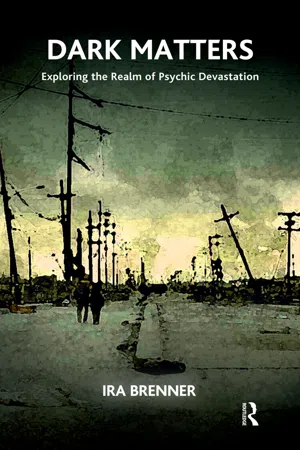
This book takes a deeper look into the darker side of the human condition by examining the psyches of those who have been victims or survivors of heinous acts perpetrated by others. From the "personal Holocaust" of sexual abuse in the family, to the genocidal persecution during "the" Holocaust, and from the shared national horror of September 11 to the Palestinian/Israeli situation, a special model of the traumatized mind is evolved to further our understanding of such "dark matters". The traditional models of the mind fall short when dealing with extraordinary people under ordinary conditions as well as with ordinary people under extraordinary conditions. This metapsychology is organized around the defensive operations of repression or splitting. In the model proposed here, defensive altered states of consciousness, or dissociation seems more helpful. A historical perspective is offered, from Freud and Breuer, with their Studies on Hysteria, to current thinking about dissociative disorders. A developmental line of dissociation is also explored.
Information
Part I
Prologue
Chapter One
Why dark matter?
“Deep into that darkness peering, long I stood there wondering, fearing.
Doubting, dreaming dreams no mortals ever dared to dream before …”
(Poe, 1845)
Junior year. Circa 1970. Urban campus a few blocks from the White House. I was walking to organic chemistry class, the do-or-die course for pre-med students. You might say I was a bit preoccupied with my future. After rounding the corner from my dormitory, heavy textbook in hand, I got caught up in an impromptu antiwar rally. Hurriedly weaving my way through the crowd, the chants, the bullhorns, and the placards, I came face to face with an approaching phalanx of the District of Columbia police department. They clearly were not going to be interested in my plight. Armoured in their riot gear of helmets, shields, and batons, they literally ploughed through the crowd. Quickly following those more prepared than I who knew where to run for cover, I scurried into the lobby of another dormitory. Just as I got through the door, the guy behind me was pulled back out by an officer, was smashed in the head with a club, and then pushed back in nearly on top of me. The image of this fellow student’s bloodied face and glazed look haunted me for a very long time. However, I am a bit hazy about getting to class that day.
Without realising it at the time, I had a first-hand experience of the marvels of traumatic memory. Sometimes, it can be indelible and intrusive. Other times, as Freud said, “… nothing of the forgotten traumas shall be remembered and nothing repeated” (Freud 1939a, p. 75).
Several decades later, I was sitting with a patient who had survived a dramatic pier collapse along the riverfront that had taken a number of lives. Negligent construction was at fault. He was enjoying the two-for-one drink special that evening and was, as the expression goes, feeling no pain. He was flirting with a woman when, suddenly and unexpectedly, the wooden structure gave way, trapping him underneath the black water amid the shattered timbers and shredded awning. The more he struggled to break free, the more he became straitjacketed by the canvas. Were he not such a strong swimmer who could hold his breath, calm himself down, and just happened to swim in the right direction to the surface, away from the watery chaos, he, too, would have drowned. He made his way to the shore many minutes later downstream, completely exhausted, and dragged himself to dry land, while paramedics were trying to resuscitate someone. It was the woman with whom he had just been flirting, but he was too horrified and depleted to react. He thought he saw her looking at him knowingly and helplessly as her life ebbed away. He was haunted by the memory of her eyes, which kept him awake at night, followed him everywhere, and persecuted him. I was able to draw on my own mini-trauma as an erstwhile antiwar dissident to help me understand, tolerate, and empathise with the horror, blocked grief, and survivor guilt of this young man. What enabled me to do so was the result of an ongoing process dealing with the dark matters of my own mind and the minds of others.
It is this simple, everyday word in the English language that usually evokes an aura of mystery, hiddenness, and possible danger—“dark”. We are all familiar with many expressions that use this word, such as the “dark side of the moon”, “going to the dark side”, “dark places”, or being in a “dark mood”. Someone may have “dark humour”, or be doing something “under the cover of darkness”, or is “afraid of the dark”. The word “dark” itself—“this is very dark”—is quite evocative. When it comes to racial politics, those of darker skin are usually more subject to prejudice and oppression. Someone also could have “dark motives”: “Who knows what evil lurks in the hearts of men? The Shadow knows!” Furthermore, it is always “darkest before the dawn”. Also, there are “dark years” and the “Dark Ages” themselves. In contrast, there seem to be many fewer positive uses of the word “dark”: rich, dark coffee, dark chocolate, and those people who prefer dark meat over white meat. Also, when we refer to the dark side of human nature, it is associated with the Latin word for left-handed, or sinister, which, interestingly, is controlled by the right side of the brain. It is in this right hemisphere, in the hidden, non-verbal, mysterious corners of the mind, where it is likely that we will find the realm in which the legacy of severe trauma leaves its dark shadows on the psyche.
Freud confidently stated that “The effects of traumas are of two kinds, positive and negative” (Freud, 1939a p. 75). While we are generally more familiar with these positive symptoms of remembering and re-experiencing, the so-called negative symptoms inhabit a murky space in our theories and in our minds. It is a realm which, as noted above, Freud insisted “… follow[s] the opposite aim: that nothing of the forgotten traumas shall be remembered and nothing repeated” (Freud 1939a, p. 75). Such a pronouncement would have these symptoms as being “beyond the pleasure principle” (Freud, 1920g), but are they really exempt from the repetition compulsion? Are they banished to some dark corner of the mind, trapped and unable to exert any influence? Gone without a trace? Almost, but not exactly. Indirect evidence of these “… defensive reactions” was to be inferred by certain “… ‘avoidances’, which may be intensified into ‘inhibitions’ and ‘phobias’” (Freud, 1939a, p. 76). Contemporary thinking would also consign dissociative phenomena to the realm of negative symptoms.
Curiously, modern scientists are grappling with a comparable and more complex challenge—understanding a mysterious force of astronomical proportions that is essentially also invisible. It does not reflect, emit, or absorb light, and has no electrical charge. Yet, it is so important that it comprises about twenty-five per cent of the entire universe and appears to be the glue that holds the galaxies together as they hurtle through space at unimaginable speed. Thought to com prise infinitesimally small, subatomic particles that have yet to be fully proved and identified, this phenomenon is known as “dark matter”. It is inferred to be present mathematically, due to unaccounted-for substances in the cosmos and by studying the subtle differences in the movement of heavenly bodies that cannot be explained by gravitational forces and other known influences. Like the excessive amnesia of childhood and adolescence that might be a clue that one has sustained severe early trauma, the presence of something extremely important might be suspected by the absence of something equally important. In this case, it is coherent narrative owned by the patient.
In the current revision of the criteria for post traumatic stress disorder in the Diagnostic and Statistical Manual of Mental Disorders, Fifth Edition (DSM-5) (American Psychiatric Association, 2013), the evolution of the concept of negative symptoms can be seen as greatly expanded from Freud’s original idea of two categories:
- C. Persistent avoidance of stimuli associated with the traumatic events(s), beginning after the traumatic event(s) occurred, as evidenced by avoidance or efforts to avoid one or more of the following:
- distressing memories, thoughts, or feelings about or closely associated with the traumatic event(s).
- external reminders (i.e., people, places, conversations, activities, objects, situations) that arouse distressing memories, thoughts, or feelings about, or that are closely associated with, the traumatic event(s).
- D. Negative alterations in cognitions and mood associated with the traumatic event(s), beginning or worsening after the traumatic event(s) occurred, as evidenced by two or more of the following:
- inability to remember an important aspect of the traumatic event(s) (typically due to dissociative amnesia [author’s italics] that is not due to head injury, alcohol, or drugs).
- persistent and exaggerated negative beliefs or expectations about oneself, others, or the world (e.g., “I am bad”, “No one can be trusted”, “The world is completely dangerous”). (Alternatively, this might be expressed as, e.g., “I’ve lost my soul forever”, or “My whole nervous system is permanently ruined”).
- persistent, distorted blame of self or others about the cause or consequences of the traumatic event(s).
- persistent negative emotional state (e.g., fear, horror, anger, guilt, or shame).
- markedly diminished interest or participation in significant activities.
- feelings of detachment or estrangement from others.
- persistent inability to experience positive emotions (e.g., unable to have loving feelings, psychic numbing). (American Psychiatric Association, 2013, pp. 143–145)
Here, we can see the growing recognition of the role of dissociative symptoms not only in the well-known intrusion phenomena of recurrent flashbacks and total absorption in the trauma, which are listed under “positive” symptoms, but also in the peritraumatic amnesia, depersonalisation, and derealisation in the negative symptoms.
The role of the psychoanalyst in the treatment of those who have sustained significant trauma in many ways parallels the history of the psychoanalytic movement itself. From its inception and early research into hysteria to its overvaluing of psychic reality, to its current recognition of the importance of the relationship, there are a multitude of models to fit all occasions and all temperaments of analysts.
I never imagined that my own career would have evolved the way that it has with a special interest in the area of psychic trauma—at least consciously. Looking back, however, I can see how certain experiences, events, relationships, and circumstances have facilitated my taking this path. I grew up in a state of confusion about heavenly and earthly matters. I could not understand how anything worked and especially why people behaved the way they did. As a very curious young boy, I wondered about everything, but most of the grown-ups around me did little to satisfy my quest for answers. My questions were either met with a shoulder shrug, a pat answer, or the sense that I should not have asked in the first place. My childish preoccupations might have been met with derision, impatience, disinterest, or worse. A little boy does not ask about a “land” far, far away called Auschwitz. Therefore, I spent a lot of time in quiet contemplation, trying to figure things out on my own and creating silly theories to explain the world around me. As fascinated as I was and still am about nature, I was particularly drawn to the human condition, especially the darker side of human nature. How could people do unimaginably cruel things to others and, more remarkably, how could anyone survive?
One of my most emblematic recollections of trying to understand motivation involved my irascible Hebrew schoolteacher, who became enraged when a fellow classmate asked something about the existence of God. Such a basic question in a parochial learning institution must have been heard as blasphemy. Our instructor, a mercurial Holocaust survivor of a very famous ghetto uprising, whose scars were quite prominent, burst forth with a thunderous retort and declared, with a menacing, pointing finger, “DON’T ASK QVESTIONS!” I thought to myself even back then that his reaction seemed a bit extreme, even downright absurd, for a supposed educator, but it was an attitude with which I was familiar, none the less. I realised years later that one of his favourite questions was a mildly humorous attempt to control his thinly veiled contempt for us well-fed and spoiled American children through his familiar refrain: “Are you thirsty for knowledge or thirsty for Coke?” My school-age formulation back then was that he was still affected by bad memories of the Holocaust and took it out on us. That someone could continue to be deeply affected by terrible experiences in the past was axiomatic for me. I lived it every day in my family, and one might say that the connection was “baked” into my mind.
I was bolstered from being too squelched in my curiosity about God because I thought I had already acquired that coveted information from the wisest man I knew—my great-grandfather. Perhaps I was even a bit smug about it. He was the most likely person in my little world to have any real answers, but he was terrifying to a four-year-old. Blind, bearded, forbidding, and lost in prayer whenever I saw him, I was not even sure he knew I existed, let alone knew who I was. Nevertheless, I somehow knew I must overcome my reticence and seek a private audience with him. I just did not know quite how to do it. Whenever I would see him at his usual spot at my grandmother’s house, where I visited weekly, he would either be standing and rocking in his silent devotion or sitting down and reading Braille with his gnarled fingers. He always seemed busy, and I could never muster up the courage to approach him on my own. I would take a step forward and then retreat to the sanctuary of an adjacent small room to watch the television that was always on, which was more “white noise” than sound and always out of focus. The “rabbit ears” on the top of their TV never worked as well as the fancier antennas on the roofs, and I always wondered why they did not have that kind. I guess I figured that since my grandmother was always too busy in the kitchen to watch and my grandfather was always working at his little corner grocery store, then the most likely person to watch was a sightless old man, so what difference did it really make if there was lousy reception. Nobody could answer that question either, so I had to come to that conclusion on my own.
I had a more important question on my mind than the state of their television, though, so when the time came to talk to him, I did not want to squander my precious moments with him. After many weeks of pondering the challenge, I told my mother I had a very important question to ask her grandfather. She did not ask what it was, and I did not specifically tell her, but I think she sensed it was of cosmic significance. To my relief and gratitude, she somehow arranged it, perhaps something as obvious as telling him I wanted to speak to him. I wondered how she did it, but did not dare ask such a foolish question. So, I dutifully approached the family sage, sat very near him, and whispered in his ear. He quietly and respectfully listened to my burning question: “Zayde, who made God?” There, I did it! He paused for a moment and matter of factly said to me, “The thunder and lightning!” I cherished that secret knowledge, an answer that only two people in the world knew for as long as my preoperational mind would allow me to do so. I could not have asked him the obvious follow-up question, which would come to me when I had a slightly more developed mind, which was, “Then who made the thunder and lightning??” By that time, I realised that if God were truly the creator of the universe, then He would have created the thunder and lightning, not vice versa, but by the time I realised all this, my great-grandfather had died. He took his mystical knowledge with him, and I was left to ponder the meaning of his response ever since. Did he truly believe what he had told me himself, or did he think that he would mollify me enough so that I would leave him alone so he could resume his silent communion with his maker? Or did he imagine that some day I would realise the circularity of his response and ponder on it and struggle with it as one would with a Buddhist koan? I would like to think the latter was the case.
I continued to struggle with deep questions and was especially drawn to the seemingly unanswerable mysteries of the mind. That I, among other things, might have become known for having expertise in the psychoanalytic treatment of dissociative identity disorder (DID), that is, providing what many consider an obsolete treatment of a condition that even many of my psychoanalytic colleagues doubt exists, fills me with both an enormous sense of pride and a sense of ironic amusement. While other devoted specialists have spent their lives in the study or pursuit of a cause they believe to be valid and worthy only to discover much later on that they were misguided at best, or had totally wasted their time at worst, the sense of disillusionment and despair from realising that one’s life work has been for naught must be overwhelming. Working in splendid isolation or with a group of over-zealous believers who reinforce each other’s views because of their like-mindedness, or blind allegiance to a charismatic leader, are prescriptions for such a disaster. Because of my own cir cumstances and relationships, however, I feel fairly assured that, despite the controversy surrounding this aspect of my work, I am on the right track. Moreover, having had some success in my clinical work has been validating. Taking this particular path, however, has, at times, been quite lonely and uncertain, with very few signposts along the way. It has, therefore, been essential to have had my own network of mentors and colleagues with whom to confer.
It has been shown that expansion and innovation in different fields often come from the periphery (Bos & Groenendijk, 2007), and the field of psychoanalysis is no exception. From the beginning of the movement, Freud’s list of ousted members of his inner circle are, for the most part, still remembered today, for example, Adler, Rank, Jung, and Stekel, not to mention other dissidents such as Ferenczi, Klein, and Horney. Those who continue to maintain their affiliations seem to have the most influence on the mainstream. Drawing on the work of McLaughlin, a sociologist who studied so-called “positive marginalists”, Bos and Groenendijk have concluded that “… optimal marginal intellectuals have access to the creative core of an intellectual tradition, but are not bound by institutional restrictions. They are therefore in an ideal position to transfer novel ideas from the margin to the core” (p. 4). They add: “When marginal ideas become consecrated they may change dominant opinion, but in themselves these ideas also change during this process because they now acquire a new status, and with that—a new meaning” (Bos & Groenendijk, 2007, p. 3).
Until recently, I did not have the perspective possessed by my two main mentors, Vamik Volkan and Judith Kestenberg, who, fairly probably, could be considered “positive marginalists”. Prominent members of the analytic community in their own right, each had a special area of interest, expertise, and creativity that was a bit off to the side of the mainstream, which mutually influenced the other. Volkan, a Turkish Cypriot, grew up on an island torn apart by ethnic violence between Greeks and Turks, and has made important contributions in many areas, such as pathological grief and applying psychoanalytic thinking to international conflict resolution. He is a brilliant clinician, superb teacher, and prolific writer, and I first met him during my psychiatric residency when his ground-breaking text on object relations theory in the 1970s was published at the same time as Kernberg’s. He offered seminars on trauma that included group disasters, both of man-made and natural origin, in which the suddenness and the enormity of the losses made it impossible for the survivors to mourn. He convincingly taught us that such individuals might manifest psychotic-like symptoms, such as hallucinations of a lost loved one and almost delusional preoccupation with inanimate objects that were their possessions, which he called linking objects. So, for dynamic reasons due to traumatic loss, I learnt that people might develop serious symptoms that are best treated by intensive, analytically orientated therapy, not medication. It was a fascinating idea that intrigued and inspired me, but was a bit ahead of my clinical experience, as I spent much time on the inpatient unit with acutely psychotic patients where medication was necessarily prescribed. Fortunately, my first attending psychiatrist on this unit was another unusually gifted individual, Salman Akhtar. Among other things, he encouraged me to write. Interestingly, the one article I did co-author with him was during that time and on the topic of the differential diagnosis of fugue-like states (Akhtar & Brenner, 1979). That paper, in a sense, fore-shadowed my work with fugues of dissociative origins and dissociative psychopathology.
Interestingly, Akhtar, my muse, whose mammoth contributions to the analytic literature rival those of any other analyst past or present, has written possibly the only paper on mentorship (Akhtar, 2003a). He describes the role of the mentor as being equidistant among parent, teacher, lover, and analyst. There is no doubt that I formed lifelong bonds with both Volkan and Kestenberg, as they have been phenomenally influential throughout my professional life.
For her part, Judith Kestenberg was like my psychoanalytic mother. Born in Poland and fortuitously being here in the USA when the Nazis invaded Poland, she could not return to her family because they were murdered in the Holocaust. She characterised herself in a darkly humorous way as “a child of non-survivors”. She was an early collaborator with Margaret Mahler, and I first met her in New York at the American Psychoanalytic Association meetings when, as a candidate, I started attending discussion groups. Her group on the Holocaust, GPSEHSG (Group for the Study of Effects of the Holocaust on the Second Generation), co-chaired with Martin Bergmann and Milton Jucovy, was of pivotal importance to me for many personal and pro fessional reasons. Here it was, back in the early 1980s, and this distinguished group of analysts was saying such things as that the real person of the analyst was important. Sometimes, even personal disclosure was necessary. Moreover, while psychic reality was no doubt essential to the analytic enterprise, the fact of external reality, and especially massive psychic trauma, was essential to take into consideration in certain cases. Specifically, with such trauma due to genocidal persecution, not only were the survivors profoundly affected but also, through some not fully understood mechanism, there c...
Table of contents
- Cover
- Half Title
- Title
- Copyright
- CONTENTS
- ACKNOWLEDGEMENTS
- ABOUT THE AUTHOR
- INTRODUCTION
- Dedication
- PART I: PROLOGUE
- PART II: CONCEPTUAL REALM
- PART III: SOCIETAL REALM
- PART IV: TECHNICAL REALM
- PART V: EPILOGUE
- NOTES
- REFERENCES
- INDEX
Trusted by 375,005 students
Access to over 1.5 million titles for a fair monthly price.
Study more efficiently using our study tools.
Frequently asked questions
Yes, you can cancel anytime from the Subscription tab in your account settings on the Perlego website. Your subscription will stay active until the end of your current billing period. Learn how to cancel your subscription
No, books cannot be downloaded as external files, such as PDFs, for use outside of Perlego. However, you can download books within the Perlego app for offline reading on mobile or tablet. Learn how to download books offline
Perlego offers two plans: Essential and Complete
- Essential is ideal for learners and professionals who enjoy exploring a wide range of subjects. Access the Essential Library with 800,000+ trusted titles and best-sellers across business, personal growth, and the humanities. Includes unlimited reading time and Standard Read Aloud voice.
- Complete: Perfect for advanced learners and researchers needing full, unrestricted access. Unlock 1.5M+ books across hundreds of subjects, including academic and specialized titles. The Complete Plan also includes advanced features like Premium Read Aloud and Research Assistant.
We are an online textbook subscription service, where you can get access to an entire online library for less than the price of a single book per month. With over 1.5 million books across 990+ topics, we’ve got you covered! Learn about our mission
Look out for the read-aloud symbol on your next book to see if you can listen to it. The read-aloud tool reads text aloud for you, highlighting the text as it is being read. You can pause it, speed it up and slow it down. Learn more about Read Aloud
Yes! You can use the Perlego app on both iOS and Android devices to read anytime, anywhere — even offline. Perfect for commutes or when you’re on the go.
Please note we cannot support devices running on iOS 13 and Android 7 or earlier. Learn more about using the app
Please note we cannot support devices running on iOS 13 and Android 7 or earlier. Learn more about using the app
Yes, you can access Dark Matters by Ira Brenner in PDF and/or ePUB format, as well as other popular books in Psychology & History & Theory in Psychology. We have over 1.5 million books available in our catalogue for you to explore.