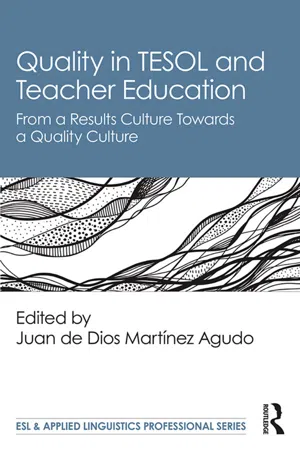
This volume takes a holistic view of the current trends and challenges in quality and quality assurance in TESOL and teacher education. Bringing together top scholars in the field from all over the world, the text features invaluable international perspectives with the common objective of improving the quality in TESOL and teacher education in constantly changing and challenging educational contexts globally.
Grouped into four wide-ranging, thematic sections – on multilingualism, diversity, teacher education, and future challenges – the book addresses new obstacles faced by educational professionals in today's rapidly changing educational landscape by offering alternatives to quantitative targets. Chapter authors cover a range of contexts and timely issues, including technology in the classroom, culturally relevant teaching, teaching for continuous improvement, professional development, and monitoring and evaluating quality.
Providing a forum of discussion on the intricacies, complexities, and challenges related to the urgent question of quality in the field, this book is a must-read for prospective ESL/EFL teachers and teacher educators.
Section II Quality in Diversity in TESOL Education
6 Quality Outcomes through Quality Process
David Crabbe
Introduction
Some years ago, I proposed a set of learning opportunities as a characterization of what is needed to learn a second language (Crabbe, 2003). Based on research in second language acquisition, I listed seven categories of learning opportunity: (processing) input, (producing) output, (engaging in) interaction, (getting) feedback, (engaging in) rehearsal, (developing) language awareness, and (developing) learning awareness. In broad terms, these opportunities might be grouped into opportunities for:
communicative performance
input, output, interaction
enhancing communicative performance
rehearsal and feedback
understanding communicative performance
awareness of language and learnin
Representing learning as deriving from a set of discrete but integrated learning opportunities in this way has its advantages. It provides teachers with the basis for auditing the balance of activity in their classes (how much of each activity the learners are exposed to) and for extending tasks to include learning opportunities that are not there, for example by adding more output or more rehearsal (see Crabbe, 2007). In this way, learning opportunities encourage teachers to think beyond tasks and exercises to the potential learning opportunities that lie within them. Moreover, the categories are meaningful not only to teachers but also to learners, who are able to regulate their own learning with reference to a range of learning opportunities. In short, the learning opportunity framework should help anyone to work on learning as a process of problem solving to achieve the learning goals instead of confining themselves to the sequence of activities in units of materials.
Beyond the individual, the learning opportunity framework enables a collective of teachers and learners to have learning conversations around the opportunities and how they might be managed: how to rehearse output, extend input, create interactive opportunities, and so on. In 2003, I went further by suggesting that learning opportunity standards might be set collaboratively for a program: how much input each week could be aimed at, how many interactive opportunities might be provided, and how many times an output opportunity such as an oral presentation might be rehearsed and with what type of feedback.
The disadvantage of setting standards, which was pointed out by Allwright (2005a), was that they might be used as a quality management tool that would confine the creativity and responsiveness of the teachers in meeting specific class needs. While this management outcome was not intended, the temptation to use standards to specify what must happen, quantify what does happen, and then use that quantification to control and assess teaching is clearly there. Such a use of external standards would be counter to a notion of teacher-learner collaboration in setting their own standards as aspirations or working goals.
The discussion of learning opportunities, standards, collectives of teachers, and learners and teachers, working together raises issues about the notion of quality and how it should be determined. While it is relatively easy to define the quality of teaching and learning in terms of the learning outcomes achieved, this after-the-event approach leaves the teaching and learning process in a black box with little understanding of what factors in any one class have contributed to success or otherwise. This chapter reflects further on the issue of quality in the process of teaching and learning: how can it be characterized and by whom.
Assumptions About Language Education
Let’s begin with some assumptions about education – beliefs that apply to all educational practice, not only to language education. These are underlying beliefs that influence the notion of quality and in particular the quality of life in the classroom, a principle borrowed from Allwright’s (2005b) important work on Exploratory Practice.
Education is relational by nature. Although we can commodify education by representing it as a set of assessable learning goals, few learners will achieve those goals without connection with others. Through exchange we draw on expertise beyond our own, we have our understanding challenged, and we get feedback on our performance. All of this depends largely on functional human relationships.
Quality, whatever it is, is for everyone and from everyone. “Everyone” here means the learners, the teachers, the sponsors, and the academic managers. If any of these stakeholders feel that the quality of what is being offered is not adequate, then that in itself will act as a self-fulfilling view. This does not mean that quality is to be “delivered” to everyone’s satisfaction. Quality is not delivered but rather developed cooperatively through ongoing learning and teaching development in context.
The quality of the whole is not equal to the sum of the quality of the parts. “Parts” here refers to the observable aspects of a curriculum at work. A high-quality curriculum based on the latest description of communication and learning, together with a well-reviewed textbook and highly qualified teachers and so on, does not guarantee overall program quality. The quality lies in how the parts are activated through human interaction aimed at achieving a sense of program coherence based on a shared and realistic understanding of the nature of the job in hand. Quality emerges; it is not something that is fully set in advance.
Learning, including second language learning, is an intentional process. This means that the main stakeholders, the learners and their teachers, have goals – goals that they can articulate in more or less specific terms. The learning intentions and goals of different stakeholders are not always aligned in the classroom, even if the overall goal of learning a second language is held in common. The quality of classroom life depends on a shared understanding of intentions and how those intentions can be realized.
These four assumptions to some extent outline parameters of the determination of quality in the process of learning: quality emerges from human relationships, from collaborative participation by all, from the coherence of the parts, and from the recognition of individual goals. Such parameters apply, whatever approach or method is used. Taking these assumptions, then, as givens, what does it mean to ensure the quality of the process of learning?
Teachers, Learners, and the Provision and Take-Up of Opportunities
While a list of learning opportunity categories provides a prompt for providing balanced and informed learning activity, the real challenge in any one class is the use of those opportunities to good effect. Textbooks provide potential opportunities that are built into tasks or exercises; teachers and learners bring them to life. The primary measure of success in bringing opportunities to life is that learners engage with them to achieve learning. This section will explore the notion of quality of language learning at the classroom level, the place where quality of learning resides. We need to understand quality in the classroom in order to consider an institutional role in supporting it.
In the classroom, the ideal relationship between teacher and learner is one of collaboration on the challenging task of learning under the expert guidance of the teacher. This is not the same as a business customer/client relationship, even though money might have exchanged hands. A coherent educational program is a service that has been provided by the state or privately in order to foster learning through structured activity and expert advice. The quality lies in the provision of the service, but it lies equally in the way in which the learner uses the service. The relatively recent emphasis on learner autonomy in language education is evidence of the view that learning is not transmitted from the teacher, but regulated by the learner.
Learning Opportunities
To start with the quality of the service itself, the obvious question is about expectations of a teacher’s role and the conditions under which that role might best emerge in any one context. This is not a question of whether a particular methodological approach has been adhered to – there is so much variation in teaching belief that to use any one universal pedagogical approach against which to measure the quality of teaching would be to set a standard that is neither stable nor context-sensitive. A good teacher is a good problem solver, able to make decisions based on an understanding of what is going on in their classroom. Using a comprehensive learning opportunity framework to adapt or develop learning activities allows for an open-ended problem-solving approach.
What does this mean in practice? Classes typically use textbooks or, perhaps more rarely, purpose-written materials. In either case, the fundamental question is what balance of learning opportunities have been encoded in the materials. For example, the role learner communicative performance plays in one unit of material: How much input has been provided? How much output practice? In what way is that performance enhanced? What rehearsal and feedback on performance is there? Fundamental pedagogical questions such as these are often bypassed by following the set sequence of tasks in a unit – with any extension work being more of the same. Understanding the intended goal of learning and processes by which that goal can be achieved is a critical part of education. In problem-solving terms, matching the ends and the means is an ongoing, collaborative venture.
Take-Up of the Learning Opportunities
The provision of learning opportunities is a relatively straightforward matter. Clarity about how an opportunity can foster learning and how one opportunity links with another is an area of understanding that both teachers and learners can work on together. Creating opportunities to understand how languages are learned and how classroom activities serve that purpose is an essential part of teaching. That brings us to the real challenge of classroom quality and of education in general. How are the learning opportunities taken up, brought to life through critical awareness of the teacher and learner?
Take-up of opportunity is dependent on a number of variables, some of which are beyond the influence of the teacher. Two of the central variables, however, are subject to influence: the learners’ motivation and a critical awareness by the learner of their own learning process. The extent of influence on these variables has an impact on the quality of the learning process in and out of the classroom. In my 2003 framework, I suggested that the teacher’s role in relation to learning opportunities was in:
Providing learning opportunities
Providing and raising awareness of opportunities in and outside the classroom
Fostering the take-up of opportunities
Contributing to a positive classroom and sociocultural environment
Modeling and discussing diverse learning approaches
Providing incentives to perform: goal structure, positive feedback, awareness of ends and means relationships
Encouraging individual action
Helping to establish routine learning behavior
Providing informed feedback and encouraging self-assessment
How does this list reflect the four educational assumptions outlined in the introduction to this paper: that education is relational, quality is for and from everyone, the whole is greater than the sum of the parts, and second language learning is intentional? The list does acknowledge the intentional nature of learning in the mention of goals, and it is fairly holistic in nature. What is perhaps underplayed is the relational nature of education and the notion that quality comes about through collaboration. In other words, the human aspect, an element that is central to Allwright’s Exploratory Practice, could, and should, be more explicit.
How to capture that human aspect explicitly is a challenge. While it would be difficult to deny its importance – and there are countless autobiographical accounts of the influence of kindly and committed teachers – how does one define the quality of human interaction in a classroom as a universal expectation, taking account of the wide range of personalities and life experiences involved? Moreover, how can this be done in a way that makes it observable to others – to learners and to other teachers? At the risk of being reductionist or simplistic, I am going to attempt to capture the essence of this through the phrase respectful engagement. Both respect and engagement are observable. Respect is shown in the discourse of teachers and learners – how they address each other, to what extent people are able to take turns, to be listened to and acknowledged, to raise questions that are then genuinely sought to be addressed by others. Engagement is shown in the extent to which there is collaborative participation in making progress in understanding – what words mean, how particular strings of words carry meaning, how to improve performance, etc. (again, Allwright’s Exploratory Practice notion applies here).
Turning to the assumption that quality is for and from everyone, it is clear that, while the provision of opportunities is a direct part of a teacher’s role, the take-up ...
Table of contents
Cover
Half Title
Series Page
Title
Copyright
Dedication
CONTENTS
Foreword
Acknowledgments
List of Contributors
Introduction and Overview
SECTION I Quality in TESOL Education in a Globalized Multilingual World
SECTION II Quality in Diversity in TESOL Education
SECTION III Quality Teachers for Quality Education
SECTION IV Looking Back and Ahead
Afterword
Index
Trusted by 375,005 students
Access to over 1.5 million titles for a fair monthly price.
Study more efficiently using our study tools.
Frequently asked questions
Yes, you can cancel anytime from the Subscription tab in your account settings on the Perlego website. Your subscription will stay active until the end of your current billing period. Learn how to cancel your subscription
No, books cannot be downloaded as external files, such as PDFs, for use outside of Perlego. However, you can download books within the Perlego app for offline reading on mobile or tablet. Learn how to download books offline
Perlego offers two plans: Essential and Complete
Essential is ideal for learners and professionals who enjoy exploring a wide range of subjects. Access the Essential Library with 800,000+ trusted titles and best-sellers across business, personal growth, and the humanities. Includes unlimited reading time and Standard Read Aloud voice.
Complete: Perfect for advanced learners and researchers needing full, unrestricted access. Unlock 1.5M+ books across hundreds of subjects, including academic and specialized titles. The Complete Plan also includes advanced features like Premium Read Aloud and Research Assistant.
Both plans are available with monthly, semester, or annual billing cycles.
We are an online textbook subscription service, where you can get access to an entire online library for less than the price of a single book per month. With over 1.5 million books across 990+ topics, we’ve got you covered! Learn about our mission
Look out for the read-aloud symbol on your next book to see if you can listen to it. The read-aloud tool reads text aloud for you, highlighting the text as it is being read. You can pause it, speed it up and slow it down. Learn more about Read Aloud
Yes! You can use the Perlego app on both iOS and Android devices to read anytime, anywhere — even offline. Perfect for commutes or when you’re on the go. Please note we cannot support devices running on iOS 13 and Android 7 or earlier. Learn more about using the app
Yes, you can access Quality in TESOL and Teacher Education by Juan de Dios Martínez Agudo in PDF and/or ePUB format, as well as other popular books in Education & Education General. We have over 1.5 million books available in our catalogue for you to explore.