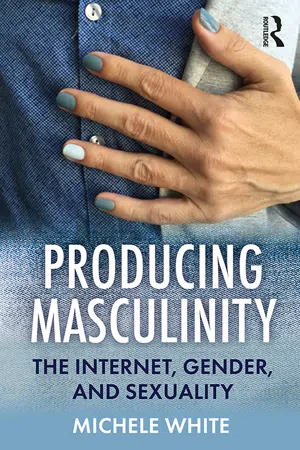
Thoughtful, witty, and illuminating, in this book Michele White explores the ways normative masculinity is associated with computers and the Internet and is a commonly enacted online gender practice. Through close readings and a series of case studies that range from wedding forums to men's makeup video tutorials, White considers the ways masculinities are structured through people's collaborations and contestations over the establishment of empowered positions, including debates about such key terms and positions as "the nice guy," "nerd," "bro," and "groom." She asserts that cultural notions of masculinity are reliant on figurations of women and femininity, and explores cultural conceptions of masculinity and the association of normative white heterosexual masculinity with men and women. A counterpart to her earlier book, Producing Women, White has crafted an excellent primer for scholars of gender, media, and Internet studies.
- 232 pages
- English
- ePUB (mobile friendly)
- Available on iOS & Android
eBook - ePub
About this book
Information
1
“But I’m a Nice Guy”: A Voice for Men, Anti-feminist Men’s Rights, and the Straw Feminist
Peter Wright introduces an online post about feminism on A Voice for Men (AVfM) and establishes that it is an anti-feminist men’s rights activist site. He articulates the position of the site when stating, “people offer differing definitions of what ‘feminism’ is, with feminists themselves pointing to glib dictionary definitions, and antifeminists preferring to define it as a female supremacy movement.”1 Wright and other contributors torque the language of feminisms on AVfM. This allows them to dismiss feminist concepts and legitimize their anti-feminist beliefs. Through such practices, AVfM functions in a similar manner to Urban Dictionary (UD) and establishes the cultural meanings and beliefs of its members. In Wright’s narrative, he suggests that there could be numerous definitions of feminism but the author, Adam Kostakis, offers a “definition that most would agree with.” Wright codes the worth of feminists and anti-feminists, with feminists portrayed as superficial and simplistic. He does not acknowledge the many forms of feminism, or feminisms, and why such things as political commitments, educational backgrounds, and identity orientations might result in different definitions of feminism. He also does not address individuals who do not fit into the binary of feminist or anti-feminist.
Wright effaces feminist concerns about equality, rights, and choice. These elisions allow him to assert the common AVfM claim, and the related narrative of anti-feminist men’s rights advocates, that feminism is a “supremacy movement.” Wright thereby associates AVfM and anti-feminists with the fight for equal rights and tolerance and modifies the usual association of supremacy with white, racist, sexist, and anti-Semitic people. Wright and other AVfM participants craft an imaginary or “straw feminist,” whose purported intellectual, affective, and ethical limitations support their anti-feminist arguments and cause. However, a critical analysis of this straw feminist, as I study this constructed figure throughout this chapter, contributes to understandings of how AVfM members are reliant on feminists and feminisms.
Wright asserts AVfM’s authority over definitions of feminism and participants’ familiarity with feminist histories, theories, and politics. Kostakis insists that “there must be some amount of general consensus over what feminism is, between feminists and anti-feminists, or we would not be able to argue about it!”2 In stating this, Kostakis suggests that AVfM’s arguments are fair and representative. Yet the site and its authors tend to rely on false equivalences and straw feminist versions of straw man arguments. The participants in AVfM simplify, mock, misrepresent, and delegitimize feminist positions. Kostakis’s claims about consensus allow him to indicate the wide-scale acceptability of his definition, including the adequacy of the explanation to feminists. However, he and Wright dismiss feminists’ definitions and know that feminists refute AVfM’s claims.
Kostakis defines feminism as the “project for increasing the power of women.” However, critical writing on feminisms focuses on women’s oppression and the construction of delimiting stereotypes. Feminist media scholar Susan J. Douglas points to feminism’s address to how “society was structured, institutionally and ideologically, through patriarchy—the domination of men over women.”3 Kostakis elides women’s concerns about the oppressed and suggests women are seeking power over men. By framing feminisms as women’s interest in increasing their power, Kostakis does not provide any context for women’s intersectional struggle for the rights of LGBTQIA+ folks, people of color, and other disenfranchised communities and how feminisms move beyond individual interests. This definition allows Kostakis and other AVfM authors to frame feminists as unreasonable and selfish. Straight white men’s already empowered positions and ways of benefitting from societal, or patriarchal, structures are not mentioned in his description.
Kostakis’s definition does not align with dictionaries or other mainstream texts even though Kostakis and Wright claim there is cultural consensus. For instance, the 24 “General” dictionaries available online through OneLook Dictionary define feminism as the belief that women should have equal rights and the movement to achieve these goals.4 In the three cases where power is mentioned in the dictionaries, it is mentioned in relation to equal rights and feminism is articulated as the “belief that women should be allowed the same rights, power, and opportunities as men and be treated in the same way.”5 While AVfM’s definitions are not supported in general dictionaries, Urban Dictionary’s top definitions of feminism and men’s rights activists suggest that AVfM, UD, and men’s rights sites convey similar beliefs. This correlation between UD and men’s rights activists is highlighted in the men’s rights part of the social news site Reddit. Men’s rights activists, including participants in the subreddit, encouraged likeminded men to upvote preferred UD definitions and then celebrated the changes.6 Man’s Voice, whose member name evokes AVfM, expresses anti-feminist sentiments on UD and indicates, “Feminism is the desire to either enslave or eradicate all men from the face of the earth.”7 ThatBritishGeekWhoHatesYou argues, “Feminism is the idea we can solve all inequalities between the genders by focusing solely on the issues of one of them.”8 These participants do not recognize culturally agreed upon explanations of the feminist movement or the ways feminisms consider men and masculinity. Instead, they figure men as victims.
Critical literature about feminisms provides more complicated conceptualizations of the term than dictionary definitions and influences feminist self-conceptions. Jessica Osborne notes in her keyword definition that the central belief of feminism is that “women are subordinated to men in western culture. Feminism seeks to liberate women from this subordination,” to “reconstruct society in such a way that patriarchy is eliminated,” and to create a culture that is “fully inclusive of women’s desires and purposes.”9 Feminists have different visions of how to resolve women and other disenfranchised subjects’ oppression. Critical feminist analysis elaborates on how binary structures, such as hierarchical and cultural understandings of men and women and everyday gendered practices, make feminist interests in equal rights more difficult to achieve.10
Kostakis, Wright, and other AVfM authors refuse to correlate feminisms with equality or to consider the different individuals acknowledged by feminisms. Kostakis states that his definition does not mention equality because “there are a number of feminists who explicitly did not pursue equality, but supremacy.” Kostakis renders feminist positions without name or reference. This is a common strategy and social technology for producing beliefs without addressing the complexities of activist and political movements. Kostakis insists that his definition is key and that feminists would not “deny that this is, at the very least, the ‘bare bones’ of feminism.”11 His reference to bones conveys another common AVfM narrative, which is the demise or “death” of feminisms, and sometimes of feminists. He claims feminists approve of his definition even though he has refused some of the key terms employed by feminists. He also correlates the definition with ideas that actively dismiss feminism and portrays the movement as the work of power hungry and unjust women. This happens when Kostakis goes on to assert that feminism “seeks to colonize and dominate every single facet of life where men and women meet.” Kostakis uses the language of feminism and anti-racist activism, including references to colonization and domination, to establish that the project of AVfM is about human rights and to criticize feminism and feminists. This claim about the relationship between men and human and civil rights is also present on Urban Dictionary and considered in more detail later in this chapter. Kostakis, Wright, and other AVfM authors reference and revise feminist critiques and terms in ways that advantage AVfM. Their mention and redeployment of feminist key terms are common strategies of anti-feminist men’s rights activists and earlier men’s movement participants.
In this chapter, I consider how AVfM authors and commenters produce and limit conceptions of feminism. This chapter is informed by my study of the posts listed under the “Feminism” category. After noting the themes and key terms in these texts, I searched for related stories on the site and in associated literature. While AVfM participants position themselves in this literature as resistant to feminism, as working to “fuck their shit up,” and as focused on undermining and eradicating the feminist project, authors actively cover feminism and feminist issues in many site stories.12 A Voice for Men’s reliance on feminism is underscored by its archive categories, which include a section on “Feminism” and subsections that associate feminists with “Bigotry,” “Bullying,” “Censorship,” “Corruption,” “Governance,” “Lies,” “Sexism,” “Stupidity,” and “Violence.”13 This linking of feminism with intolerance and power suggests how AVfM frames feminism and expresses AVfM’s organizational logic. AVfM produces a scripted and inaccurate version of feminism and feminists, including the idea that feminist struggles for equity are deceptive.
A Voice for Men constructs a “straw feminist,” as I detail this version of the straw man (or straw individual), where individuals misrepresent adversaries and then contest the distortions.14 AVfM authors and commenters tend to declare their hatred of feminism and feminists but the feminist movement and individual feminist figures are necessary for the continuation of AVfM, and possibly for the continuation of the men’s rights activist (MRA) movement more generally. Thus, AVfM participates in the feminist project and the cultural production of feminism, although AVfM’s versions are skewed when compared to more mainstream feminisms. I employ the critical literature on masculinity-in-crisis, containment narratives, straw man fallacies, and straw feminists as a means of studying the processes through which AVfM constitutes men, masculinity, and their MRA project as under threat and disempowered. I also use this literature to suggest that despite its intentions, AVfM authors perform as a kind of feminist.
The Men’s Movement and Men’s Rights Activists
A Vo...
Table of contents
- Cover
- Half Title
- Title Page
- Copyright Page
- Dedication
- Table of Contents
- List of Figures
- Acknowledgements
- Introduction: Producing Masculinity by Using Women and Femininity
- 1. “But I’m a Nice Guy”: A Voice for Men, Anti-feminist Men’s Rights, and the Straw Feminist
- 2. “Penis, penis, who’s got” the Pants: Levi’s® Ex-Girlfriend Jeans and the Ex-girlfriend
- 3. “You never want to ever looked caked in makeup”: Men’s Natural Look Makeup Video Tutorials
- 4. “It’s boner bashing time”: Leandra Medine’s Man Repeller Blog
- 5. “Not a newbridetobe”: Wedding Masculinity and Forums for Grooms
- Afterword: Turning Masculinity Around: Breasted Masculinity, Wedding Suits, and Altered Terms
- Selected Bibliography
- Index
Trusted by 375,005 students
Access to over 1.5 million titles for a fair monthly price.
Study more efficiently using our study tools.
Frequently asked questions
Yes, you can cancel anytime from the Subscription tab in your account settings on the Perlego website. Your subscription will stay active until the end of your current billing period. Learn how to cancel your subscription
No, books cannot be downloaded as external files, such as PDFs, for use outside of Perlego. However, you can download books within the Perlego app for offline reading on mobile or tablet. Learn how to download books offline
Perlego offers two plans: Essential and Complete
- Essential is ideal for learners and professionals who enjoy exploring a wide range of subjects. Access the Essential Library with 800,000+ trusted titles and best-sellers across business, personal growth, and the humanities. Includes unlimited reading time and Standard Read Aloud voice.
- Complete: Perfect for advanced learners and researchers needing full, unrestricted access. Unlock 1.5M+ books across hundreds of subjects, including academic and specialized titles. The Complete Plan also includes advanced features like Premium Read Aloud and Research Assistant.
We are an online textbook subscription service, where you can get access to an entire online library for less than the price of a single book per month. With over 1.5 million books across 990+ topics, we’ve got you covered! Learn about our mission
Look out for the read-aloud symbol on your next book to see if you can listen to it. The read-aloud tool reads text aloud for you, highlighting the text as it is being read. You can pause it, speed it up and slow it down. Learn more about Read Aloud
Yes! You can use the Perlego app on both iOS and Android devices to read anytime, anywhere — even offline. Perfect for commutes or when you’re on the go.
Please note we cannot support devices running on iOS 13 and Android 7 or earlier. Learn more about using the app
Please note we cannot support devices running on iOS 13 and Android 7 or earlier. Learn more about using the app
Yes, you can access Producing Masculinity by Michele White in PDF and/or ePUB format, as well as other popular books in Social Sciences & Gender Studies. We have over 1.5 million books available in our catalogue for you to explore.