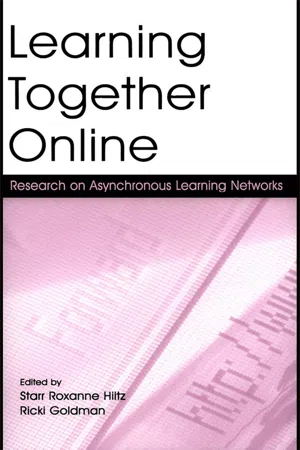
This book is about the past and future of research on the effectiveness of learning networks (also known as "e-learning" or "online learning" or "Web-based learning"). Learning networks are groups of people using computer technology, communicating and collaborating online to build knowledge together. Over the past decade there has been an explosion not only of online courses, but also of studies on them.
In Learning Together Online: Research on Asynchronous Learning Networks, leading researchers in the field use an integrated theoretical framework, which they call "Online Interaction Learning Theory," to organize what past research shows and where future research is going. It models the variables and processes that are important in determining the relative effectiveness of online learners working to reach a deeper level of understanding by interacting with each other and with the texts under investigation.
Now that there have been hundreds of studies and thousands of courses offered online, what does the empirical evidence show? This book addresses the question directly by presenting what is known from research results about how to design and teach courses effectively online, ranging from the organizational context and characteristics of students to learning theories and research design methods. It also provides a research agenda for the next decade.
Learning Together Online: Research on Asynchronous Learning Networks is both a textbook for graduate students and a professional reference for faculty teaching online, researchers conducting studies, and graduate students taking courses about learning technologies who need to know the state of the art of research in the area of online learning.
eBook - ePub
Learning Together Online
Research on Asynchronous Learning Networks
- 320 pages
- English
- ePUB (mobile friendly)
- Available on iOS & Android
eBook - ePub
Learning Together Online
Research on Asynchronous Learning Networks
About this book
Information
II
LEARNING NETWORKS: WHAT WE KNOW AND WHAT WE NEED TO KNOW
6
Contextual Factors That Influence ALN Effectiveness
J.B.Arbaugh
University of Wisconsin-Oshkosh
Raquel Benbunan-Fich
City University of New York
There seems to be little question that our present understanding of the use of CMC and computer conferencing for purposes of online learning is seriously limited. Progress will necessitate a concerted and multipronged approach to studying the technology, pedagogy, and organization of online learning. Moreover, scholars in the field of distance education must take a leading role in this work or risk being marginalized in an area where we have previously provided innovative leadership. The importance to the field of distance education of further research on the use of computer-mediated communication (CMC) for purposes of online learning should not be underestimated. Perhaps no other area of study will have a greater impact on the future of distance education. (Garrison, Anderson, & Archer, 2003, p. 127)
INTRODUCTION
As the theoretical framework presented in chapter 2 suggests, there are several contextual or environmental factors that influence ALN effectiveness. These include characteristics of the technology used (e.g., the software platform and the media mix), the instructor and his or her pedagogical style, the course, and especially the type of support provided by the institution through which the course is offered.
Although characteristics of individual instructors and/or students certainly impact the learning environment, institutions seeking to develop online courses and programs need to consider additional factors in developing their virtual instructional capability. These factors are important because student expectations for overall quality of online instruction are rising both quickly and dramatically. Identifying a set of noninstructor-specific characteristics that positively influence online learning could help build a more level playing field for all instructors, and raise the overall quality of the online educational experience they provide. This chapter examines some of those “nonperson-specific” characteristics that may be the most influential for ALN effectiveness. We review existing literature on contextual factors, identify significant characteristics that emerge from the findings, suggest some other potential factors, and describe ways in which these characteristics might be more thoroughly studied in future research.
TECHNOLOGICAL CHARACTERISTICS
From their humble beginnings as extensions of proprietary computer-mediated communication systems or combinations of electronic tools such as e-mail, web pages, and newsgroups (Dumont, 1996), delivery platforms for ALNs have evolved in a relatively short time period into fairly sophisticated, increasingly interactive software packages. Although a substantial body of research has been conducted on institution-specific platforms such as NJIT’s Virtual Classroom® (Benbunan-Fich & Hiltz, 1999; Coppola, Hiltz, & Rotter, 2002; Hiltz, 1994; Hiltz & Turoff, 2002; Hiltz & Wellman, 1997) and the SUNY Learning Network’s Course Management System (Fredericksen, Pickett, Shea, & Pelz, 2000; Swan, 2002; Swan et al. 2000), many institutions are adopting platforms produced by outside software companies. Research on these commercial platforms is growing rapidly.
Software Platforms
The predominant courseware packages are Blackboard®, an online course management system that traces its technology roots to Cornell University, and WebCT®, another popular asynchronous course management system developed at the University of British Columbia, Vancouver. Other systems include First Class®, TopClass®, and Lotus LearningSpace®. The latter is an add-on application written in Lotus Notes, which requires setup and configuration, because it is a client-based software platform.
WebCT®, developed by Dr. Murray Goldberg and a group of researchers at the University of British Columbia (Wernet, Olliges, & Delicath, 2000), was intended to make the development and maintenance of ALNs a relatively simple exercise for faculty. Studies of WebCT® to date have generally been favorable, particularly in situations in which it is used to supplement classroom courses (Hartman, Dziuban, & Moskal, 2000; Sandercock & Shaw, 1999; Wernet et al., 2000) or synchronous online course offerings (Borthick & Jones, 2000).
Another commonly used software platform that has received research attention is Lotus Notes®, and its learning software derivative, LearningSpace®. Unfortunately, results of research on ALN courses using LearningSpace® have been mixed. Although LearningSpace® has performed favorably in comparisons of student performance in ALNs and classroom courses (Alavi, Yoo, & Vogel, 1997; Arbaugh, 2000a; Piccoli, Ahmad, & Ives, 2001), it also has been associated with increased interaction difficulty (Arbaugh, 2000b; Yoo, Kanawattanachai, & Citurs, 2002), scored significantly lower in user friendliness compared to other software packages (Arbaugh, 2002a; Arbaugh & Duray, 2001), and has required the installation of Lotus Notes® on student machines to ensure that the students did not lose their work (Smith, 2001). These difficulties may be part of the reason that Lotus Development has been seeking to use LearningSpace® as more of a synchronous learning tool in the future.
Despite its increasing popularity, research on the Blackboard®/CourseInfo software package is rather limited. However, a recent study shows it as having higher scores of perceived usefulness and ease of use along with significantly higher student satisfaction scores when compared with LearningSpace® (Arbaugh, 2002a). Other software platforms on which research has been conducted include FirstClass® (McIssac et al.
1998), TopClass® (Freeman & Capper, 1999); and MeetingWeb® (Warkentin, Sayeed, & Hightower, 1997), Although each of these software platforms has received varying degrees of research attention, comparative research on the effectiveness of these software packages is rather limited (Palloff & Pratt, 2001).
Functionality
ALN functionality as implemented in these commercial software applications includes a variety of features in three main areas:
- Content delivery: includes document posting (e.g., course syllabus, lecture notes, assignments, etc.) and file sharing for homework submission.
- Communication: in two modes, synchronous and asynchronous. Synchronous communication refers to real-time chats, whereas asynchronous refers to e-mail, bulletin boards, and threaded discussions.
- Assessment: tools for the evaluation of student performance. They include online quizzes with time monitoring, exams, and surveys.
In addition, these software platforms typically include capabilities for secure student log-in, centralized database-centered syllabus with links to internal or external web pages, and integrated e-mail. As in the early ALN implementations, the objective of this new generation of commercial applications is to provide a central location for delivery of course content and additional information or links, and communication between instructors and students or among students.
Quality and Reliability
The quality and reliability of any ALN environment is critical, especially when it is used as the only instructional delivery medium. Technology-mediated distance courses in which the technology is reliable and of high quality tend to be more successful (Webster & Hackley, 1997). However, the effects of system quality and/or reliability typically have not been measured in the design of most ALN research. This is likely because intentionally varying system quality and reliability would be inappropriate in actual educational environments. However, if researchers considered and designed their studies for the possibility that systems may not work as planned, they could produce useful research on the management of technological crises in the delivery of education via ALNs.
Media Bandwidth
Historically, courses delivered using ALNs have relied extensively on text-based transmission of course content and discussion. This is true for a number of reasons, such as limited bandwidth, concerns over minimum hardware/software requirements for students, and the learning curve required for both students and instructors to effectively manage the ALN environment. As a result, research that examines the effects of various types of media on ALN course outcomes is rather limited, and the body of research available on the use of media in ALNs has produced mixed results. (See chap. 10 in thisvolume for a more extensive review of media research.)
For instance, Webster and Hackley (1997) studied 29 technology-mediated distance courses with full-motion video and compressed video. Findings suggest that in order to be successful, technology-mediated distance learning courses should use rich media, few student locations, and instructors who project positive attitudes, employ interactive teaching styles, and help students become comfortable with having their images displayed on the screen.
LaRose, Gregg, and Eastin (1998) compared traditional classroom instruction with a web telecourse based on prerecorded audio class interactions and a course web site. Findings show that students in the telecourse had test scores and perceptions (student attitude and teacher immediacy ratings) equal to those of students in the traditional classroom. Conversely, Arbaugh (2002b) found that the use of varying numbers of audio and/or video clips in a study of 13 ALN courses was not a significant predictor of student learning or course satisfaction. Some possible research questions in this area include: How much media variety is most effective within ALN settings? What are some of the contextual factors most likely to influence the optimal course media mix? In what ways can the various media types be used most effectively in ALNs? (These issues are explored further in chap. 10.)
THE INSTRUCTOR’S PEDAGOGY AND BEHAVIOR
Different pedagogical approaches and learning strategies suggest different ALN uses and may require different software capabilities. In fact, effective applications of ALN are those that match the pedagogical model driving the course (BenbunanFich, 2002). As previously described in chapter 2, there are two broad categories of pedagogies: instructivist and constructivist. The instructivist model is based on lecturing using a one-way transmission of knowledge from the professor (or recorded lectures or books) to the students. In this approach, each student learns individually. The constructivist perspective assumes that knowledge is created or constructed by every learner interacting with others (Leidner & Jarvenpaa, 1995). In this model, teaching is a communal experience in which knowledge is created through constructive dialogue and group discussion, and the professor’s role is to facilitate the process. These different approaches make different demands on technology (Benbunan-Fich, 2002).
Teaching/Learning Models
Pedagogy emphasizing the one-way transmission of concepts (instructivist approach) calls for the use of a system that improves the efficiency of this transfer in the lecturing process. In contrast, constructivist models call for learner-centered applications in which students can construct their own knowledge by formulating ideas into words and building on these ideas through discussions, reactions, and responses of their peers. For constructivist methods based on collaborative group assignments, the technological platform should support communications among students (Benbunan-Fich, 2002).
A significant question meriting future research attention is whether either of these approaches or a combination of them best predicts student learning and/or satisfaction in the ALN environment. Evidence to date is somewhat mixed. Initial research on learning in computer-mediated communication environments suggests that ALNs support collaborative constructivist approaches better than classrooms do (Alavi, Wheeler, & Valacich, 1995; Chidambaram, 1996), but some subsequent studies have found that classroom settings are associated with greater student satisfaction with collaborative learning approaches (Card, 2000; Warkentin et al., 1997). However, these studies typically compared learning settings on their applicability for collaborative approaches rather than studying the viability of the approach itself Also, many of these earlier studies were based on individual courses or a limited number of courses.
More recent research has examined collaborative learning in larger course samples, but results are inconsistent. Hiltz, Coppola, Rotter, Turoff, and BenbunanFich (2000) studied 26 information systems courses over a 3-year period and found strong evidence for the effectiveness of collaborative learning in ALN environments. However, a study conducted by Swan (2002) of 73 courses offered by the SUNY Learning Network found that collaborative learning was negatively associated with student learning in ALNs. She pointed out that it was difficult to determine whether this relationship could be attributed to the concept of collaborative learning being faulty or whether the concept is fine but was poorly practiced. The inconclusive nature of this research to date suggests that determining which pedagogical approaches are most appropriate or the contextual factors that make one more appropriate than another will be a topic meriting extensive research throughout the first decade of the 21st century (it is explored further in chap. 9).
One variable related to the instructor’s behavior that has been well established is the extent to which quality interaction takes place among course participants (Fredericksen et al., 2000; Hiltz & Turoff, 2002; Nulden, 1999; Palloff & Pratt, 1999). Some studies suggest that it is the instructor’s role in course interaction that is most critical (Arbaugh, 2000b, 2000a; Brower, 2003; Fredericksen et al., 2000), whereas others suggest that the students’ role in interaction most significantly predicts student learning and/or satisfaction (Arbaugh, 2002b; Borthick & Jones, 2000; Nulden, 1999; Smith, Ferguson, & Caris, 2001), and still others suggest that both roles are equally important (Coppola et al., 2002; Hiltz, 1993; Jiang & Ting; 2000; Palloff & Pratt, 2001). However, it is not certain whether this interaction should be primarily between the instructor and the students, or among the students themselves.
Although the prominence of the instructor’s role in course interaction remains unclear, the nature of their interaction is becoming well established. The extent to which an instructor engages in immediacy behaviors appears to be strongly associated with student outcomes. Originally conceptualized by Mehrabian (1971), immediacy refers to communication behaviors that reduce social and psychological distance between people (Myers, Zhong, & Guan, 1998). In the ALN context, immediacy describes behaviors such as including personal examples, using humor, providing and inviting feedback, and addressing students by name (Gorham, 1988). There is increasing evidence that these behaviors are positively associated with student learning and satisfaction with the course format (Arbaugh, 2001, 2002b; Frietas, Myers, & Avtgis, 1998).
Pedagogical Techniques
ALNs allow instructors to increase the efficiency of knowledge transmission in regular...
Table of contents
- Cover Page
- Title Page
- Copyright Page
- Preface
- Acknowledgments
- About the Authors
- I: Foundations of Research on Learning Networks
- II: Learning Networks: What We Know and What We Need To Know
Trusted by 375,005 students
Access to over 1.5 million titles for a fair monthly price.
Study more efficiently using our study tools.
Frequently asked questions
Yes, you can cancel anytime from the Subscription tab in your account settings on the Perlego website. Your subscription will stay active until the end of your current billing period. Learn how to cancel your subscription
No, books cannot be downloaded as external files, such as PDFs, for use outside of Perlego. However, you can download books within the Perlego app for offline reading on mobile or tablet. Learn how to download books offline
Perlego offers two plans: Essential and Complete
- Essential is ideal for learners and professionals who enjoy exploring a wide range of subjects. Access the Essential Library with 800,000+ trusted titles and best-sellers across business, personal growth, and the humanities. Includes unlimited reading time and Standard Read Aloud voice.
- Complete: Perfect for advanced learners and researchers needing full, unrestricted access. Unlock 1.5M+ books across hundreds of subjects, including academic and specialized titles. The Complete Plan also includes advanced features like Premium Read Aloud and Research Assistant.
We are an online textbook subscription service, where you can get access to an entire online library for less than the price of a single book per month. With over 1.5 million books across 990+ topics, we’ve got you covered! Learn about our mission
Look out for the read-aloud symbol on your next book to see if you can listen to it. The read-aloud tool reads text aloud for you, highlighting the text as it is being read. You can pause it, speed it up and slow it down. Learn more about Read Aloud
Yes! You can use the Perlego app on both iOS and Android devices to read anytime, anywhere — even offline. Perfect for commutes or when you’re on the go.
Please note we cannot support devices running on iOS 13 and Android 7 or earlier. Learn more about using the app
Please note we cannot support devices running on iOS 13 and Android 7 or earlier. Learn more about using the app
Yes, you can access Learning Together Online by Starr Roxanne Hiltz,Ricki Goldman in PDF and/or ePUB format, as well as other popular books in Education & Education General. We have over 1.5 million books available in our catalogue for you to explore.