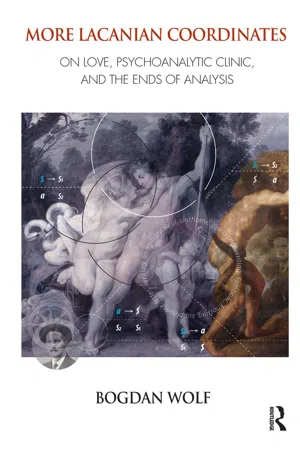
Psychoanalysis is an experience of truths and lies in language. It is also a discourse, and it is a praxis. Lacanian Coordinates takes the reader from the beginning of Lacan's teaching, from the logic of the signifier and the Lacanian subject, to the drive and object a, qua object a, the paradoxes of guilt, and finally to the desire of the Other, love, and femininity. Volume One explores the points of Lacanian orientation that lead us to the particularity of the subject, and considers whether we find them not solely in the discourse of the universal, to which religion, science and philosophy testify, but also in the analytic experience itself. Volume Two - More Lacanian Coordinates - opens with the question of love that for Lacan forms a discourse of fragments and letters addressed to the one, which circumscribe the nonexistence of the sexual relation. Further, Lacan situates love in relation to knowledge, making ignorance, alongside love and hatred, the third passion.
eBook - ePub
More Lacanian Coordinates
On Love, Psychoanalytic Clinic, and the Ends of Analysis
- 224 pages
- English
- ePUB (mobile friendly)
- Available on iOS & Android
eBook - ePub
About this book
Information
Chapter One
On love and the woman that does not exist: an introduction
From the signifier to the letter
By way of introduction to the subject of love and the woman that does not exist in Seminar XX Encore (1998a), Lacan resumes speaking about the signifier and its relation to the letter. He refers to Jacobson, Saussure, and linguistics. Why does he speak about the signifier before speaking about love? Lacan’s steps in this seminar should be read meticulously as they provide us with many clues about love.
Lacan also speaks about reading. A letter is read and it is read in more than one way. While it is read in what way does it bear a relation to the signifier? Reading a letter and reading the unconscious are obviously not the same thing. If the unconscious is what is read, it is read not as a literary text made of letters, but as the subject of the unconscious, as that which slips away from speech while being tied with the jouissance it pins. Unlike the signifier, Lacan says, the letter is an effect. The signifier, in turn, is primary, and Lacan often mentions in his teaching the primacy of the signifier. The relation between the signifier and the letter has the same logic as that of cause and effect. The signifier precedes the speaking subject that is constituted by the signifier that represents the subject for another signifier. This is Lacan’s classical definition of the subject. The movement of the signifiers, its associative chain, sustains the subjectivity. The signifier therefore pre-exists the subject, giving it its abode and its means to exist. The letter, in turn, is an effect—an effect of discourse. For the subject to read the unconscious involves speaking that has to do with the dimension of signifiers but not only. It also involves a letter which is where the real makes its impact. So in reading the unconscious the letter as an effect of discourse comes to play a part as having to do with the real. Some part of this interplay between the letter and the signifier remains in the domain of the unreadable.
From the perspective of Freud’s intuitions in his text On Aphasia (1891b), we could say that writing is introduced through reading that is not without signifying effects. When a signifier is written down it turns into a letter and becomes distinguishable from the signifier by virtue of being self-identical. So, the letter is an effect of discourse. The writing of a matheme for Lacan is introduced and accompanied by speaking a language that is understandable. That’s why a letter, say a, that designates something to the readers of Lacan, does not have to be understood because when Lacan wrote it, it was an effect of discourse. And in this sense it was also an effect of castration. This letter is real because it is material and does not have to be understood. It can be read, like the unconscious, and like desire, but it does not have to yield to understanding. In discourse, for example the discourse of the unconscious, it suffices that we can talk about the letter, and in doing so link it to another letter. For example, when we speak about the Other, designated by the letter A, we also link it to the letter $, designating the subject as divided. The writing of a matheme, that is after all made of letters, and therefore of places, makes use of another term that is introduced through the hole or gap in language. For Lacan this term is the signifier as such, the phallus, the signifier of desire that is uncoupled by any signified. It is a signifier that allows to mark the difference between the sexes, between women and men. In his later teaching Lacan used the phallus as a marker of a mode of jouissance he placed on the masculine side. In this sense the phallus is no longer the mark of division between the sexes but a mode of jouissance to which both men and women can accede. When reading a matheme things do not make sense, it is because the reader stands face to face with the signifier of desire that addresses no one in particular, and this can make the reader feel stupid. That’s why a matheme or a letter does not have to make sense at all because we have a language with which to move between gaps, to represent, to explain, and to make sense. That’s where the phallic signifier is useful because it allows the addressee to read the letter as addressed to the subject. In this sense the phallus does not discriminate between women and men as both sexes can make use of it. Both women and men can in their reading make sense of the writing of a matheme or to enjoy phallic jouissance produced in the course of this reading.
On a different pole, and in distinction to the Lacanian letter, we have the legacy of the notation of classical logic with p, q, and so on. Notation of logic, whether classical or not, is not a discourse. Although the notation of logic is, like the Lacanian matheme, also made of letters that designate functions, the notation of logic is not a discourse. For me this makes the Lacanian letter quite unique. The reason why the notation of logic used by the mathematicians remains distinct from the Lacanian discourse concerns the fact that the letter, the Lacanian letter, is an effect of the signifier. For Lacan the movement runs from the primacy of the signifier in the unconscious to the letter as an effect of discourse. For Freud, the primacy of the signifier is rooted in the unconscious to the extent that the acoustic element of which the signifier is made is also linked to the object-presentations. In this way a connection to what is called reading, which involves visual images, becomes possible and with it so does another connection to what Freud thought was a relatively simple process, namely writing. So we have reading, writing, notation of logic, and the discourse of psychoanalysis that can be written by means of letters.
These symbolic agents have always drawn in Lacan’s teaching on the Other as a locus in the structure where they are guaranteed. The operator of the Name-of-the-Father has been supposed to overlook the signifying relations. But in Seminar XX this status of the Other is no longer the only one. Lacan appears now to shift the status of the Other to that of the Other sex. At the same time he speaks of writing qua the nonexistence of the sexual relation. This is what Lacan arrived at, not without Freud’s intuitions, in his later teaching for which it is a premise. For Lacan the relation with the Other as the Other sex cannot be written. I will come back to this. The nonexistence of the sexual relation is a fundamental premise of Seminar XX Encore. It is not the aim of this seminar but a premise on which Lacan builds the relations between the sexes, the discourse of love and the modalities of sexuation. There are relations between the sexes, which we touch upon in the love discourse with different signs of love circulating between the lovers, men and women alike, but the sexual relation does not exist. What does Lacan designate under this term of nonexistence? My former logic teacher used to insist that unicorns did not exist. He would then wave the piece of chalk in his hand saying that this chalk did exist. How would he account for Lacan’s nonexistence of the sexual relation? Are these negations equivalent? But is it the same to say that the unicorns do not exist and to say the sexual relation does not exist? We can start to answer this by saying that the sexual relation does not exist because the relation between two modes of jouissance between the sexes cannot be written or said. There is no notation that would inscribe the unity of jouissance, that of a woman and that of a man.
Lacan introduced the nonexistence of the sexual relation in addition to the function of the signifier. We could also say that based on the premise of the nonexistence of the sexual relation Lacan introduced a new function of the signifier that leans on the lack or gap in language. It implies that the function of the signifier rests on the signifier of the lack in the Other. This writing of Lacan is not new. He developed it already in the late 1950s, especially at the time of Seminars V and VI where he was working on the graph of desire. He wrote this signifier as S (A̸). This signifier of the lack in the Other plays a crucial role in Seminar XX (1998a). Lacan himself refers to “graphicisation” as different ways to support desire and its cause. Having thus written the signifier in the old fashioned way as S (A̸), the way of Seminar VI Desire and Its Interpretation (2013a), Lacan now refinds it in Encore in relation to the Other as the Other sex. He places this old formulation of the signifier in the new way, namely on the woman side of the table of sexuation, implying that only the woman as the Other sex can have a relation with it. In fact, this formula of the signifier stands for the truth of the Other sex in so far as desire comes from there, from the Other as lacking. In other words, the Other can only be reached through the lack, for example through the object a because it can be found in the place of the lack as a cause of desire. In which case, as Lacan states in the lesson from Encore entitled “Knowledge and truth”, love relates to semblance. The Other can be addressed through object a as a cause of desire, and love is addressed as a semblance of being.
Passion and eulogy
Since the sexual relation cannot be written, writing takes place in lieu of the nonexistent relation and therefore as a non-relation. What is written then appears to be of the order of the One. The One in this formulation of Lacan is not a mark of unity the lovers aim at in love, because such a mark does not exist, but concerns the One of the signifier. Lacan says Y a d l’Un, “there is such a thing as/something of the One”. This One, in the Lacanian sense, is not the One of addition, of adding up two jouissance of a woman and a man, but the One of the signifier. The One of the sexual relation between the two sexes does not exist and cannot be written in so far as ex-istence is a symbolic category. So the only One, to put it this way, is the One of the signifier. Lacan does not say the One of the letter. He says the One of the signifier because he wants to isolate it from the jouissance of the body of the Other. Following this, once the One is separated from the Other’s body, Lacan can say that the body of the Other is not a sign of love. And he adds that although the jouissance of the Other, which is the Other sex, is not a sign of love, love demands more love, encore but also en-corps, in the body. What body if not that of the Other from which it is supposed to come from? Lacan presents us with a paradox here, which is not simply a paradox of love as passion but of logic of love, which is complex and paradoxical. Love has nothing against logic as it can be written, for example as a demand for love which is a sign to the other, and as a love discourse where semblance has a part in the repertoire of truth. The paradox concerns the jouissance of the body of the Other that is not a sign of love, and the One that is.
The statement above “the notation of logic is not a discourse”, which is tantamount with saying there is no discourse of logic, seems to me to be a correlative to what Lacan never refrained from reiterating, namely that there is no Other of the Other or, which is the same thing, that there is no metalanguage. In this regard a matheme comes to form a way of logicisation that strikes the subject as real. And in this sense it is miles away from how things are done by the mathematicians. Lacan’s matheme of fantasy, $ ◊ a, captures something of the real by failing, namely missing the relation with the real, so we are left with the letters. Once formalised, the matheme made of the letters now requires an explanation. $ is the subject, ◊, lozenge, should be read as “desires for”, and a is the object little a, the cause of desire. The letter as such, like the signifier, is stupid. That’s why Lacan linked the statement to the enunciation, as the latter implicates subject’s desire. The statement is no more and no less than a signifying representation of the subject, which leads to enunciation where something else is said, what in saying was said as unsaid. Irrespective of how contentious a statement may be—and in the end of analysis none proves to be more so than fireworks in the daylight—it is underlined by enunciation. Given that what I am aiming at here is love, and given that there is no such thing as a discourse of logic, we can make another step by asking ourselves if there is such a thing as a discourse of love.
Roland Barthes (1979) certainly thought so. He wrote under this title a long series of fragments of what constitutes a kind of a monologue on what this thing called love might be. In it, Barthes says, to think of another, which he presents as I-you relation, to think of you, boils down to a forgetting, to you as forgotten. For Barthes life is only sustainable as a forgetting. This forgetting functions for him as a metonymy of thinking. You are forgotten therefore I think of you. In which case “you” appears as an effect of this process, as you I think about. Barthes goes on to say that it is impossible to think you except for a memory of “you”, which I can cause to recur over and over again. This you for Barthes is what I forget and bring back as an object wished for, and therefore a memory. And then he links this metonymised thought to writing as an act of having nothing to tell you. And that’s because there is no one really there except for the memory and the thought. The love discourse for Barthes amounts to a certain practice of writing about a love object as lost and memorised, that is to say without you I really love. This leads to a certain kind of reciprocity without the Other as desiring, as speaking. It is in this sense that Lacan approached love as always reciprocated. For Lacan love is always requited because loving another presupposes an image I love and which is the answer to my demand for love, and therefore plays part in this dialogue. And here we have a writer who is engaged in this reciprocity. A love letter supposes an answer from the image to which I write. Barthes makes the lost love object love him back, and this echoes Lacan’s idea of a love as always requited. In this way, and Barthes quotes Goethe on Werther as an example, writing a love letter amounts to an act of both demanding love and giving up on it, which brings back Lacan’s guilt. There is so much to say but nothing to tell you.
Marguerite Duras (1990), who had a lot to say about love, found Barthes’ book on love unreadable. She appreciated the cleverness of his tactics, the enticing flow of fragments, but she found him to be the sort of writer who is unable to love, who cannot open up to the unknown in the other. For her he remained a writer of the stiff and stereotypical. This was a harsh criticism of a man who devoted himself to writing. What does not surprise is that this harsh criticism comes from a woman who said that all men are homosexual. According to Duras, men are unable to love because love is heterosexual and heterosexuality implies a desire and a lack. For the heterosexual, desire leaves love as always lost. It is the lack, therefore, castration in effect that conditions for the man access to the Other through object a. But Lacan put into question this access to the Other, leaving the man with the object a. At the same time it is the loss that makes love a form of semblance. Duras’ logic of love resonates with Lacan’s statement that the heterosexual is the one who loves women. For Lacan then some men are heterosexual. But Duras does not think so. As a man the heterosexual will try to reconcile man and woman as an inseparable couple. He will attempt to make the sexual relation exist by trying to write it myriad of times in legion of ways. The best Duras can do for a heterosexual man is to present him as the one who makes the sexual relation exist. That’s what love may be for a heterosexual man. It is a passion. But as a passion it leaves him, according to Duras, to love only the passion itself. He is left with a belief in the passion of loving another. And this is no longer love directed to the Other who is radically other. That’s why she calls it homosexuality. Homosexuality’s greatest passion is homosexuality. In homosexuality, according to Duras, one only loves another as oneself, as the semblable. For her, this at least is the case for a man.
As for a woman, love is not only a passion. It is also a eulogy. It speaks of loss as inscribed in the heart of passion. Duras was not surprised to see men being repelled by her story of love between a young white girl and a Chinese man. She noted that while men were up to a point curious about love, they would glimpse through pages without reading them. She was baffled how it is possible to read with your eyes closed. She described love as passion and as eulogy, stating that this young girl represented for her the freedom she herself had lost. Duras wrote not only about love as loss but also wrote eulogy to love.
Courtly love
What Lacan was attempting to deal with in his seminar Encore (1998a) is not only the eulogy of love but the enigma of heterosexuality. Those who love women, he says, are heterosexuals. Even women who love women? If female homosexuality has for Lacan the same logic as heterosexuality it implies that the woman he has in mind is utterly Other, and that by asking about the woman, both sexes refer to the woman as Other sex, other both for women and for men. And that’s the Woman, Lacan says that does not exist. And he writes this as La femme with the bar on La. She does not exist as a whole, is not a whole, pas-tout. On the one hand, the sexual relation between the sexes does not exist, because the jouissances of men and women cannot be represented as one. On the other hand, The Woman does not exist as each one is different and each one experiences her ecstasies differently. This leaves us with the series of ones. As if the nonexistence of the sexual relation was not sufficient to give us the coordinates of the relations between the sexes, Lacan supplements his own coordinates by adding the Woman that does not exist either. She does not exist as generic or universal, nor does she exist as whole and complete some men would want to attain. She is truly Other. Which is why Lacan makes it precise by supplementing his statement with the one about not-whole. The woman is pas-tout, not whole and sometimes not-all.
There is a relation then between the nonexistence of the sexual relation and the nonexistence of the Woman. Since the Woman as a whole does not exist, the relationship with her, in so far as she stands for the Other sex, cannot be written. One can only write love letters to a woman or women in the plural as Don Juan did. Every woman is different and counts as one. Analytic experience shows, and the writings of Duras as well as of holy women commonly known as saints confirm, that there are not only phallic women.
What Lacan was trying to encapsulate in his seminar Encore was that the jouissance called phallic is not all there is to jouissance. There is, Lacan says, another one, not a phallic one but a feminine one. Lacan read and wrote on the feminine ravishing in one of Duras’s books some years later. She confirmed his findings, and in the end there was nothing she was able to say Lacan did not teach about with regard to women and love. But what Lacan said about Duras, she was unable to say of Barthes. In the seminar Encore Lacan does not speak about the discourse or dialogue of love. He speaks of love letters because they can be written or uttered, which is not easy either, especially for men. Some of these letters are sent out and support the logic of love as the nonexistence of the sexual union. But some are not sent out, and then one can ask to whom were they addressed in the first place?
What is love? In the first place love is narcissistic. It is addressed to the mirror image and seeks to preserve the lover in the image of the loved one. What is at stake is the image of complementarity which made Lacan say that love is requited, always reciprocated. It is the Janus of love, the face on one side loves the face on the other side, and is loved in return. The reciprocity Lacan speaks about derives from loving the object as mine in the other, for example in the memory of the beloved one. This directs the investments and expectations to the other in such a way that the ego in the subject assumes he is loved in return. Later, Lacan used the Barthesian “you” as the one that remains, to say that there is more to “you” I love, more beyond the “you” I love, namely the object a, which is why I destroy “you”. This would be Lacan’s supplement to Barthes’ fragment on loving the other who is not there. The imaginary reciprocity contributes to the supposition of knowledge in the other that became of importance to La...
Table of contents
- Cover
- Half Title
- Title
- Copyright
- Dedication
- Contents
- ABOUT THE AUTHOR
- PREFACE
- CHAPTER ONE On love and the woman that does not exist: an introduction
- CHAPTER TWO Antigone, the beautiful, or beyond death in the analytic experience
- CHAPTER THREE On obsessional neurosis: from Freud to Lacan and back
- CHAPTER FOUR On psychosis: how Joyce constructed his body
- CHAPTER FIVE Knowledge in discourse or fourfold ignorance
- CHAPTER SIX To conclude—the ends of analysis in the teaching of Lacan (1)
- REFERENCES
- INDEX
Trusted by 375,005 students
Access to over 1.5 million titles for a fair monthly price.
Study more efficiently using our study tools.
Frequently asked questions
Yes, you can cancel anytime from the Subscription tab in your account settings on the Perlego website. Your subscription will stay active until the end of your current billing period. Learn how to cancel your subscription
No, books cannot be downloaded as external files, such as PDFs, for use outside of Perlego. However, you can download books within the Perlego app for offline reading on mobile or tablet. Learn how to download books offline
Perlego offers two plans: Essential and Complete
- Essential is ideal for learners and professionals who enjoy exploring a wide range of subjects. Access the Essential Library with 800,000+ trusted titles and best-sellers across business, personal growth, and the humanities. Includes unlimited reading time and Standard Read Aloud voice.
- Complete: Perfect for advanced learners and researchers needing full, unrestricted access. Unlock 1.5M+ books across hundreds of subjects, including academic and specialized titles. The Complete Plan also includes advanced features like Premium Read Aloud and Research Assistant.
We are an online textbook subscription service, where you can get access to an entire online library for less than the price of a single book per month. With over 1.5 million books across 990+ topics, we’ve got you covered! Learn about our mission
Look out for the read-aloud symbol on your next book to see if you can listen to it. The read-aloud tool reads text aloud for you, highlighting the text as it is being read. You can pause it, speed it up and slow it down. Learn more about Read Aloud
Yes! You can use the Perlego app on both iOS and Android devices to read anytime, anywhere — even offline. Perfect for commutes or when you’re on the go.
Please note we cannot support devices running on iOS 13 and Android 7 or earlier. Learn more about using the app
Please note we cannot support devices running on iOS 13 and Android 7 or earlier. Learn more about using the app
Yes, you can access More Lacanian Coordinates by Bogdan Wolf in PDF and/or ePUB format, as well as other popular books in Psychology & History & Theory in Psychology. We have over 1.5 million books available in our catalogue for you to explore.