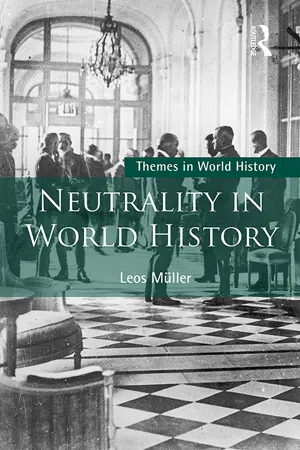
Neutrality in World History provides a cogent synthesis of five hundred years of neutrality in global history. Author Leos Müller argues that neutrality and neutral states, such as Switzerland, Sweden, Belgium have played an important historical role in implementing the free trade paradigm, shaping the laws of nations and humanitarianism, and serving as key global centers of trade and finance. Offering an intriguing alternative to dominant world history narratives, which hinge primarily on the international relations and policies of empires and global powers, Neutrality in World History provides students with a distinctive introduction to neutrality's place in world history.
- 190 pages
- English
- ePUB (mobile friendly)
- Available on iOS & Android
eBook - ePub
Neutrality in World History
1
Introduction
Why Neutrality?
You know as well as we do that right, as the world goes, is only in question between equals in power, while the strong do what they can the weak suffer what they must.Melian Dialogue, Athenians on the address of Melians who refused to ally with Athens1
What is this thing. Neutrality? I do not get it. There is nothing to it.The Swedish king Gustavus Adolphus on the address of the Brandenburg neutrality 16302
Why Neutrality?
On 22 April 1793, President George Washington issued the first Proclamation of Neutrality of the United States. It declared that the United States would stay impartial in the European conflict between revolutionary France and Great Britain and its allies. For much of the long lasting French Revolutionary and Napoleonic Wars (1793–1815) the United States stayed out of the conflict; only the short War of 1812 against the British broke the American stance. In 1914, President Woodrow Wilson declared the neutrality of the United States in the First World War, and the United States upheld this position for almost three years—until March 1917. US Congress passed further Neutrality Acts in 1935, 1936, 1937 and 1939, faced with the possible outbreak of what would become the Second World War, but, following Japan’s attack on Pearl Harbor the United States definitely abandoned its position. Today, it seems remarkable that the United States had stayed out of major wars for almost 150 years—for most of its history. Neutrality does not seem compatible with the United States’ role in the Second World War, the Cold War and the recent War on Terror. The US President George W. Bush’s statement after 9/11 that “Every nation, in every region, now has a decision to make. Either you are with us, or you are with the terrorists” made it clear that neutrality was not an option in that conflict. Why had it been an option in other wars?
Neutrality is a strange thing. It has been dismissed as either unrealistic or immoral—or both. But in spite of its long history of being despised, it still is alive and still considered as a foreign policy option. European long-term neutral nations, past and present, are successful small states. Switzerland, Sweden, Norway, Denmark, the Netherlands, Austria, Ireland and Finland are among the best countries to live in. They are socially and culturally developed, and they enjoy high living standards. They have well-functioning welfare states. They function, too, as competitive economies, free-traders, well-endowed to prosper in today’s global economy. We find these states at the top of the ranking lists of most competitive economies, the best countries to live in, the wealthiest nations. And they all share a long history of neutrality. Moreover, for many of them, neutrality is an important component of their modern national identity. I do not claim that neutrality is the reason for these countries’ success, but, apparently, neutrality has not been a disadvantage. In fact, neutrality offers a plausible explanation for a few of their competitive advantages.
In addition to the European nations, and the long-standing impartiality of the United States, there are many Latin American nations that have adopted this policy. Nevertheless, it is more difficult to find examples of neutrality in the world outside the Americas and Europe. But the so-called Non-Aligned Movement, consisting of 120 developing countries, is siding with the principle of non-alignment, closely related to neutrality. The movement includes many influential UN nations that wished to stay impartial throughout the Cold War of the 1960s and 1970s. And neutrality has recently been discussed as a possible solution to the tensions between Vladimir Putin’s Russia and NATO in countries such as Ukraine and Moldova. Thus, neutrality still is a relevant, rational and realistic option for many nations.
Arguments for Studying Neutrality
This book presents four major arguments for the study of neutrality. First, I argue that neutral states have played an important role in shaping the modern world order by providing an alternative to the early modern warlike and unpredictable aspects of international relations. These processes took place mainly in the eighteenth century, one of the most bellicose in human history. After the end of the French Revolutionary and Napoleonic Wars in 1815, neutrality became a standpoint in many international conflicts, and it functioned as a leading principle in international relations. And, in spite of the carnage of the two world wars and the Cold War, and in spite of the widespread criticism and rejection of it, neutrality is still a part of international relations in the modern world. We cannot understand the history of international relations without seriously considering this political stance.
Second, I argue that neutral states were key agents in implementing the free-trade paradigm in international trade. Neutral maritime states fought for their rights to trade and navigate freely during wartime, with anyone and anywhere. They also employed legal arguments for ensuring the freedom of the sea, and they took steps to enforce their trade rights. Even in this case, the struggles to implement laws guaranteeing the freedom of the sea and the free-trade paradigm took centuries to carry out. By the mid-nineteenth century, the two paradigms were embodied in international law.
Third, I suggest that neutral states were and are important trading, shipping and industrial nations, and represent centres of finance. They have had an important role in the world economy for at least three centuries. Neutral trade has often been perceived as a morally wicked phenomenon, a way of making money through others’ bloodshed. But that kind of trade has always been a part of international trade over the course of centuries in which warfare was a normal state of things; neutral trade, in fact, often reduced the damaging economic impact of warfare. In general, the economic development of small, free-trading neutrals has been better than, or as good as, the development of great powers and states with grand military ambitions.
The fourth claim is that neutrality is a key concept of international law, and in this way neutrality has also played a role in the rise of internationalism, humanitarianism and the peace movement, and so has contributed to the foundations of the twentieth-century international organizations such as the League of Nations and the United Nations. More than great powers, small neutral nations are interested in the establishment of the rule of international law (law of nations), because this law guarantees their sovereignty and independence. Since the early eighteenth century, lawyers of neutral nations have built up the body of international law and argued for its implementation in inter-state relations. Neutrality has been at the core of internationalism.
What is decisive for these four arguments is neutrality’s connection to the sea, the fact that the leading neutrals until the nineteenth century were maritime nations. Trade and shipping under neutral flags were especially important in the eighteenth century, when many maritime states (the Netherlands, Denmark, Sweden, the United States, Tuscany, Portugal and others) started to apply a long-term neutral strategy. And the early modern maritime states continued with their policy of neutrality throughout the nineteenth and twentieth centuries. This connection between maritime trade and neutrality might seem odd today, considering that the most typical neutral is the landlocked Switzerland, while the Netherlands, Denmark and the United States are no longer neutral. But what the early modern maritime neutrals shared with the Switzerland of today is the concern with free trade, peaceful international relations, and a safe and stable world order.
The chronological focus of the book is on the five centuries between 1500 and the present, a short period in the context of world history. This does not mean that there had not been neutrality before 1500. Neutrality existed in antiquity, as well as in medieval times. But I argue that 1500 marks a crucial breaking point. After 1500, neutrality became a key component of international relations. After 1500, we cannot understand the working of international relations—the world order—without also understanding neutrality. This post-1500 role of neutrality is related to two early modern European “inventions”: the rise of the specifically European sovereign state and its system—which I call here, for reasons of convenience, the Westphalian state system—and the fact that the oceanic space after Columbus and Magellan was divided between territorial and international waters. The two points of departure, the birth of Westphalian sovereignty and its state system and the invention of international waters (“the free sea”) will receive much attention in the book.
The dilemmas of neutrality policy in the twentieth century have made us ignorant of neutrality’s role in shaping the modern world. When looking at the failures of neutrality in the First and Second World Wars and the abortive League of Nations in the inter-war period 1919–1939, it is easy to dismiss neutrality as irrelevant, immoral and unrealistic. The aim of this book is to redress this misjudgement.
What Is Neutrality?
Undoubtedly, the meaning of neutrality varies depending on context and time, or the agent employing the term. We might start with the simple statement that neutrality is a policy employed in war. Strictly speaking, neutrality does not exist in peacetime. But because warfare has characterized a great part of our history, not least in the last five centuries, neutrality is a relevant and useful concept in a world dominated by military conflicts. Neutrality assumes an armed conflict between two legally equal sovereign parts, and where a third (neutral) part stays impartial. Of course, in modern times the term neutrality is used also in peacetime. Here, neutrality means either long-term non-alignment, a pledge that one state makes to not ally itself with any part in a future war; or there is permanent neutrality, a declaration of neutrality by a state directed to the international community. The legal or political status of non-alignment or declarations of permanent neutrality vary, but in principle they both imply that the neutral state will stay neutral in an upcoming armed conflict. The policy of neutrality in peacetime has been adopted especially in the post-war period, in the Cold War, which, in fact, was a “cold” conflict between the West and the East.
The concept of neutrality in war thus also presumes a definition of “war” in a consistent way. War is here understood as an armed conflict between two sovereign polities. The sovereignty (equality in legal terms) is founded on a general acknowledgement by the international community that the belligerent states are sovereign states. Uprisings, revolutions or civil wars taking place on the territory of a sovereign state are not truly legitimate wars. Such a distinction between a legitimate war between two sovereign states and an internal conflict within a sovereign state is crucial in declarations of neutrality, as we will see. Neutrality cannot be declared in a civil conflict because this would, de facto, mean that the neutral state acknowledges the sovereignty of either of these fighting parts. This was a matter of great significance in the transformation of the American Revolutionary War from a rebellion of British colonial subjects into a legitimate war: when the French acknowledged the United States as sovereign nation and entered the war on the US side, neutrality became legal option. With the rising number of internal conflicts (civil wars) in the twentieth century, questions about the legality of a war and thus options about adopting a position of neutrality have once again been raised.
In a legal sense, special focus must be put on the inactivity and impartiality of a neutral state. If a neutral state abstains from taking a stance in favour of one part in an armed conflict, then it is crucial it breaks all its contacts with both sides and stays inactive, or at least treats the belligerents in an equally “impartial” way. In this way the seventeenth-century Dutch scholar Hugo Grotius understood neutrality, and in this way the duties and rights of neutrals were defined in the Hague Conferences of 1899 and 1907 which drew up the law of neutrality. But such a legal ideal of impartiality has been far removed from the reality of maritime neutrality in early modern times, or from the realities of the Swiss or Swedish trades with Nazi Germany. We have to put different understandings of neutrality into proper historical context.
The differences in the meaning of neutrality are not only related to legal, economic, political or other contexts, but also to the fact that neutrality has been employed in different ways by different states. In a very broad sense, we can make distinctions between three different uses of the term, which also correspond with different periods of time. The most traditional understanding of neutrality implies a one-sided declaration of neutrality in a war. This does not necessarily mean that the neutral state would stay neutral during the whole war, and it did not compel the state to stay neutral in an ensuing conflict. Such “occasional” neutrality was employed in the seventeenth and eighteenth centuries, for example by England, Sweden and Denmark. The same kind of occasional neutrality was frequently employed by states in the nineteenth century. It was adopted by both great powers and small states. Many nineteenth-century wars started with multiple declarations of neutrality by states not engaged in a conflict. This was the case even at the beginning of the First and Second World Wars. The purpose of such occasional neutralities was to contain the conflict and, hopefully, draw economic or strategic benefits from it. Such neutrality expressed only a short-term realist policy that did not entail any long-term commitment.
The second kind of neutrality has been adopted by “long-term voluntary” neutrals. These were states that adopted neutrality as a long-term strategy in their foreign policy. Long-term neutrality was typically adopted by small states with limited military resources. The first long-term neutrals were states with considerable maritime interests, such as the Netherlands and Denmark. From the late eighteenth century even Sweden and the United States could be added to the group. What distinguished the long-term neutrals from the occasional ones was the declaration of neutrality as a long-term aim of their foreign policy, and the endeavour to institutionalize neutrality as a part of international law, international cooperation or international institutions. Long-term voluntary neutrals were very active members of the international community in the nineteenth century, when neutrality thrived. What is important to stress here is that long-term neutrals, even if they did not take part in great-power wars, made substantial investments in their defence capabilities, making their neutrality tenable.
The third type of neutrality, permanent neutrality, was an outcome of the nineteenth-century conference system. It was neutrality guaranteed to a neutral state by an agreement among great powers. Two classical cases of permanent neutrality were Switzerland and Belgium. Swiss neutrality was guaranteed by Britain, France, Russia, Prussia and Austria at the Vienna Congress of 1814–1815. Belgium first became an independent state in 1830, and its international neutral status was guaranteed by European great powers in upcoming years. In both cases, permanent neutrality was a solution that was supposed to minimize tensions between the great powers. Permanent neutrality was also first employed in plausible conflict zones between the great powers. For centuries, the territories of the Low Countries (the Netherlands and Belgium) made up a conflict zone between France, the German states (the Habsburg Empire, Prussia and Germany) and Britain. Also, the Swiss cantons were a vulnerable area of conflict between French, Austrian and Italian interests. In the case of Switzerland, “neutralization” was a great success. Neutralization from above was transformed into a long-term neutrality that provided the Swiss federation with a new kind of international legitimacy, and the Swiss with a national identity. Notably, maritime neutrality did not play any significant role in the permanent neutralization of these two states.
In the nineteenth century, neutralization by a great-powers agreement had been tested in a number of conflict situations outside Europe, for example in the cases of the Suez Canal or Siam (present-day Thailand), where British and French imperial interests clashed. After 1945, permanent neutrality has been used to resolve tensions between the Soviet bloc and the West in Austria and Finland. In Austria’s case, permanent neutrality was an outcome of the agreement between the wartime Allies. In the Finnish case, permanent neutrality was a condition of the treaty between Finland and the Soviet Union which normalized Finland’s situation after the Second World War. Both in Ukraine and Moldova, two post-Soviet republics with a troublesome relationship with Russia, neutralization has been discussed as possible way to negotiate between Russia and NATO.
Is There a World History of Neutrality?
World history has too often been written as a history of empires, ancient or modern, and their relations and conflicts. After 1500, the narrative of world history has been about European great powers, their colonial expansion, and nineteenth-century imperialism. The role of small states, even European ones, has too often been explained away or ignored. But an exclusive empire or great-power perspective on world history makes it incomprehensible why small states have survived, and indeed thrived. I argue here that small states have played a more important role in the history of the world order than we usually admit, and that neutrality is an important part of that argument. We have to remember, too, that many nations altered their status over time. For example, Sweden, Denmark and the Netherlands were great powers in the early modern period, but have more recently turned into long-term neutrals. On the other hand, the United States was a “peripheral” neutral nation throughout most of its history. In this respect, by focusing on small neutral nations, this book offers an alternative perspective on world history.
The history of neutrality here is studied mainly through the lens of European neutrality. This is not a sign of the author’s Eurocentric perspective, but a consequence of the points of departure of the book, the European state model and its international relations, and the sea. The European sovereign state has become, over time, a model for the major...
Table of contents
- Cover
- Half Title
- Series Page
- Title Page
- Copyright Page
- Table of Contents
- List of Tables
- Acknowledgements
- 1. Introduction: Why Neutrality?
- 2. Birth of Maritime Neutrality: 1500–1650
- 3. Neutrality at Sea: 1650–1815
- 4. The Golden Age of Neutrality: 1814–1914
- 5. Neutrality in Trouble: 1914–2016
- 6. Concluding Remarks: Neutrality in the Past, Present and Future
- Index
Trusted by 375,005 students
Access to over 1.5 million titles for a fair monthly price.
Study more efficiently using our study tools.
Frequently asked questions
Yes, you can cancel anytime from the Subscription tab in your account settings on the Perlego website. Your subscription will stay active until the end of your current billing period. Learn how to cancel your subscription
No, books cannot be downloaded as external files, such as PDFs, for use outside of Perlego. However, you can download books within the Perlego app for offline reading on mobile or tablet. Learn how to download books offline
Perlego offers two plans: Essential and Complete
- Essential is ideal for learners and professionals who enjoy exploring a wide range of subjects. Access the Essential Library with 800,000+ trusted titles and best-sellers across business, personal growth, and the humanities. Includes unlimited reading time and Standard Read Aloud voice.
- Complete: Perfect for advanced learners and researchers needing full, unrestricted access. Unlock 1.5M+ books across hundreds of subjects, including academic and specialized titles. The Complete Plan also includes advanced features like Premium Read Aloud and Research Assistant.
We are an online textbook subscription service, where you can get access to an entire online library for less than the price of a single book per month. With over 1.5 million books across 990+ topics, we’ve got you covered! Learn about our mission
Look out for the read-aloud symbol on your next book to see if you can listen to it. The read-aloud tool reads text aloud for you, highlighting the text as it is being read. You can pause it, speed it up and slow it down. Learn more about Read Aloud
Yes! You can use the Perlego app on both iOS and Android devices to read anytime, anywhere — even offline. Perfect for commutes or when you’re on the go.
Please note we cannot support devices running on iOS 13 and Android 7 or earlier. Learn more about using the app
Please note we cannot support devices running on iOS 13 and Android 7 or earlier. Learn more about using the app
Yes, you can access Neutrality in World History by Leos Müller in PDF and/or ePUB format, as well as other popular books in History & World History. We have over 1.5 million books available in our catalogue for you to explore.