- 292 pages
- English
- ePUB (mobile friendly)
- Available on iOS & Android
eBook - ePub
About this book
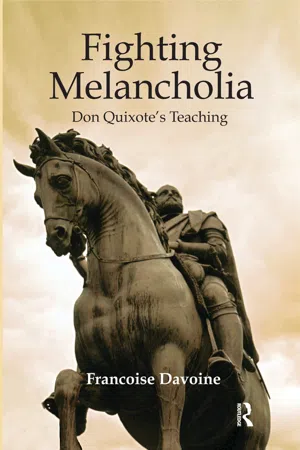
Francoise Davoine has been investigating psychotic phenomena and trauma for over thirty years, in collaboration with Jean-Max Gaudilliere. In this book, she draws on her literary background to take the reader on a fascinating voyage with an unexpected but most helpful guide: Don Quixote. In her work, Davoine approaches madness not as a symptom, but rather as a place, the place where the symbolic order and the social link have ruptured. She sees the psychotic as a seeker, engaged in a form of exploration into the nature and history of this place. This brings us to the seeker Don Quixote. Davoine takes the reader into the world of the knight-errant, to describe his adventures in a fascinating new light.Cervantes, the survivor of war trauma, captivity, and all manner of misfortunes, created this hero, first and foremost, so that the tale be told.
Information
CHAPTER ONE
Andante!
The psychoanalysis of knights-errant ...
This is what gave rise to the idea of a reading of Don Quixote in this seminar—Don Quixote and his wandering knights who might come to the rescue of our duenna. For today old Dame Psychoanalysis seems unable to defend herself from the invasion of her domain by her rival, the brain. In truth, the brain lends itself without hesitation to the standard protocols: biochemical, electric, even psychological with videotaping, one-way mirrors or two-way mirrors for that matter. Moreover, its value keeps increasing on the world’s stock markets, despite recession, while when all is said and done, the psyche only yields peanuts.
Indeed, when wounded psyches possessing these profitable neuronal networks come knocking on our door, they are a sorry sight to see. Bleary-eyed, their faces empty as if all their energy had been sucked out of them by a vacuum pump, their discourse, like a broken record, endlessly repeats that their fate is sealed. Above all, they do not believe in psychoanalysis. They insist that their future is completely predictable. When things are going too well, they will get worse, you can count on it. Besides, they have been told that their disease appears to be genetic—what isn’t, these days? Nothing can persuade them otherwise. The disease was passed down by their parents and is transmissible to their descendants forever and ever, Amen; their family and friends sing the same refrain. But, thankfully, their mood is stabilised by the latest discovery of the ancient humoral theory, be it drops, pills or electroshock.
These psyches come to talk to us, but insist that they have nothing to say. They demand answers, but they no longer hope for anything. And yet, they succeed in carrying out impossible missions in which they fight windmills, as evidenced by the following story.
One day, we had a call from someone who introduced himself as a psychiatrist, and said that he had heard of our seminar on Don Quixote. He added that he would like to send a knight-errant to us. I acquiesced, thinking all this was a joke. Soon afterwards, a young man made an appointment and, when he arrived, he introduced himself as “the Knight”. After four centuries of roaming the earth, and his adventures becoming an international best-seller, he wandered into my office, to my astonishment and secret delight. With the simplicity of someone returning from a fabulous journey, he recounted his adventures, how he dodged the CIA and the French DST (Directorate of Territorial Surveillance), and how he predicted the war in Iraq. But he was perplexed and wondered why he had come to see me. I told him about our seminar and about his doctor’s call concerning Don Quixote, adding that I was willing to be his Sancho Panza.
I had to explain to him in detail how Don Quixote’s madness delves into the traumatic revivals of his creator, Cervantes, who in 1571, at the age of twenty-four, enrolled as a soldier for five years in the war against the Turks, and spent the next five years as a slave in the prisons of Algiers. He did not return to Spain until ten years later, in 1580. Our psychoanalytic adventure, initiated in this fashion, produced results. Without going into details, suffice it to say that I was led to ask myself, as was he, if forward psychoanalysis had not been discovered well before the First World War, by the old one-handed soldier of Lepanto, who wrote Don Quixote as a manual for psychic survival.
This is what gave me the idea of writing this book in the form of a psycho-dynamic talking cure between Don Quixote and Sancho Panza, using their exchanges after each episode of traumatic revival, since these are the episodes which reactivate in subsequent generations the kinds of physical and emotional wounds Cervantes had suffered as an elite soldier and later a captive. This also gave me the opportunity to show how Don Quixote then became the psychoanalyst of a madman identified as such, in turbulent sessions that served as lessons for my work.
... and wandering souls
But was I not committing sacrilege? At the end of the Second Part of the book (De Cervantes, 2001), published one year before Cervantes’ death at the age of sixty-nine, in 1616, an explicit prohibition is formulated. Having given his son, at long last, a splendid death, like that of Socrates, Don Quixote’s father hung up his quill—which, he says, is also his lance—, forbidding anyone from taking it up again. He had had enough of literary hostage-takers, like Avellaneda, a native of Tordesillas, who vandalised the first Don Quixote by writing a spurious and stupid sequel (Canavaggio, 1991, p. 280). This is why he had his hero die, to prevent plagiarists from profiting by the hero’s marketing throughout Europe and even America.
In Chapter VI of the novel, the books in the knight’s library are thrown into the flames. When Don Quixote wakes up and looks for his books (De Cervantes, 2013, p. 41), his caregivers comfort him with platitudes, telling him not to fret, and that the whole episode was only a dream, as Helen of Troy sings on the eve of the Trojan War, in Offenbach’s operetta composed shortly before the 1870 Franco-Prussian War (Offenback, 1864).
Sometimes, through the years when Jean-Max Gaudillière and I conducted our seminar, I had the impression that the Ecole des hautes études en sciences sociales was haunted by what Aby Warburg called “surviving images” (Warburg, 1923, pp. 277–292). Warburg, who was mad about books as well, and an expert on Renaissance art history, became delusional in Hamburg in 1914, declaring himself to be general-in-chief of the army. Hospitalised in the early 1920s in Switzerland, at the Binswanger Clinic, he kept shouting that the Jews would all be exterminated. At last, he was “cured” of his madness, just as the knight had been, a few years before his death in 1929.
Warburg’s gigantic library was comprised of books that his brothers kept providing throughout his life, in exchange for his birthright, that he conceded to them at the age of thirteen, for the bank owned by the family. This childish pact was concluded between the Warburg siblings in 1880, the year when the first Anti-Semitic League was founded by Wilhelm Marr in Hamburg. Aby Warburg’s library was secretly relocated in London in 1933 to escape destruction by the Nazis (Chernow, 1994, p. 25). Since then, it has been enormously augmented. Known as the Warburg Institute, it now operates as a research centre. But all this makes me ask myself if Aby’s surviving images (nachleben) might not be the errant forms of books and people long-vanished, imbued with energy, persisting in their effort to escape annihilation.
From Lepanto to Algiers
I learned everything that follows by consulting Jean Canvaggio’s biography of Cervantes (Canavaggio, 1991) and his translation with commentary of Don Quixote—subsequent to Jean Cassou’s translation into French. Born in 1547, Cervantes spent ten years outside Spain, between 1570 and 1580. In 1571, at the naval battle of Lepanto, he was hit with three harquebus shots in the chest, and lost the use of his left hand. He served another four years as an elite soldier (soldado avantajado) on Spanish galleys off Sicily, with his brother Rodrigo.
In 1575, when they were finally returning to Spain, in sight of the Catalan coast, they were kidnapped by Turkish pirates near Cadaques, put in chains and carried as slaves to Algiers, to one of the infamous bagnios of the Ottoman Empire. Miguel was twenty-eight. He would spend five years in Algiers, shackled for several months as a result of four attempted escapes, threatened with beatings and impalement— a fate that befell many of his companions. He was ransomed in extremis, on the eve of his transfer to Constantinople, where all trace of him would have been lost.
All this is recounted in a book published in 1612, around the same time as Don Quixote, by an author using the pseudonym Fray Diego de Haedo, whose work is entitled Topographie et histoire générale d’Alger (De Haedo, 1998). In fact, this book had been written twenty years earlier by one of Cervantes’ fellow captives, Doctor Antonio de Sosa. (Garcés, 2002, pp. 67–77). He wrote about his friend: “The life and exploits of Miguel de Cervantes would deserve a particular narrative.”
The book describes four attempted escapes, all of which failed, year after year, bringing the threat of death decreed by the Dey of Algiers, Hassan Pacha, a Venetian converted to Islam who eagerly tortured his former co-religionists and condemned to death all those who tried to escape with Cervantes. As for any questions that might arise in connection with Cervantes’ survival, the testimony of his fellow captives is unanimous. During the mandatory investigations following the return of prisoners to Spain, they all declared that Cervantes always took responsibility for the escapes and never collaborated (De Cervantes, 2001, p. xvii).
But trauma always strikes twice.
In 1597, seventeen years after his return to Spain, Cervantes finds himself imprisoned again, in Seville, where he conceived Don Quixote. The second trauma is provoked, in classic fashion, by betrayal of his own people. This time, the trauma prompts him to write again. He had, in fact, stopped writing after the publication of his pastoral romance Galate and a collection of plays (including Naval Battle and Algerian Customs). Thus, writing became vital for him immediately after returning to Spain. In his endeavour to extricate himself a second time from the sphere of trauma, Don Quixote contributed new elements still lacking in the cathartic process initiated earlier but interrupted in 1587, around the time when his father, the apothecary-surgeon named Rodrigo (like Miguel’s younger brother), died.
When he returned from war and captivity, Cervantes was, in fact, a thirty-three-year-old war veteran. Like many veterans, he was no doubt looking for a way to talk about his hellish experiences, and for a possible audience. He was poor, maimed, his parents had become destitute after paying the ransom needed to free their two sons; Rodrigo was freed first, after two years, for a smaller ransom. At the age of thirty-six, Miguel married Catalina, but acquired, at the same time, her parent’s debts.
He thought he might try to change his fortune by immigrating to the West Indies in 1590. He could imagine holding a post as paymaster of the Territory of New Granada, governor of Soconusco in Guatemala, auditor to the galleys in Cartagena, or chief magistrate in the city of La Paz (De Cervantes, 1949, p. xxi). All his petitions were rebuffed by the royal administration.
For over ten years, Cervantes worked as a commissary agent of provisions and travelled through the Spanish countryside requisitioning supplies and collecting taxes destined for Spain’s military ventures, such as the impending disaster involving the Invincible Armada in 1588. His functions caused him to be imprisoned again in 1592 in Castro del Rio, where his requisitions had angered some monks. In 1597, the cause of his imprisonment was of a different nature. He was betrayed by the Sevillian banker to whom he had entrusted the sums he collected, to be paid to the treasury in Madrid; the financier became bankrupt and Cervantes was denounced and incarcerated.
Second trauma
At the age of fifty, twenty years after his return from Algiers, Cervantes relives once more the uncanny situation of a soldier coming home from the front as a stranger in his own country. Ousted from the world of the living, which he had been on the verge of leaving more than once, he can no longer find his bearings in civilian life. Since he first left at the age of twenty-three, society has completely changed, and so has he.
Jonathan Shay remarks in his discussion of contemporary wars (Shay, 1995), that when your own people betray you, a real deconstruction takes place, an “undoing of character”. Most of Cervantes’ friends had built successful lives, they no longer had time for him. Something about him repulsed them, his stories upset everyone. He had aged prematurely and was haunted by the ghosts of his comrades’ unlived lives, interrupted in full swing. In addition, as his biographer confirms, Cervantes, like many veterans, was “innocent in his honesty” when it came to business (Canavaggio, 1991, p. 158).
Perhaps, like Don Quixote, he rushed into zones of chaos familiar to him, to restore justice after having been wronged, and to attack the scoundrels that everyone else tolerated. His battles and attempted escapes had long since sharpened his senses and taught him to focus on the essential. In Spain, a country he no longer recognises, he analyses the signs predicting a “paralysis that was to immobilise [the country] in torpor for several centuries” (Vilar, 1971, pp. 3–16).
Now, he found himself thrown in jail by his own countrymen, in a place “where every misery is lodged and every doleful sound makes its dwelling”. It was there that he conceived “a dry, shriveled, whimsical offspring, full of thoughts of all sorts and such as never came into any other imagination” (De Cervantes, 2013, p. 3). Cervantes even admits paternity, only to disavow it later, preferring to declare himself the hero’s stepfather.
Cervantes’ apologetic confession awakens my reminiscences. “You are not my daughter”, my mother would say when she found me too tough. By coincidence, I also spent my first months as an embryo in prison, between October 1942 and February 1943. My mother was arrested when she was caught crossing the demarcation line. The guide was killed and my mother was imprisoned at Chalon-sur-Saône and later at Autun, where “every misery [was] lodged”, since the cell was crammed with women, hostages like us, expecting to be shot at dawn every morning, and where “every doleful sound [made] its dwelling”, because the torture chamber was next door.
For Cervantes, trauma struck again in 1600, five years before the publication of Don Quixote. His younger brother Rodrigo, whom he had joined in Italy when he had been only twenty-three, his companion in combat and slavery, was killed in the first Battle of the Dunes in Flanders, in which the Duke Maurice de Nassau inflicted a severe defeat upon the Spanish troops in 1600.
Thus, Don Quixote, an old child “approaching fifty” came onto the world scene on the occasion of his bereaved creator’s fifty-seventh birthday, in 1605, carrying the traumas of his lineage.
The black moleskin notebooks
White-haired children, those we call patients, regularly bring me texts written in pencil in black moleskin notebooks, found at the bottom of drawers or in attics, like those written today by soldiers in Iraq or Afghanistan (Carroll, 2006). A small number of these texts were published after the war.
This is how I came to read the notes of a young physician taken prisoner and assigned to the sewers of Cologne (Garin, 1946) to pick up the debris after Allied bombardments: he was looking after fugitives from death camps at the risk of his own life. And then there is the letter—carefully rewritten in clear handwriting for his grandchildren— from a British soldier in the First World War to his fiancée: the hours spent playing dead in the no man’s land, under enemy fire, drawn out endlessly, unforgettably, while he crawled at snail’s pace towards his own front lines. We also have the testimony of a young Navy pilot who steered ships to Dunkirk amid floating mines dropped by German planes (Dubard, 1945). There are also the war diaries of an Air France pilot who became a fighter pilot in the RAF, with the future writer Jules Roy as a bombardier. And the recollections of two grandfathers who lost their legs in Verdun, and so on.
As I read these illegible scrawls, I ask myself what to do with the phantom limbs that hop around in my office. And what should I make of the former prisoners who were sent back to prison in peacetime, like the sixty-five-year-old soldier who, in 1979, was imprisoned and then found innocent, not understanding what was happening to him any better than Cervantes did in Seville. Questioned by the examining magistrate, the veteran reminded him of his service record in the last war, the shame of defeat, the prison camps, the deportation of his brother Emile, the fact that his father had been gassed in Péronne, that his father-in-law was a stretcher bearer in World War I, that he himself had organised provisioning for the Tarentaise underground in order to stop the retaliations between the Resistance fighters and the mountaineers. The answer of the young, inflexible judge, son of the Nazi collaborator employed as porter at the hotel where the Nazis were housed during the war was: “Nobody forced you to do it.”
Table of contents
- Cover
- Half Title
- Title
- Copyright
- Dedication
- Contents
- ABOUT THE AUTHOR
- WARNING TO THE READER
- CHAPTER ONE Andante!
- CHAPTER TWO Cervantes, an old warrior
- CHAPTER THREE PTSD: post-traumatic son Don Quixote (the post-traumatic son of Cervantes)
- CHAPTER FOUR First sally, first sessions
- CHAPTER FIVE Second sally towards the psychotherapy of trauma
- CHAPTER SIX Widening of the field of war and beyond
- CHAPTER SEVEN Don Quixote becomes a psychoanalyst in the Sierra Morena
- CHAPTER EIGHT Regenerating the social link
- CHAPTER NINE A sombre affair
- CHAPTER TEN History makes its entrance
- CHAPTER ELEVEN Farewell to arms
- CHAPTER TWELVE "Bella ciao! ciao! ciao!"
- REFERENCES
- INDEX
Trusted by 375,005 students
Access to over 1.5 million titles for a fair monthly price.
Study more efficiently using our study tools.
Frequently asked questions
Yes, you can cancel anytime from the Subscription tab in your account settings on the Perlego website. Your subscription will stay active until the end of your current billing period. Learn how to cancel your subscription
No, books cannot be downloaded as external files, such as PDFs, for use outside of Perlego. However, you can download books within the Perlego app for offline reading on mobile or tablet. Learn how to download books offline
Perlego offers two plans: Essential and Complete
- Essential is ideal for learners and professionals who enjoy exploring a wide range of subjects. Access the Essential Library with 800,000+ trusted titles and best-sellers across business, personal growth, and the humanities. Includes unlimited reading time and Standard Read Aloud voice.
- Complete: Perfect for advanced learners and researchers needing full, unrestricted access. Unlock 1.5M+ books across hundreds of subjects, including academic and specialized titles. The Complete Plan also includes advanced features like Premium Read Aloud and Research Assistant.
We are an online textbook subscription service, where you can get access to an entire online library for less than the price of a single book per month. With over 1.5 million books across 990+ topics, we’ve got you covered! Learn about our mission
Look out for the read-aloud symbol on your next book to see if you can listen to it. The read-aloud tool reads text aloud for you, highlighting the text as it is being read. You can pause it, speed it up and slow it down. Learn more about Read Aloud
Yes! You can use the Perlego app on both iOS and Android devices to read anytime, anywhere — even offline. Perfect for commutes or when you’re on the go.
Please note we cannot support devices running on iOS 13 and Android 7 or earlier. Learn more about using the app
Please note we cannot support devices running on iOS 13 and Android 7 or earlier. Learn more about using the app
Yes, you can access Fighting Melancholia by Francoise Davoine, Agnes Jacob in PDF and/or ePUB format, as well as other popular books in Psychology & History & Theory in Psychology. We have over 1.5 million books available in our catalogue for you to explore.