- 300 pages
- English
- ePUB (mobile friendly)
- Available on iOS & Android
eBook - ePub
About this book
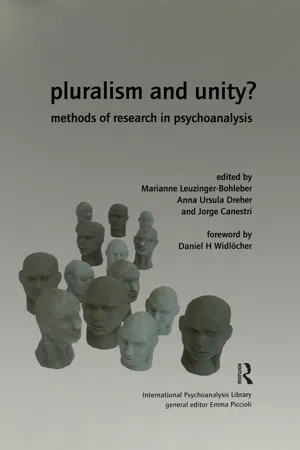
This book compiles the papers presented at an International Conference, "Pluralism of Sciences: The Psychoanalytic Method between Clinical, Conceptual and Empirical Research" in 2002. It provides the variety and diversity of psychoanalytic research cultures in different psychoanalytic societies.
Information
1
Pluralism and unity in psychoanalytic research: some introductory remarks
Psychoanalytic research in times of globalization: uniformism versus multitude?
At the beginning of the twenty-first century, the world of sciences—including the world of psychoanalysis and all kinds of psychotherapy research—is determined by a global network. As a consequence, new possibilities are created, which is as true for psychoanalytic research as for other fields. In science an easy exchange of knowledge, research methods, and results has, of course, many advantages: a Korean analyst is able to discuss her research project with the most able members of the International Psychoanalytical Association’s Research Committee—no matter whether they are located in London, Denver, or Santiago de Chile. However, it is a known fact that globalism has negative aspects as well: distinct local features, cultural multiplicity, and the charm of diverse traditions are endangered through having to adopt a uniformity—or they may even disappear.
A similar danger can also exist for an internationally linked psychoanalytic research community. An epistemologically outdated, uniform understanding of science in the sense of “Einheitswissenschaff [unity of science] presumes to become the dominating or even exclusive definition of “science”, simply because it claims to have apparently global and universally valid criteria of scientific quality. Such a uniform understanding of science destroys the richness and variety of attempts to research unconscious phantasies and conflicts, a research subject characterized by the fact that it is not observable directly, as well as by its complexity and its ambiguousness.
In contrast to a uniform view of science, in this volume the editors would like to make visible some of the variety and diversity of psychoanalytic research cultures in different psychoanalytic societies and their shared commonalities. It is our hope that the diverse approaches to the search for insight become apparent in this collection. The great respect and curiosity for the Other, for locally grown perspectives, could even guarantee a creative and innovative development in worldwide psychoanalytic research, as we would like to outline in this introduction.
We found a fascinating promotion for diversities and contradictory views in the first part of the well-known, provocative book Empire: The New World Order (2000) co-authored by Michael Hardt, a scientist in literary studies, and the political scientist Antonio Negri. In the book, which was recently released in German, the authors ask themselves which movements lead to new developments in times of globalization—that is, developments that are based on the local, diverse, and plural but where nevertheless a global perspective always emerges. Their thesis is that intellectuals in different countries will form a kind of intuitive, not strategically planned resistance. This occurs as soon as mighty, destructive globalized tendencies and strategies (on the part of any kind of “empire”) start to dominate and threaten local traditions and value systems. Hardt and Negri use the term “multitude” for such innovative and creative movements and describe it as “the various amounts of productive and creative individuals in globalisation, which has learnt to sail this huge ocean. Always moving, they form the constellations of singularities and events; they continuously and globally force the system to reconfigure …” (Hardt & Negri, 2000, p. 71).
It seems to us that this thesis also has relevance to current psychoanalytic research. Productive globalized discourses on research in psychoanalysis probably also rely on the critique of the multitude. This means that intellectually and psychoanalytically active members of the different psychoanalytic societies criticize the uniforming of science and globalizing movements in order to “continuously and globally force” international research institutions “to reconfigure” in the wake of contradictions that manifest themselves locally, in the diverse psychoanalytic cultures. These protests and critical reflections—in the sense of a “multitude”—are not planned or coordinated. Nevertheless, they can form a common force—for example, by remembering the specific quality of psychoanalysis as a science of the unconscious, which cannot be studied through seemingly globally “true, effective, and objective” research strategies that have been postulated worldwide.
Let us briefly remember why the myths of science, of “objectively measuring” psychoanalytic processes and therapy outcomes, seem to dominate a certain international Zeitgeist: during the last two decades, the health-care systems of many countries have put pressure on psychoanalysis as a way of treatment. Psychoanalysis should show in an “objective” way that the results of treatment are effective, efficient, and cost-effective. The psychoanalytic communities have tried to take up this challenge in many different ways: the IPA presidents Joseph Sandler, Robert Wallerstein, and Otto Kernberg made great efforts to strengthen research in psychoanalysis by creating the annual Research Conference in London, the Research Advisory Board, and the Research Committee chaired by Peter Fonagy. In 1985 Horst Káchele and Helmut Thomà organized a pre-conference on empirical research in Ulm, separately from the IPA conference in Hamburg. In contrast, such pre-conferences took place right before the main conference in Santiago de Chile in 1999 and in Nice in 2001.
The stronger direct contact, especially with quantitative-empirical research approaches in psychoanalysis, has enabled many members of the IPA to participate actively in a critical discussion on research in psychoanalysis. Representatives of most different, locally conceived traditions in research are in a position to express their standpoints. To name just one example: the connection between psychoanalytic research and philosophy, literature, and art is a great deal more important to French and German colleagues than empirical-psychoanalytic research based in psychiatry and academic psychology (see the contributions of André Green and Roger Perron in this volume). Some believe that trying to prove the results of psychoanalytic treatment in an empiricist-objective way is a gesture of exaggerated adjustment to the above-mentioned Zeitgeist, which uses the “myth of science” to disregard feelings of impotence and helplessness while one is confronted with the complex and often hidden determinants of psychic suffering in human beings. Instead, these colleagues plead for an intensive reflection of this Zeitgeist, applying the Freudian tradition of cultural criticism [“Freud sche Kulturkntik”] in order to try to understand the unconscious roots of idealized terms of science like “objectivity” and “efficiency”.
These manifold discussions on psychoanalytic research may have been one of the reasons why the current president of the IPA, Daniel Widlocher, wanted to underline the breadth of possible research areas in psychoanalysis by creating a second Research Subcommittee for Conceptual, Clinical, Epistemological and Historical Research. Within this body, the plurality and variety of psychoanalytic research is to be considered, and contradictions and controversies, freed from the hidden resistance against quantitative-empirical research, are to be brought to the surface. Of course, with the existence of two different subcommittees, some danger of reciprocal projections could arise and support polarizations that are in reality non-existent. We, however, hypothesize that the multitude of different research traditions could push ahead the psychoanalytic research fleet on this globalized ocean and clamour for a change of direction wherever necessary and wherever rationally justified.
Such unavoidable corrections of mainstream positions and political decisions within the IPA research culture may be based on scientific discourses, including the critical reflections of different research traditions and diverse epistemological backgrounds. Therefore we would like to sketch some of these discourses and reflections in the early parts of our introductory remarks, illustrating some of the roots of the current pluralism of science. We then try to contribute to a more precise definition of clinical, conceptual, and empirical research in psychoanalysis while at the same time introducing the different contributions of this volume. The chapter concludes with a brief report we have added on the International Conference held in Frankfurt in September 2002—“Pluralism of Sciences and the Psychoanalytic Method between Clinical, Conceptual and Empirical Research”—which was organized by the new Research Subcommittee and at which the papers that make up this book were originally presented.
Clinical psychoanalytic research and “Freud-bashing”
According to Freud and many contemporary psychoanalysts, clinical experience and research cannot be separated. Insight is followed by the curing of the patient and simultaneously supports research. However, in the age of worldwide “Freud-bashing” (see, e.g., Lear, 1995), there is more and more criticism of this “Junktim of research and curing (Freud, 1926e). With this criticism, the understanding of science as described above is once again radically questioned: it is claimed that this psychoanalytic understanding of science does not correspond to “science” (as, for example, applied in experimental, controlled studies). These claims are often based on a naive but powerful idealization of natural science, whose triumph over the human and social sciences is celebrated. What epistemological arguments and points as regards content can be put forward to counter these attacks against psychoanalysis, which stem from the current natural-scientific positivist research paradigm? How can it be justified that even if not every clinician is devoted to research, clinical-psychoanalytic everyday experience is still the indispensable “field-research” for psychoanalysis? Are genuinely psychoanalytic or extra-clinical “objective” criteria decisive for clarifying whether insights are limited to a specific clinical situation, to a single case, or whether they contribute generally in the “scientific” sense to a knowledge that is “universally valid”? Are there differences between “healing” insights in the psychoanalytic situation and “research”—and if so, what differences?
These questions lead us right to the centre of the epistemological, methodological, and clinical discourse of today’s psychoanalysis. Therefore, only some of the above-mentioned aspects are discussed in this introduction in order to contribute to a current discussion that already fills entire libraries.
The understanding of psychoanalytic research and its criteria is influenced not only by scientific theory, but also by specific cultural phenomena: consider, for instance, the corresponding discourses in the Anglo-Saxon compared with the European continental (e.g. French and German) culture (see, e.g., Werner Bohleber’s contribution in this volume). When it comes to ourselves, we are most familiar with research traditions in Switzerland and Germany. The following thoughts are based mainly on these traditions. We take them as a contribution to the current effort, concerned with intensifying the dialogue between psychoanalysts and researchers who belong to these different research cultures.
Some remarks on the history of science: “unified science” and the “pluralism of sciences”
Since resources in the German health sector have become tighter, the “scientific nature”, “efficiency”, and “effectiveness” of psychoanalytic treatment have once again come into doubt. In the wake of these debates it is claimed time and again that psychoanalysts need to subject their work to so-called controlled studies, apparently forgetful of the fact that discussion concerning these studies has gone on for decades (cf., inter alia, Káchele, 1992).
Political motives apart, a historically outdated “model of unified science” [“einheitswissenschaflliches Modell”] is declared the yardstick for quality and forms the basis for these claims. According to this standard, for example, the natural scientific ideal of the controlled, “prospective-empirical” double-blind trials (Randomized Controlled Trials: RCTs) is considered the most important scientific hallmark. Hardly anyone remembers, however, the fact that RCTs were originally used in pharmacology in order to test “blindly” the effect of a new medication in comparison to a control group, who were given placebos, and that this research strategy cannot simply be taken out of its context and transferred to other disciplines. It certainly cannot be denied that research based on this paradigm boasts striking successes in medicine, and an idealization of the scientific paradigm of pharmaceutical medicine seems therefore understandable. However, it is impossible to equate the success of a psychotherapy with the success of a medication. Evaluation of the first is far more complex: each patient’s and his or her therapist’s idiosyncrasies have to be taken into account; moreover, the large variety of therapeutic dyads cannot be ignored. On the other hand, psychoanalysis cannot escape from proving its efficiency. It is impossible to avoid this responsibility by pointing to the speciality of the science if we want to stick to our demands that psychoanalysis remain a cure financed by public means. Above all, it would be problematic for us psychoanalysts to retreat to a psychoanalytic ivory tower, as this might mean that eventually our science’s creative and innovative potential could run out. We know from chaos theory that each shielding of a system means that its liveliness and creativity dries out. Thus, according to our experience as clinicians and researchers, we have to come to terms with a characteristic area of conflict: on the one hand, there is the danger of over-adjustment to an understanding of research that is inadequate for psychoanalysts; on the other hand, there are the perils of refusing a scientific discourse by a self-absorbed retreat to an exclusive discussion within our psychoanalytic ivory tower. This is an area of conflict that we have to be able to bear and to reflect on critically if we are to prevent the future of our discipline being seriously threatened. If psychoanalysis sacrifices its autonomy as scientific discipline and clinical-therapeutic method, it will lose its “thorn Freud” and, as Freud (1926e) feared, become just another partial discipline in medicine. He writes in The Question of Lay Analysis:
Yes indeed. I wanted to bring up a third interest—the interest of science. What I have to say about that will concern you little; but, by comparison, it is of all the more importance to me.
For we do not consider it at all desirable for psycho-analysis to be swallowed up by medicine and to find its last resting-place in a text-book of psychiatry under the heading “Methods of Treatment”, alongside of procedures such as hypnotic suggestion, autosuggestion, and persuasion, which, born from our ignorance, have to thank the laziness and cowardice of mankind for their short-lived effects. It deserves a better fate and, it may be hoped, will meet with one. As a “depth-psychology”, a theory of the mental unconscious, it can become indispensable to all the sciences which are concerned with the evolution of human civilization and its major institutions such as art, religion and the social order. It has already, in my opinion, afforded these sciences considerable help in solving their problems. But these are only small contributions compared with what might be achieved if historians of civilization, psychologists of religion, philologists and so on would agree themselves to handle the new instrument of research which is at their service. The use of analysis for the treatment of the neuroses is only one of its applications; the future will perhaps show that it is not the most important one. In any case it would be wrong to sacrifice all the other applications to this single one, just because it touches on the circle of medical interests [Freud, 1926e, p. 248]
However, if psychoanalysis refrains from the critical dialogue with other sciences and the public, it will not only sacrifice its potential as far as critique of culture is concerned but also its innovative, creative new findings and developments in its own discipline.
As far as philosophy of science is concerned, we suppose that there are some parallels to dealing with this area of conflict, in the above-mentioned paradigm of unified science. “Scientific objectivity” and “unambiguous truths” are idealized, whereas epistemological differences between the various scientific disciplines are denied. [The idea of the “megalomania of being able to achieve and control everything” included in this concept is a related subject, with which Devereux (1967) dealt intelligently in the area of research; a more recent brilliant analysis of the same issue was published by Holzhey (2001).] We want to address this point briefly. (See also Michael Hampe’s contribution in this volume.)
Hampe and Lotter recently (2000) demonstrated the historical roots of this paradigm. Bacon and Descartes were the first to compare “naturalistic experience” with scientific knowledge. Thus, they stood out against scholastic science, in which, rather than new knowledge being generated, it was well-known experience that was to be discussed and reasoned. Bacon and Descartes explained—in contrast to the latter assumption—that the discovery of until then unknown fields of reality was the real aim of the new sciences in the seventeenth century. According to their findings, new discoveries can only be made by means of a methodical and controlled experience, whereas everyday experience rather dulls people’s minds instead of brightening them. Interestingly, this important role of methodologically controlled experience was increasingly forgotten in the nineteenth century, and it was not until much later that it turned up again in an idealized form—in combination with the way scientific experiments are conducted nowadays. The physics experiment, which examines quantitative dependencies between exactly defined entities in artificially generated systems (cf. controlled double-blind trials), became the paradigm of scientific experience for a long time.
In the opinion of Bacon, Bachelard, and Popper, scientific experience is opposed to everyday life. According to them, “empirically based” means the “result of a certain measurement” that is not based on everyday experience but—if it is scientifically interesting—produces new knowledge that does not correspond to the usual way of thinking—that is, everyday experience—and is independent of the respective researcher conducting the experiment. Karl Popper describes science as a generator of hypotheses that are all the better the more improbable they seem to be in the light of everyday experience (and predominating scientific assumptions). Scientific experience should approach truth in a completely negative way by “falsifying” hypotheses.
This contrast between scientific and personal experience proved to be crucial: everyday and life experience can never be simply repeated, and they are neither independent of the situation, nor can they be separated from practical issues, as is the case with experiments. Moreover, we learn “by experience”—that is, we attribute to experience importance, its own activity and creativity—in contrast to the empiricists, who consider a researcher’s subjective ...
Table of contents
- Cover
- Half Title
- Title
- Copyright
- CONTENTS
- THE INTERNATIONAL PSYCHOANALYSIS LIBRARY
- ACKNOWLEDGEMENTS
- EDITORS AND CONTRIBUTORS
- FOREWORD
- 1 Pluralism and unity in psychoanalytic research: some introductory remarks
- 2 The pluralism of sciences and psychoanalytic thinking
- 3 Plurality of sciences and the unity of reason
- 4 Between hermeneutics and natural science: some focal points in the development of psychoanalytic clinical theory in Germany after 1945
- 5 Freud and psychoanalytic research: a brief historical overview
- 6 What are we looking for? How?
- 7 What does conceptual research have to offer?
- 8 What kind of evidence makes the analyst change his or her theoretical and technical ideas?
- 9 The logic of psychoanalytic research
- 10 Attachment theory and long-term psychoanalytic outcome: are insecure attachment narratives less accurate?
- 11 Psychotherapy with a victim of extreme violence: clinical case report and qualitative analysis
- 12 Preliminaries for an integration of psychoanalysis and neuroscience
- 13 Two pathways towards knowing psychoanalytic process
- 14 Psychoanalysis and science: some remarks on demarcation and legitimation
- APPENDIX Summary of additional studies presented at the Pluralism of Sciences Conference
- REFERENCES AND BIBLIOGRAPHY
- INDEX
Trusted by 375,005 students
Access to over 1.5 million titles for a fair monthly price.
Study more efficiently using our study tools.
Frequently asked questions
Yes, you can cancel anytime from the Subscription tab in your account settings on the Perlego website. Your subscription will stay active until the end of your current billing period. Learn how to cancel your subscription
No, books cannot be downloaded as external files, such as PDFs, for use outside of Perlego. However, you can download books within the Perlego app for offline reading on mobile or tablet. Learn how to download books offline
Perlego offers two plans: Essential and Complete
- Essential is ideal for learners and professionals who enjoy exploring a wide range of subjects. Access the Essential Library with 800,000+ trusted titles and best-sellers across business, personal growth, and the humanities. Includes unlimited reading time and Standard Read Aloud voice.
- Complete: Perfect for advanced learners and researchers needing full, unrestricted access. Unlock 1.5M+ books across hundreds of subjects, including academic and specialized titles. The Complete Plan also includes advanced features like Premium Read Aloud and Research Assistant.
We are an online textbook subscription service, where you can get access to an entire online library for less than the price of a single book per month. With over 1.5 million books across 990+ topics, we’ve got you covered! Learn about our mission
Look out for the read-aloud symbol on your next book to see if you can listen to it. The read-aloud tool reads text aloud for you, highlighting the text as it is being read. You can pause it, speed it up and slow it down. Learn more about Read Aloud
Yes! You can use the Perlego app on both iOS and Android devices to read anytime, anywhere — even offline. Perfect for commutes or when you’re on the go.
Please note we cannot support devices running on iOS 13 and Android 7 or earlier. Learn more about using the app
Please note we cannot support devices running on iOS 13 and Android 7 or earlier. Learn more about using the app
Yes, you can access Pluralism and Unity? by Jorge Canestri in PDF and/or ePUB format, as well as other popular books in Psychology & History & Theory in Psychology. We have over 1.5 million books available in our catalogue for you to explore.