eBook - ePub
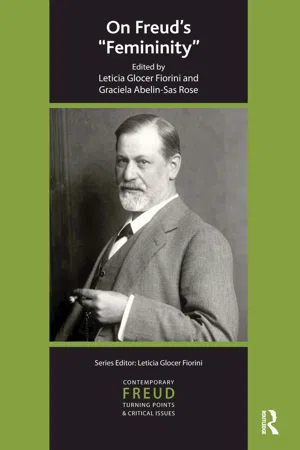
On Freud's Femininity
- 272 pages
- English
- ePUB (mobile friendly)
- Available on iOS & Android
eBook - ePub
On Freud's Femininity
About this book
In this book a group of contemporary psychoanalytic authors dedicated to studies on women and the feminine have been assembled with the objective of displaying points of concordance and discordance in relation to Freudian proposals. Discourse on women has changed greatly since Freud's time. It coincides with deep changes experienced by women and the feminine position, at least in most of the Western world. It is common knowledge that contraceptives, assisted fertilization, advances in women's rights, growingly evident sublimational capacities and demonstrations of professional success have definitely changed ideas regarding an eternal and immutable feminine nature. The authors are interested in illuminating ways in which these changes have or have not influenced psychoanalytic debate in relation to the feminine. This implies renewing the question of what is authentically feminine and whether there is any essential truth concerning the feminine.
Information
PART I
Lecture XXXIII: “Femininity” (1933)
Sigmund Freud
Lecture XXXIII
Femininity1
LADIES AND GENTLEMEN,—All the while I am preparing to talk to you I am struggling with an internal difficulty. I feel uncertain, so to speak, of the extent of my licence. It is true that in the course of fifteen years of work psycho-analysis has changed and grown richer; but, in spite of that, an introduction to psycho-analysis might have been left without alteration or supplement. It is constantly in my mind that these lectures are without a raison d'être. For analysts I am saying too little and nothing at all that is new; but for you I am saying too much and saying things which you are not equipped to understand and which are not in your province. I have looked around for excuses and I have tried to justify each separate lecture on different grounds. The first one, on the theory of dreams, was supposed to put you back again at one blow into the analytic atmosphere and to show you how durable our views have turned out to be. I was led on to the second one, which followed the paths from dreams to what is called occultism, by the opportunity of speaking my mind without constraint on a department of work in which prejudiced expectations are fighting to-day against passionate resistances, and I could hope that your judgement, educated to tolerance on the example of psycho-analysis, would not refuse to accompany me on the excursion. The third lecture, on the dissection of the personality, certainly made the hardest demands upon you with its unfamiliar subject-matter; but it was impossible for me to keep this first beginning of an ego-psychology back from you, and if we had possessed it fifteen years ago I should have had to mention it to you then. My last lecture, finally, which you were probably able to follow only by great exertions, brought forward necessary corrections—fresh attempts at solving the most important conundrums; and my introduction would have been leading you astray if I had been silent about them. As you see, when one starts making excuses it turns out in the end that it was all inevitable, all the work of destiny. I submit to it, and I beg you to do the same.
To-day's lecture, too, should have no place in an introduction; but it may serve to give you an example of a detailed piece of analytic work, and I can say two things to recommend it. It brings forward nothing but observed facts, almost without any speculative additions, and it deals with a subject which has a claim on your interest second almost to no other. Throughout history people have knocked their heads against the riddle of the nature of femininity—
Häupter in Hieroglyphenmützen,
Häupter in Turban und schwarzem Barett,
Perückenhäupter und tausend andre
Arme, schwitzende Menschenhäupter. . .1
Häupter in Turban und schwarzem Barett,
Perückenhäupter und tausend andre
Arme, schwitzende Menschenhäupter. . .1
Nor will you have escaped worrying over this problem—those of you who are men; to those of you who are women this will not apply—you are yourselves the problem. When you meet a human being, the first distinction you make is 'male or female?' and you are accustomed to make the distinction with unhesitating certainty. Anatomical science shares your certainty at one point and not much further. The male sexual product, the spermatozoon, and its vehicle are male; the ovum and the organism that harbours it are female. In both sexes organs have been formed which serve exclusively for the sexual functions; they were probably developed from the same [innate] disposition into two different forms. Besides this, in both sexes the other organs, the bodily shapes and tissues, show the influence of the individual's sex, but this is inconstant and its amount variable; these are what are known as the secondary
1 Heads in hieroglyphic bonnets,
Heads in turbans and black birettas,
Heads in wigs and thousand other
Wretched, sweating heads of humans. . . .
Heads in turbans and black birettas,
Heads in wigs and thousand other
Wretched, sweating heads of humans. . . .
(Heine, Nordsee [Second Cycle, VII, 'Fragen'].)
sexual characters. Science next tells you something that runs counter to your expectations and is probably calculated to confuse your feelings. It draws your attention to the fact that portions of the male sexual apparatus also appear in women's bodies, though in an atrophied state, and vice versa in the alternative case. It regards their occurrence as indications of bisexuality,1 as though an individual is not a man or a woman but always both—merely a certain amount more the one than the other. You will then be asked to make yourselves familiar with the idea that the proportion in which masculine and feminine are mixed in an individual is subject to quite considerable fluctuations. Since, however, apart from the very rarest cases, only one kind of sexual product—ova or semen—is nevertheless present in one person, you are bound to have doubts as to the decisive significance of those elements and must conclude that what constitutes masculinity or femininity is an unknown characteristic which anatomy cannot lay hold of.
Can psychology do so perhaps? We are accustomed to employ 'masculine' and 'feminine' as mental qualities as well, and have in the same way transferred the notion of bisexuality to mental life. Thus we speak of a person, whether male or female, as behaving in a masculine way in one connection and in a feminine way in another. But you will soon perceive that this is only giving way to anatomy or to convention. You cannot give the concepts of 'masculine' and 'feminine' any new connotation. The distinction is not a psychological one; when you say 'masculine', you usually mean 'active', and when you say 'feminine', you usually mean 'passive'. Now it is true that a relation of the kind exists. The male sex-cell is actively mobile and searches out the female one, and the latter, the ovum, is immobile and waits passively. This behaviour of the elementary sexual organisms is indeed a model for the conduct of sexual individuals during intercourse. The male pursues the female for the purpose of sexual union, seizes hold of her and penetrates into her. But by this you have precisely reduced the characteristic of masculinity to the factor of aggressiveness so far as psychology is concerned. You may well doubt whether you have gained any real advantage from this when you reflect that in some classes of animals the females are the stronger and more aggressive and the male is active only in the single act of sexual union. This is so, for instance, with the spiders. Even the functions of rearing and caring for the young, which strike us as feminine par excellence, arc not invariably attached to the female sex in animals. In quite high species we find that the sexes share the task of caring for the young between them or even that the male alone devotes himself to it. Even in the sphere of human sexual life you soon see how inadequate it is to make masculine behaviour coincide with activity and feminine with passivity. A mother is active in every sense towards her child; the act of lactation itself may equally be described as the mother suckling the baby or as her being sucked by it. The further you go from the narrow sexual sphere the more obvious will the 'error of superimposition'1 become. Women can display great activity in various directions, men are not able to live in company with their own kind unless they develop a large amount of passive adaptability. If you now tell me that these facts go to prove precisely that both men and women are bisexual in the psychological sense, I shall conclude that you have decided in your own minds to make 'active' coincide with 'masculine' and 'passive' with 'feminine'. But I advise you against it. It seems to me to serve no useful purpose and adds nothing to our knowledge.2
One might consider characterizing femininity psychologically as giving preference to passive aims. This is not, of course, the same thing as passivity; to achieve a passive aim may call for a large amount of activity. It is perhaps the case that in a woman, on the basis of her share in the sexual function, a preference for passive behaviour and passive aims is carried over into her life to a greater or lesser extent, in proportion to the limits, restricted or far-reaching, within which her sexual life thus serves as a model. But we must beware in this of underestimating the influence of social customs, which similarly force women into passive situations. All this is still far from being cleared up. There is one particularly constant relation between femininity and instinctual life which we do not want to overlook. The suppression of women's aggressiveness which is prescribed for them constitutionally and imposed on them socially favours the development of powerful masochistic impulses, which succeed, as we know, in binding erotically the destructive trends which have been diverted inwards. Thus masochism, as people say, is truly feminine. But if, as happens so often, you meet with masochism in men, what is left to you but to say that these men exhibit very plain feminine traits?
And now you are already prepared to hear that psychology too is unable to solve the riddle of femininity. The explanation must no doubt come from elsewhere, and cannot come till we have learnt how in general the differentiation of living organisms into two sexes came about. We know nothing about it, yet the existence of two sexes is a most striking characteristic of organic life which distinguishes it sharply from inanimate nature. However, we find enough to study in those human individuals who, through the possession of female genitals, are characterized as manifestly or predominantly feminine. In conformity with its peculiar nature, psycho-analysis does not try to describe what a woman is—that would be a task it could scarcely perform—but sets about enquiring how she comes into being, how a woman develops out of a child with a bisexual disposition. In recent times we have begun to learn a little about this, thanks to the circumstance that several of our excellent women colleagues in analysis have begun to work at the question. The discussion of this has gained special attractiveness from the distinction between the sexes. For the ladies, whenever some comparison seemed to turn out unfavourable to their sex, were able to utter a suspicion that we, the male analysts, had been unable to overcome certain deeply-rooted prejudices against what was feminine, and that this was being paid for in the partiality of our researches. We, on the other hand, standing on the ground of bisexuality, had no difficulty in avoiding impoliteness. We had only to say: 'This doesn't apply to you. You're the exception; on this point you're more masculine than feminine.'
We approach the investigation of the sexual development of women with two expectations. The first is that here once more the constitution will not adapt itself to its function without a struggle. The second is that the decisive turning-points will already have been prepared for or completed before puberty. Both expectations are promptly confirmed. Furthermore, a comparison with what happens with boys tells us that the development of a little girl into a normal woman is more difficult and more complicated, since it includes two extra tasks, to which there is nothing corresponding in the development of a man. Let us follow the parallel lines from their beginning. Undoubtedly the material is different to start with in boys and girls: it did not need psycho-analysis to establish that. The difference in the structure of the genitals is accompanied by other bodily differences which are too well known to call for mention. Differences emerge too in the instinctual disposition which give a glimpse of the later nature of women. A little girl is as a rule less aggressive, defiant and self-sufficient; she seems to have a greater need for being shown affection and on that account to be more dependent and pliant. It is probably only as a result of this pliancy that she can be taught more easily and quicker to control her excretions: urine and faeces are the first gifts that children make to those who look after them [see p. 100 above], and controlling them is the first concession to which the instinctual life of children can be induced. One gets an impression, too, that little girls are more intelligent and livelier than boys of the same age; they go out more to meet the external world and at the same time form stronger object-cathexes. I cannot say whether this lead in development has been confirmed by exact observations, but in any case there is no question that girls cannot be described as intellectually backward. These sexual differences are not, however, of great consequence: they can be outweighed by individual variations. For our immediate purposes they can be disregarded.
Both sexes seem to pass through the early phases of libidinal development in the same manner. It might have been expected that in girls there would already have been some lag in aggressiveness in the sadistic-anal phase, but such is not the case. Analysis of children's play has shown our women analysts that the aggressive impulses of little girls leave nothing to be desired in the way of abundance and violence. With their entry into the phallic phase the differences between the sexes are completely eclipsed by their agreements. We are now obliged to recognize that the little girl is a little man. In boys, as we know, this phase is marked by the fact that they have learnt how to derive pleasurable sensations from their small penis and connect its excited state with their ideas of sexual intercourse. Little girls do the same thing with their still smaller clitoris. It seems that with them all their rnasturbatory acts are carried out on this penis-equivalent, and that the truly feminine vagina is still undiscovered by both sexes. It is true that there are a few isolated reports of early vaginal sensations as well, but it could not be easy to distinguish these from sensations in the anus or vestibulum; in any case they cannot play a great part. We are entitled to keep to our view that in the phallic phase of girls the clitoris is the leading erotogenic zone. But it is not, of course, going to remain so. With the change to femininity the clitoris should wholly or in part hand over its sensitivity, and at the same time its importance, to the vagina. This would be one of the two tasks which a woman has to perform in the course of her development, whereas the more fortunate man has only to continue at the time of his sexual maturity the activity that he has previously carried out at the period of the early efflorescence of his sexuality.
We shall return to the part played by the clitoris; let us now turn to the second task with which a girl's development is burdened. A boy's mother is the first object of his love, and she remains so too during the formation of his Oedipus complex and, in essence, all through his life. For a girl too her first object must be her mother (and the figures of wet-nurses and foster-mothers that merge into her). The first object-cathexes occur in attachment to the satisfaction of the major and simple vital needs,1 and the circumstances of the care of children are the same for both sexes. But in the Oedipus situation the girl's father has become her love-object, and we expect that in the normal course of development she will find her way from this paternal object to her final choice of an object. In the course of time, therefore, a girl has to change her erotogenic zone and her object—both of which a boy retains. The question then arises of how this happens: in particular, how does a girl pass from her mother to an attachment to her father? or, in other words, how does she pass from her masculine phase to the feminine one to which she is biologically destined?
It would be a solution of ideal simplicity if we could suppose that from a particular age onwards the elementary influence of the mutual attraction between the sexes makes itself felt and impels the small woman towards men, while the same law allows the boy to continue with his mother. We might suppose in addition that in this the children are following the pointer given them by the sexual preference of their parents. But we are not going to find things so easy; we scarcely know whether we are to believe seriously in the power of which poets talk so much and with such enthusiasm but which cannot be further dissected analytically. We have found an answer of quite another sort by means of laborious investigations, the material for which at least was easy to arrive at. For you must know that the number of women who remain till a late age tenderly dependent on a paternal object, or indeed on their real father, is very great. We have established some surprising facts about these women with an intense attachment of long duration to their father. We knew, of course, that there had been a preliminary stage of attachment to the mother, but we did not know that it could be so rich in content and so long-lasting, and could leave behind so many opportunities for fixations and dispositions. During this time the girl's father is only a troublesome rival; in some cases the attachment to her mother lasts beyond the fourth year of life. Almost everything that we find later in her relation to her father was already present in this earlier attachment and has been transferred subsequently on to her father. In short, we get an impression that we cannot understand women unless we appreciate this phase of their pre-Oedipus attachment to their mother.
We shall be glad, then, to know the nature of the girl's libidinal relations to her mother. The answer is that they are of very many different kinds. Since they persist through all three phases of infantile sexuality, they also take on the characteristics of the different phases and express themselves by oral, sadistic-anal and phallic wishes. These wishes represent active as well as passive impulses; if we relate them to the differentiation of the sexes which is to appear later—though we should avoid doing so as far as possible—we may call them masculine and feminine. Besides this, they are completely ambivalent, both affectionate and of a hostile and aggressive nature. The latter often only come to light after being changed into anxiety ...
Table of contents
- Cover
- Half Title
- Title
- Copyright
- Contents
- CONTEMPORARY FREUD
- EDITORS AND CONTRIBUTORS
- Introduction
- PART I Lecture XXXIII: "Femininity" (1933)
- PART II Discussion of "Femininity"
- REFERENCES
- INDEX
Trusted by 375,005 students
Access to over 1.5 million titles for a fair monthly price.
Study more efficiently using our study tools.
Frequently asked questions
Yes, you can cancel anytime from the Subscription tab in your account settings on the Perlego website. Your subscription will stay active until the end of your current billing period. Learn how to cancel your subscription
No, books cannot be downloaded as external files, such as PDFs, for use outside of Perlego. However, you can download books within the Perlego app for offline reading on mobile or tablet. Learn how to download books offline
Perlego offers two plans: Essential and Complete
- Essential is ideal for learners and professionals who enjoy exploring a wide range of subjects. Access the Essential Library with 800,000+ trusted titles and best-sellers across business, personal growth, and the humanities. Includes unlimited reading time and Standard Read Aloud voice.
- Complete: Perfect for advanced learners and researchers needing full, unrestricted access. Unlock 1.5M+ books across hundreds of subjects, including academic and specialized titles. The Complete Plan also includes advanced features like Premium Read Aloud and Research Assistant.
We are an online textbook subscription service, where you can get access to an entire online library for less than the price of a single book per month. With over 1.5 million books across 990+ topics, we’ve got you covered! Learn about our mission
Look out for the read-aloud symbol on your next book to see if you can listen to it. The read-aloud tool reads text aloud for you, highlighting the text as it is being read. You can pause it, speed it up and slow it down. Learn more about Read Aloud
Yes! You can use the Perlego app on both iOS and Android devices to read anytime, anywhere — even offline. Perfect for commutes or when you’re on the go.
Please note we cannot support devices running on iOS 13 and Android 7 or earlier. Learn more about using the app
Please note we cannot support devices running on iOS 13 and Android 7 or earlier. Learn more about using the app
Yes, you can access On Freud's Femininity by Graciela Abelin-Sas Rose, Leticia Glocer Fiorini, Graciela Abelin-Sas Rose,Leticia Glocer Fiorini in PDF and/or ePUB format, as well as other popular books in Psychology & History & Theory in Psychology. We have over 1.5 million books available in our catalogue for you to explore.