![]()
Chapter 1
Starting early: what do younger language learners do better?
This chapter considers the rationale for an early start to language learning since it is important that this is made explicit; it cannot simply be assumed. There are many reasons for beginning learning a language early, not least of all the greater openness of early learners to new sounds and their natural curiosity to engage with new activities. MFL teaching and learning in the UK has redefined itself for the twenty-first century. Children are now being taught to be able to speak a given foreign language, as well as to be equipped with a range of foundational language-learning skills that reinforce whole-curriculum learning and encourage increased social and cultural awareness of difference. The emphasis in this chapter is very much on promoting what can be an enriching learning experience for pupils and teachers and articulating a rationale.
Key issues
- MFL learning needs to go beyond the mimicry stage of parrot-fashion learning to encourage creative use of language and experimentation.
- Popular opinion suggests the younger the learner of a language, the more effective their learning. Is there real evidence for this assertion and are there real long-term benefits?
- Failure to engage with MFL learning represents a myopic view of language education and a missed opportunity at many levels.
- Progressive cross-phase learning between primary and secondary school is essential to a child’s successful school-based language learning trajectory.
- Is one language easier to learn than another? Which language(s) should we be teaching?
Introduction – can parrots talk?
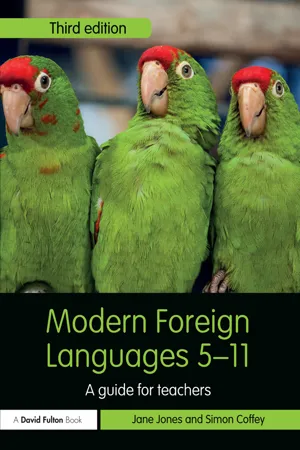
Parrots are birds of immense fascination, given their natural curiosity, varied personalities and propensity for mimicry. It appears that a certain African grey parrot of some renown – Alex – was trained to use words to identify, describe and count objects, and even answer questions about them such as ‘How many red squares?’ seemingly with some 80 per cent success. The parrots on the cover of the book can be seen as a symbol of these skills and remind us of much that we observe in children who show inquisitiveness as well as learning capacity. Primary MFL learning provides an opportunity for all children to demonstrate more than their powers of mimicry. While teachers sometimes talk of children parroting words and phrases – a natural part of the early stage of language learning – children have the cognitive flexibility and physiological apparatus to become competent and creative language users. Babies visibly enjoy babble and infants thrive on constant chatter and verbal interrogation of their world. As toddlers grow into children and their language use becomes more sophisticated, they retain the flexibility to unconsciously absorb and ‘parrot’ new words in their mother tongue or in any language that they come into contact with, as any parent who has spent some length of time abroad with young children engaged in social contact in a foreign language can testify.
Children aged 5–11 are focused on the nature of the communication afforded by language use and are not concerned with the cultural load of which words and which language they are using. This natural, uninhibited use of language makes early learners particularly receptive to learning in MFL classes, and it is a foundation to build upon.
The intrinsic motivation to learn foreign languages cannot be assumed, even with younger learners. We know that play and creativity are natural resources but that motivation to engage in particular activities depends on messages modelled by significant others, including teachers, and that feedback should include ‘praise [for] effort rather than performance’ (Goswami and Bryant 2007: 2). It is essential, therefore, that younger learners develop positive attitudes to languages and that these are maintained throughout the entire primary phase and into the secondary-school phase of learning to ensure the success of the primary MFL project. One of the concerns expressed in the MFL community of practice – that is the group of professionals interested in and committed to the promotion of skilled MFL teaching – has been about the decline in interest that is often characteristic of the secondary stage of learning. After many discussions with secondary teachers and interviews with Year 7 children, it appears that there is some justification for this. Let us, by way of illustration, consider comments from two groups of Year 7 pupils (11-year-olds). Year 7 children in a school with a strong tradition in languages in the London area gave the following answers when asked to describe the differences in the way MFL is taught at secondary level:
Here the teacher just says it without explaining and expects you to understand.
At primary school we did colours and answered questions. Here the words are harder.
It’s ace. The teacher’s accent is amazing.
We have gone from almost nothing learnt to soooo much learnt.
More homework here. [When asked what sort of homework] Just revision.
Given its previous history as a former language college and the funding that allowed it to develop excellent resources, MFL clearly enjoyed an important place in the curriculum at this school. However, the children’s views were not necessarily more favourable than those of pupils in a comprehensive school where languages did not have such a high profile or record of success. We interviewed another group of Year 7 pupils attending such a school at the same time during their first autumn term. One pupil – supported by others in the group – expressed enthusiasm for the French and German teacher and the languages:
I just love it. I can’t stop speaking French! Ça va? Tu vas bien? [to the author in the interview]. Miss gets us to sing and move around all the time [seat-dancing movements]. It’s not embarrassing as we all do it. The PowerPoints are excellent. Miss gets us to work in teams and we get points when we say something good. If you are not sure, she helps us then comes back to us and asks us again. The German lessons are fun too [group bursts out into a volley of German phrases]. I can’t wait to do Spanish.
This comment is a testimony to particular primary and secondary teachers who, working together, have succeeded in maintaining cross-phase interest, motivation and progression in language learning, arguably the cornerstones of this book. Without continuity and coherence of learning on a progressive basis, primary MFL is likely to be perceived as a failed project (see the report by Burstall et al. 1974 on the perceived ineffectiveness of primary MFL, whose findings hang like a cloud over primary language teaching to this day). If this is the case, an evident lack of success could lead to considerable disquiet on the part of secondary colleagues, and probably sceptical primary teachers who might feel inclined to challenge the rather over-generalised, albeit contested, notion (see, for example, the National Curriculum Review (DfE 2011)) that provides the basis for primary MFL: ‘the younger the better’.
The younger the better? The ‘optimum age’ issue
Age-related issues have been discussed extensively and reviewed by, for example, Bland (2015), Johnstone (1994) and Martin (2000). It seems that decisions about when to introduce foreign language learning depend, in different countries, on politically variable local and national school contexts. In various European countries the ‘optimum starting age’ for language learning has been researched, yet there is contradictory evidence on almost every count. Across Europe we can find starting ages ranging from five to 11 – even younger in some countries and in many private schools. For example, children learn (usually) French in UK independent schools from the age of three. Neurobiologists have been involved in research on the optimum age to start learning an additional language, and results have led to an ongoing debate. For example, the Swiss linguist Georges Lüdi, from the University of Basel, working with colleagues in neurobiology on brain activation and the capacity for the development of early bilingualism, has asserted that the optimum age for the development of early bilingualism is before the age of three. Lüdi does, however, stress the need to be conscious of children’s individuality and their flexibilities in different areas of acquisition and at different ages. While the neurobiological research of languages has yet to come to a conclusive result, and while the Swiss context is somewhat different to the primary-school classrooms under discussion in this book and our language-learning aims rather more modest, such research continues to fuel the ‘optimum age’ debate.
In view of the discussion of the ‘earlier the better’, Martin rightly questions the meaning of ‘better’ in respect of children’s learning: is it ‘proficiency and the ultimate level of attainment’ or ‘the rate of acquisition … and … which aspects of language learning are they best at?’ (Martin 2000: 10). However we choose to interpret ‘better’, the key lies, according to Martin, in the planning of an appropriate age-related programme that capitalises on what younger learners can do better and with the greatest enthusiasm in order to maximise their advantages. Similarly, MFL provision at the secondary level needs to be planned to exploit the advantages of the secondary-aged learner by consolidating and building on, but not repeating, terrain already covered. It can be seen from this that the case for an early start is not so much age-dependent but rests on a range of other more influential factors. These are reflected forcefully in the following statement from Jurgen Meisel of the University of Hamburg (cited by Georges Lüdi in an address to the Education Department in Basel, 16 June 2004), according to whom ‘monolingualism can be regarded as resulting from an impoverished environment where an opportunity to exhaust the potential of the language faculty is not fully developed.’
Primary MFL provides – assuming training, funding and support for teachers and schools – added value in the primary classroom and indeed the whole-school environment. It offers language-learning opportunities for all children on an equal basis, whatever their ability or language background, and can make the most effective use of children’s full language-learning capital and potential.
What, then, are the advantages of an early start?
Throughout this book, we address KS2 teaching and include KS1, as we believe, in line with Sharpe and Driscoll, that ‘foreign language learning should begin at the start of compulsory primary schooling’ (2000: 83). However, we recognise that the gains of such an early start may not always be clearly quantifiable linguistically. Much of the research looking into the nature and benefits of early language learning has tried to measure the success of children’s ‘acquisition rate’ compared to peers who did not have an early start. The most famous example of this was the Burstall et al. NFER report (1974), which ultimately led to the disintegration of the pilot Primary French Project started in the 1960s. When children who had studied French at primary level were compared to those who had not, and to older secondary children who had studied French for the same period of time, it was found that children who had started learning earlier did not demonstrate greater proficiency. It could be argued, though, that the research data were flawed as they were based on testing linguistic gains when children had already moved on to secondary school and so had started learning French ‘again’ as beginners in Year 7, along with peers who had not previously learnt any foreign language in their primary school.
In linguistic terms, there is some evidence (Singleton 1989; Tierney and Gallastegi 2005; Vilke 1988) to show that an early start helps to improve foreign language listening skills and pronunciation. Johnstone’s review of evidence in Scottish primary schools related to early learning indicated some ‘positive effect on auditory capacities’ (2003: 15). These studies seem to resonate with Lenneberg’s (1967) ‘critical period hypothesis’, which claimed that the brain of a child before puberty was more receptive to imitating native-like pronunciation. However, the critical period hypothesis has been widely challenged as evidence shows that acquisition and learning gains vary enormously across all age groups (see Herschensohn 2007). Contentious gains in linguistic proficiency cannot be the only reason for advocating an early start for language learners, for we would maintain that the main benefits that early MFL learning engenders lie rather in:
- enjoyment of languages
- mutual reinforcement of first-language development
- cultural awareness and enhanced understanding.
The debate about the optimal learning age will certainly continue, as different research projects have yielded mixed findings relating to the long-term effectiveness of an early start. In the long term, a more formal investigation confirming connections between early language learning and these advantages is required. This needs to take into consideration that the learning must already be embedded in a progressive trajectory that crosses the school phases both vertically through the years and horizontally across the curriculum. Language learning provision for KS1 learners is very patchy in the state system (a fait accompli in the independent sector often from the age of three). An early start or at least sensitisation to language is both possible and desirable, as case studies in this book show.
Which language?
There is much popular wisdom propagated about which language should be taught in schools. Most of the ideas exchanged are based on the concept of maximum ‘usefulness’ of a given language. This usefulness is sometimes understood in relation to the language with which we have the greatest contact (in tourism or business), or even in terms of the language with the largest number of speakers (Mandarin Chinese) – though, historically, sheer numbers of speakers have never motivated learners to learn a language unless there is a commensurate prestige or utilitarian value.
Many adults in the UK associate language learning at school with French only and this can reflect negatively or positively on the attitudes they convey to their children. Some parents continue to enjoy learning and rekindle their own French through their child’s experience of language learning, whereas others may have an entrenched dislike for French and encourage their child to learn another language. Parental attitudes and other ‘learnt’ ideas are clearly visible when asking children which language they prefer; for example, a child cited in Chapter 4 commented ‘French is hard to pronounce’ – an attitude that is more likely to come from a parent/an adult than from the child himself/herself.
French has always been, by far, the most taught modern foreign language in the UK and this picture looks set to continue for the time being (‘offered by 89 per cent of primary schools in 2008’, Wade and Marshall 2009: 3) although the KS2 NC (DfE 2014) gives schools the freedom to choose. French remains the obvious choice for several reasons:
- it is the language of our nearest neighbours and most countries have a tradition of familiarity with their neighbouring language and culture;
- there are important historical and cultural links between Britain and France;
- French is ingrained into our education system and into our psyches as ‘the’ foreign language, with most MFL material aimed at French and French attracting the highest number of students, thereby language-qualified staff;
- although now no longer comparable with English, French retains international prestige as an international language of culture;
- as a mother tongue or second language, French connects a wide range of different societies around the world (la Francophonie);
- the linguistic effects of history have resulted in enormous lexical congruity between English and French.
There is an increasing interest in other languages, especially Spanish. Some schools are able to offer two languages, either concurrently at KS2 or sequentially one after the other across KS1 and 2. In certain areas, community languages are taught as MFL as well as ‘second language’, e.g. Portuguese in South London. Perceived easiness was a reason that the authors were g...