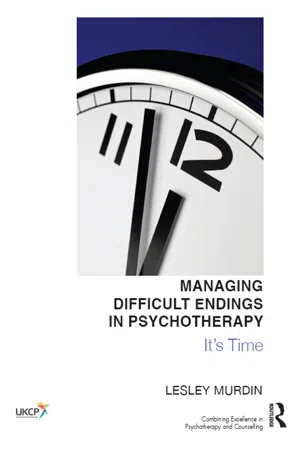
- 160 pages
- English
- ePUB (mobile friendly)
- Available on iOS & Android
eBook - ePub
About this book
This book is about the difficulty of endings, but it is also about learning from the endings that we know have gone wrong as well as those that have worked well. It sets out how the psychological therapist can help a person to live well while life is available, and to face the endings that confront all of us with honesty, and the acceptance of our human fragility. Therapists suffer through the fears and failures of the people they see as well as through their own endings. These difficulties can either help each one to be more understanding and helpful, or can lead to disaster. This book is about making sure that we use experience as well as theory constructively.
Information
CHAPTER ONE
Ending causes pain
What harm can ending do?
What harm can arise from a poorly managed ending? Not only is useful work missed but the work that has been done may be spoiled. This is determined, to some extent, by the length of the therapy that is ending and by the strength of the attachment that has developed. The attachment, of course, need not be positive. In fact, the negative and ambivalent relationships that arise can lead to emotional disturbance which is by no means healed by ending the relationship. Some patients who are angry may want to walk away rather than stay and face the fear of being angry with the person who seems to hold the promise of something better for the future. This patient fears that he will destroy his own hope.
William Blake’s poem “The Poison Tree” conveys the common belief that anger will be fatal. He grows a metaphorical poisonous fruit which kills his enemy:
I was angry with my friend:
I told my wrath, my wrath did end.
I was angry with my foe:
I told it not, my wrath did grow.
In the morning glad I see
My foe outstretched beneath a tree.
—Blake, 1794
One of the achievements of psychotherapy might be to enable the expression of hostile and negative feelings without the fear that they will be deadly. The alternative might be to expect that other people will be delighted with the honesty of the person who has become able to express feelings. This person might then be hurt to discover that the expression of anger often leads to an angry response, and is certainly not always welcomed. Both of these reactions may be experienced and made less dangerous in the therapeutic process.
In his book, Julian Barnes writes of his mother, who was an atheist. She said “People only believe in religion because they are afraid of death”. (Barnes, 2008, p. 8) Barnes says that this is a statement that shows his mother’s confidence in her own views. Nevertheless it makes an interesting point. Most people are afraid of final endings and in particular of death, whether their own or that of someone they love. Religions that offer a life after death have attractions in the context of this fear. The practising psychotherapist has to help people deal with loss in whatever way they can, and maybe help them discover how to return to a trusting state of mind that enables the individual to begin to live in the present.
Freud wrote the paper “On Transience”, (Freud, 1916) in which he conducts a debate with an imaginary poet. The poet argues that the knowledge that all we are, have and see must come to an end and reduces the value of life—therefore we must believe in life after death. Freud argues that transience and our knowledge of endings add to the value of that which must go. This of course has relevance for therapy because, whether it is time-limited or open ended, it will still have an ending which must be recognised. Transience value is scarcity value in time. (Freud, 1916, p. 305)
The therapist may share with the patient the fear of the losses that an ending brings. This may be one of the reasons why endings can go wrong. This book will consider some of these possibilities. On the other hand, how could we expect therapists to be without this fear? Should we in fact wish for that? If the therapist were immune from this aspect of the human condition, she might be able to help patients to end their therapy without a tremor of regret, but that would perhaps not help the patient to deal with the grief and distress that normally accompanies bereavement. The fear of death is a curious phenomenon for psychoanalysis because, as Freud pointed out, (Freud, 1915, p.296) the unconscious cannot entertain the idea of death. We also know that consciously, we all find it difficult to imagine our own death and total absence from the world.
Ending as transition
Ending psychoanalytic work can be difficult, not only because all ending is seen as symbolic of death, but also because it indicates the ending of at least one stage of a process of development. Since most people have been exposed to at least one of the world’s religions, most have formed views about death as the end or as a transition to another state of being. The approach to ending may carry with it this ambivalence about whether it is an ending. Ending therapy is usually a transition and carries its own particular shades of doubt and uncertainty. The therapist handing the duty of care back to the patient has to accept that she is no longer needed. One useful way of thinking about the function of the therapist is in relation to Donald Winnicott’s concept of the transitional object. (Winnicott, 2011, p. 107) The infant finds an object, often a piece of soft cloth, which feels to him to be partly himself and partly Other. It allays anxiety and is often essential for going to sleep. Its use is to enable the infant to negotiate the stage of recognising the existence of external objects that are not under his control, and then gradually the limits of his own body and mind. The fate of the object is to be gradually “relegated to limbo”, that is to say, it is not forgotten but loses its meaning as the transitional area extends to the whole cultural experience of the individual.
Endings that are destructive
The therapist is experienced in something of the same way, until she can be allowed to lose meaning and is no longer needed to allay anxiety because the patient has achieved his own understanding of inside and out. For a time, however, the therapist is seen in phantasy as part of the patient herself and is not allowed to diverge too far from being what the patient wants her to be. This is the phenomenon described by Heinz Kohut as the twinship transference. In Analysis of the Self, (Kohut, 1971) Kohut describes the functioning of the narcissistic transference, which by definition is a form of mirroring. The patient is highly anxious and seeks to lower the level of anxiety by unconsciously coercing the other to be like the self. This produces the twinship transference in which the analyst must be perceived to be the same as the self and any deviation or expression of her individuality is fiercely resisted. The commitment to this idealisation is related to the demands of the grandiose self of the toddler. Jacques Lacan elaborates the ego’s mistaken sense of its own perfection in early childhood in Le Stade du Miroir Comme Formateur de la Fonction du Je. (Lacan, 1949). From then on, each of us sees the world through a distorting prism.
Termination may be difficult just because, in Winnicott’s model of simply growing out of a stage, the process seems to lack drama. Of course this ending, that is simply a letting go, might be less painful. Perhaps the pain is needed to enable the process to be useful for bearing bereavements. An alternative view of ending which recognises the more violent, frightening aspects of endings comes, for example, in the poem by Robert Frost in which he describes the way the world will end in fire or ice. He knows that desire can burn and destroy but has to consider that ice can also destroy. Even though fire might be the more likely way in which we destroy each other, we now know that the universe will die in coldness and darkness: “To say that for destruction ice/Is also great/And would suffice”. (Frost, 1955)
This of course is metaphorical, but it reminds us that we imagine ending as destructive. There are many different ways of imagining the ending of the therapeutic work, including T.S. Eliot’s thought in “The Hollow Men” about the way the world ends, “not with a bang but a whimper”. (Eliot, 1936) One useful quest for the therapist is to elicit the patient’s image of ending and death in order to discover whether he can live with it.
If a whimper is what is expected and is the predominant image, both the therapist and the patient may expect, and then experience, some disappointment. This is clearly conveyed by Kohut in his paper, “The two analyses of Mr Z”. The patient ended his first analysis in a calm way but without much feeling:
What was wrong at that time is much harder to describe than what seemed to be right. Yet, I believe that, although both the patient and I must have known it precociously, we failed to acknowledge and confront a crucial feature of the termination phase. What was wrong was, to state it bluntly, that the whole terminal phase, in stark contrast to the striking contents that we transacted, was, with the exception of one area, emotionally shallow and unexciting – noteworthy because the patient was not an obsessional personality, was not inclined to split ideation and affectivity. On the contrary, he had always been able to experience and to express strong emotions. He had always experienced shame and rage with great intensity and often felt deeply upset about setbacks and wounds to his self-esteem; and he could also react with a warm glow of triumphant satisfaction when accomplishment and success enhanced his self-esteem. To draw specific comparisons: nothing in the terminal phase – neither his experiences in real life nor his experiences in the analytic sessions came anywhere near equalling the emotional depth with which in earlier phases of the analysis he had talked about his idealization of the pre-Oedipal mother and his admiration for the counsellor. Only the feelings concerning the parting from the analyst appeared to have real depth; and his ultimate acceptance of the fact of having to give up the analytic relationship seemed hard-earned and genuine. (Kohut, 1979, p. 12)
Kohut was unable to make much of this, although in fact the two parted “with a warm handshake”. Mr Z then returned for a second period of analysis when they were able to understand something of what had been missing. He had a dream of his father appearing outside the door with a pile of colourfully wrapped presents:
… [H]e was in a house, at the inner side of a door which was a crack open. Outside was the father, loaded with gift-wrapped packages, wanting to enter. The patient was intensely frightened and attempted to close the door in order to keep the father out. (Kohut, 1979, p. 8)
At first this dream was taken in a warning sense: “beware of Greeks bearing gifts”. But, in the second analysis, Kohut was able to help the patient reach the understanding that his father might bring him gifts that he would want and need. The second analysis allowed the primitive mirroring transference, arising from the grandiose self of the young child, to develop into a much more realistic view of the potential in the father and the danger of idealising the mother. Not many therapists have the opportunity for this sort of revision of their understanding. Most often, the thinking must be done immediately, using the learning that we can derive from experience, both our own and that of others.
The end of the story
The account of Mr Z illustrates that one of the pains of ending is the missed opportunity. When you say goodbye to a person, job or place to live, you close down all the possibilities for the future that might have been. Therapists tend to like stories. That is one essential qualification for the job, and while it helps us to be able to listen with interest to the stories of patients, it makes ending difficult. Freud described the process of analysis as being like sitting on a train while a passenger describes the scene that passes across his vision outside the window. (Freud, 1913, p. 134) If the listener cannot see what is outside, he needs the seeing passenger to tell him. No wonder the listener feels some resistance to letting his companion leave. Daniel Spence, in his discussion of therapy as narrative, took up this image:
Not only is the patient not merely reporting what is seen through the window (the mind’s eye), but he or she may also have the fantasy that the analyst knows what the patient knows and that, as a result, the patient’s private language needs no explanation. (Spence, 2003, p. 879)
Spence pointed out that the passenger is by no means an objective observer who merely reports what he sees. There is a continuous choice, selecting details or points of emphasis; there are also effects arising from the context. Above all, the speaker is aware of the listener and will alter the associations because of it. He invokes the patient’s tendency to use metonymy – substituting the part for the whole, for example, “the crown” for “the monarchy”. This may be done to protect the listener or the speaker, but will be used along with many other techniques to hide and blur the edges of the message that needs to be conveyed. Sometimes the patient speaks elliptically because he believes that the therapist knows what he is thinking. This assumption involves a level of magical thinking that is difficult to disentangle. It takes time and requires what Winnicott saw as gradual disillusionment. (Winnicott, 2011, p. 111)
Another part of the distortion of the account of the landscape may come from the difficulty of seeing. The landscape may be dark, or the country may be concealed at crucial moments, for example by a train on another line, or more seriously by camouflage imposed by others. The patient might be short sighted and unable to see very far or very clearly. He may be unaware of his own deficiency if he has never been able to see more. The therapist may begin only after time to understand what the limits are. Freud’s image can be extended to describe the distortions that arise from processes of projection or transference.
Digging up the past
The second image of the therapeutic process that Spence considers is Freud’s archaeological metaphor. The therapist is engaged in piecing together a story from a number of fragments that are, perhaps, dug up in the wrong order or puzzlingly broken and fragmented. Whether or not the therapist now thinks that she is embarking on some process of reconstruction, she is confronted with fragments and is trying to make some sense of them for both herself and her patient. An ending will leave her with fragments that have not been satisfactorily labelled or assigned a place. The archaeological metaphor, however, does allow that the pieces of the past may be mysterious but they are still available to be examined. The train window analogy implies that the view from the window, once passed, has gone forever and there is no second chance. Both of these images hold some truths for the therapeutic process. The moment when a patient tells the therapist of some event from the past will never return in exactly the same way. Some aspect of the context will change and, if the therapy comes to an end, the listener will be a different person. Maybe the patient will have to listen to himself. Since we know that memories are constructed through many elements that co-exist at the moment of retrieval, we have to accept that the memory, and all that it tells us, may be different each time and may be gone forever when it has once been told.
Loftus and Bernstein (Loftus & Bernstein, 2002) have shown the extent to which memory is variable. They argue that experiments have shown that memories are distorted in a way that makes it impossible for the therapist to distinguish true memories from false. In some ways this research is disturbing but it is also exciting. The truth that looks clear and historical one day becomes blurred and indistinct or may be completely changed the next. The effect is that, however much archaeological digging the therapist may help the patient to achieve, there will still be a sense in which the major achievement of the therapy will be to enable both people to accept that there are few certainties and that what is clear today may need a new approach tomorrow. Living with this degree of uncertainty is always going to demand courage and the ability to find, and live through, inner resources.
So far, this chapter has considered the pain of loss that the therapist might feel in accepting the patient’s wishing to end. The patient might feel some of the same kinds of disappointment or frustration, but he will also have his own disappointments. The extent to which the therapist has become a transitional object will determine to some extent the potential for separation either with maturity or with great pain. In the process of development, the good enough mother allows her infant to have the illusion that the breast is part of him and under his magical control. Maturity involves the gradual loss of the need for this belief. Winnicott (Winnicott, 2011) says that it can be left behind as the capacity to relate to another outside the self develops. He also adds that the creativity that this stage shows can be developed in the arts: in music, in painting, and in writing. One way or another, a transitional object can be allowed to become itself and be separate.
Winnicott himself recognised that his formulation was provisional. It leaves out the importance of dependence which can grow into mature interdependence. This is important because the therapeutic relationship might develop beyond the point when the patient requires the therapist to be part of himself without separate thoughts or wishes. When the patient can move on, he can allow the therapist to be separate. If this can be achieved, it brings into existence the possibility of the sadness of losing the separate person whom the therapist has become. This makes clear some of the reasons why patients might end therapy too soon. There is a growing awareness of the importance of the relationship as the therapist becomes a separate person. Better to leave before the attachment grows greater and the sadness of leaving becomes more intense. The patient may also have an intellectual understanding that he will have to leave at some point, and may feel ashamed of the long term dependency that he sees himself beginning to feel. Of course there are many possible reasons for ending therapy unilaterally, and this kind of fear might remain unconscious or dimly felt, but unacknowledged.
Angry endings
The angry ending is known to most therapists and may be a defence against the experience of sadness. Inexperienced therapists take the anger at face value, but they might perhaps think that there is something beneath stormy accusations of inadequacy and incompetence. That is not to say that these are not also important. All therapists should consider what they have done or not done, and how much they have failed to live up to what might have been expected of them. Whatever can be understood of the angry patient, the aftermath is painful for both patient and therapist. The patient has to take away an image of a damaged and demolished therapist who may never have had the chance to convey her own point of view, or show that she can survive.
This is the sort of experience that can lead to levels of guilt that may even be conscious. We know that guilt can eat away at the individual, especially if it echoes guilt from a previous experience. The guilt might or might not be justified, but i...
Table of contents
- Cover
- Half Title
- Title Page
- Copyright Page
- Table of Contents
- ACKNOWLEDGEMENTS
- ABOUT THE AUTHOR
- UKCP SERIES PREFACE
- INTRODUCTION
- CHAPTER ONE Ending causes pain
- CHAPTER TWO Time in psychotherapy
- CHAPTER THREE The patient decides to end
- CHAPTER FOUR The therapist’s loss
- CHAPTER FIVE The trouble with ending
- CHAPTER SIX Therapy is a manic defence
- CHAPTER SEVEN Hopes and desires
- CHAPTER EIGHT Was there a choice?
- REFERENCES
- INDEX
Trusted by 375,005 students
Access to over 1.5 million titles for a fair monthly price.
Study more efficiently using our study tools.
Frequently asked questions
Yes, you can cancel anytime from the Subscription tab in your account settings on the Perlego website. Your subscription will stay active until the end of your current billing period. Learn how to cancel your subscription
No, books cannot be downloaded as external files, such as PDFs, for use outside of Perlego. However, you can download books within the Perlego app for offline reading on mobile or tablet. Learn how to download books offline
Perlego offers two plans: Essential and Complete
- Essential is ideal for learners and professionals who enjoy exploring a wide range of subjects. Access the Essential Library with 800,000+ trusted titles and best-sellers across business, personal growth, and the humanities. Includes unlimited reading time and Standard Read Aloud voice.
- Complete: Perfect for advanced learners and researchers needing full, unrestricted access. Unlock 1.5M+ books across hundreds of subjects, including academic and specialized titles. The Complete Plan also includes advanced features like Premium Read Aloud and Research Assistant.
We are an online textbook subscription service, where you can get access to an entire online library for less than the price of a single book per month. With over 1.5 million books across 990+ topics, we’ve got you covered! Learn about our mission
Look out for the read-aloud symbol on your next book to see if you can listen to it. The read-aloud tool reads text aloud for you, highlighting the text as it is being read. You can pause it, speed it up and slow it down. Learn more about Read Aloud
Yes! You can use the Perlego app on both iOS and Android devices to read anytime, anywhere — even offline. Perfect for commutes or when you’re on the go.
Please note we cannot support devices running on iOS 13 and Android 7 or earlier. Learn more about using the app
Please note we cannot support devices running on iOS 13 and Android 7 or earlier. Learn more about using the app
Yes, you can access Managing Difficult Endings in Psychotherapy by Lesley Murdin in PDF and/or ePUB format, as well as other popular books in Psychology & History & Theory in Psychology. We have over 1.5 million books available in our catalogue for you to explore.