![]()
The establishment of the European Communities and European Union and sources of law
| Explain why the European Communities were established and how the European Union has developed | |
| Explain the key features of the Treaties establishing the European Communities and the European Union and the content of the amending Treaties | |
| Outline the main features of the Treaty of Lisbon | |
| Identify and discuss the four main sources of EU law | |
| Discuss the requirements that new EU Legislation must satisfy in order to be legally valid | |
Sources of Law
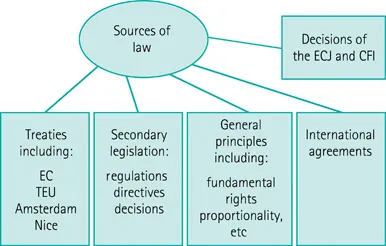
There are four sources of EU law:
law enacted by Member States which are the founding Treaties (primary legislation) and law enacted by the EU (secondary legislation);
general principles of law recognised by the Court of Justice (CJ) [formerly European Court of Justice (ECJ)];
international agreements with non-Member States;
decisions of the Court of Justice and the General Court [formerly Court of First Instance (CFI)].
Primary Legislation
One of the main characteristics of the EU legal order is that it is based on a written constitution made up of the constitutive Treaties as follows:
ECSC Treaty (1951)
EC Treaty (1957)
EURATOM Treaty (1957)
Convention Relating to Certain Institutions Common to European Communities (1957)
Merger Treaty (1965)
First and Second Budgetary Treaties (1970 and 1975)
Treaties of Accession (1972, 1979, 1985, 1994, 2003 and 2005) Single European Act (1986) Single European Act (1986)
Treaty on European Union (1992)
Treaty of Amsterdam (1997)
Treaty of Nice (2001)
Treaty of Lisbon (2007)
European Coal and Steel Community Treaty (ECSC)
Established by the Treaty of Paris in 1951, the purpose of the European Coal and Steel Community (ECSC) was to create a common market for coal and steel products.
The ECSC Treaty was the first of the constitutive Treaties. It exhibited a functionalist approach to integration, attempting to integrate economies sector by sector. A criticism of this approach is that it was an unnatural operation, as the integrated sector retained indissoluble links with other sectors of the economy which still had their national character. Its justification was that it was a first step, to be followed by integration of other sectors of the economy, toward the eventual integration of the whole economy.
An innovative feature of the ECSC Treaty was the creation of four supranational institutions:
- Council of Ministers – representing the Member States;
- High Authority – intended as a supra-national executive, consisting of independent individuals rather than government representatives, empowered to take legally binding decisions and to procure funds, fix maximum and minimum prices for certain products and fine businesses in breach of competition rules;
- Assembly – a parliament composed of delegates appointed by respective parliaments of the Member States;
- Court of Justice – intended to review the legality of the Acts of the High Authority or, in some cases, businesses.
(Note: The ECSC lapsed in July 2002.)
European Atomic Energy Community Treaty (EURATOM)
Established by the Treaty of Rome in 1957, the purpose of EURATOM was to create a specialist market for atomic energy and distribute it through the Community, and to develop nuclear energy and sell surplus to non-Community States.
EURATOM had its own Commission (which was the equivalent of the ECSC’s High Authority) and Council of Ministers, but shared an Assembly and Court of Justice with the ECSC and European Economic Community. EURATOM was another example of sectoral, or functional, integration.
European Economic Community Treaty (the European Community after the TEU)
The European Economic Community was established by a separate Treaty of Rome in 1957, and its name was amended by the Treaty on European Union (TEU). Its aim, as stated in the Preamble, was ‘to lay the foundations of an ever closer union among the peoples of Europe’.
Membership
The original EEC was formed by six Member States: Belgium, France, (West) Germany, Italy, Luxembourg and the Netherlands. Since then the EEC (subsequently renamed EC) has expanded to include a further 21 countries: Denmark, Ireland and the UK (in 1973), Greece (1981), Portugal and Spain (1986), Austria, Finland and Sweden (1995), Cyprus, Czech Republic, Estonia, Hungary, Latvia, Lithuania, Malta, Poland, Slovakia and Slovenia (2004), Bulgaria and Romania (2007). Negotiations continue with Turkey.
The EEC had its own separate Commission and Council of Ministers but it shared an Assembly and Court of Justice with EURATOM and the ECSC.
The Treaty of Rome embodied a very different approach to integration from that of the ECSC and EURATOM Treaties. Whereas the latter attempted to integrate sector by sector, the EEC Treaty concentrated on types of activity rather than particular industries (with the exception of agriculture and transport), and aimed to ensure the effective functioning of the market together with free and fair competition. Another characteristic of the Treaty of Rome was that it laid down general principles, leaving it to the institutions to enact in detail. Policy making and regulation were also left to the institutions. Timetables were laid down for the elimination of both mutual trade barriers and the common external tariff. Through these methods, the founders hoped to achieve economic integration, which was intended to be the forerunner of political integration. The Treaty...