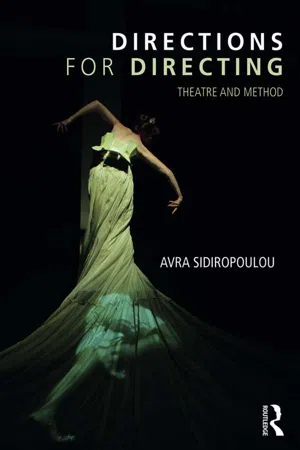
Directions for Directing: Theatre and Method lays out contemporary concepts of directing practice and examines specific techniques of approaching scripts, actors, and the stage. Addressed to both young and experienced directors but also to the broader community of theatre practitioners, scholars, and dedicated theatre goers, the book sheds light on the director's multiplicity of roles throughout the life of a play – from the moment of its conception to opening night – and explores the director's processes of inspiration, interpretation, communication, and leadership. From organizing auditions and making casting choices to decoding complex dramaturgical texts and motivating actors, Directions for Directing offers practical advice and features detailed workbook sections on how to navigate such a fascinating discipline. A companion website explores the work of international practitioners of different backgrounds who operate within various institutions, companies, and budgets, providing readers with a wide range of perspectives and methodologies.
- 208 pages
- English
- ePUB (mobile friendly)
- Available on iOS & Android
eBook - ePub
About this book
Information
Chapter 1
Inspiration
Becoming Inspired
Connection and Choice
As a director, you operate on inspiration—the fuel that gets your engine going. You’ll find it in every creative act, an indispensable element without which few works of art can ever feel complete. All vigor, claimed American transcendentalist poet and philosopher Ralph Emerson, is contagious, and when we see creation, we also begin to create. Each inspired vision of the world represented onstage, can, in some way or another, lead both artists and spectators to uplifting physical, psychological, or mental actions. First and foremost, however, feeling inspired is a prerequisite for any fulfilling interaction between a director and a theatre company: not only a profoundly personal but also a contagious affair, which combines the past of your background and training, the present of rehearsal work, and the future of sharing a performance with an audience. In the world of directing, inspiration usually comes across as a sincere instinctual attachment to an idea; an image; a sound; a person; or a sensory, emotional, or intellectual stimulus, which activates the imagination, generating a mood for reflection and a desire for expression and participation. A rare approximation of an ideal and a state of clarity and engagement, it is both a blessing and a necessity. Essentially, inspiration can be described in terms of a discovery: a dormant thought, feeling, or response suddenly reemerges, preparing us to meet the world in all its turmoil.
For directors and audiences alike, performances can be powerful triggers of inspiration. They invite us to think, participate, share, play, empathize, and imagine. Directors are usually attracted to particular genres, texts, themes, and processes, a connection that is essential for artistic growth. The decision to embark on a project varies according to factors determined by personality, life circumstances, education, and training. Complex needs further inform the choice of material, and as a result, different decisions describe and generate different work methodologies and styles, approaches to text and to form, as well as hierarchies of meaning-making. The one thing, however, that is common in most creative practices is the artists’ strong affinity to their source. Such a bond usually drives art that is nothing short of necessary and that appears inevitable.
Which are a director’s sources of inspiration?
What makes some directors more inspiring than others?
Is an inspired director by definition inspirational?
Can inspiration be communicated?
Some of the aforementioned questions, which keep resurfacing in many discussions on directing, are naturally rhetorical. There are no recipes or manuals for readily available inspiration circulating freely among theatre makers. These queries do, however, serve a dual function: they help us think about inspiration as an impulse—something that is instantaneous and irresistible—and a process that can be communicated and cultivated. Jerzy Grotowski’s observation sums it up nicely: “The director’s purpose is to create a condition which leads another to a new experience; a thousand times it won’t work, but once it will, and that once is essential” (qtd in Benedetti 1985, 129).
Love and Meaningfulness
In the case of preexisting plays—as opposed to devised or nonverbal material—directors relate to the text for various reasons and through different mediums. You may, for instance, enjoy a play’s intricate structure, the unexpected manipulation of dramatic form, the freshness of ideas, or the complexity of the characters. Yet the original connection you experience pierces through the transparency of form toward something much more intuitive. Whether or not you are intrigued by the suspenseful plot, political acumen, density of imagery, or authentic feel of dialogue, sooner or later, you will need to address the text’s meaningfulness, a sense of urgency and an emphasis on whatever feels relevant at a particular moment in time. In point of fact, directing forces you to step out of your comfort zone and reflect on how history, culture, and the global scope of contemporary society not only influence your life but also affect everybody around you. Striving for meaningfulness has as much to do with asking the big human questions as with being able to articulate why a specific text must be delivered to an audience now. In this sense, inspiration seems to be a medium for (re)discovering meaning.
As readers who flip through the pages of a play script for the first time, we unconsciously expect a revelation. We crave to be surprised, even shocked, because when that happens, we feel more alive. Bonding with a text unearths undeclared feelings, impels—almost forces—us to express ourselves. Directors, in particular, are especially sensitive to these epiphanies. Each new reading can be an opportunity for enlightenment, an opening into a range of aesthetic and emotive experiences, a possibility for wisdom and beauty, all of which can create moments of theatre that can move, instruct, and delight. Good art stimulates more good art, awakening the desire for creativity. And because texts are processed both emotionally and intellectually, it stands to reason that during the early readings, you, the director, are absorbed dually—both intuitively and analytically. Your initial confrontation with a play stimulates all kinds of images and impetuous, almost irrational reactions. Such responses, far from mere abstractions, are predominantly embodied. As neuroscientist Antonio Damasio argues, the essence of feelings can be described as something “you and I can see through a window that opens directly onto a continuously updated image of the structure and state of our body” (Damasio 1994, xviii). The understanding that “a feeling is the momentary ‘view’ of a part of […] body landscape” (xix) may, for example, explain why our pulse quickens or our stomach tightens when we experience something that excites us.
It is during this phase that you will begin to grasp the emotional temperature of the play and form a preliminary sensory score based on the imagery and rhythm of the words on the page. Those first readings encourage you to receive everything the text emits without censoring it or testing its validity and value. This kind of engrossment may lead to useful building blocks with which you can develop your vision; it is a unique, creative reading, a by-proxy staging that takes place in an (virtual) intermediary field, where the universe of the play and that of the interpreter (director) come into close contact. The two worlds—alternately antagonizing and validating or complementing each other—exist in a nebulous space defined mainly by the interaction of the context provided by the written words and the director’s life experience. As a result, interpretation is negotiated as an inspiration-based encounter, where meaning is produced both individually, in the mind of the director, and jointly, in the dialogue between the director, the company, and the text.
Creative Reading is an involved lécture that invites “stage readers” (virtual directors) to look for performative parameters in the text. Unwittingly, these lectors project their memories and speculations on their reading, not only playing back their life stories but also mentally placing themselves in specific theatre spaces and setting those stories to images, sounds, or patterns of movement. In the end, the text becomes dynamically “in-space/d” and stageable, at least in the reader’s mind.
Any encounter with the text mobilizes a circuit of diverse reflections, often imparting universal knowledge expressed from unusual angles. Remaining open to this nexus of influences, you are actually inviting inspiration to enter your work. After all, it is nothing but a catalyst that helps stirring impressions to emerge out of your mental storage of life experiences. And even though a director may “periodically tidy, sort, arrange and file the contents” in the “lumber rooms” that exist in the “attics of his memory,” there must always be an “untidiness,” some degree of “clutter” that can “reappear spontaneously when needed” (Roose-Evans 1968, 83–4). Once revealed and addressed, the “clutter” will no longer be an unacknowledged and disposable mess but will emerge in more definite shapes and force you to get to work and create.
On occasion, directors-readers will be struck by an idea they will want to develop further, a concept that feels fresh to the moment but has somehow been constantly present in their mind. A conversation you may have overheard, a memorable scene witnessed, a piece of literature with astonishing language, and numerous other triggers are all instances of a rush of inspiration which can also affect choice. Some stories convey themes that specifically touch upon fears or desires cast aside for too long. They draw us in without notice and produce reflex responses that can be pleasurable or disturbing but are almost always significant. As a director, you are likely to have been consciously or unconsciously pulled toward plays whose contexts recall your life circumstances or those that raise questions you have a burning desire to address. Often, there is this nagging thought at the back of your head that dealing with your issues from the safety of distance can lead to a sharper awareness, a fuller recognition, a smoother recovery. To use an example: calling attention to the idea of personal responsibility, Henrik Ibsen’s Little Eyolf (1894) tells the story of an estranged couple’s (Alfred and Rita Allmer’s) pain and guilt when forced to come to terms with the death of their nine-year-old child. Because of the somber subject matter and sinister tone, the play never made it to the playwright’s “top-5” works. Yet Ibsen’s profound treatment of loss and denial could mean a lot to those similarly afflicted, making their personal investment stronger and their response to the text potentially more discerning. Despite the distress you experience at the invocation of painful memories, subconsciously, you may be prepared to tackle such accumulated affliction vicariously.
It is no wonder that the collision of texts and people, of creative material and artists, has repeatedly been described as a coup de foudre (love at first sight), an immediate attraction, a condition similar to intoxication, which fires up unconscious reverberations. British director Katie Mitchell describes the sensation generated from reading a text one wants to direct as “akin to falling in love,” where one may find that their “heartbeat increases and their body temperature rises” (Mitchell 2008, 8). In time, the dedicated involvement with a text—a self-ruling plexus of ideas and emotions—will feel like a deeply committed relationship. A strong attachment is necessary for endorsing any project because when you connect, the company and the audience will also connect. In contrast, the absence of engagement can be a warning sign, a kind of red flag for which you should watch out. If your original drive is weak, there is little you can do to support your longing to make captivating theatre. Directing is as much about instinct and passion as it is about cognition and method.
WORKBOOK 1.1
The Workbook section of the book has sampled a range of exercises that are meant to be a warm-up or general rehearsal tools for the director and the company of actors. Depending on the levels of experience, some exercises will serve better in a group of beginners, while others may feel more specialized or advanced. If this is a class of directing students, you can gauge the exercises’ usefulness and applicability to specific teaching units. Often, examples from well-known plays are brought in to clarify their function and scope. Usually, the activities provide a model framework within which to examine the particular text (here referred to as “play of choice”) that a theatre company is staging or on which a directing/drama/acting/scenography class is currently working.
Practice 1. Connecting to the Text
The following activities are meant to reveal a more personal connection to the source.
Activity 1. Identifying the Connection
Pick up the climactic scene from your play of choice. Read it through, and then put it aside.
Give it some time to “sit,” and then try to summarize in one sentence the core event of the scene. The way you respond will make plain your original, instinctive approach to the text.
After determining what the scene is about, try describing it to someone else in as much detail as possible. As a director, you should ask your actors to take turns with their own sentence.
You will realize that the way each version is colored, including possible omissions or points of emphasis, has a lot to do with how actors read themselves into the world of the play, in general.
Activity 2. Building on the Connection
Ask your group members to discuss their involvement with the play of choice. Could they be characters in it? Have they ever been in any situation that even remotely resembles what goes on in the text? Apply the same questions to yourself, the director of the piece.
Ask your actors to change the character’s name into their own and to turn the other characters’ names into the names of people who play an active part in their life. Do the same thing for yourself.
Focus on the part of the play that is particularly interesting to you/them. Adjust the circumstances of the play to yours/theirs, and try to “meet” the text, stretching the story line as much as it allows you to.
You may give your play a different ending or keep it open.
You can now go back to the text and reread it.
Soon, you’ll begin to find yourself behind many parts. Isolate the ones that are unusually persistent.
Pinpoint your primary connection to the play, and ask your company to identify theirs. You and your actors are now one step closer to a solid concept for the production.
Communicating Your Vision
Spreading the Disease
Negotiating between the pragmatics of production and the fleeting nature of imagination is a crucial challenge. Sometimes, the clamor of administration takes priority over the slow-burning, invisible demands of ephemeral inspiration, which can disappear just as fast as it first hits. Granted, it is rare to respond immediately to a new stimulus; it is useful, however, to recognize the function of inspiration as a call to action and a force that sets things moving, and accept that, in and of itself, inspiration instigates interpretation. In rehearsal, interest and commitment are solid venture points for exploration. Not only can inspiration reveal the less-apparent reasons why you may want to work on a particular play or a particular theme at this moment in time; it also motivates you to revise hermeneutic mechanisms of analysis and research verbal, visual, and kinetic forms that will support your original vision.
Enjoying the luxury of building autonomous, although fictional, realities that bear their own rules and can transport audiences “into states of mind rather than real places” (Rich 1985), directors typically carry enhanced privileges and responsibilities within the ensemble. The collaborative nature of theatre-making notwithstanding, you are expected to envision the entire production, draft out models of staging, provide the materials, and oversee its progress. Combining the functions of an architect, a contractor, and a construction worker, you will be held accountable for handing in a functional and enterprising building plan.
Interestingly, the manner in which theatre practice continues for the most part to layer the several stages and agents of inspiration from playwright down to spectator echoes Plato’s dialogue ...
Table of contents
- Cover
- Half Title
- Title Page
- Copyright Page
- Dedication
- Table of Contents
- List of Figures
- Acknowledgments
- Introduction
- 1 Inspiration
- 2 Interpretation
- 3 Method, Leadership, Collaboration
- 4 Director and Text(uality)
- 5 Director and Stage
- 6 Director and Actor
- Index
Trusted by 375,005 students
Access to over 1.5 million titles for a fair monthly price.
Study more efficiently using our study tools.
Frequently asked questions
Yes, you can cancel anytime from the Subscription tab in your account settings on the Perlego website. Your subscription will stay active until the end of your current billing period. Learn how to cancel your subscription
No, books cannot be downloaded as external files, such as PDFs, for use outside of Perlego. However, you can download books within the Perlego app for offline reading on mobile or tablet. Learn how to download books offline
Perlego offers two plans: Essential and Complete
- Essential is ideal for learners and professionals who enjoy exploring a wide range of subjects. Access the Essential Library with 800,000+ trusted titles and best-sellers across business, personal growth, and the humanities. Includes unlimited reading time and Standard Read Aloud voice.
- Complete: Perfect for advanced learners and researchers needing full, unrestricted access. Unlock 1.5M+ books across hundreds of subjects, including academic and specialized titles. The Complete Plan also includes advanced features like Premium Read Aloud and Research Assistant.
We are an online textbook subscription service, where you can get access to an entire online library for less than the price of a single book per month. With over 1.5 million books across 990+ topics, we’ve got you covered! Learn about our mission
Look out for the read-aloud symbol on your next book to see if you can listen to it. The read-aloud tool reads text aloud for you, highlighting the text as it is being read. You can pause it, speed it up and slow it down. Learn more about Read Aloud
Yes! You can use the Perlego app on both iOS and Android devices to read anytime, anywhere — even offline. Perfect for commutes or when you’re on the go.
Please note we cannot support devices running on iOS 13 and Android 7 or earlier. Learn more about using the app
Please note we cannot support devices running on iOS 13 and Android 7 or earlier. Learn more about using the app
Yes, you can access Directions for Directing by Avra Sidiropoulou in PDF and/or ePUB format, as well as other popular books in Media & Performing Arts & Acting & Auditioning. We have over 1.5 million books available in our catalogue for you to explore.