1.2 Introduction to Sustainable Development
Since the 1960s, environmental quality became a major issue and concern. Sustainable development was not conceptualized until the 1980s when the World Commission on Environment and Development (WCED) in their 1987 Report defined it. Since then, there have been many definitions of sustainable development. However, the WCED definition remains the most accepted. It indicates that sustainable development is “development that meets the needs of the present without compromising the ability of future generations to meet their own needs” (WCED 1987). Therefore, it has been generally understood that environmental aspects are included within social and cultural ones. It has been considered as environmentalism with a human approach (Allenby 2012).
Since the beginning of the industrial revolution, Glasby (2002) indicated that “mankind’s occupation of this planet has been markedly unsustainable” and that the WCED concept of sustainable development is not achievable presently due to the depletion of nonrenewable resources, and excessive exploitation of renewable resources. Ainger and Fenner (2014) postulated that “human development must be sustainable within environmental limits: that is, must be able to continue indefinitely within the environmental carrying capacity of our one planet.” This statement, similar to that of Yong et al. (2014), is that “all the activities associated with development in support of human needs and aspirations, must not compromise or reduce the chances of future generations to exploit the same resource base to obtain similar or greater levels of yield.”
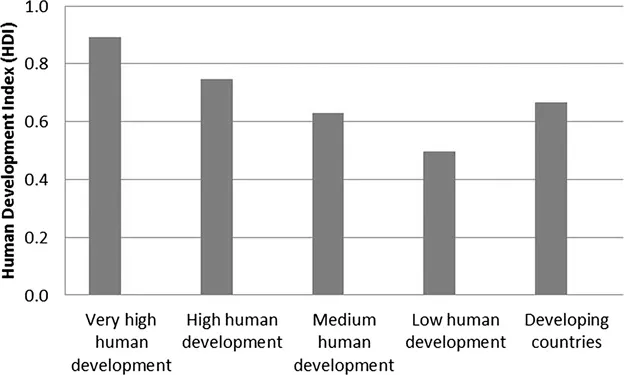
Social and economic developments are essential globally. The UN Human Development Index (HDI) is a measure of these (http://hdr.undp.org/en/content/human-development-index-hdi). Health, education, and gross domestic product are combined into a score of 1.000. The target is 0.8. The scores of some countries are very low (less than 0.4) due to quality of life while developed countries need to reduce their ecological footprint to 1.9 ha/person (worldwide average). The HDI was developed by the United Nations. A long, healthy life, adequate education, and decent living standards are included in the index. These are measured by life expectancy, actual or expected years of schooling, and gross national income, respectively. All scores are normalized and aggregated using a geometric mean. Norway is ranked first with an HDI of 0.944. The United States’ HDI is 0.915. Other countries, such as India, have much lower HDI of 0.609 and are ranked 1,309 (UNDP 2016). A general grouping according to development is shown in Figure 1.1.
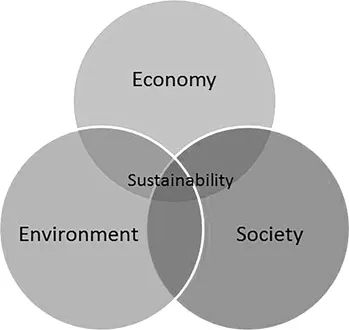
Figure 1.2 shows the triple bottom line concept often used to incorporate the three aspects of sustainable development (environmental, social, and economical). It was introduced in 1997 by Elkington (1998). It is also referred to as the three pillars of sustainability. Resilience is another aspect that is often considered along with sustainability. It refers to the capacity to change while maintaining its main characteristics. This reflects its origin in ecology where function and structure remain despite disturbances in the system (Walker and Salt 2006). Resilience differs from sustainability in that it focuses more on the process of adapting to change whereas sustainability focuses on outcomes (Redman 2014).
The aspect of future generations, in the definition of sustainable development, is difficult to estimate, as there are many unknowns. However, ethically there must be a responsibility toward future generations. In the past, there have been many incidences of environmental mismanagement. Commoner (1971) has suggested that society has been impacted by short-term planning. Activities must have a minimal impact on the environment. The intent of this book is to provide an understanding and guidance for the (a) identification of the impacts that result from human activities and (b) indicators, tools, and procedures needed to avoid, minimize, and/or mitigate these impacts through more sustainable design practices. These impacts will be elaborated in the following chapters.
FIGURE 1.1
HDI according to human development group. (Data from UNDP [2016].)
FIGURE 1.2
Triple bottom line concept of sustainable development.
The 27 principles in the 1992 Rio Declaration highlight the importance of protection of environmental quality while meeting the needs of population growth. These principles were reinforced in the 2002 World Summit on Sustainable Development (WSSD) in Johannesburg. Principles 1, 3, and 4 of the Rio Declaration state that:
“Human beings are at the centre of concerns for sustainable development. They are entitled to a healthy and productive life nature” (Principle 1).
“The right to development must be fulfilled so as to equitably meet developmental and environmental needs of present and future generations” (Principle 3).
“In order to achieve sustainable development, environmental protection shall constitute an integral part of the development process and cannot be considered in isolation from it” (Principle 4).
Many believe that such statements are not practical or feasible scientifically as development incurs the depletion of resources that cannot be sustainable. However, the WSSD of 2002 and the Rio Summit +20 in 2012, declarative statements of principles and others that have followed, show the need to develop the knowledge and tools to address the goals of sustainability. Although more than 190 nations agreed in the latter summit for better global environmental management and protection of the oceans and food security and promotion of a green economy, many have criticized the lack of detail and ambition.
The most recent set of goals for 2030 (https://sustainabledevelopment.un.org/rio20) aim to:
End poverty in all its forms everywhere
End hunger, achieve food security and improved nutrition, and promote sustainable agriculture
Ensure healthy lives and promote well-being for all at all ages
Ensure inclusive and equitable quality education and promote lifelong learning opportunities for all
Achieve gender equality and empower all women and girls
Ensure availability and sustainable management of water and sanitation for all
Ensure access to affordable, reliable, sustainable and modern energy for all
Promote sustained, inclusive and sustainable economic growth, full and productive employment, and decent work for all
Build resilient infrastructure, promote inclusive and sustainable industrialization, and foster innovation
Reduce inequality within and among countries
Make cities and human settlements inclusive, safe, resilient, and sustainable
Ensure sustainable consumption and production patterns
Take urgent action to combat climate change and its impacts
Conserve and sustainably use the oceans, seas, and marine resources for sustainable development
Protect, restore, and promote sustainable use of terrestrial ecosystems, sustainably manage forests, combat desertification, and halt and reverse land degradation and halt biodiversity loss
Promote peaceful and inclusive societies for sustainable development, provide access to justice for all and build effective, accountable, and inclusive institutions at all levels
Strengthen the means of implementation and revitalize the global partnership for sustainable development
For example, one of the most relevant for sustainable engineering is goal 3.9, which indicates that by 2030 there will be substantial reduction in the number of deaths and illnesses from hazardous chemicals and air, water and soil pollution, and contamination. Goals 6, 7, 9, 11, and 13 are most important for engineers. More detail is shown in Appendix A. Furthermore, to address climate change, countries adopted the Paris Agreement at the COP21 in Paris on December 12, 2015 (UNFCCC 2015). The Agreement entered into force shortly thereafter, on November 4, 2016. In the Agreement, all countries agreed to work to limit global temperature rise to well below 2°C and, given the grave risks, to strive for 1.5°C.
Relevant elements include:
To achieve this temperature goal, parties aim to reach global peaking of greenhouse gas emissions to achieve a balance between anthropogenic sources and removals by sinks of GHGs.
Developed countries should take the lead.
Sinks and reservoirs should be conserved and enhanced.
Enhancing adaptive measures.
In summary, these agreements pose challenges and opportunities for engineers for design of infrastructure, processes, and projects.
1.3 Challenges Faced by Engineers and Their Responsibilities
Since engineers are builders and problem solvers in industry and society, it is reasonable that engineering education is an excellent platform for imparting additional skills that can address contemporary challenges worldwide. Multi- and interdisciplinary approaches are necessary to address these complex social, economic, and technological challenges. These approaches can effectively complement the result-oriented analytical approach to problem-solving that engineers receive as an integral part of their rigorous training. There also exists a clear trend toward multidisciplinary education in all fields of engineering: de Graaff and Ravesteijn (2001) describe the crucial need for the “complete engineer,” an individual who not only has technical-scientific skills, but also an understanding of the interplay between technology and society, organizational and management skills, as well as social and communications skills.
Engineers, for example, often select materials for infrastructure or other processes. Infrastructure is highly important, as it is needed by humans to live in urban settings, shelter them from environmental risks, and protect the environment from wastes. Some materials such as minerals are not renewable and may be depleted eventually. Others such as wood are considered renewable. Other materials for construction such as concrete contain a wide variety of materials. Thus, the choice of materials can have significant impacts on resources. Past practices are not sufficient for the changing world. Engineers provide solutions to problems for the real world. However, there are many constraints for engineers as the world is becoming more and more complex. New technologies are being developed. Numerous sciences including biological and social must be considered by engineers. Engineers must work with people of various cultures and within many different regulations. Different cultures prioritize aspects differently, for example, such as access to clean water over considerations of climate change. Environmental standards may not be stringent in the developing country so higher than local standards must be applied or practices or materials modified for local conditions. The World Federation of Engineering Organizations (WFEO) has developed the Model Code of Ethics and the Model Code of Practice for ...