- 280 pages
- English
- ePUB (mobile friendly)
- Available on iOS & Android
eBook - ePub
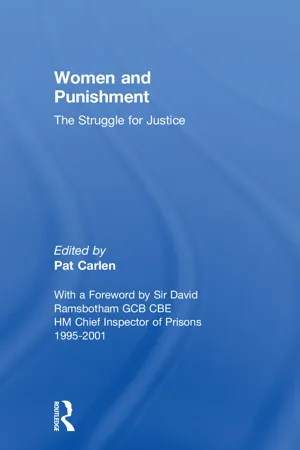
Women and Punishment
About this book
In the last decade there has been growing international concern about the increasing numbers of women in prison, the effects that imprisonment has on their children, the realisation that gaoled women have different criminal profiles and rehabilitative needs to male prisoners, and the seeming intractability of the associated problems. In response there has been an overarching policy concern in many countries to fashion and co-ordinate gender-specific policies towards female offenders which aim both to slow down the rate of their offending and/or imprisonment, and also to engender flexible programmes which will reduce the time spent in custody and/or away from their young children. The major objective of this book is to describe and analyse contemporary opportunities for, and barriers to, both the reduction of female prison populations and the reduction of the pain of those women who continue to be imprisoned. It assesses the most important recent attempts to reduce both women's imprisonment and the damage it does, identifying and analyzing cross-jurisdiction and gender-specific lessons to be learned, and the unexpected consequences of some of the reform strategies. This book brings together leading scholars and practitioners in the field, providing a critique of the reform initiatives which have taken place, and a much-needed theorization of cross-national policy in this area. It will be essential reading for all with an interest in prisons and prison reform.
Information
Part One
Context
Chapter 1
Introduction: Women and
punishment
Pat Carlen1
The coupling of ‘women’ and ‘punishment’ occurs only infrequently in penological literature2. This is not surprising. Theories of punishment are usually expected to be gender-neutral: the state punishes, the citizen submits and the legitimacy of the punishment is debated according to the jurisprudential principles of the time. Of course, punishments are meted out in a range of relationships characterised by imbalances of power and /or legitimated rule-enforcement institutions; but, by and large, even in the literature that has focused on the deliberate imposition of pains or deprivations in return for wrongdoing, there seems to have been a reluctance to conceive of punishments as being gender-specific.
The cause of the general failure to confront the fact that punishment involves gendered bodies most probably inheres in a supermix of political, social and ideological conditions: the recurring modernistic anxiety to move beyond the vengeful and wasteful imposition of pain towards a more economic and productive repair of faulty organisms (Foucault 1977; Kendall chapter 10 this volume); the ideological desirability to repress all knowledge of social inequalities between the punished and the punishers if the legitimacy of the avenger's power to punish might thereby be strengthened; and the postmodern condition of uncertainty and multiple risk awareness wherein the anxious certainty that ‘something must be done’ about crime is usually balanced by an equally anxious lack of certainty that whatever is done will be either politically warranted or socially efficacious.
When it comes to the ‘punishment’ of ‘women’, moreover, there are several additional and more specific difficulties in conceptually linking the punishable wrong with the punishing rite. The first is that women just do not commit so much crime as men and the crimes they do commit are physically less dangerous and socially less injurious. Accordingly, the nightmarish and murderous felon in the shadows has not traditionally lurked in female form. Then, as far as formal criminal sanctions are concerned, women have always been subject more to informal than formal modes of regulation, and that may be another reason why they have appeared in the criminal courts much less frequently than men (Hagan et al 1979; Carlen 1995). Thirdly, when they have been brought before the courts for punishment, women have, more often than not, been seen less as criminals and more as either maddened or misguided victims of a variety of malign social circumstances. As a result, therefore, of the different modes of women's social regulation and the sexualised and pathologising popular gender stereotypes of all women (and especially poor or black women) who either break the law and /or deviate from informal social rules, there has been a tendency to talk about the social control of women not so much in terms of ‘punishment’ — even when that is what is at stake — but more often (and variously) in terms of something else. Sociologists have favoured ‘social regulation’; criminologists have analysed very specific aspects of the criminal justice or penal systems; both the lay public and the bureaucratic and professionalised criminal justice and prisons personnel have routinely talked as if women's prisons are really something other than they are (for instance, hospitals or domestic science colleges or, more recently, feminist finishing schools); while prison reformers, many of whom have always been ambivalently ‘abolitionist’ in their penal politics, have seldom been quite certain as to exactly what it is they have been attempting to reform — or why! Finally, the pornographic nuances of ‘women and punishment’ may also, in some quarters, have been inhibitive of too loose a usage of the phrase. Certainly professional discourses have never fully explicated and confronted the sexual connotations pervasively resonant in the subtext of many personally invasive procedures imposed on female prisoners in the name of security — for instance, strip searches, various forms of physical restraint and a close disciplinary surveillance too often violatory of bodily or emotional privacy (see Carlen 1998:138–143).
Given the extreme plasticity of popular and official conceptions of women's crimes and women's punishments, it is understandable why critiques and assessments of women's treatment in the penal system have themselves been riven with contradictory assumptions, assertions and aspirations (see Hudson, next chapter, for a clear exposition of the changing and contradictory jurisprudential rationales for some recent sentencing policies). Always seen but darkly through the distorting mirror of male criminality, issues relating to women and punishment have been extremely difficult to extricate from the long shadows cast by the much larger male penal estate (see De Cou chapter 5 this volume). Thus, although women have routinely been punished in several different ways to men, it has been a frequent criticism (especially in relation to the design of prisons and custodial regimes) that they have also been punished as if they are men. Relatedly, though women's guilt has traditionally been differentially calculated in the courts, it has also been a familiar plaint (especially in relation to women's crimes against violent men) that the logic of the courts has discriminated against women by treating them as if their life experiences (and therefore any reasoning rooted in them) could be assumed to be identical to men's. Furthermore, and at a more material level, though women's prisons in many countries have been organised differently to men's for several decades, a recurring criticism has been that women's custodial facilities have been primarily designed by men and only with men's needs in mind — and that the ensuing disadvantageous differences have tended to stem not so much from any gender-sensitive design, but rather from the repeated losses suffered by women's institutions in the battles with the men's establishments over regime and rehabilitative resources.
More recently there has been disagreement as to the jurisprudential, ideological and practical utility of representing women in prison only — or primarily — as victims of class, race or gender inequities or abuses (Carlen 1994; Bosworth 1999; Denton 2001). And this at the same time as there has been widespread agreement that women who end up in prison are likely to have suffered disproportionately from poverty and racism, a cluster of associated social deprivations (such as inadequate health care, education and employment opportunity) as well as injuries relating to physical, sexual and emotional abuse during childhood! (See Loucks 1997; De Cou chapter 5 of this collection.)
So then, even at the beginning of the twenty-first century, even after several decades of work by campaigning groups and concerned criminal justice personnel for a better deal for women in the criminal justice system, questions of women's punishment are still fraught with confusion and contradiction — many of them having been aggravated, rather than alleviated, by recent twists and turns in the on-going struggle to make the punishment of women less damaging to themselves and their families, and (by reducing the likelihood of recidivism) more effective in diminishing the quantity of social injury suffered (see especially, Hannah-Moffat, chapter 11 of this book).
The following essays address many of the contemporary issues relating to women and their punishment by the criminal justice system.
They are by women who, as criminal justice personnel, campaigners and/or academics, have been closely involved with either the implementation of new approaches to the punishment of female offenders, or in the analysis of why the new forms of punishment3 have taken the forms they do. The rest of this first chapter will introduce and discuss the book's main themes; and the discussion will be organised around seven questions central to debates about women and punishment:
1. Are women punished differently to men?
2. Should women be sentenced according to different criteria to men?
3. Is a ‘gendered justice’ viable?
4. Is it desirable or possible for penal institutions to be used for ‘treatment’?
5. Is it desirable or possible for the penal system to be used to address non-criminal issues of social justice?
6. What are women's prisons for?
7. What are the possible and desirable relationships between critique and reform?
In the discussion of these questions there is no intention of implying that any of the other contributors to this collection would give the same answers, nor that they are the only questions worthy of address (though it is contended that, apart from the first question, they are questions that are often neglected or conflated with each other). Nor are any of the ‘answers’ intended as blueprints for reform. Instead, the more modest purpose is to delineate the complexity of the issues involved.
None the less, there is an insistence that these are political questions, the answers to which cannot easily be read-off from either analyses of the social, mental or emotional conditions of female prisoners (see chapter 12), or the ideologies of any one or more of the campaigning groups, institutional interests or contributors to this book. It is hoped, however, that in the future reform bodies and policy writers will address at least some of these questions and work out where they stand on them at the commencement of their reforming endeavours — rather than, by their silence, imply that what is at stake in relation to women and the punishment of the courts is fairly obvious to all people of good heart and sound mind. For, because of the multiple interpretations and contradictions entangled in competing philosophies and practices of punishment (and the human condition) agreement as to what would constitute ‘justice for women’ (or men) is impossible to achieve. It should be possible, however, for reformers and policy makers — as they struggle to achieve their various objectives — to be more aware of when and where the ideological and policy trade-offs have occurred, and why (see Hannah Moffat chapter 11). Hence these questions.
1. Are women punished differently to men?4
There are six main bodies of broadly critical literature which can be mined to provide answers to this question: historical literature which describes the different punishments imposed on women over the centuries and which focuses on both the quantity and quality of women's punishments (e.g. Freedman 1981; Rafter 1985; Knelman 1998; Maybrick 1905; Zedner 1991); sociological literature which locates women's punishments in the broader context of social (and anti-social) controls and argues that as women have become more closely constrained by informal controls of family, factory, fashion, men and medicine so have they appeared less frequently in the criminal courts (Carlen 1995; Hagan et al 1979; 1995; Feeley and Little 1991); socio-legal studies which have attempted to establish whether or not women are sentenced more or less harshly than men (Daly 1994); criminological studies which have attempted to gauge and explain the quality of the confinement suffered by women in closed penal institutions (e.g. Carlen 1983; Girshick 1999); a campaigning literature which has argued that, for a variety of reasons, imprisonment for women is a harsher punishment than it is for men (see Owen 1998; Cook and Davies 1999); and an official and administrative literature which, in a number of countries has, for the last decade, been complementing, or responding to, the criticisms of the campaigners (see, for example, Task Force on Federally Sentenced Women 1990 — for Canada; Social Work Services and Prisons Inspectorates for Scotland 1998; Home Office 2000a — for England and Wales; Select Committee on the Increase in the Prisoner Population — Interim Report [on the increases in numbers of women prisoners in New South Wales] 2000).
In sum, the findings of all this research and scholarship suggest that there is no strong statistical evidence to support claims that women are sentenced more harshly than men. Furthermore, such evidence would be extremely difficult to compute because of the difficulties of untangling gender criteria from others such as those relating to racism and class.
During the early 1980s a series of English research studies suggested that in the English criminal justice system women tended to be sentenced more severely than men (e.g. Edwards 1984; Seear and Player 1986). Subsequently, a number of investigators took issue with these claims (see especially Allen 1987a); and the most recent English research concludes that women are not sentenced more harshly than men, that they are sentenced less harshly (Hedderman and Gelsthorpe 1997). However, very few commentators have argued that all women are sentenced more or less harshly than all men. Rather, and on the basis of the demographic characteristics of imprisoned women, this author, for instance, has always argued that although the majority of women are, in comparison with men, treated more leniently by the criminal justice system, certain women — those who have been brought up in the state's institutional care, have transient lifestyles, have their own children already in state guardianship, are living outwith family and male-related domesticity, or are members of ethnic minority groups (see Chiquada 1997) — are more likely to proceed through the criminal justice system and end up in prison (Carlen 1983,1998). Such an argument does not contradict the findings of those who argue that overall women are sentenced more leniently than men. On the contrary, and as the authors of a previous statistical report which concluded that women are not sentenced more harshly than men recognised:
The likelihood that female offenders may overall receive more lenient treatment than males does not rule out the possibility that individual women receive unusually harsh treatment.(Hedderman and Hough 1994:4)
Thus it seems that gender considerations do affect sentencing, but that they do so only obliquely and eccentrically: obliquely rather than transparently primarily because conventional gender typifications are filtered through dominant ideological strictures about the relationships between the formal and informal social control systems, with the dominant assumption being that the formal control system should be used most harshly against those citizens not controlled by informal means: that is, by the family, male-related domesticity and the welfare state in the case of women (see Ehrenrich and English 1979; Eaton 1986; Donzelot 1979; Worrall 1990; Zedner 1991; Smart 1992); and by work in the case of men (see Young 1975; Laffargue and Godefroy 1989; Slack 1990). Yet even that is too simple. For, once gender typifications are read thus, it is very difficult to separate them out from the effects on criminal justice of racism and other socially-structured inequalities. Hence, the effects of gender typifications on sentencing are not only oblique — because they are filtered through other ideological forms; but they are also eccentric — becau...
Table of contents
- Cover Page
- Half Title page
- Title Page
- Copyright Page
- Contents
- Acknowledgements
- Foreword
- About the contributors
- Part One: Context
- Part Two: Practice
- Part Three: Critique
- References
- Index
Trusted by 375,005 students
Access to over 1.5 million titles for a fair monthly price.
Study more efficiently using our study tools.
Frequently asked questions
Yes, you can cancel anytime from the Subscription tab in your account settings on the Perlego website. Your subscription will stay active until the end of your current billing period. Learn how to cancel your subscription
No, books cannot be downloaded as external files, such as PDFs, for use outside of Perlego. However, you can download books within the Perlego app for offline reading on mobile or tablet. Learn how to download books offline
Perlego offers two plans: Essential and Complete
- Essential is ideal for learners and professionals who enjoy exploring a wide range of subjects. Access the Essential Library with 800,000+ trusted titles and best-sellers across business, personal growth, and the humanities. Includes unlimited reading time and Standard Read Aloud voice.
- Complete: Perfect for advanced learners and researchers needing full, unrestricted access. Unlock 1.5M+ books across hundreds of subjects, including academic and specialized titles. The Complete Plan also includes advanced features like Premium Read Aloud and Research Assistant.
We are an online textbook subscription service, where you can get access to an entire online library for less than the price of a single book per month. With over 1.5 million books across 990+ topics, we’ve got you covered! Learn about our mission
Look out for the read-aloud symbol on your next book to see if you can listen to it. The read-aloud tool reads text aloud for you, highlighting the text as it is being read. You can pause it, speed it up and slow it down. Learn more about Read Aloud
Yes! You can use the Perlego app on both iOS and Android devices to read anytime, anywhere — even offline. Perfect for commutes or when you’re on the go.
Please note we cannot support devices running on iOS 13 and Android 7 or earlier. Learn more about using the app
Please note we cannot support devices running on iOS 13 and Android 7 or earlier. Learn more about using the app
Yes, you can access Women and Punishment by Pat Carlen in PDF and/or ePUB format, as well as other popular books in Ciencias sociales & Política social. We have over 1.5 million books available in our catalogue for you to explore.