- 562 pages
- English
- ePUB (mobile friendly)
- Available on iOS & Android
eBook - ePub
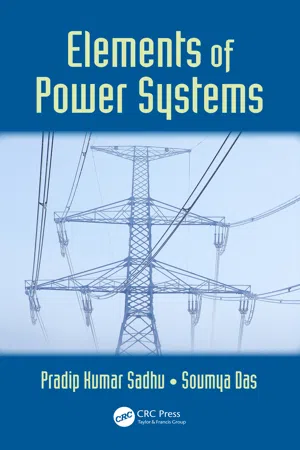
Elements of Power Systems
About this book
Elements of Power Systems prepares students for engineering degrees, diplomas, Associate Member of the Institution of Engineers (AMIE) examinations, or corresponding examinations in electrical power systems. Complete with case studies, worked examples, and circuit schematic diagrams, this comprehensive text:Provides a solid understanding of the the
Information
Chapter 1
Introductory
1.1 Introduction
Energy is the main reason to progress. The natural resources of a country may be massive but they can only be turned into assets if they are developed, exploited, and interchanged for other goods. This cannot be achieved without energy. Energy exists in different forms in nature but the most important form is electrical energy. Energy is needed for heat, light, motive power, etc. The modern development in science and technology has made it possible to convert electrical energy into any desired form. This has given electrical energy a place of pride in the modern world. The survival of industrial undertakings and our social structures depend primarily upon low cost and continuous supply of electrical energy. In fact, availability of sufficient electrical energy and its proper use in any country can result in its people rising from subsistence level to the highest standard of living.
1.2 Significance of Electrical Energy
Electrical energy is advanced to all other forms of energy due to the following reasons:
- Convenient form. Electrical energy is a very useful form of energy. It can be easily transformed into other forms of energy. For example, if we want to convert electrical energy into heat, we just need to pass electrical current through a wire of high resistance, for example, a heater. Similarly, electrical energy can be converted into light (e.g., electric bulb), mechanical energy (e.g., electric motors), etc.
- Easy control. The electrically operated machines have simple and easy starting, control, and operation. For instance, an electric motor can be operated by turning on or off a switch. Similarly, with simple arrangements, the speed of electric motors can be easily varied over the desired range.
- Greater flexibility. One important reason for preferring electrical energy is the flexibility that it offers. It can be easily transported from one place to another with the help of conductors.
- Cheapness. Electrical energy is much cheaper than other forms of energy. Thus, it is overall economical to use this form of energy for domestic, commercial, and industrial purposes.
- Cleanliness. Electrical energy is not associated with smoke, fumes, or poisonous gases. Therefore, its use ensures cleanliness and healthy conditions.
- High-transmission efficiency. The consumers of electrical energy are generally situated quite away from the centers of its production. The electrical energy can be transmitted conveniently and efficiently from the centers of generation to the consumers with the help of overhead conductors known as transmission lines.
1.3 Basic Concepts of a Power System
Generating stations, transmission lines, and the distribution systems are the main components of an electric power system. Generating stations and a distribution system are connected through transmission lines, which also connect one power system (grid, area) to another. A distribution system connects all the loads in a particular area to the transmission lines. For economical and technological reasons, individual power systems are organized in the form of electrically connected areas or regional grids (also called power pools). Each area or regional grid operates independently both technically and economically, but these are eventually interconnected to form a national grid (which may even form an international grid) so that each area is contractually tied to other areas in respect to certain generation and scheduling features. India is now heading for a national grid.
The siting of hydro stations is determined by the natural water power sources. The choice of site for coal-fired thermal stations is more flexible. The following two alternatives are possible.
- Power stations may be built close to coal mines (called pit head stations), and electric energy is evacuated over transmission lines to the load centers.
- Power stations may be built close to the load centers, and coal is transported to them from the mines by rail road.
In practice, however, power station siting will depend upon many factors—technical, economical, and environmental. As it is considerably cheaper to transport bulk electric energy over extra high-voltage transmission lines than to transport equivalent quantities of coal over rail road, the recent trends in India (as well as abroad) is to build super (large) thermal power stations near coal mines. Bulk power can be transmitted to fairly long distances over transmission lines of 400/765 kV and above. However, the country’s coal resources are located mainly in the eastern belt and some coal-fired stations will continue to be sited in distant western and southern regions. As nuclear stations are not constrained by the problems of fuel transport and air pollution, a greater flexibility exists in their siting, so that these stations are located close to load centers while avoiding high-density pollution areas to reduce the risks, however remote, of radioactivity leakage. In India, as of now, about 75% of electric power used is generated in thermal plants (including nuclear), 23% from mostly hydro stations, and 2% come from renewable and others. Coal is the fuel for most of the steam plants; the rest depends upon oil/natural gas and nuclear fuels.
1.4 Single-Line Diagram of a Power Supply Network
The large network of conductors between the power station and the consumers can be broadly divided into two parts viz., transmission system and distribution system. Each part can be further subdivided into two—primary transmission and secondar...
Table of contents
- Preface
- Acknowledgments
- Authors
- Symbols of Circuit Elements
- Chapter 1 - Introductory
- Chapter 2 - Per-Unit Systems
- Chapter 3 - Load Characteristics
- Chapter 4 - Tariffs
- Chapter 5 - Mechanical Design of Overhead Line
- Chapter 6 - Overhead Line Insulators
- Chapter 7 - Corona
- Chapter 8 - Transmission Line Parameters
- Chapter 9 - Performance of Transmission Lines
- Chapter 10 - Underground Cables
- Chapter 11 - Distribution Systems
- Chapter 12 - Fault Analysis
- Chapter 13 - Circuit Breakers
- Chapter 14 - Different Types of Relays
- Chapter 15 - Protection of Alternators and Transformers
- Chapter 16 - Traveling Wave
- Chapter 17 - Earthing
- Chapter 18 - Substation
- Chapter 19 - Power System Stability
- Chapter 20 - Load Flows
- Bibliography
Trusted by 375,005 students
Access to over 1.5 million titles for a fair monthly price.
Study more efficiently using our study tools.
Frequently asked questions
Yes, you can cancel anytime from the Subscription tab in your account settings on the Perlego website. Your subscription will stay active until the end of your current billing period. Learn how to cancel your subscription
No, books cannot be downloaded as external files, such as PDFs, for use outside of Perlego. However, you can download books within the Perlego app for offline reading on mobile or tablet. Learn how to download books offline
Perlego offers two plans: Essential and Complete
- Essential is ideal for learners and professionals who enjoy exploring a wide range of subjects. Access the Essential Library with 800,000+ trusted titles and best-sellers across business, personal growth, and the humanities. Includes unlimited reading time and Standard Read Aloud voice.
- Complete: Perfect for advanced learners and researchers needing full, unrestricted access. Unlock 1.5M+ books across hundreds of subjects, including academic and specialized titles. The Complete Plan also includes advanced features like Premium Read Aloud and Research Assistant.
We are an online textbook subscription service, where you can get access to an entire online library for less than the price of a single book per month. With over 1.5 million books across 990+ topics, we’ve got you covered! Learn about our mission
Look out for the read-aloud symbol on your next book to see if you can listen to it. The read-aloud tool reads text aloud for you, highlighting the text as it is being read. You can pause it, speed it up and slow it down. Learn more about Read Aloud
Yes! You can use the Perlego app on both iOS and Android devices to read anytime, anywhere — even offline. Perfect for commutes or when you’re on the go.
Please note we cannot support devices running on iOS 13 and Android 7 or earlier. Learn more about using the app
Please note we cannot support devices running on iOS 13 and Android 7 or earlier. Learn more about using the app
Yes, you can access Elements of Power Systems by Pradip Kumar Sadhu,Soumya Das in PDF and/or ePUB format, as well as other popular books in Tecnologia e ingegneria & Ingegneria elettronica e telecomunicazioni. We have over 1.5 million books available in our catalogue for you to explore.