- 328 pages
- English
- ePUB (mobile friendly)
- Available on iOS & Android
eBook - ePub
About this book
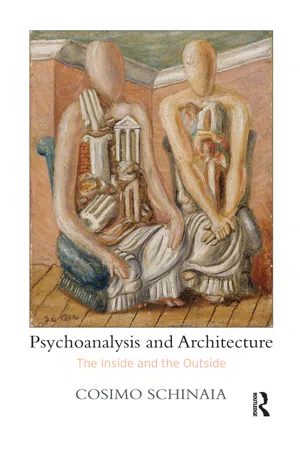
This book explores how psychoanalysis and architecture can enhance and increase the chances of mental 'containment', while also fostering exchange between inside and outside. The way in which psychoanalysts take care of mental suffering, and the way in which architects and city planners assess the environment, are grounded in a shared concern with the notion of 'dwelling'. It is a matter of fact that dwelling exists in a complex context comprised of both biological need and symbolic function. Psychoanalysis and architecture can work together in both thinking about and designing not only our homes but also the analyst's consulting rooms and, more generally, our therapy places. However, this is possible only if they renounce the current limited and restrictive model of this interaction, and propose one more that is more in harmony with the questions and situations that clients themselves pose.
Information
Chapter One
The origins of a meeting
Ithaca has given you the wondrous journey:
Without her you’d never have set out.
She has nothing left to give you any more.
Without her you’d never have set out.
She has nothing left to give you any more.
If you find her poor, Ithaca has not deceived you.
As wise as you’ve become, with such experience, by now
You will have come to know what Ithacas really mean.
As wise as you’ve become, with such experience, by now
You will have come to know what Ithacas really mean.
(Konstantinos Kavafis, Ithaca, 1911, p. 37)
To belong to our home place and to set in new contexts
In Kavafis’ poem the island of Ithaca is a metaphor. It is the destination at the end of an experiential journey during which the traveller becomes aware of the human condition and asserts the autonomy of his conscience and the freedom to define himself. The arrival is of no importance: the meaning of the journey is found in the adventures experienced in a dangerous world. The only monsters the traveller encounters are those existing in his archaic imagination. They annihilate, devour, and paralyse. Because man has to face the unknown outside of himself, he is forced to confront the unknown inside of himself. The only truth he can make reference to during the journey is his place of origin. This is a place that prompts the questions encouraging man to start his journey and this place of origin accompanies and transforms him throughout. In the end, one’s place of origin is where answers and peace are found.1
It is likely that my birth in Taranto, a city in Apulia (a region in the south of Italy that was once the capital of Magna Graecia. Situated in the middle of a gulf, Apulia faces the part of the Mediterranean known as the Ionian Sea) has favoured the making of a professional life at the crossroads of different specialisations and interests. It is also likely that Genoa, where I have settled for reasons of work, has become my Ithaca due to a sort of recognition and recovery of my roots. Genoa, a city in Liguria (a narrow region in the north of Italy at the border with France) is a superb seaside town like Taranto: it has a large port and is located in the middle of a gulf in the Ligurian Sea.
The focus on the relationships between the home place and the new context must be wide and able to comprehend various points of view.
In The Four Quartets (1943, p. 17) the poet Thomas S. Eliot writes: “Home is where one starts from.” However, from a different perspective, in his Mediterranean: A Cultural Landscape (1987, p. 7) the writer Predrag Matvejevic seems to reply to Eliot in this way: “Eventually the place of embarkation will be less important than the place of destination, and what we have seen and how.” Both Eliot and Matvejevic’s perspectives are able to consider the various and conflicting features of emigrating.
To emigrate is to be confronted with the new and the unknown: it means allowing yourself to be traversed by the unknown without allowing yourself to be assimilated by it, without being annihilated by dismay, and without feeling threatened. At the same time, emigration fuels the need to firmly preserve one’s roots and allows them to grow in the face of otherness: this means to not ignore that your original identity is always inside of you, but rather to slow down that hard work of transformation that aims at reaching a separation from our origins. Emigration means having experienced the loss of the container object. Such a feeling is strictly connected to the removal of the indigenous reference points. The ethnologist and philosopher Ernesto De Martino (1952) has called it “territorial anxiety” and the psychoanalysts Leon and Rebeca Grinberg (1984) “protective deficiency”.
The subject desires integration into a new culture and thus he has to face an opposing resistance to integration that places him in a state of affective ambivalence. “The person who emigrates faces a sort of double absence: the absence of the world that she has left behind and, at the beginning, the absence of the world in which she lives now.” (Algini & Lugones, 1999, p. 13)
In her poem Homesickness Marina Tsvetaeva (1934, p. 102) sorely expresses a feeling of indifference from which we can see a glimmer of hope:
Houses are alien, churches are empty
everything is the same
but if by the side of the path one
particular bush rises
the rowanberry …
everything is the same
but if by the side of the path one
particular bush rises
the rowanberry …
Migration implies crossing not only a geographic border, but also a cultural and existential one. This is because the border represents the utmost place of transformation and transition. In other words, the fact of being in transit implies a complex process of psychic transformation and discussion at the relational and cultural level. The border defines a whole psychic dimension in which we can stay for a significant time. In fact, a true process of reformulation of identity requires time (De Micco, 2014b).
Let’s think about Freud’s long journey:
Freud was born in a border town and went to live in Vienna, a city near the border of Western Europe. Later, he went to study in Trieste and then in Berlin, both border cities. Is this a coincidence? Perhaps we can say that, by gladly accepting the decisions of destiny, Freud developed a great passion for frontiers, ridges, crossroads … borders, forks, deviations, in few words, for that line that cannot be precisely placed and able to connect and separate different areas. (Ricci, 1995, pp. 18–19)
Leon and Rebeca Grinberg (1984) argue that the migration experience is an out-and-out rebirth experience. This is because, in such an experience, it is necessary to again travel through a complete developmental path in a foreign country. In a certain sense, the migrant experiences again the condition of the child who, at the beginning of life, does not know the meaning of language and must orient herself through the emotional undertones of communication. The more dreadful and distressing these tones, the less comprehensible they are. The more chaotic, emotion-laden, and persecutory they sound, the less acceptable and representable they will be.
This situation involves learning to tolerate and perhaps to endorse an ambivalence both insurmountable and fruitful. This is difficult to do without running the risk of losing focus, that is to say, running the risk of falling into an unstable equilibrium between security and insecurity, the known and the unknown, recognition and disorientation, identification with the origins and identification with the stranger.
In ancient Greece, the centre of the agora was where the moneychangers could be found. Anyone who wanted to start a journey had to pass through the peristyle, to stand up and be counted, to approach a moneychanger in order to finally improve her future purchasing power (Nunzio, 1976).
The psychiatrist Flavio Pavan argues that this ritual has a hidden symbolic meaning:
Going out into the open space is a prelude to separation from the protection of the mother country. In a condition of relative absence of references in which the traveller has to face the fear of a painful experience of isolation and alienation, the ritual offers her a person with whom to identify. This can inspire her capacity to adapt to new realities and to acquire new horizons free of the most threatening aspects. The position of moneychangers in the centre of the agora is umbilical. In fact, it indicates the future separation and gives testimony to the choral interest of community for the experiences of others. Community members consider these experiences of exploration and the return of one any of them as possibilities of growth for all of them. (1984, p. 256)
The psychoanalyst Giovanna R. De Ceglie writes of symbol formation and notes that:
The Greek word symbolon means a sign of recognition. The symbolon was an object that was broken in half by two people, each retaining one piece. After a long absence from one another, when reunited they would match the two pieces together as a sign of recognition of their relationship. The symbolon is a representation of our need to grow and separate without losing our sense of belonging to our origins … Without the symbolon we would not manage separation … Without separation we would not be called upon to exercise the function of creating symbols and with them to furnish our internal home. (2005, p. 103)
Recognition of our self occurs through a type of prior disorientation caused by otherness, that is to say, in the house of someone different from us, a foreigner. We are forced to expose ourselves out of our own houses (Pesare, 2007).
The philosopher and sociologist Jean Baudrillard (1990, p. 197) writes: “The other is what allows me not to repeat myself for ever.”
The philosopher Gianni Vattimo (1989) points out that the achievement of a continuous oscillation between belonging, displacement, and reintegration is the only possibility for a contemporary human being to dialectically experience a new world. Such a world is certainly full of differences, but also offers a great wealth of wisdom and freedom.
According to the anthropologist Franco La Cecla:
To lose yourself is … either the state of origins, the need and the land from which you start or restart to direct yourself. There is a cultural process between losing and directing yourself. Such a process is to make the external and fortuitous occasions favourable, that is to say, to make the unknown hospitable and comfortable. For example, to direct yourself could mean … all frustrations, failed attempts, acquaintances, long waits, senses of a new reality, life preservers made up of people and places. Day-to-day all these things start as an elementary network … that becomes more and more complex and permits both to recognise and include the remaining unknown sites and to part from and return to more familiar places. (2000, pp. 16–17)
The back and forth between losing ourselves and meeting ourselves again, between the house of the other and one’s own house can also be a possibility for balancing the necessary separateness of the impersonal and the pre-individual dimension of the mind. That is to say:
The separateness can be meaningful only if we can keep it in fluctuation with the impersonal and pre-individual dimension of the mind. Such a dimension ensures permeable borders and allows sharing and empathising. Then, the differentiated and the undifferentiated are the two focal points in the formation of the subject. (Ambrosiano & Gaburri, 2013, p. 19)
Creativity … implies a capacity to regress and to not be differentiated or, more precisely, to become more complicated and complete. The human psychic development risks being (and generally is) the output of a progressive depletion. For realising some of our many starting potentialities, any one of us slowly forgets the most of them. Only one who can psychically return to the conditions in which these potentialities could be represented can see the external stimuli in a new way and thus think about new solutions from the inside. (Semi, 2014, pp. 178–179)
Between eradication and hyper-adaptation
To build up new points of reference, to get accustomed to new sights, to settle into new contexts, and to continuously provide necessary mediations and translations between them allows us to “learn to learn” (Bateson, 1972). This means reconsidering features taken for granted and becoming involved again. In other words, this means allowing fantasies of a new beginning in opposition to those feelings of having sacrificed, blocked, or censored some authentic aspects of the self in order to adapt to the environment. As stated by the philosopher and historian Tzvetan Todorov (2002), the individual can remove himself from his country, language, and childhood traumas because members of the human species can continuously modify themselves.
An obstacle to communication and to an exchange without suspicions is certainly the language and the accent. This is because the accent immediately identifies a foreign person or a stranger.
As the anthropologist and sociologist René Girard (1982, p. 153) points out, “the person with the accent, any accent, is always the person who is not from here. Language is the surest indicator of the being with.”
However, linguistic difference includes not only “a vocabulary and a syntax to learn, but also facial expressions and gestures to recognise and symbols to appreciate … Joys and afflictions have not the same translation everywhere” (Pélicier, 1964, p. 2719). Thus, some inevitable errors of interpretation of the surrounding world and its messages are always possible (Frigessi Castelnuovo & Risso, 1982).
I believe there is the risk2 of adopting a compensatory mechanism of hyper-adaptation to a new environment, I mean, a superficial and artificial assimilation into the new culture without an authentic working through. In this sense, a person runs the risk of creating a sort of robotic false self with conformist features, which rigidly submits to rules and is inhibited in its affects.
Beyond the rhetoric of enhancement provided by hybridisation and hybrid cultures, so-called multicultural societies offer an unsettling and unstable panorama. In fact, in such a panorama, the uneasiness of identity appears multiple and painful due to a total lack of tools for subjective appropriation of radical anthropological transformations caused by the migration itself. Immigrants often experience a dramatic collapse of their symbolising apparatus (De Micco, 2014a). The discomforts of such a collapse are often hidden behind masks of perfect integration that are built up by privileging certain attitudes that act as camouflage. Actually, nomadic identities are built along uncertain and unstable cultural boundaries and continuously struggle to find a psychic place in which to live and a symbolic space in which to lay roots (De Micco, 2012).
According to the psychoanalyst Silvia Amati Sas (2010), if our unconscious were penetrable by the mentality of others, it would be as if our mind were pervaded in a natural, not disturbing, and free-from-anxiety (that is to say, free from alienation and perplexity) manner. In this manner our mind would become part of the obvious and the implicit natural world living in us and that surrounds us.
However, the sociologist Georg Simmel (1908) argues that the foreigner learns to adapt in a more conscious and penetrating (though painful) way compared to those who live their belonging as a right without a conflicted relationship to their environment. An accent that identifies a person as a foreigner or a stranger can constitute an obstacle to communication and generate suspicion.
According to the sociologist Richard Sennett (2008), the changes required to modify relations between human beings and the physical world are so great that only a certain sense of self-displacement and estrangement can lead to concrete practices of change and to the reduction of our consuming desires.
In this hustle of psychoanalysis and sociology, the psychoanalyst Claudio Neri (1999) reminds us that although domestic objects can give us comfort, they cannot help us to recover the vital force, that is to say, the energy of life enhancement. This energy can only come with the meeting of a stranger.
On this point, the psychoanalyst Antonio Alberto Semi argues that:
Only a careful consideration of the original effects and of the possibility of building up new representations up at every level of psychic life allows the individual to detach himself from the original internal objects and from every lost object. Such a detachment has certainly a human dimension because it permits the assessment of experiences with these lost objects as unique. Further, it permits the assessment of these objects as different in respect from those that are now represented as new and noticeable. It is only in this way that the nostalgia for the beloved and lost objects would not be held in grievance against possible new objects that cannot take the place of the old ones or give up to the narcissistic presumption of morbidly repeating a lost object and the relation with it. It is only in this way that the nostalgia will emerge as something clear, recognisable (because it was already recognised), and able to guarantee psychic continuity. This is because it represents such a continuity and even before the reality of desire. (2014, pp. 47–48)
Literary critic Jean Starobinski writes:
Nowadays … nostalgia no longer in...
Table of contents
- Cover
- Half Title
- Title
- Copyright
- Dedication
- Contents
- ACKNOWLEDGMENTS
- ABOUT THE AUTHOR
- FOREWORD TO THE ENGLISH EDITION Entering and exiting
- PREFACE TO THE ITALIAN EDITION
- INTRODUCTION
- CHAPTER ONE The origins of a meeting
- CHAPTER TWO Fruitful contaminations
- CHAPTER THREE The metaphorical architecture of mind
- CHAPTER FOUR The space
- CHAPTER FIVE Architecture between past, present, and future
- CHAPTER SIX Continuity and discontinuity in psychoanalysis
- CHAPTER SEVEN The haste in the world around us
- CHAPTER EIGHT The uncanny
- CHAPTER NINE Psychoanalysis and architecture: the need for an interdisciplinary debate
- CHAPTER TEN The house
- CHAPTER ELEVEN Therapy places
- CHAPTER TWELVE The analyst's consulting room
- CHAPTER THIRTEEN Some notes and suggestions on a possible partnership between architects and psychoanalysts
- CONCLUDING REMARKS
- AFTERWORD TO THE ENGLISH EDITION
- NOTES
- REFERENCES
- INDEX
Trusted by 375,005 students
Access to over 1.5 million titles for a fair monthly price.
Study more efficiently using our study tools.
Frequently asked questions
Yes, you can cancel anytime from the Subscription tab in your account settings on the Perlego website. Your subscription will stay active until the end of your current billing period. Learn how to cancel your subscription
No, books cannot be downloaded as external files, such as PDFs, for use outside of Perlego. However, you can download books within the Perlego app for offline reading on mobile or tablet. Learn how to download books offline
Perlego offers two plans: Essential and Complete
- Essential is ideal for learners and professionals who enjoy exploring a wide range of subjects. Access the Essential Library with 800,000+ trusted titles and best-sellers across business, personal growth, and the humanities. Includes unlimited reading time and Standard Read Aloud voice.
- Complete: Perfect for advanced learners and researchers needing full, unrestricted access. Unlock 1.5M+ books across hundreds of subjects, including academic and specialized titles. The Complete Plan also includes advanced features like Premium Read Aloud and Research Assistant.
We are an online textbook subscription service, where you can get access to an entire online library for less than the price of a single book per month. With over 1.5 million books across 990+ topics, we’ve got you covered! Learn about our mission
Look out for the read-aloud symbol on your next book to see if you can listen to it. The read-aloud tool reads text aloud for you, highlighting the text as it is being read. You can pause it, speed it up and slow it down. Learn more about Read Aloud
Yes! You can use the Perlego app on both iOS and Android devices to read anytime, anywhere — even offline. Perfect for commutes or when you’re on the go.
Please note we cannot support devices running on iOS 13 and Android 7 or earlier. Learn more about using the app
Please note we cannot support devices running on iOS 13 and Android 7 or earlier. Learn more about using the app
Yes, you can access Psychoanalysis and Architecture by Cosimo Schinaia in PDF and/or ePUB format, as well as other popular books in Psychology & Interior Design. We have over 1.5 million books available in our catalogue for you to explore.