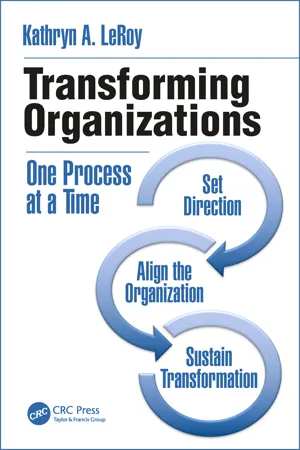
This book offers leaders an approach to systemically affect change and create cultures of excellence where staff work together to change the way they view their work. Based on well-known quality concepts, readers will discover the essential concepts and actions that have the power to transform every system.
- 228 pages
- English
- ePUB (mobile friendly)
- Available on iOS & Android
eBook - ePub
chapter one
Transform through a culture of excellence
Knowing is not enough; we must apply.
Willing is not enough; we must do.1
Goethe
Do you want to transform your organization and create a culture of excellence? High performing teams and organizations possess the desire and persistence to achieve at the highest level—essential to creating a culture of excellence. Are we willing to learn, to persist, to be courageous? The first lesson in this book is that transformation begins with doing.
Act to transform
I have observed organizations that try to think as a system. They try to continually improve. They try to engage employees. They try to measure effectiveness of their work. They try to listen and understand the needs of their customers and stakeholders. They try; trying is not doing.
Doing and acting build a culture of excellence. Creating that culture requires keeping “a constant awareness and vigilance to always be your best with passion, competency, flexibility, communication, and ownership.”2 Passion is not about platitudes or posters exhorting employees to strive for excellence. Passion is about inspiring a positive focus on possibilities. Too often, we become our own worst enemy simply because we lose hope and become fixated on what appear as insurmountable odds.
Transformation of any kind requires many types of skills across the organization. Building the capacity of everyone to accomplish the work is essential for excellence. We must not limit competency to professional skills. Interpersonal skills and emotional intelligence support effective decision making, collaboration, and become the foundation for a culture of excellence. As we become more confident in our ability to do our best, individually and in teams, we can tackle the seemingly impossible.
Communicate, communicate, communicate! Communication in a culture of excellence balances listening and speaking. Whether you have a large organization or your business consists of you and one or two others, never underestimate the importance of effective communication. The way we deliver the message and the extent to which we listen and respond to others has the power to shape perceptions. A respected colleague pointed out to me the interdependent relationship between communication, commitment, and compromise. Success often depends on our willingness to communicate our commitment knowing that compromise influences our relationships and decisions. This one area can derail our efforts, and we can easily delude ourselves in thinking that everyone knows and everyone shares the same commitment.
Without exception, continuous improvement requires change. When you begin to transform your organization and improve how you do your work, the status quo does not exist. Inherent to excellence is the continual recalibration of our knowledge and skills and the way we achieve goals or outcomes. The difference between success and failure often lies in the extent to which you and your team can persist, flex with the inevitable, and accept that doing your best always results in change.
Blame undermines relationships and progress, leaves us frustrated, and erodes trust. We cannot blame others for our circumstances. The complexity of modern organizations tempts us to approach our situation as victims. Operating as a victim creates blind spots where we fail to recognize the central issue, or that we likely have created the crisis and the only way out is to own it. We may balk at the word accountability as overused and vague. We can define accountability as, “A personal choice to rise above one’s circumstances and demonstrate the ownership necessary for achieving desired results—to See It, Own It, Solve It, Do It.”3
This work also requires a leader and a vision. Without these two critical components, excellence may be elusive and out of reach—not because it is hard and not because people do not desire to do their best. Excellence will be out of reach because a system requires an aim and a leader who will take intelligent risks. We need leaders who will consistently model the behaviors that will shape excellence. Leaders must understand that leading is about relationships and connecting to employees and stakeholders.
Are you ready to do? If you are, the chapters that follow will give you the foundation and practical actions to begin your journey. The actions are simple, but ironically, many leaders choose not to take these small steps.
Why? Perhaps, the small steps seem so insignificant to those looking for a big splash or instant gains. Creating a culture for excellence and transforming an organization is about building. And, as they say, “Rome wasn’t built in a day.” We cannot transform an organization to create a culture of excellence in a day.
Make a commitment to excellence
Whether we are talking about personal, group, or organizational excellence, one component is nonnegotiable—commitment. I am not a particularly athletic person, but at one point I had the opportunity to play in a local tennis league. My tennis experience consisted of what I learned in a physical education class in college—roughly six weeks of hitting against a backboard, lobbing the ball in the air, and several miserable attempts at playing the game.
I would not achieve my goal to compete in tennis if I did not make a commitment to learning skills, practicing the skills, and playing increasingly with more advanced players. I could never successfully compete in any tennis tournament if I only watched as others played tennis. I had to make a commitment and act to do what it took to improve my tennis skills.
So, I did just that. I practiced. I watched videos. I practiced. I bought a decent racket. I practiced. I played against opponents better than me and some who were worse than me. I made a firm commitment to excel in tennis. Now, I wish I could tell you that I went on to Wimbledon, but I did improve and continued to play against those who were better and more experienced. In a league that classified teams from F (least experienced) to A (awesome and experienced), I started on the F team. With commitment and perseverance, I transformed my tennis ability and worked my way up to the C team.
My tennis acumen may seem unimpressive, but for me, it represented quite an accomplishment. Success, no matter how small, did not come by blaming others for my poor performance. I committed to the basics to continually improve my serves, my agility, or my understanding and execution of good form. I never once said I just wanted to be okay at playing tennis. I wanted to be my best and made a commitment to do just that.
I often wonder why organizations choose to remain mediocre but claim excellence as their vision. Leaders have told me that using tools such as Six Sigma, ISO, process management, etc. detracts from the real work of the company. They lament, “We just can’t take the time for that in this economy and competitive market.”
My response? You cannot NOT take time to do the things that will build your competitive advantage, create a culture of learning and excellence, develop loyal customers, and actively engage your workforce in accomplishing your vision.
In the eyes of the customer, whether you sell shoes, run a nonprofit, manufacture high tech gadgets, treat illnesses, or educate our children, being “sort of” good is simply not enough. Buyers, patients, students, parents, teachers, and communities want our best.
Yet, many of us work exceptionally hard at just okay. What disturbs me most is that we often do not even realize we made that choice. We make excuses, we blame the economy, the laws, the competition, and whatever or whomever we believe has created an obstacle to our success.
Performance excellence, by organizations, individuals, or teams, rarely succeeds without a clear vision of the outcome and the commitment ...
Table of contents
- Cover
- Half Title
- Title Page
- Copyright Page
- Dedication
- Contents
- Preface
- Acknowledgments
- Insights for the Journey Interviewee List
- Author
- Chapter one: Transform through a culture of excellence
- Section one: Set organizational direction for excellence
- Section two: Align the organization for excellence
- Section three: Sustain transformation
- Appendix
- Index
Trusted by 375,005 students
Access to over 1.5 million titles for a fair monthly price.
Study more efficiently using our study tools.
Frequently asked questions
Yes, you can cancel anytime from the Subscription tab in your account settings on the Perlego website. Your subscription will stay active until the end of your current billing period. Learn how to cancel your subscription
No, books cannot be downloaded as external files, such as PDFs, for use outside of Perlego. However, you can download books within the Perlego app for offline reading on mobile or tablet. Learn how to download books offline
Perlego offers two plans: Essential and Complete
- Essential is ideal for learners and professionals who enjoy exploring a wide range of subjects. Access the Essential Library with 800,000+ trusted titles and best-sellers across business, personal growth, and the humanities. Includes unlimited reading time and Standard Read Aloud voice.
- Complete: Perfect for advanced learners and researchers needing full, unrestricted access. Unlock 1.5M+ books across hundreds of subjects, including academic and specialized titles. The Complete Plan also includes advanced features like Premium Read Aloud and Research Assistant.
We are an online textbook subscription service, where you can get access to an entire online library for less than the price of a single book per month. With over 1.5 million books across 990+ topics, we’ve got you covered! Learn about our mission
Look out for the read-aloud symbol on your next book to see if you can listen to it. The read-aloud tool reads text aloud for you, highlighting the text as it is being read. You can pause it, speed it up and slow it down. Learn more about Read Aloud
Yes! You can use the Perlego app on both iOS and Android devices to read anytime, anywhere — even offline. Perfect for commutes or when you’re on the go.
Please note we cannot support devices running on iOS 13 and Android 7 or earlier. Learn more about using the app
Please note we cannot support devices running on iOS 13 and Android 7 or earlier. Learn more about using the app
Yes, you can access Transforming Organizations by Kathryn A. LeRoy in PDF and/or ePUB format, as well as other popular books in Business & Business General. We have over 1.5 million books available in our catalogue for you to explore.