![]()
1
Introduction
Visions and futures in the study of low-carbon energy systems
The human condition can almost be summed up in the observation that, whereas all experiences are of the past, all decisions are about the future. The image of the future, therefore, is the key to all choice-oriented behavior. The character and quality of the images of the future which prevail in a society are therefore the most important clue to its overall dynamics.
Kenneth E. Boulding, 1973 In F. L. Polak. The image of the future. Amsterdam/London/New York: Elsevier Scientific. 1973. p. v.
All the great empires of the future will be empires of the mind.
Sir Winston Churchill, 1953 In Edward Hedican. Anthropology in the future. Social Anthropology: Canadian Perspectives on Culture and Society. Canadian Scholars Press. 2012. p. 237.
As messengers Boulding and Churchill opine, how we think about the future can both reveal fundamental aspects of the human condition, and also motivate exploration and intellectual empire building. Visions of the future have a long history inspiring humanity to create a better tomorrow. Fred Polak, a sociologist who practically founded the field of future studies, goes as far as to argue that the heights of classical civilization, Judaic culture, Islamic culture, the Renaissance and the Enlightenment, and the early industrial era were all preceded by daring imaginative leaps forward and new visions of human possibility.1 Although one can debate his logic, for Polak, culture itself can be defined by its vision of the future. “Thinking about the future,” he concluded, “is not only the mightiest lever of progress but also the condition of survival.”2 Something known as “Quigley’s Law” supposes that “successful societies are defined by their readiness to allow consideration of the future to determine today’s choices.”3 As the epitaph above suggests, Elise Boulding and Kenneth E. Boulding add that at an even more basic level, unless we think we know something about the future, decisions are impossible; all decisions involve choices among images of alternative futures.4 To Kenneth E Boulding in particular, “all decisions are made about imaginary futures, not about real ones”5
Visions of the future can also play a key role in the innovation and research process itself. Fujimura’s work has demonstrated how genomic scientists use “future imaginaries” to mobilize financial support for their research,6 and Van Lente has similarly shown that fantastic expectations of technology can motivate engineers and designers to initiate projects.7 Jasanoff and Kim write about “socio-technical imaginaries” operating behind nuclear research in South Korea and the United States, and point out that national “imaginations can penetrate the very designs and practices of scientific research and technological development.”8 Mads Borup and colleagues argue that expectations are of great importance for the development of technologies as they stimulate, steer and coordinate actors as diverse as designers, managers, investors, sponsors, and politicians. As they go on to write:
Future-oriented abstractions are among the most important objects of enquiry for scholars and analysts of innovation. Such expectations can be seen to be fundamentally “generative,” they guide activities provide structure and legitimation, attract interest and foster investment. They give definition to roles, clarify duties, offer some shared shape of what to expect and how to prepare for opportunities and risks. Visions drive technical and scientific activity, warranting the production of measurements, calculations, material tests, pilot projects and models. As such, very little in innovation can work in isolation from a highly dynamic and variegated body of future-oriented understandings about the future.9
Offering more support, Cynthia Selin adds that “the expectations, hopes, fears, and promises of new technologies are not set apart from, nor layered on top of scientific and technological practices but are, rather, formative elements of innovation,”10 and Nightingale calls technological optimism and fantasy an elemental part of the “cognitive” dimension of innovation.11 Technological visions and fantasies can even become exclusionary and self-replicating, convincing those that do not share them to leave a project or disciplinary field entirely. To all of these disparate types of thinkers, “the future is what matters in the present.”12
For perhaps these reasons, visions of the energy future in particular have become a powerful force in the construction (and deconstruction) of energy and climate scenarios, forecasts, and analysis. Outside of the research community, business analysts, regulators, titans of industry and inventors (among others) continually devote a significant amount of effort towards developing, deploying, and even negating futuristic narratives and images for political and economic ends. In the public domain, users, consumers, citizens, and the media also frequently invent, modify, circulate, and/or resist such narratives.13
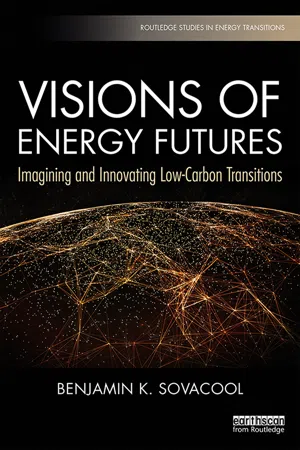
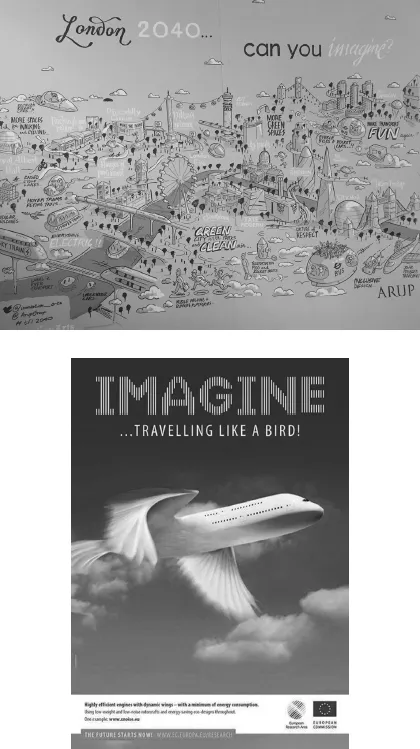
Therefore, fantastic, visionary, and delightful narratives can capture public imaginations and solicit political support for low-carbon technologies. They can facilitate Churchill’s “empire building of the mind.” One can even see appeals to imagination and fantasy when they visit local museums or funding agencies such as the European Commission, as Figure 1.1 indicates. Visions and fantasies therefore have relevance for all those concerned about energy technology choice, innovation, commercialization, and energy and climate policy decisions.14,15,16
FIGURE 1.1 Imaginary visions about energy and transport in London and Brussels, 2017. (a) Top panel: At the London Transport Museum, Covent Garden, London, October 2017. (b) Bottom panel: At the Research and Innovation Offices of the European Commission, Brussels, Belgium, May 2017
Source: Author
Notwithstanding their prominence, little academic work has attempted to engage the topic of visions and fantasies empirically or theoretically in a systematic or comparative manner, or connected them to pressing policy concerns such as low-carbon transitions. To address this gap, this book seeks to examine the visions (and fantasies, frames, discourses, imaginaries, and expectations) associated with six state-of-the-art energy systems—nuclear power, hydrogen fuel cells, shale gas, clean coal, smart meters, and electric vehicles—playing a key role in current deliberations about low-carbon energy supply and use. The book’s methodology is based on extensive original data or analysis including semi-structured interviews, media content analysis, and systematic reviews.
Why these six innovations? To offer a balance between supply side options (gas, coal, nuclear) and decentralized or even end-use options (fuel cells, smart meters, electric vehicles), as well as a mix of fuels (some renewable, some fossil fueled, and fission) and scales (household, industrial, commercial). Moreover, although we will see how some have deeper historical origins than commonly articulated, all of them are relatively new, and at early stages of commercialization or diffusion, meaning that critically examining them can influence actual deployment and innovation trajectories and ultimately consumer acceptance (or rejection). There was lastly an effort at novelty, to break new ground and not study energy technologies that have received the bulk of visions or discourse scholarship so far, notably biofuel and biomass,17,18,19,20,21,22 hydropower,23,24,25,26 wind energy,27,28,29,30,31 and solar energy32,33,34,35,36 (which is why these types of energy systems are not examined here).
Ultimately, the book is motivated by the premise that tackling climate change via low-carbon energy systems (and practices) is one of the most significant challenges of the twenty-first century, and that success will require not only new energy technologies but also new ways of understanding language, visions, and discursive politics. In doing so, the book unveils what the future of energy systems could look like and how their meanings are produced, often alongside moments of contestation. The discursive creation of the energy systems of tomorrow are often propagated in polity, hoping to be realized as the material fact of the future but processed in conflicting ways with underlying tensions as to how contemporary societies ought to be ordered (and disordered). Visions thus nestle in a critical space between the possible and impossible, the emergent and divergent, and the material and corporeal.
Definitions and terms
Admittedly, some of the core terms and concepts in the book—vision, discourse, narrative, expectation, storyline, fantasy—interrelate and overlap. Although I offer varying definitions throughout the chapters, the term “vision” is broadly meant to be an umbrella concept covering “a description of what could occur in the near-term, mid-term, or long-term future.” At the core of analyzing a vision is an assessment of the symbolic aspects of communication, highlighting the relationship between what passes for scientific reality or engineering capability, and things that mediate that reality such as stories, expectations, and visions.37,38,39,40,41 In other terms, articulated visions are simultaneously rational and allegorical, reflecting both a penchant for storytelling and constructing myths as much as logical reasoning or rational action.
That said, my use of the term “fantasy” is more precise: it refers to “a storyline that captures the human need to experience and interpret drama.” For Bormann (see Chapter Three on “symbolic convergence” for more), “fantasy” refers to the way that communities of people share their social reality, a creative interpretation of events that fulfill a psychological and rhetorical need.42 It is not to be mistaken for something that is imaginary (like ghosts or aliens), pejorative (signifying some...