eBook - ePub
Linear Programming and Algorithms for Communication Networks
A Practical Guide to Network Design, Control, and Management
- 208 pages
- English
- ePUB (mobile friendly)
- Available on iOS & Android
eBook - ePub
Linear Programming and Algorithms for Communication Networks
A Practical Guide to Network Design, Control, and Management
About this book
Explaining how to apply to mathematical programming to network design and control, Linear Programming and Algorithms for Communication Networks: A Practical Guide to Network Design, Control, and Management fills the gap between mathematical programming theory and its implementation in communication networks. From the basics all the way through to m
Information
Chapter 1
Optimization problems for communications networks
Communication networks consist of nodes and links. Figure 1.1 shows an example of a network. This network consists of six nodes, node 1 to node 6. An arrow between two nodes is a connection, called a link, of those nodes. The traffic has a direction from the tail to the head of the arrow. For example, the arrow from node 1 to node 2 means that node 1 and node 2 are connected and the traffic flows from node 1 to node 2. The network in which each link has a direction, represented by a corresponding arrow, as shown in Figure 1.1, is called a directed graph. A number on each link indicates its link cost. In the case that the connection is represented by just a line, instead of an arrow, the traffic can flow in both directions on the link. A network with links through which the traffic flows in both directions is called a undirected graph.
This chapter introduces typical examples of the problems posed by communication networks, starting with the shortest path problem.
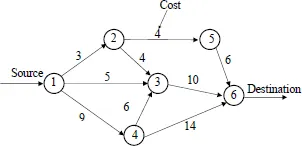
Figure 1.1: Network model with link costs.
1.1 Shortest path problem
Consider that node 1 wants transmit traffic to node 6, as shown in Figure 1.1. We need to find the path with the minimum cost to transmit the traffic. Nodes 1 and 6 are called source and destination nodes, respectively. The path with the minimum cost from the source node to the destination node is called the shortest path. The shortest path is determined by considering the link costs in the network. This problem is called the shortest path problem. The problem is solved and the solution is obtained, as shown in Figure 1.2. The shortest path from node 1 to node 6 is 1 → 2 → 5 → 6, and the path cost, which is the sum of costs of the links on the path, is 3 + 4 + 6= 13.
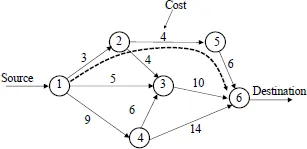
Figure 1.2: Shortest path from node 1 to node 6.
1.2 Max flow problem
Figure 1.3 shows a network that considers the capacity of each link. The number on each link represents the link capacity; that is the maximum traffic that can be transmitted through the link. Traffic volume, v, is injected from node 1. How much maximum traffic can we send from node 1 to node 6? Which route should the traffic be transmitted on? This problem is called the max flow problem. Figure 1.4 shows the solution of this problem. The maximum traffic volume from node 1 to node 6 is v = 195 and consists of five paths with their corresponding traffic volumes of v1 to v5. v1 = 15 is sent on the first path, 1 → 2 → 5 → 6. v2 = 10 is sent on the second path, 1 → 2 → 3 → 6. v3 = 100 is sent on the third path, 1 → 3 → 6. v4 = 60 is sent on the fourth path, 1 → 4 → 3 → 6. v5 = 10 is sent on the fifth path, 1 → 4 → 6. The total traffic v is v1 + v2 + v3 + v4 + v5 = 15 + 10+100 + 60+10 = 195. The traffic that flows on each link does not exceed the link capacity. For example, the traffic on link 1 → 2 is v1 + v2 = 15 + 10 = 25, which does not exceed 25 (25 is the capacity of link 1 → 2). The traffic on link 3 → 6 is v2 + v3 + v4 = 10 + 100 + 60 = 170 does not exceed 200 (200 is the capacity of link 1 → 2).
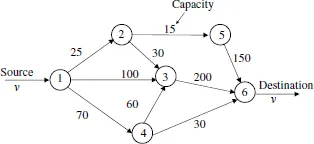
Figure 1.3: Network model with link capacities.
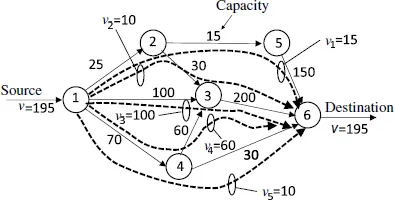
Figure 1.4: Max flow routing from node 1 to node 6.
1.3 Minimum-cost flow problem
Figure 1.5 shows a network that considers the cost and capacity of each link. The numbers on each link represents the link cost and the link capacity. The traffic flow cannot exceed the link capacity. The traffic volume that is required to be transmitted from a source node, node 1, to a destination node, node 6, is set to v = 180. How can we send the required traffic volume from node 1 to node 6 at the minimum cost? This problem is called the minimum-cost flow problem. In the minimum-cost flow, the required cost for each link is defined as the cost of the link × the traffic volume that flows on the link. We minimize the sum of costs on the path(s) to send the traffic from node 1 to node 6.
Figure 1.6 shows the solution of the minimum-cost flow problem. The traffic with the volume of v is divided into five paths, from v1 to v5. v1 = 15 is sent on the first path, 1 → 2 → 5 → 6. v2 = 10 is sent on the second path, 1 → 2 → 3 → 6. v3 = 100 is sent on the third path, 1 → 3 → 6. v4 = 25 is sent on the fourth path, 1 → 4 → 3 → 6. v5 = 30 is sent on the fifth path, 1 → 4 → 6. The total traffic volume is v = v1 + v2 + v3 + v4 + v5 = 15 + 10 + 100 + 25 + 30 = 180. The total cost is 3180. There is no traffic flow that exceeds the capacity of the link on which it flows.
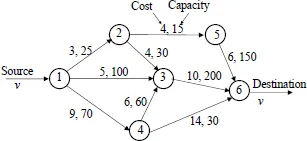
Figure 1.5: Network with link costs and capacities.
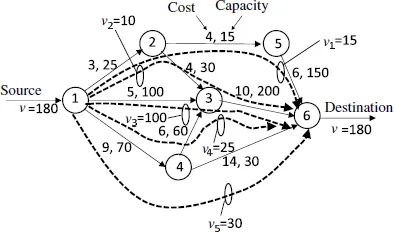
Figure 1.6: Minimum-cost flow from node 1 to node 6.
Chapter 2
Basics of linear programming
An optimization problem is a problem that aims to find the best solution from all feasible solutions. The best solution can be the minimum or maximum solution. An example of the former is finding the route from point A to point B that takes the shortest time. An example of the latter is determining how a production factory can maximize its profit using limited materials. Both problems are optimization problems. An optimization problem can be solved by mathematical programming, a technique that expresses and solves problems as mathematic models.
This chapter explains linear programming, which is a special case of mathematical programming.
2.1 Optimization problem
A businessman must travel from city A to city B on a business trip. He has two choices as to the means of transportation: airplane or train. How can he travel with the minimum cost given the following conditions?
• Condition 1: The price for a one-way ticke...
Table of contents
- Cover
- Title Page
- Copyright
- Contents
- Preface
- 1 Optimization problems for communications networks
- 2 Basics of linear programming
- 3 GLPK (GNU Linear Programming Kit)
- 4 Basic problems for communication networks
- 5 Disjoint path routing
- 6 Optical wavelength-routed network
- 7 Routing and traffic-demand model
- 8 IP routing
- 9 Mathematical puzzles
- A Derivation of Eqs. (7.6a)–(7.6c) for hose model
- B Derivation of Eqs. (7.12a)–(7.12c) for HSDT model
- C Derivation of Eqs. (7.16a)–(7.16d) for HLT model
- Answers to Exercises
- Index
Trusted by 375,005 students
Access to over 1.5 million titles for a fair monthly price.
Study more efficiently using our study tools.
Frequently asked questions
Yes, you can cancel anytime from the Subscription tab in your account settings on the Perlego website. Your subscription will stay active until the end of your current billing period. Learn how to cancel your subscription
No, books cannot be downloaded as external files, such as PDFs, for use outside of Perlego. However, you can download books within the Perlego app for offline reading on mobile or tablet. Learn how to download books offline
Perlego offers two plans: Essential and Complete
- Essential is ideal for learners and professionals who enjoy exploring a wide range of subjects. Access the Essential Library with 800,000+ trusted titles and best-sellers across business, personal growth, and the humanities. Includes unlimited reading time and Standard Read Aloud voice.
- Complete: Perfect for advanced learners and researchers needing full, unrestricted access. Unlock 1.5M+ books across hundreds of subjects, including academic and specialized titles. The Complete Plan also includes advanced features like Premium Read Aloud and Research Assistant.
We are an online textbook subscription service, where you can get access to an entire online library for less than the price of a single book per month. With over 1.5 million books across 990+ topics, we’ve got you covered! Learn about our mission
Look out for the read-aloud symbol on your next book to see if you can listen to it. The read-aloud tool reads text aloud for you, highlighting the text as it is being read. You can pause it, speed it up and slow it down. Learn more about Read Aloud
Yes! You can use the Perlego app on both iOS and Android devices to read anytime, anywhere — even offline. Perfect for commutes or when you’re on the go.
Please note we cannot support devices running on iOS 13 and Android 7 or earlier. Learn more about using the app
Please note we cannot support devices running on iOS 13 and Android 7 or earlier. Learn more about using the app
Yes, you can access Linear Programming and Algorithms for Communication Networks by Eiji Oki in PDF and/or ePUB format, as well as other popular books in Technik & Maschinenbau & Computernetzwerke. We have over 1.5 million books available in our catalogue for you to explore.