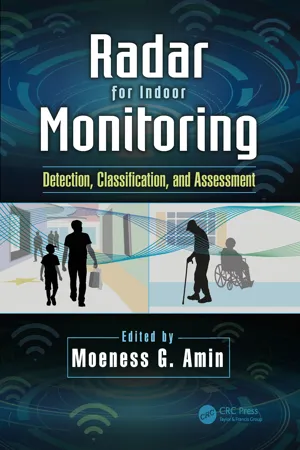
This book aims to capture recent advances and breakthroughs in in-home radar monitoring of human motions and activities. It addresses three key attributes of radar for in-door human monitoring, namely: motion classification including fall, detection of vital signs, and categorization of human gait for risk assessment and progression of physical impairments and disabilities. It explores recent developments in radar technology for human monitoring inside homes and residences. The reader will learn enhanced detection and classification techniques of radar signals associated with human micro- and macro-motions. Furthermore, the book includes examples using real data collected from healthy individuals, patients, and retirement communities based on the subject Doppler and range information, and using different single and multi-antenna radar system configurations. Results are also presented using modeled data based on biomechanics and kinematics. Indoor monitoring is further demonstrated using alternative technologies of infrared sensors and RF signals of opportunities.
- 390 pages
- English
- ePUB (mobile friendly)
- Available on iOS & Android
eBook - ePub
About this book
Information
1
Fundamentals of Indoor Radar
CONTENTS
1.1 Introduction
1.1.1 The Problem of Indoor Detection and Imaging
1.2 Radar Fundamentals and Radar Range Equation
1.2.1 Radar Range Equation
1.3 Pulse-Doppler Radar
1.3.1 Radar Data Cube
1.4 Frequency-Modulated CW Radar
1.5 Stepped Frequency Radar
1.6 Signal Processing and Target Detection
1.6.1 Signal Processing
1.6.2 Event Detection
1.7 Image Formation
1.8 Indoor Radar Applications
1.8.1 Through-the-Wall Radar
1.8.2 Assisted Living Radar
1.8.3 Concealed Weapon Detection
1.9 Conclusions
References
1.1 Introduction
Radar, an acronym for radio detection and ranging, is an apparatus that detects radio frequency (RF) signals scattered from distant objects. The basic idea of radar has its roots in the electromagnetic radiation experiments conducted by the German physicist Heinrich Hertz (1886–1888) (Galati, 2016). He developed a device generating radio waves and demonstrated that radio-wave reflection could happen when distant metallic objects are located in their path. In 1904, Christian Hulsmeyer patented a collision prevention device for ships (Galati, 2016; Sarkar et al., 2016). The device was given the name Telemobiloskop, which is considered the first and most primitive form of radar (Sarkar et al., 2016). Robert Watson-Watt is often given credit for inventing radar following his contribution to building the British Chain Home (CH) radar system in the late 1930s (Sarkar et al., 2016). The CH system consisted of a network of transmission towers used in World War II to provide early detection of aircraft fleets. In parallel to the British efforts, research and experimental activities aiming at developing radar took place in Germany (Pritchard, 1989), the United States (Galati, 2016), and other nations (Swords, 1986; Chernyak and Immoreev, 2009; Guarnieri, 2010). In particular, experiments with radio transmission and reception at the Naval Research Laboratory in Washington, DC, were carried out by Lawrence Hyland, Albert Taylor, and Leo Young in 1930 (Galati, 2016). The experiment involved placing communication stations on opposite sides of the Potomac River. Interference caused by ships passing between these two communication stations proved to be a reliable indicator of the presence of an object. However, the developed technique for detecting objects stayed short of determining location and velocity. Motivated by the desire to measure range, experiments using pulsing techniques were conducted in 1934 (Sarkar et al., 2016). Later, the use of continuous-waves (CWs) in tandem with encoding techniques enabled extracting information about the location and velocity of moving objects (Sarkar et al., 2016). It is worth noting that the term radar was first used by the U.S. Navy in 1940 (Nguyen and Park, 2016).
Although radar was originally motivated and fostered by defense applications, the radar technology has been continuously developing and found numerous applications in both military and civilian areas. The need for advanced radar technologies has been driven by the radar’s ubiquitous applicability, ranging from microscale radars applied in biomedical engineering to macroscale radars used in radio astronomy. Classical military applications of radar include detection and search, aviation, air traffic control, maritime surveillance, target acquisition, target tracking, missile guidance, weather, and airborne synthetic aperture radar. Civilian applications of radar include automotive, collision and avoidance, medical imaging, detection of abnormal conditions of structures, nondestructive testing, and detection of subsurface objects. During the past two decades, radar has found its applications in new areas such as assisted living for elders, homeland security, through-the-wall detection, and indoor imaging. Sparsity-aware radar sensing has recently been used for utilizing the presence of only few targets in low-scattering scene backgrounds and for coping with reduced measurements due to sampling rate restrictions and data gathering logistics difficulties (Amin, 2015).
1.1.1 The Problem of Indoor Detection and Imaging
During the past two decades, the emerging concept of indoor radar is becoming increasingly appealing and has received a considerable amount of attention from researchers and practitioners alike. Indoor radars are compact noncontact sensing devices that can improve our quality of life and enhance our security. They can provide fingerprinting and environmental profiling, offering the means for determining animate and inanimate object locations inside buildings and enclosed structures, thus enabling indoor target localization for civilian, security, and defense applications (Munoz-Ferreras et al., 2015). Recently, the use of radar technology for health monitoring has received additional attention (Mercuri et al., 2013; Porter et al., 2016a, b). Radar-based human monitoring has been successfully applied for classification of human motion articulations toward wellness and aging-in-place applications, most notably fall detection. The worldwide elderly population is growing and is projected to increase to one billion in 2030 (Amin et al., 2016). Investing in technology-based elderly assisted living has a potential to increase the life expectancy while minimizing the cost of providing care for elders. Radar technology can also be used for noncontact vital sign detection (Gu et al., 2010). Indoor radar applications include elderly care, rehabilitation, intruder detection, breath and/or vital sign detection, real-time health care, fall detection, and sleeping infant detection, among others. Indoor radar-based localization and positioning technologies hold promise for many ambient intelligence and security applications. More indoor radar applications are expected to emerge as the respective technology is proving safe, reliable, and cost effective, and most importantly, its deployment is being accepted by the end user.
Research on indoor radar imaging began as early as 1989 when a three-dimensional (3D) imaging millimeter-wave (mm-wave) radar system was developed for sensor-based locomotion (Lange and Detlefsen, 1989). A low-power X-band indoor radar was developed in 1995 for indoor intrusion alarm applications (Battiboia et al., 1995). The introduction of through-the-wall r...
Table of contents
- Cover
- Half Title
- Title Page
- Copyright Page
- Table of Contents
- Preface
- Editor
- Contributors
- 1. Fundamentals of Indoor Radar
- 2. Radar Hardware for Indoor Monitoring
- 3. Modeling and Simulation of Human Motions for Micro-Doppler Signatures
- 4. Continuous-Wave Doppler Radar for Fall Detection
- 5. Continuous-Wave Doppler Radar for Human Gait Classification
- 6. Range-Doppler Processing for Human Motion Detection and Classification
- 7. Tracking Humans in the Indoor Multipath Environment
- 8. Bistatic Radar Configuration for Human Body and Limb Motion Detection and Classification
- 9. Microwave and Millimeter-Wave Radars for Vital Sign Monitoring
- 10. Multiple-Input Multiple-Output Radar for Monitoring of Bed-Ridden Patients
- 11. Activity Recognition and Localization Using Array Antenna: Array Sensor
- 12. Radar Monitoring of Humans with Assistive Walking Devices
- 13. Radar for Disease Detection and Monitoring
- 14. Wireless Sensing for Device-Free Recognition of Human Motion
- 15. IR Sensors for Indoor Monitoring
- Index
Trusted by 375,005 students
Access to over 1.5 million titles for a fair monthly price.
Study more efficiently using our study tools.
Frequently asked questions
Yes, you can cancel anytime from the Subscription tab in your account settings on the Perlego website. Your subscription will stay active until the end of your current billing period. Learn how to cancel your subscription
No, books cannot be downloaded as external files, such as PDFs, for use outside of Perlego. However, you can download books within the Perlego app for offline reading on mobile or tablet. Learn how to download books offline
We are an online textbook subscription service, where you can get access to an entire online library for less than the price of a single book per month. With over 1.5 million books across 990+ topics, we’ve got you covered! Learn about our mission
Look out for the read-aloud symbol on your next book to see if you can listen to it. The read-aloud tool reads text aloud for you, highlighting the text as it is being read. You can pause it, speed it up and slow it down. Learn more about Read Aloud
Yes! You can use the Perlego app on both iOS and Android devices to read anytime, anywhere — even offline. Perfect for commutes or when you’re on the go.
Please note we cannot support devices running on iOS 13 and Android 7 or earlier. Learn more about using the app
Please note we cannot support devices running on iOS 13 and Android 7 or earlier. Learn more about using the app
Yes, you can access Radar for Indoor Monitoring by Moeness Amin in PDF and/or ePUB format, as well as other popular books in Technology & Engineering & Biomedical Science. We have over 1.5 million books available in our catalogue for you to explore.