eBook - ePub
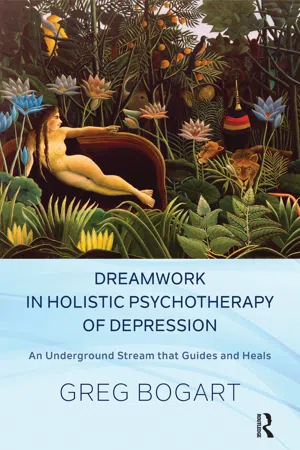
Dreamwork in Holistic Psychotherapy of Depression
An Underground Stream that Guides and Heals
- 224 pages
- English
- ePUB (mobile friendly)
- Available on iOS & Android
eBook - ePub
Dreamwork in Holistic Psychotherapy of Depression
An Underground Stream that Guides and Heals
About this book
This book describes how dreamwork can help alleviate depression, in both long-term and time-limited psychotherapy, and in self-treatment. The author shows how dreams shed light on issues contributing to depression-including drug and alcohol abuse, divorce, death and bereavement, conflicts about sex, health and body image, parenting, workplace stress and burnout, and ancestral, intergenerational trauma. Greg Bogart presents a synthesis of Jungian and existential psychotherapy, detailing how attention to archetypal symbolism brings into immediate focus new responses to pressing life challenges. He shows that allowing oneself to be affected by dream images and narratives promotes emotional, relational, and spiritual rejuvenation.
Information
CHAPTER ONE
Symbols of woundedness in dreams
This book describes how interpreting and working with dreams can help alleviate depression. In recent decades there have been many changing trends and favored techniques used within the mental health field to treat depression, including cognitive behavioral therapy, dialectical behavioral therapy, narrative therapy, holotropic breathwork, mindfulness-based therapy, hypnosis and regression therapies, bright light therapy, electroconvulsive therapy, and psychotropic medications. What I’ve found most effective in my own work with clients is Jungian dreamwork—a method of attending to dream symbols with an eye to both their personal significance and their mythic and archetypal dimensions. I use this with my clients because dreamwork is what has worked best in my own life. Dreams spring from an underground stream that guides and heals, and I find them to be a great source of wisdom. I like to imagine that if Carl Jung were alive and practicing during our era of managed care and time-limited psychotherapy, he would work much as he did a hundred years ago, listening to the unconscious and trusting it to provide imagery to assist a client’s growth and life transitions. Adopting this attitude, I put dream images under a microscope, magnifying their emotional and spiritual meaning using free association and creative imagination, inviting a catalytic event in the moment of dream interpretation.
In this book I offer a series of case studies and vignettes that describe how I use Jungian dreamwork in the treatment of depression, as a tool to explore various issues that can be the source and ongoing focus of depressed mood: alcoholism and substance abuse; trauma, illness, and disability; marital strife; negative body image; internalizing of feelings; divorce; relational victimization and domestic violence; encountering racism; intergenerational transmission of trauma; conflict or internal self-judgment about sexual orientation; complicated bereavement; and dissatisfaction in the workplace. Most readers will recognize issues and concerns that are familiar.
Encapsulating and going directly to the heart of our symptomatic behaviors and our present soul condition, dreams help us touch the wounds, traumas, and existential issues that can make us depressed, anxious, and emotionally distressed. Jung said that the dream “shows the inner truth and reality of the patient as it really is, . . . not as he would like it to be, but as it is” (Jung, 1934, para. 304). Each dream compensates for or complements a deficiency in the dreamer’s conscious position; and every dream can be considered a message from a superior intelligence, the Guiding Self, director of the individuation drive, the urge to become what one is (Whitmont & Perera, 1989, pp. 17–18). These basic assumptions guide and bring orientation to my work.
Some of the examples I’ll share focus on brief therapy where a single dream played a significant role in resolving an emotional problem, resetting the individual’s compass, initiating change. Other examples feature a series of dreams from clients in long-term psychotherapy, illustrating the artistry of the unconscious in creating a vibrant personal symbolism with resonant healing effects. I note and emphasize the archetypal elements in dreams, portraying recurrent patterns of transformation, pathways of change. Archetypes are archaic riverbeds the unconscious cascades through, forming symbols conveying timeless experiences of womblike gestation, radiant or stormy birth, heroic quests, odysseys and initiations, marriage, confrontations with adversaries, and transformative encounters with the numinous. If you look closely into any dream image you’ll find archetypal tapestry. Participation in these eternal dramas and mythic themes gives meaning and purpose to our current life challenges and benefits our mental and emotional health.
Sometimes it seems that Jungian dreamwork isn’t considered to be in the mainstream of clinical work, that it’s viewed by some as quaint and mildly amusing. I’d like to see that perception change, because dreamwork has something important and practical to offer in alleviating human suffering. I’m not saying that dream interpretation works for everyone. Some people don’t dream much, or don’t remember their dreams upon awakening, or choose to ignore their dreams. Some people don’t see dreams as meaningful at all. Others are resistant to a therapist’s interpretation of a dream. Then there’s the problem that some people suffering from depression experience insomnia and a lack of dream recall (Cartwright, 2010, pp. 49–51; Tribi, Wetter, & Schredl, 2013), and for this reason may require other forms of treatment. And dreams aren’t necessarily curative in and of themselves. But talking about a dream can open up a resonant discussion about a problem, bringing the conversation to a sharp focus and a deep feeling level. A shift in our awareness occurs so that healing is possible. A dream is a natural projective image inviting us to paint canvases of our inner worlds evoked by the elusive, mystifying characters and narratives. Dreamwork takes us to a place where we discover emotional and existential truths.
The dream of the girl in the basement
Tina, a very quiet, shy young woman suffering from depression told me this dream in our initial meeting:
I’m in a basement trying to climb out on a wooden ladder, but the ladder breaks and falls down on a little girl, six or seven years old. The girl lies there bleeding, but she doesn’t say anything or make a sound.
I asked Tina the obvious question: “What do you remember about being six or seven?”
“I was alone a lot because my mother was in the hospital. She was schizophrenic. My dad was gone at work. Whenever I’d hurt myself or needed something he’d be very angry at me and say it was my fault. So I learned to keep quiet and not say anything.”
“So you were neglected, alone, and frightened. And you learned to silence yourself and not to show any needs or feelings. The girl in the basement is in your unconscious and carries the memory of who you are. You can’t climb up into the light of consciousness until you see that girl, see her bleeding, and rescue her, treating her with care and compassion.”
“I’ve always been afraid to think about this because I’m afraid I’ll be schizophrenic like my mother.”
I said, “You’re not schizophrenic. You’re brave and strong. You were just a little girl, and the whole world felt like it fell on you. But it didn’t crush you. You took care of yourself when nobody was there.” Tina cried for a few minutes and couldn’t speak. Then she said, “Nobody ever saw me this way before, and I never really saw myself either.” We both took in the impact of her statement that she’d never felt truly seen before that moment. Dreamwork enables us to extend compassion toward ourselves; and compassion is like water on a parched plant. We soak it in and it brings us back to life.
Attending to the woundedness in dreams
Dreams bring emotionally charged material into the sphere of our consciousness, allowing us to feel the painful aspects of our lives, to get close to and familiar with our woundedness. Dream researcher Strephon Kaplan Williams used to ask, “What is wounded in the dream?” and “Where is the healing in the dream?” (Williams, 1976). Similarly, James Hillman used the term “pathologizing” to describe the psyche’s tendency to portray images of illness, disorder, and suffering and “to experience and imagine life through this deformed and afflicted perspective” (Hillman, 1978, p. 57). The way I like to state this is that dreams portray our affliction, pain, or vulnerability in a manner that is strengthening and integrative. By recognizing the wounded elements in dreams, we can attend empathically to the sources of depression.
The dream of a pig in a pot
Ella, age fifty-four, was grieving several months after her fifty-year-old brother Wallace died. Wallace was a homeless alcoholic who died after being assaulted in a park. Ella was quite depressed and preoccupied during this period of bereavement. She dreamed:
A pig is being boiled in a pot.
The pig reminded Ella of a sacrificial victim, like an innocent sacrificial lamb, a suffering Christ. This association evoked the insight that Wallace had died a kind of suffering martyr and messiah, a lonely misunderstood poet, a social outcast and gentle, harmless soul who brought joy to his family and friends. The dream mythically portrayed Wallace’s dying as the passion of a messiah, a suffering savior. Ella said, “He reminds me of Christ, and he always carried a crucifix with him. He definitely carried his cross. Yet he was my bright star. He loved me and lit up my life.” Ella teared up in a wave of emotional release as she perceived the spiritual meaning of Wallace’s life and his death. This allowed her to put her brother to rest, to let go and feel more at peace about his passage.
Ella’s pig dream reminded me of a passage from Joseph Campbell’s Creative Mythology concerning ancient Celtic images, from the time of the Roman Empire, depicting a boar, “whom the Romans equated with their own lord of the underworld, Pluto (Greek Hades), by whom Proserpina (Persephone) was abducted; and when the earth opened to receive her, it took down a herd of swine as well” (Campbell, 1968a, p. 125). Campbell notes “[t]he association of the pig with the underworld journey, labyrinth motif and mysteries of immortality. . . . [T]he pig [is] clearly a counterpart of the sacrificed Savior, opener of the way, and guide to eternal life. . . .” (pp. 126–127). This passage indicates that the association between the pig and Christ has ancient precedents and an archetypal basis. The pig appearing in Ella’s dream at a time of bereavement links to the motif of the journey of the dead in the underworld.
The dream of broken glass
The next example is also about loss of life, love, and emotional attachment, and illustrates how dreams help heal the wounds of the past. Bethany, thirty-five years old, was a touring musician who was constantly on the road. In her first therapy session she told me this dream:
I was on a greyhound bus; the seats were facing backward. I’d left my headphones on a hook at the back. Then I was by a swimming pool, at the shallow end. Someone dropped their goggles and a lens shattered. There was glass on the bottom of the pool. I looked down and saw chunks of glass. I started to spit out kernels of glass; endless chunks kept coming out of my mouth. Then out came baby bracelets with names. People were concerned and said you’ve got to get out of the pool. People brought me to a couch. I was supposed to call a man I was going to go out on a date with. I couldn’t do it because of this glass. An older male friend came in and said, “What happened to you?”
Being on the bus facing backward reminded her of being on tour, but also looking backward and living in the past. She told me that five years earlier she and her boyfriend Albert were in a car crash and he hadn’t survived. “After that I gave away everything and left our hometown and never went back. That was the last time I had roots somewhere.” The chunks of glass reminded her of the car accident in which Albert died. “Glass was embedded in my face, under my skin. I had to undergo plastic surgery to remove it from my face.” She hadn’t spoken to anyone about the accident for a long time, nor had she dated anyone since then. Prolonged bereavement had frozen her development. She was longing for home and connection but was depressed and unable to reach out to others, staying constantly on the move, on the road.
The image of her headphones on a hook reminded Bethany of still being hooked on Albert. “His death left me on the hook,” she said. Listening to headphones reminded her of privacy, withdrawing inward, tuning out her feelings, not wanting to be around people. The dream conveyed the insight that she was still suffering from PTSD, still spitting out chunks of glass. The image of baby bracelets reminded her that she was approaching the end of her prime time to have children. The lens that shattered reminded her of feeling shattered. The dream portrayed the healing imagery of the swimming pool, signifying the watery initiation, an emotional healing through reconciliation with the past and with oneself (Hill, 1992). The dream offered an incentive to come to terms with these traumatic events, and with her prolonged state of grief, serious injuries, displacement from home, and shattered dreams. Her body, her innocence, and her love were delicate and easily broken.
I said, “Your dream evokes dismembering events that tore you apart. And it’s by remembering them that you can begin to be whole again. The death of a love is a soul-shattering event. The dream explicitly asks, ‘What happened to you?’ and invites you to tell the story.”
The concerned people in the dream signified the emergence of concern for herself. The existential psychologist James Bugental (1992) has emphasized the importance of feeling concern for the self, as opposed to tuning out and, in Bethany’s case, staying on the move, convincing herself that she didn’t need any emotional attachments. In a sense the dream was encouraging her to get out of the pool, out of wallowing immersion and identification with her bereaved feeling state. Where Bethany had disavowed her needs and made herself unavailable, now the dream was asking her to consider going out on a date with someone.
This dream image was an entry point into exploring these traumas and losses. Bethany and I sat in the room, knowing each other for only thirty minutes but immediately able to talk about these important matters. The dream portrayed Bethany’s situation with laserlike accuracy and provided a useful starting point for her course of time-limited therapy. The dream depicted her involvement in a process of gathering the shattered fragments of her life in the service of wholeness.
The dream of a passenger's death and a cop
At this juncture I’d like to sharpen my comments to make a central assertion. In my practice I often see clients who are taking several psychiatric medications. Many of these people report lethargy, emotional numbness, weight gain, diminished sex drive, digestive upset, jitteriness, and mental fog. And they’re still depressed, anxious, restless, and uneasy. So their doctors keep upping their dosages. I believe we have a better tool at our disposal, something that can help us touch the emotional wounds, traumas, and existential issues that make people depressed, anxious, and unable to sleep at night. Certainly many people need meds. They help a lot of people. I’m not disputing that. But meds on their own don’t heal. Dreamwork can heal.
Chris, age twenty-seven, had been diagnosed by various psychiatrists as suffering from schizophrenia, bipolar disorder, major depression, and attention deficit disorder, and he was taking a cocktail of psychiatric drugs, including two antidepressants, antipsychotic medication, sleep meds, and meds for ADHD. Chris had been fired from his last two jobs and was on the verge of walking out of his current job, in the middle of a demanding project, stating that he was too burned out to continue. After taking his history and speaking to him for an hour, I had doubts that Chris merited the diagnosis of schizophrenia. He presented as completely lucid mentally, but physically and emotionally unhealthy. His most acute problem was alcohol abuse. He drank excessively (plenty of the hard stuff), which could be especially problematic in combination with some of the medications he was taking, and he was a hermit who stayed up all night and slept during the day. His whole pattern of existence went against the grain of the collective. Chris worked in computer systems programming and was much sought after, earning a six-figure income. He had prodigious intellectual capacities and was recognized as an innovator and genius in computer science and mathematics. He’d published several articles and taught at universities, although he had no graduate degree. Chris was wired and eccentric, but not visibly psychotic or delusional. He exuded a rebellious, disrespectful attitude that had gotten him fired from several jobs, and he was currently in trouble at work because of his erratic behavior and poor work habits.
Chris told me this dream:
There was a passenger in my vehicle. I killed him in an accident, and I didn’t know what to do. I left the body there. A cop drove past.
I asked Chris about the passenger, who reminded Chris of “my best friend Morty from high school. He shaped me in various ways. Throughout high school he had a better defined sense of identity; he was a brilliant dude who played in a punk-rock bar band. He was the most rotten alcoholic. I drank with him for years. He was troubled, got kicked out of school.” This was Chris’s role model. He had to be that guy, a defiant, alcoholic troublemaker.
I said, “Your dream suggests a need to kill or sacrifice the attitude represented ...
Table of contents
- Cover
- Half Title
- Title
- Copyright
- Contents
- ACKNOWLEDGMENTS
- PERMISSIONS
- ABOUT THE AUTHOR
- PREFACE
- CHAPTER ONE Symbols of woundedness in dreams
- CHAPTER TWO Developmental themes and intergenerational stressors in dreams
- CHAPTER THREE A dreamer's quest for love and self-acceptance
- CHAPTER FOUR The weight of married life: six dreams
- CHAPTER FIVE Dreaming of conflicted family relationships
- CHAPTER SIX Dreamwork through an existential lens
- CHAPTER SEVEN A dreamer approaching retirement
- CHAPTER EIGHT Dreams of an elder
- CHAPTER NINE The healing symbol of wholeness
- REFERENCES
- INDEX
Trusted by 375,005 students
Access to over 1.5 million titles for a fair monthly price.
Study more efficiently using our study tools.
Frequently asked questions
Yes, you can cancel anytime from the Subscription tab in your account settings on the Perlego website. Your subscription will stay active until the end of your current billing period. Learn how to cancel your subscription
No, books cannot be downloaded as external files, such as PDFs, for use outside of Perlego. However, you can download books within the Perlego app for offline reading on mobile or tablet. Learn how to download books offline
Perlego offers two plans: Essential and Complete
- Essential is ideal for learners and professionals who enjoy exploring a wide range of subjects. Access the Essential Library with 800,000+ trusted titles and best-sellers across business, personal growth, and the humanities. Includes unlimited reading time and Standard Read Aloud voice.
- Complete: Perfect for advanced learners and researchers needing full, unrestricted access. Unlock 1.5M+ books across hundreds of subjects, including academic and specialized titles. The Complete Plan also includes advanced features like Premium Read Aloud and Research Assistant.
We are an online textbook subscription service, where you can get access to an entire online library for less than the price of a single book per month. With over 1.5 million books across 990+ topics, we’ve got you covered! Learn about our mission
Look out for the read-aloud symbol on your next book to see if you can listen to it. The read-aloud tool reads text aloud for you, highlighting the text as it is being read. You can pause it, speed it up and slow it down. Learn more about Read Aloud
Yes! You can use the Perlego app on both iOS and Android devices to read anytime, anywhere — even offline. Perfect for commutes or when you’re on the go.
Please note we cannot support devices running on iOS 13 and Android 7 or earlier. Learn more about using the app
Please note we cannot support devices running on iOS 13 and Android 7 or earlier. Learn more about using the app
Yes, you can access Dreamwork in Holistic Psychotherapy of Depression by Greg Bogart in PDF and/or ePUB format, as well as other popular books in Psychology & Abnormal Psychology. We have over 1.5 million books available in our catalogue for you to explore.