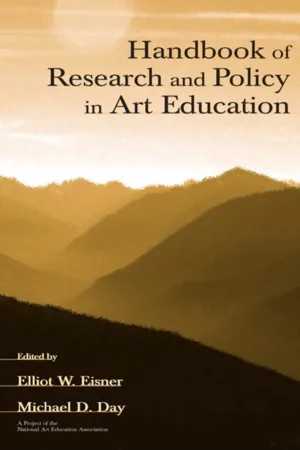
The Handbook of Research and Policy in Art Education marks a milestone in the field of art education. Sponsored by the National Art Education Association and assembled by an internationally known group of art educators, this 36-chapter handbook provides an overview of the remarkable progress that has characterized this field in recent decades. Organized into six sections, it profiles and integrates the following elements of this rapidly emerging field: history, policy, learning, curriculum and instruction, assessment, and competing perspectives. Because the scholarly foundations of art education are relatively new and loosely coupled, this handbook provides researchers, students, and policymakers (both inside and outside the field) an invaluable snapshot of its current boundaries and rapidly growing content. In a nutshell, it provides much needed definition and intellectual respectability to a field that as recently as 1960 was more firmly rooted in the world of arts and crafts than in scholarly research.
eBook - ePub
Handbook of Research and Policy in Art Education
- 288 pages
- English
- ePUB (mobile friendly)
- Available on iOS & Android
eBook - ePub
Handbook of Research and Policy in Art Education
About this book
Information
III
Learning in the Visual Arts
11
Introduction: Development and Learning in Art
Anna M. Kindler
University of British Columbia/Hong Kong Institute of Education
University of British Columbia/Hong Kong Institute of Education
INTRODUCTION
A baby moves her finger across a spilled milk and looks with an interest at a mark that her gesture leaves behind.Atoddler holding a felt pen with a firm grip hits a sheet of paper covering it with a rain of dots. A preschooler attentively adds lines to an oval explaining that his dog has just run away. A third-grader completes a collage made of tiny pieces of orange paper to celebrate Halloween. Her companion adds another Little Kitty drawing to the margins of the notebook. A teenager, with his hands and face splashed with mud adds finishing touches to a vase swirling on a potters wheel while his classmate carefully sketches a still life compiled in the back of the art room. A college student frustrated with the low speed of his computer transforms a scanned photograph he took with the help of Photoshop. An artist leans over a large canvas in a spacious studio. Her friend stands in a doorway of a gallery contemplating her latest work. What accounts for changes in pictorial behavior that may lead from a play with spilled milk to an art exhibition?
Questions about the origins and nature of pictorial behavior and attempts to describe a developmental journey that may lead from first acts of representation to artistic accomplishment recognized by and acclaimed within the artworld have long been of interest to art education. What motivates the infant’s interest in her early graphic marks? How do these early discoveries transform into pursuit of imagery that carries with the desired level of accuracy and precision the meaning intended by its creator? What cognitive processes propel change; and what psychobiological and/or cultural factors bear influence on the invention, learning, or mastery of pictorial systems that effectively function within the boundaries of relevant cultural expectations? How do manifestations of representational intent materialized within the pictorial domain enter the sphere of visual arts?
From the time when art has abandoned its academic definition in the modernist era and ventured into the territory of visual imagery that in the present day and age knows no limits or rules of category membership, the possibility to answer some of these questions has become increasingly problematic. Yet, these questions remain significant to art education as the field continues its struggle to design curricula and implement pedagogy that would allow children and adolescents to meet their artistic potential.
This section of the Handbook focuses on the relationship between the learner and the domain of art. It inquires about the developmental factors that underlie acquisition of artistic knowledge, skills, and competencies and explores origins and developmental pathways of human ability to manipulate symbol systems that shape the world of art. How do people construct artistic knowledge? What processes guide development of art-related abilities? How do biological and sociocultural influences impact on development in pictorial representation? What founds aesthetic judgment and reasoning? A team composed of leading art educators, cognitive scientists, and psychologists was invited to address these and other related issues that are of significance to curriculum development and implementation in art education.
The section on “Development and Learning” in art is organized into six chapters, each focusing on a specific aspect of the developmental debate. It opens with a discussion of theories and models of artistic development that suggests a need for a significantly revised approach to the developmental question. The subsequent chapters address specifically the origins of development in pictorial representation and expression; the “nature vs. nurture” dilemma, with special emphasis on the role of culture as a determinant or mediator of artistic behavior; development in three-dimensional representation; the origins and developmental pathways of aesthetic judgment and reasoning; and finally, consideration of talent and exceptionality in the visual arts. Each chapter offers a comprehensive overview of research conducted in the area of its focus, points to its relevance to the teaching of art and identifies issues that merit further inquiry.
The opening chapter by Anna Kindler asks provocative questions regarding the “impossibility” of artistic growth and questions the link between specific psychobiological and/or cultural phenomena with a comprehensive notion of development in art. It raises doubts about the epistemological appropriateness of defining “artistic development” as a distinct phenomenon and reframes studies in artistic development as segments of knowledge relevant to the domain rather than defining a universal set of processes necessary and sufficient for artistic progression. These doubts and questions are raised in the context of a comprehensive review of research in art, education, psychology, cognitive sciences, and neuroscience, which has attempted to shed light on processes engaged in manipulation of artistic media resulting in outcomes that may fit diverse definitions of art.
The chapter includes a presentation of different theoretical models and offers a critique of their conceptual strengths as well as weaknesses often linked to assumptions that do not stand the test of cultural or historical relevancy. Much attention is given to models that consider multiple trajectories of growth in the development of pictorial representation as they effectively address some of the shortcomings of the single-endpoint, linear conceptions of development in art. Yet, Kindler points to the fact that even these more open and broad conceptions are bound by limitations which prevent them from accurately accounting for the vast universe of processes responsible for all possible dimensions and venues of what could be considered as improvement in artistic performance.
The author’s doubts about “artistic development” echo Wilson’s observation about “child art” being a cultural construction and extend it to the broader realm of development in art. Kindler makes a reference to Csikszentmihalyi’s (1988, 1999) systems approach to creativity that highlights the interaction among an individual, a “domain,” and a “field” and suggests that confluence theories of creativity may signal a possible way to restructure discourse about artistic development in the future. She notes, however, that flexibility and elasticity of the concept that such theories afford come at the expense of precision and consistency of meaning that may reduce pragmatic, practical value of these accounts.
John Matthews, whose long-standing research interests have focused on beginnings of expressive and representational thought in infancy, addresses in his chapter “the art of infancy.” Drawing on the results of his and other scholars’ work, Matthews argues that even the earliest pictorial behavior is not limited to a simple sensorimotor exploration. He presents evidence suggesting that both as process and as product, early drawings carry a profound meaning and represent significant outcomes of cognitive activity. Matthews’ account of development in early childhood, while largely limited to consideration of two-dimensional imagery, explores significance of different pictorial media, including what he refers to as “electronic paint” providing insights into very young children’s attempts to employ computer technology for expressive and representational purposes.
Matthews draws attention to the importance of social and interpersonal contexts in early pictorial representation and brings his extensive teaching experience in early childhood environments to complement formal research findings in his analysis of their significance. His British upbringing and education combined with years of working in Singapore provide him with a good platform to address issues of culture and its impact on artistic development and learning. This chapter benefits from Matthews’ firsthand experience with cross-cultural inquiry and expertise in early childhood art education practices in selected settings in North America and Asia. A unique aspect of Matthews’ contribution is consideration of gender issues in early childhood classrooms. The author claims that, given the demographics of the early education workforce, learning environments are typically “designed by females, run by females, for females.” His discussion of “sexism in the nursery” considers negative impact of gender-biased practice on both girls’ and boys’ development in expression and representation.
Matthews is careful to point out that artistic development in early childhood is not a process of unilinear unfolding limited to the domain of graphic representation. He describes the process as a much more complex endeavor that benefits from adult intervention rather than from interference. He supports “scaffolded” or “mediated learning” in early childhood art education where adults and young children become “companions as intellectual adventurers” in the context of play.
The following chapter is contributed by Brent Wilson who, together with Marjory Wilson, pioneered the notion of development in art as a form of cultural learning. In their groundbreaking 1977 article “An Iconoclastic View of the Imagery Sources of Young People,” theWilson’s contradicted long-standing models of development that attributed changes in pictorial production to internal, psychobiological mechanisms and proposed instead a conception that pointed to the fundamental role of culture in development of pictorial representation. Brent Wilson has remained faithful to this idea through decades of his research, and this chapter is a logical extension of his earlier work. In “Child Art After Modernism: Visual Culture and New Narratives” Wilson argues that “child art” is in itself a cultural construction and that conceptions of development as a natural unfolding of representational abilities resulted from a confusion brought upon the modernist set of values and resulted in a “grand narrative of art education” that has greatly constrained art education practice. Wilson claims that there is nothing natural about artistic development and that assumption that children are more creative than adults is nothing but a cultural artifact. His views, which some art educators may consider controversial, are carefully supported with cross-cultural research evidence and with engaging anecdotes and narrative that describe children’s engagement with visual culture. Wilson advocates the need for a comprehensive theory of art/visual culture that would allow rewriting a philosophy of child art and art education relevant to and reflective of the reality of children of the present day.
Discussion of artistic development has traditionally been focused on development in twodimensional pictorial representation, and the number of studies addressing processes that found performance in three-dimensional media has been very limited. One of the few researchers who has devoted significant time exploring development in three-dimensional representation is Claire Golomb, a psychologist with a long standing interest in visual arts. In her contribution to the Handbook, Golomb describes and analyzes research that traces the origins of children’s engagement with clay from their first prerepresentational actions to sculptures with clear representational intent and outcomes marked by technical and expressive success. She frames her presentation with a backdrop of history of art making in three-dimensional media on the one hand and accounts of developmental progression in drawing, on the other.
The author argues that although there are some similarities in which development across two- and three-dimensional media progresses, such as the initial use of global, minimally differentiated forms, she notes significant medium-specific differences. For example, she argues that while increased differentiation has long been considered as one of the hallmarks of progress in drawing, the process of differentiation in clay sculpture tends to level off in middle childhood. She attributes this to the tension between the desire for uprightness and detail that need to be mediated in the context of the physical properties of the medium and the technical difficulties in coping with its demands.
Golomb points out that studies of development in clay clearly document that even very young children exhibit basic three-dimensional understanding and that their representational concepts are three-dimensional in nature. This offers further support to theories that reject intellectual immaturity thesis as accounting for the outcomes of young children’s engagement with artistic media. It is rather a limited experience with the medium, lack of practice and technical skill, as well as lack of knowledge of traditions and practices that prevail in the medium that account for the “primitive” appearance of young children’s early sculptures.
Golomb recognizes limitation of a clinical approach that marks much of research referred to in her chapter and suggests the need for more inquiry conducted in “studio-like environments where professional assistance is made available, where work is sustained over several sessions and the young artist’s conceptions can evolve (and be systematically studied) over time.” This places art educators in a very good position to contribute to the generation of knowledge in this area that could help guide improvement in classroom practice.
Discussion about development and learning in art would not be complete without consideration of artistic reasoning and aesthetic judgment. Norman Freeman’s chapter focuses on aesthetic thinking and exploresways in which people acquire assumptions about pictorial functions, decide about what is important in pictures, and formulate opinions about their artistic worth. Freeman notes that the concepts of expressivity, attractiveness, and recognizability are at the core of aesthetic reasoning about pictorial images and presents an overview of research that examined how these concepts function in human reactions to artifacts.
Referring to his theory of pictorial reasoning (Freeman, 1995), the author devotes much of the chapter to the exploration of pictorial communication. He argues that a broad analysis of pictorial reasoning requires attention to four entities: artist, viewer, picture, and referent. From a developmental perspective, Freeman notes that although children as young as 3 years of age understand that viewer–picture relations can vary and that people differ in their pictorial preferences, this “is a long way from understanding viewers as representational agents whose culturally relative pictorial judgments will vary depending on what they bring to the viewing situation.”
Freeman’s theoretical position interacts with Parsons’ (1987) notion, attributing great significance to “pictorial assumptions” that viewers bring to an aesthetic experience. He is careful to note that these assumptions remain closely related to the core four terms that he identified in pictorial communication and demonstrates how the salience and weighting of these components may vary and how they affect an aesthetic reaction. The author highlights the fact that communication through images involves a variety of “cultural devices” that eventually “bridge the gap between minds and between physical and mental reality.” He articulates the role that education can play in helping people challenge and reshape their pictorial assumptions in order to make them better equipped to respond to changes and innovations in art.
Finally, David Pariser and Enid Zimmerman provide a thorough account of research on development, identification, and nurturing of artistic talent. The chapter begins with an introduction of the complex nature of the concepts of gifted and talented and the tendency to associate giftedness with superior academic abilities and talent with exceptional abilities in the arts. The authors contradict this distinction by referring toWinner’s (1996) description of giftedness that identifies generic cognitive characteristics that mark exceptionality across academic and artistic fields. This definition points to the talented children’s early and rapid development of skills within a symbolic domain in ways that exceed standard expectations for individuals of the same age. It also notes talented children’s “urge to master” that domain and an exceptional ability to find unique solutions to problems that they encounter along their learning journey and relative independence in their learning pursuits. Drawing on Jellen and Verduin’s work (1986), Pariser and Zimmerman highlight the need to consider the concept of artistic ta...
Table of contents
- Cover Page
- Half-Title Page
- Title Page
- Copyright Page
- Table of Contents
- Introduction to the Handbook of Research and Policy in Art Education
- I: HISTORICAL CURRENTS IN ART EDUCATION
- II: POLICY PERSPECTIVES IMPACTING THE TEACHING OF ART
- III: LEARNING IN THE VISUAL ARTS
- IV: TEACHING AND TEACHER EDUCATION
- V: FORMS OF ASSESSMENT IN ART EDUCATION
- VI: EMERGING VISIONS OF THE FIELD
- Author Index
- Subject Index
Trusted by 375,005 students
Access to over 1.5 million titles for a fair monthly price.
Study more efficiently using our study tools.
Frequently asked questions
Yes, you can cancel anytime from the Subscription tab in your account settings on the Perlego website. Your subscription will stay active until the end of your current billing period. Learn how to cancel your subscription
No, books cannot be downloaded as external files, such as PDFs, for use outside of Perlego. However, you can download books within the Perlego app for offline reading on mobile or tablet. Learn how to download books offline
Perlego offers two plans: Essential and Complete
- Essential is ideal for learners and professionals who enjoy exploring a wide range of subjects. Access the Essential Library with 800,000+ trusted titles and best-sellers across business, personal growth, and the humanities. Includes unlimited reading time and Standard Read Aloud voice.
- Complete: Perfect for advanced learners and researchers needing full, unrestricted access. Unlock 1.5M+ books across hundreds of subjects, including academic and specialized titles. The Complete Plan also includes advanced features like Premium Read Aloud and Research Assistant.
We are an online textbook subscription service, where you can get access to an entire online library for less than the price of a single book per month. With over 1.5 million books across 990+ topics, we’ve got you covered! Learn about our mission
Look out for the read-aloud symbol on your next book to see if you can listen to it. The read-aloud tool reads text aloud for you, highlighting the text as it is being read. You can pause it, speed it up and slow it down. Learn more about Read Aloud
Yes! You can use the Perlego app on both iOS and Android devices to read anytime, anywhere — even offline. Perfect for commutes or when you’re on the go.
Please note we cannot support devices running on iOS 13 and Android 7 or earlier. Learn more about using the app
Please note we cannot support devices running on iOS 13 and Android 7 or earlier. Learn more about using the app
Yes, you can access Handbook of Research and Policy in Art Education by Elliot W. Eisner, Michael D. Day, Elliot W. Eisner,Michael D. Day in PDF and/or ePUB format, as well as other popular books in Education & Teaching Art. We have over 1.5 million books available in our catalogue for you to explore.