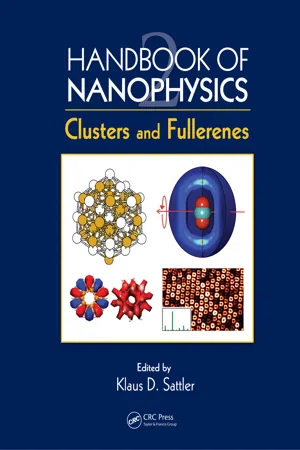
The field of nanoscience was pioneered in the 1980s with the groundbreaking research on clusters, which later led to the discovery of fullerenes. Handbook of Nanophysics: Clusters and Fullerenes focuses on the fundamental physics of these nanoscale materials and structures. Each peer-reviewed chapter contains a broad-based introduction and enhances
- 912 pages
- English
- PDF
- Available on iOS & Android
eBook - PDF
About this book
Information
Table of contents
- Front cover
- Contents
- Preface
- Acknowledgments
- Editor
- Contributors
- Part I: Free Clusters
- Chapter 1. Nanocluster Nucleation, Growth, and Size Distributions
- Chapter 2. Structure and Properties of Hydrogen Clusters
- Chapter 3. Mercury: From Atoms to Solids
- Chapter 4. Bimetallic Clusters
- Chapter 5. Endohedrally Doped Silicon Clusters
- Chapter 6. The Electronic Structure of Alkali and Noble Metal Clusters
- Chapter 7. Photoelectron Spectroscopy of Free Clusters
- Chapter 8. Photoelectron Spectroscopy of Organic Clusters
- Chapter 9. Vibrational Spectroscopy of Strongly Bound Clusters
- Chapter 10. Electric and Magnetic Dipole Moments of Free Nanoclusters
- Chapter 11. Quantum Melting of Hydrogen Clusters
- Chapter 12. Superfluidity of Clusters
- Chapter 13. Intense Laser-Cluster Interactions
- Chapter 14. Atomic Clusters in Intense Laser Fields
- Chapter 15. Cluster Fragmentation
- Part II: Clusters in Contact
- Chapter 16. Kinetics of Cluster-Cluster Aggregation
- Chapter 17. Surface Planar Metal Clusters
- Chapter 18. Cluster-Substrate Interaction
- Chapter 19. Energetic Cluster-Surface Collisions
- Chapter 20. Molecules and Clusters Embedded in Helium Nanodroplets
- Part III: Production and Stability of Carbon Fullerenes
- Chapter 21. Plasma Synthesis of Fullerenes
- Chapter 22. HPCL Seperation of Fullereness
- Chapter 23. Fullerene Growth
- Chapter 24. Production of Carbon Onions
- Chapter 25. Stability of Charged Fullerenes
- Chapter 26. Fragmentation of Fullerenes
- Chapter 27. Fullerene Fragmentation
- Part IV: Structure and Properties of Carbon Fullerenes
- Chapter 28. Symmetry of Fulleroids
- Chapter 29. C20, the Smallest Fullerene
- Chapter 30. Solid-State Structures of Small Fullerenes
- Chapter 31. Defective Fullerenes
- Chapter 32. Silicon-Doped Fullerenes
- Chapter 33. Molecular Orbital Treatment of Endohedrally Doped Fullerenes
- Chapter 34. Carbon Onions
- Chapter 35. Plasmons in Fullerene Molecules
- Chapter 36. [60]Fullerene-Based Electron Acceptors
- Part V: Carbon Fullerenes in Contact
- Chapter 37. Clusters of Fullerenes
- Chapter 38. Supramolecular Assembiles of Fullerenes
- Chapter 39. Supported Fullerenes
- Chapter 40. Fullerene Suspensions
- Chapter 41. Fullerene Encapsulation
- Chapter 42. Electronic Structure of Encapsulated Fullerenes
- Chapter 43. Metal-Coated Fullerenes
- Chapter 44. Fullerol Clusters
- Chapter 45. Polyhydroxylated Fullerenes
- Chapter 46. Structure and Vibrations in C60 Carbon Peapods
- Part VI: Inorganic Fullerenes
- Chapter 47. Boron Fullerenes
- Chapter 48. Silicon Fullerenes
- Chapter 49. Boron Nitride Fullerenes and Nanocones
- Chapter 50. Fullerene-Like III-V Binary Compounds
- Chapter 51. Onion-Like Inorganic Fullerenes
- Index
- Back cover
Trusted by 375,005 students
Access to over 1.5 million titles for a fair monthly price.
Study more efficiently using our study tools.
Frequently asked questions
Yes, you can cancel anytime from the Subscription tab in your account settings on the Perlego website. Your subscription will stay active until the end of your current billing period. Learn how to cancel your subscription
No, books cannot be downloaded as external files, such as PDFs, for use outside of Perlego. However, you can download books within the Perlego app for offline reading on mobile or tablet. Learn how to download books offline
Perlego offers two plans: Essential and Complete
- Essential is ideal for learners and professionals who enjoy exploring a wide range of subjects. Access the Essential Library with 800,000+ trusted titles and best-sellers across business, personal growth, and the humanities. Includes unlimited reading time and Standard Read Aloud voice.
- Complete: Perfect for advanced learners and researchers needing full, unrestricted access. Unlock 1.5M+ books across hundreds of subjects, including academic and specialized titles. The Complete Plan also includes advanced features like Premium Read Aloud and Research Assistant.
We are an online textbook subscription service, where you can get access to an entire online library for less than the price of a single book per month. With over 1.5 million books across 990+ topics, we’ve got you covered! Learn about our mission
Look out for the read-aloud symbol on your next book to see if you can listen to it. The read-aloud tool reads text aloud for you, highlighting the text as it is being read. You can pause it, speed it up and slow it down. Learn more about Read Aloud
Yes! You can use the Perlego app on both iOS and Android devices to read anytime, anywhere — even offline. Perfect for commutes or when you’re on the go.
Please note we cannot support devices running on iOS 13 and Android 7 or earlier. Learn more about using the app
Please note we cannot support devices running on iOS 13 and Android 7 or earlier. Learn more about using the app
Yes, you can access Handbook of Nanophysics by Klaus D. Sattler in PDF and/or ePUB format, as well as other popular books in Physical Sciences & Condensed Matter. We have over 1.5 million books available in our catalogue for you to explore.