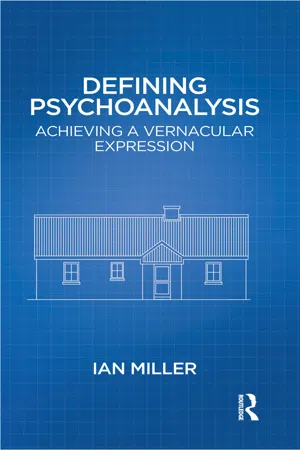
The empirical baseline of today's psychoanalytic vernacular may be inferred from what psychoanalysts read. Contemporary information aggregation provides us with a unique moment in "reading" today's psychoanalytic vernacular. The PEP Archive compiles data on journal articles analogous to radio stations' "hit parades" of contemporary favorites. Defining Psychoanalysis: Achieving a Vernacular Expression provides a close reading of this contemporary assemblage, including three "strong" readings by Winnicott and two by Bion. It pursues the elements generated by these papers as an indication of contemporary psychoanalytic "common sense", our consensual building blocks of theory and practice.
- 128 pages
- English
- ePUB (mobile friendly)
- Available on iOS & Android
eBook - ePub
About this book
Information
CHAPTER ONE
Expressing vernacular psychoanalysis
I
Defining psychoanalysis in the present moment, 2014–2015, might seem a relatively simple task. Like most definitional searches in our busy lives, it begins with the one-stop destination of Wikipedia. Once there, the reader is informed that psychoanalysis is “a set of psychological and psychotherapeutic theories and associated techniques” with at least twenty-two different theoretical orientations, after the foundational work of Sigmund Freud (https://en.wikipedia.org/wiki/Psychoanalysis).
Despite this breadth of difference, Wikipedia attributes five common tenets to psychoanalysis. Together, these provide a fairly accurate snapshot; certainly, enough to frame the outline of an undergraduate essay or to fit roughly into what Auden (1940) recognises as the ubiquity of psychoanalytic influence within the modernist “climate of opinion”.
As we will come to see, our Wikipedia definition provides a vernacular expression of psychoanalysis. Its shorthand accessibility provides the information and flexibility adequate for immediate use. Functionally, it achieves what Nobel laureate Herbert Simon (1945) calls “satisficing” in that it satisfies the impatience of the casual reader’s demand in its economy of expression. It is sufficient, if incomprehensive. It addresses what is partial rather than complete. It is a provision of knowledge compressed to pocket size. Its “satisficing” also corresponds to Potter Stewart’s famous statement in defining pornography that
I shall not today attempt further to define the kinds of material I understand to be embraced within that shorthand description [“hard-core pornography”], and perhaps I could never succeed in intelligibly doing so. But I know it when I see it.
(https://en.wikipedia.org/wiki/ Jacobellis_v._Ohio)
However, unlike Justice Stewart’s disclaimer, the implicit knowledge within psychoanalysis that “I know it when I see it” is thickly definitional. It defines the observed object of inquiry under conditions of use that are at least minimally sufficient and minimally satisfying. Our Wikipedia definition of psychoanalysis achieves this in spelling out five global elements for the reader’s consideration. These include: 1) the observation of considerable irrational and unconscious determination in human experience; 2) the observation that conflicts, not only at the unconscious level but also between conscious and unconscious levels, give rise to emotional disturbance; 3) the observation that the human journey from the beginning of life is marked by moments of consciousness but also by lack of experiential formulation and forgetting; 4) the observation that aspects of unconscious experience are released into conscious awareness through the skilled guidance of a therapist, and 5) the observation that the therapeutic process of making conscious that which is unconscious necessitates acquaintance with “defence mechanisms” set up to protect the individual’s equilibrium. Therapy, whether “bypassing psychological resistance” as Wikipedia terms it, or meeting it headlong, is necessarily disruptive to our pre-therapeutic adjustments, no matter how personally painful these might be. Effective therapy dis-equilibrates our adaptive steady-states. Often it generates discomfort, but of a quality different than the discomfort it seeks to address.
Our Wikipedia definition of psychoanalysis takes us only so far. As the reader entertains questions generated through its thick or global description, like the patient seeking psychotherapy, he encounters great confusion in the gaps between definition and the stumbling blocks thrown up by our lived experience. We only learn what we have been seeking in the process of our doing. And, in the doing of psychotherapy, the coolly observed determinants of psychoanalysis, even in its user-friendly Wikipedia form, quickly depart for the patient (as for the therapist) under the dyadic pressures of therapeutic engagement. Our former assumption that “I know it when I see it” crumbles under uncertainty. What Wikipedia does not tell us is that there is a gap within psychoanalytic understanding, along the continuum of knowing between conceptual definition and experience.
How does the patient experience psychoanalysis from within its multiple and differing moments of process? How does the therapist construe the job of psychoanalytic psychotherapy (we’ll get to the distinction between psychoanalysis and psychoanalytic therapy in Chapter Eight)? What do such observations mean for a prospective patient considering psychoanalytic psychotherapy or for a trainee psychotherapist, considering the career-long journey of one’s own psychodynamic discoveries; or indeed, of the practising analyst tentative about reflecting upon her own model of understanding relative to that of another analyst (Tuckett et al., 2008)?
The present chapter approaches psychoanalysis as therapists construe it in daily clinical practice. My goal is to consider psychoanalysis as a work in progress, integrating its technique and theory from multiple points of development across a century and more of practice, through forms that are both unique to each practitioner and also aligned with our current understandings of psychoanalysis as it is defined from time to time through the developing lens of the field’s emerging identity. Within psychoanalytic literature, this implicit process is hardly terra incognita; yet, as a central dimension of psychoanalytic thinking, it is rarely emphasised. Looking back a century to Freud’s “Mourning and Melancholia”, the reader encounters a narrative version of this process in the editors’ notes (1917e). There, the temporal progression of Freud’s thinking is historically documented in relation to the subject of mourning that ultimately culminates in the statement “Mourning and Melancholia”. As we shall see below, from Winnicott (1949), the process of containing aspects of feeling and thinking, borne without certainty over long periods of time (and not unlike the formation of psychoanalytic interpretations), also characterises the recognition and articulation of psychoanalytic conceptual elements. Freud’s thinking on this subject begins in 1897, but seems to disappear as other developments become primary. Thirteen years later, in 1910, he comments briefly that the problem still remains currently insoluble. “Mourning and Melancholia” achieves its published form in 1917; but only through Freud’s prior development of his thinking on narcissism, which functions as a platform providing the foundation upon which the published expression of “Mourning and Melancholia” becomes possible (Freud, 1917e).
Such processes correspond to the elusive and shifting forms of psychoanalysis that the therapist holds in mind, implicit in her work. Sometimes notions appear clear and consciously present; sometimes (as illustrated by Freud in “Mourning and Melancholia”) they are unavailable or unrecognised within their incubation. Continuously stimulated by clinical experience, by personal analysis, by supervision and reading, we discover our psychoanalytic definitions in their vernacular evolutions and expressions over time.
II
The boundaries and hierarchies of psychoanalysis have been cast through overdetermined collisions of elements shaping its structure and form (Grossman, 1992). These are necessarily developments that emerge historically. Time-bound, they may be located through consideration of different historical circumstances in psychoanalytic development (Makari, 2008). Such convergence within moments of historical time together with their generative conceptual possibilities within a potential, if bounded range of emergent ideas, suggests the psychodynamic concept of “compromise formation”. This is a unification of tensions between centre and periphery, of a central concept and the penumbra of thoughts generated by that concept.
Historically, the conception of compromise formation is situated in a structure such as a symptom, dream, or joke that balances our internal needs with the demands of external reality. As compromise, like other components of psychoanalysis at different levels of conceptual formulation (such as the structural dimension of the ego), such formations combine multiplicity of function or purpose within a synthesised singularity of form (Waelder, 1930).
As Freud tells us, this is the dynamic tension that makes a joke funny or allows us to sleep as we entertain conflictual imagery. Herbert Simon’s depiction of “satisficing” is a restatement of the compromise formation concept in non-therapeutic application. However partial in relation to an idealised fantasy of a singular and unified whole, such compromises are “good enough” in their partial and practical, more or less transitional, usages. In revealing different aspects of psychoanalytic identity, such conceptions also spur new thinking and advance new combinations of ideas, new compromise formations. An example we shall encounter later in our readings, is of Freud’s 1911 paper, “Formulations on the Two Principles of Mental Functioning”, parts of which become the anchorage for two very different ideas generated half a century beyond the moment of its writing, by D. W. Winnicott and W. R. Bion.
Once generated, such ideas remain as points of reference, markers in time, readily absorbed into historical developments that emerge well after their original articulation. In this way, the momentary state of psychoanalytic identity employs time both as developmental history and as a singular point in the present moment.
Significant concepts emerge within the development of psychoanalytic practice in much the same way that consensual ideas emerge between patient and analyst in the therapeutic dyad. Their dense, idiosyncratic shapes are clarified within therapy in a nexus of understanding between patient and therapist. Here, they proceed along a continuum from the unformulated to the poorly uttered towards possible arrivals at momentary, clear verbalisations, recognised by both individuals (Miller, 2015). Since the early 1920s, it has been understood that such therapeutic acts of explanatory translation address the unconscious communications within the patient’s therapeutic repetitions (Ferenczi & Rank, 1924, p. 3). Clinicians from Bion to Sullivan have illustrated this process as a form of translation in that one therapeutic co-participant says to the other, “The idea or concept that I call ‘x’ is what I recognise in the behaviour or thought experienced by us both in therapy, as ‘y’.” From within this relational context of interpersonal activity, such acts of explanatory translation weave a jointly constructed fabric of plausibility and understanding, providing an experiential foundation for the development of trust in the therapeutic enterprise. In so doing, they also describe a continuum from subjective reality, often experienced as painful, through the generation of plausible meanings, towards other possible alignments between individual experience and the constraints of the external world. Yet, at another level, therapeutic destabilisation of painful subjective realities may also feel disruptive, even violent, as it both unleashes heretofore suppressed or repressed feeling and thought as well as presenting the patient with new states of uncertainty.
In parallel to the transitory states of arrival and departure that mark the ongoing relationship of therapist to patient, our definitions of psychoanalytic identity are also necessarily emergent and transitory. Against the authority of our institutional desires, such recognitions may also destabilise our transient certainties (Sandler, 1983; Tuckett et al., 2008). Late in his life, Paul Federn would comment on the destabilising impact of new and productive thinking within psychoanalytic development. Indeed, for Federn, an analyst whose career began within Freud’s original Vienna circle, a lifetime of experience eventuates in the observation that creative productive thought is resisted by the larger field into which it is introduced; even in a psychoanalysis mindful of resistance as an ongoing dynamic force. The general problem in psychoanalytic resistance to new thinking is that
… colleagues and experts in his own field are unwilling to accept the new discoveries, do not understand what is really new. Besides, by preoccupation with the new, they would lose contact with their contemporaries. This produces tension which is hard to stand. Most people compromise and follow the herd whom they are expected to guide. Teaching prevents learning!
(Federn, 1989, p. 127)
Such resistance to the new involves a challenge to the synthetic expression of individual clinicians’ hard-won psychoanalytic identity and understanding (Tuckett et al., 2008). I think of such identities as expressions of “vernacular” psychoanalysis. The idea of a “vernacular” immediately signals what is local, common, so unimportant. It carries with it the backwater tang of linguistic dialects rather than the high culture and language of the academy. Against the theoretical authority of received wisdom, pure and idealised, the vernacular appears roughly formed and approximate.
Yet vernacular expressions are unavoidable; indeed, our Wikipedia compression of psychoanalytic definition, compiled by the contributions of interested Wikipedia volunteers, is a good example of vernacular expression. It is compressed, user friendly, and while casual, sufficiently definitive to provide a generalised notion of its subject. In the case of our Wikipedia expression, its five tenets are oriented broadly to acquaint the reader with the concepts of unconscious causality, repression, and the possibility of therapeutic effectiveness despite the reliable presence of the patient’s defensive operations within the process of psychotherapy.
The vernacular illuminates the gaps and disruptions recognised both by Freud in his analogies between archaeology and psychoanalysis, and by Foucault in his recognition that disruptions and gaps are unrecognised structural dimensions of the multiple series that result from academic consolidations of ideas (Foucault, 1972). Operating together with the clinician’s nascent sense of the analytic object as purpose, structure, and form (Bolognini, 2011), the vernacular’s approximations to conscious awareness describe moments of process within both thought and interpersonal relations. The elements of vernacular psychoanalytic expression are always formed through their adaptation within daily use. And, as in the architectural study of “vernacular” structures, the term
… marks the transition from the unknown to the known: we call buildings “vernacular” because they embody values alien to those cherished in the academy …. The study of vernacular architecture, through its urge toward the comprehensive, accommodates cultural diversity. It welcomes the neglected into study in order to acknowledge the reality of difference and conflict.
(Glassie, 1999, p. 20)
A psychoanalysis composed of multiple vernacular expressions bridges a significant divide between the analyst’s tacit, procedural work, and the multiple influences upon her thinking that eventuate in clinical participatory activity (Sandler, 1983). This gap corresponds to the flux of unconscious and preconscious experience as against our desire for a clear and singular systematic, reflective articulation of what we do. Because vernacular expression is inclusive and associative, its expansiveness defeats our wish for neat, concise definition.
This psychoanalytic practice of theoretical inclusivity, not only among similar viewpoints but also among contrasting and opposing viewpoints all potentially operative at any given time, multiplies rather than limits meanings; and so makes difficult a limitation of psychoanalytic definition. For example, dreams under Freud’s reading express the fulfilment of wish; yet wish fulfilment in no sense negates Bion’s seemingly opposite reading of the dream as expressing a frustrating situation or W. H. R. Rivers’s even earlier understanding of dreams as presenting problematic elements to the dreamer for solution (Bion, 1992; Rivers, 1923). Rather, as Bion illustrates by clinical example (1959), the multiplication and expansion of viewpoints continuously portray our momentary understandings as partial, and the aspects of fantasy and reality to which we relate, transitory and expressive of parts rather than the whole of our human experience.
Vernacular expression marks a transition from the unknown to recognising the overdetermined, multivariate nature of our work. At issue is how analysts locate and utilise the elements of psychoanalysis available to them at different moments, how we both seek and modify influential currents of psychoanalytic experience as an intrinsic and necessary dimension of our everyday work, evoked in the immediacy of clinical contact.
Vernacular elements are indeterminate in their origins, often contentiously disputed within received psychoanalytic identity; and also mark difference on the therapeutic frontier. Differing composites of vernacular elements operate at different hierarchical levels within the structure of psychoanalytic thought. As ideas are formulated and increasingly used among clinicians, notions that begin as unarticulated vernacular currents become accepted across the discipline through generational consensus. The cost of denying this intellectual progression, as in maintaining a narrow, if contented, expression of psychoanalytic vernacular based in circumscribed study, such as limiting our reading to only the “early” Freud or to Melanie Klein without the productive succession of post-Kleinian thinkers, misses the extraordinary work of change and emergence both within and between generations during 120 years of psychoanalytic theory and practice (Meltzer & Williams, 2008, p. xvi).
Gabbard and Westen (2003) address examples of four such consolidations in their contemporary description of therapeutic action: 1) the expansion of psychoanalysis from an interpretive discipline to one that includes relationship; 2) the presence within psychoanalysis of multiple modes of action; 3) a “shift in emphasis from reconstruction to the here-and-now interactions between analyst and patient”; and 4) the continuous negotiation of “therapeutic climate” (pp. 82–84). Through noting their earlier presence in the reflected light of subsequent psychoanalytic development, new clinical generations discover formerly unrecognised links within therapeutic practice operating in different places and times in psychoanalytic history (Conci., 2009).
Harold Bloom persuasively interprets this emergence to argue that reading within traditions of thought displays a competitive expansion both as successor generations reread precursor generations and as individual thinkers reconstrue their earlier creations (Bloom, 2011). For B...
Table of contents
- Cover
- Half Title
- Title
- Copyright
- Contents
- ABOUT THE AUTHOR
- FOREWORD
- CHAPTER ONE Expressing vernacular psychoanalysis
- CHAPTER TWO Winnicott's 1949 expression, "Hate in the Countertransference"
- CHAPTER THREE Winnicott's 1953 expression, "Transitional Objects and Transitional Phenomena"
- CHAPTER FOUR Winnicott's 1960 expression, "The Theory of the Parent-Infant Relationship"
- CHAPTER FIVE Bion's 1962 expression, "The Psycho-Analytical Study of Thinking"
- CHAPTER SIX Thinking with Bion on thinking
- CHAPTER SEVEN Bion's 1959 expression, "Attacks on Linking"
- CHAPTER EIGHT Discovering one's own vernacular
- APPENDIX
- REFERENCES
- INDEX
Trusted by 375,005 students
Access to over 1.5 million titles for a fair monthly price.
Study more efficiently using our study tools.
Frequently asked questions
Yes, you can cancel anytime from the Subscription tab in your account settings on the Perlego website. Your subscription will stay active until the end of your current billing period. Learn how to cancel your subscription
No, books cannot be downloaded as external files, such as PDFs, for use outside of Perlego. However, you can download books within the Perlego app for offline reading on mobile or tablet. Learn how to download books offline
Perlego offers two plans: Essential and Complete
- Essential is ideal for learners and professionals who enjoy exploring a wide range of subjects. Access the Essential Library with 800,000+ trusted titles and best-sellers across business, personal growth, and the humanities. Includes unlimited reading time and Standard Read Aloud voice.
- Complete: Perfect for advanced learners and researchers needing full, unrestricted access. Unlock 1.5M+ books across hundreds of subjects, including academic and specialized titles. The Complete Plan also includes advanced features like Premium Read Aloud and Research Assistant.
We are an online textbook subscription service, where you can get access to an entire online library for less than the price of a single book per month. With over 1.5 million books across 990+ topics, we’ve got you covered! Learn about our mission
Look out for the read-aloud symbol on your next book to see if you can listen to it. The read-aloud tool reads text aloud for you, highlighting the text as it is being read. You can pause it, speed it up and slow it down. Learn more about Read Aloud
Yes! You can use the Perlego app on both iOS and Android devices to read anytime, anywhere — even offline. Perfect for commutes or when you’re on the go.
Please note we cannot support devices running on iOS 13 and Android 7 or earlier. Learn more about using the app
Please note we cannot support devices running on iOS 13 and Android 7 or earlier. Learn more about using the app
Yes, you can access Defining Psychoanalysis by Ian Miller in PDF and/or ePUB format, as well as other popular books in Psychology & History & Theory in Psychology. We have over 1.5 million books available in our catalogue for you to explore.