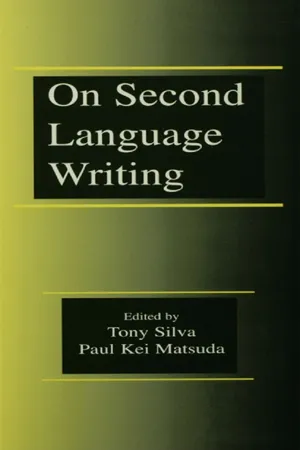
On Second Language Writing brings together internationally recognized scholars in a collection of original articles that, collectively, delineate and explore central issues with regard to theory, research, instruction, assessment, politics, articulation with other disciplines, and standards. In recent years, there has been a dramatic growth of interest in second-language writing and writing instruction in many parts of the world. Although an increasing number of researchers and teachers in both second-language studies and composition studies have come to identify themselves as specialists in second-language writing, research and teaching practices have been dispersed into several different disciplinary and institutional contexts because of the interdisciplinary nature of the field. This volume is the first to bring together prominent second-language writing specialists to systematically address basic issues in the field and to consider the state of the art at the end of the century (and the millennium).
- 241 pages
- English
- ePUB (mobile friendly)
- Available on iOS & Android
eBook - ePub
On Second Language Writing
About this book
Information
1
The Composition of a Life in Composition
California State University, Northridge
In the summer of 1998, I ran into an old graduate professor of mine whom I had not seen for many years: Bill Rutherford, a well-known person in the field of second language grammar from the University of Southern California. I revealed to him that since assuming the mantle of teacher trainer myself, I passed along to many novice teachers a method he showed me more than 20 years ago for how to mark a variety of linguistic errors in student compositions.1 He was gratified to hear that in training me, he had, in fact, trained numerous others as well. Later in our conversation, he mentioned that he regarded me as someone who had helped pioneer the field of teaching second language writing. If I was one of the pioneers, it is because I happened to find myself in circumstances that allowed me to participate in the field in its infancy. How exactly this pioneering unfolded is the subject of this chapter.
The topic of this chapter is in itself a kind of pioneering, for not much in the field of second language writing has been published in the area of personal reflection. So herewith, in true pioneering fashion, I want to stake my claim in the fairly new territory I call autobiographical reflection, a genre that seems to be emerging and fostered among first language (L1) writing teachers (see, e.g., McCracken, Larson, & Entes, 1998; McGann, 1997; Tompkins, 1996; White, 1999) but that has not gotten much exposure in our second language (L2) writing circles (although, see Spack, 1997, for a related discussion). In the “reading” of my life story as unfolded in this chapter, I believe I will be able to find important lessons not only for myself but for others as well. One of the most significant lessons I draw from my own history is how strongly our personal stories shape our teaching on an ongoing basis. Further, as we grow in experience and continue to increase our knowledge, what also expands is our ability to reflect on our choices and decisions more insightfully, and our own autobiographies play a critical role in this.
In her case study on teaching styles in the composition classroom, Katz (1996) identified each of the four English as a Second Language (ESL) writing teachers she investigated by a metaphor that she selected to encapsulate each one’s dominant style and classroom personality. What I see in the two assignments discussed in this chapter, and what is apparent in my teaching career as a whole, is that I have always been ready to try new ideas and to create materials and assignments when I come across something that lends itself to creative use. Thus, adding a new term to those in Katz’ model, the metaphor I apply to myself is that of teacher as improviser, a term most appropriate for pioneers. Why I believe this is true for me will hopefully become clear as I recount my story.
I have been in this field a long time, and elsewhere I have spoken about some of the earlier practices and beliefs I now look back on with embarrassment in light of what we know and what we do today (Kroll, 1996). But it is also important to state that all of the things that I did in all of my writing classes (for both English-speaking and nonnative English-speaking students) 20 or 30 years ago, whether it was designing my syllabi, creating writing assignments, conducting individual classes, or responding to student writing—all of my practices were in keeping with what people believed at the time. It is just that—especially as regards to ESL writing—there did not seem to be that many people around who had an interest in both composition and in second languages, so there were few places or people to turn to for guidance, and people did not talk much then about what they believed anyway. (They just did it.) Thus, it was, in a sense, the perfect time for pioneering.
A Pioneering Assignment
Let me begin to tell you about my pioneer days by sharing with you an assignment that dates back to my early teaching. It is only through what I learned later in my career that I am able to interpret why this particular assignment worked out to be so successful in the classroom, but I present it now as a way to illustrate how some of my improvising manifested itself.
This assignment evolved from my response to an essay that was required reading for English majors I was teaching in Israel in the early 1970s. The essay was the introduction to a book on literature, and its purpose was to explain how literature differed from other types of texts and what the value of reading literature could be. The authors began by presenting a presumably simple fact about a murder: “A man murders a girl with whom he is in love” (Brooks, Purser, & Warren, 1952, p. 2). From this basic scenario the authors then created a variety of short texts: an autopsy report, a legal indictment, a newspaper account, and a “sob sister’s” story. Later in the essay, the “facts” as embedded in these versions of the murder were revealed to summarize, more or less, Robert Browning’s poem, “Porphyria’s Lover,” and the essay’s authors explained what, in their view, made the literary text superior to the four other short texts they had written (Brooks et al., 1952, pp. 5–8).
What I lifted from this essay was the idea of presenting the students with a series of facts and then asking them to embed all of those exact facts in two completely different texts of their own invention. For the purpose of this assignment, I created the character of James Brandon, a college professor, and then listed five miscellaneous details of his biography. I quote for you the exact assignment I presented to my students in January, 1974:
Instructions
Incorporate all of the information contained in the five sentences below into two separate essays unified by two completely different themes. You may add as much information as necessary to get the point of view across, but you may not omit any of the details, except those contained in parentheses.
Facts
- James Brandon was the youngest of five children.
- He received his PhD in political science at the age of 25 (in 1962).
- He was voted “Most Popular Teacher of the Year’’ by the student body of Clearview University (in 1967).
- He was a Fulbright Professor (1969–70 at Aarhus University) in Denmark.
- He played the violin and drove a motorcycle.
My Israeli students loved this assignment and really were inventive beyond my wildest dreams. Some examples of the texts they came up with included a newspaper article describing James Brandon’s win in a local motorcycle race; a business letter from a matchmaker to a client about finding the perfect match for her daughter; an obituary from the school paper about his tragic death in a motorcycle accident pointing to the poignancy of finding his smashed violin case in the wreckage; and a personal letter from his wife explaining to her mother why she had decided to leave him (the revving of the motorcycle engine and the off-key violin had driven her over the edge).
As a class, we looked at examples of several of the texts produced and discussed how the same presumably objective fact could be embedded in a context that gave it a positive or negative connotation. One minute the man was a multitalented admirable fellow and the next he was an egotistical, self-centered philanderer. What did that tell us about truth and reality? What did that tell us about the writer’s need to consider audience and purpose in shaping truth and reality? These were lessons that I did not have to teach because the students had taught themselves through their own writing. This was definitely an assignment to recycle.
In later incarnations because I did not remember the exact name of my character, he metamorphosed into David James. After giving the writing assignment to my international students as a teaching assistant (TA) at the University of Southern California, and again finding how much the students enjoyed the task, I distributed 150 copies of a version of this assignment at the teacher’s resource swap at the Conference on College Composition and Communication in Minneapolis in 1979. More recently, in the early 1990s, when I served for several years as the TA trainer for the freshman composition program at California State University, Northridge, I passed along this assignment to a few dozen teachers in training, and I suspect that David James (or James Brandon) continues to live on in classrooms all around the world.
Interpretive Break: Although it would be many years before I could put a term to it, what this assignment served to create was a community of writers in the classroom. As the class progressed and we read additional texts and moved on to other writing assignments requiring practice in a range of skills, there were many occasions for us to refer back to fames Brandon and the rhetorical and linguistic choices that had been made in shaping the written products about him. Somehow the students were all in this together, and long before I knew about peer collaboration or group problem, solving, I witnessed it taking place spontaneously as a result of this assignment.
Building a Career
When I first started to think back on my teaching career, what struck me was that the path to how I got in that career was as significant as the career itself in shaping my classroom persona today. Although I was interested in writing and in languages ever since I can remember, it took me a long time to find the exact career that would combine both of these interests. Perhaps it is not surprising, then, that I think that the best-equipped ESL writing teacher must cross, at the very least, these disciplinary boundaries, a view shared by many in the field (Matsuda, 1998; Silva, Leki, & Carson, 1997). Still, that can only happen if one is aware that these disciplines exist, and I surely knew nothing about linguistics or about composition studies when I started my higher education.
I am very interested in the dynamics of our personal histories. I find this important because I have come to believe that a teacher is not only someone who must know both content and pedagogy, but also someone with a personal history that shapes his or her classroom in both subtle and overt ways. Each time I teach a class, my autobiography is in that classroom just as surely as are the textbook materials and the course assignments. If the personal is political, as so many feminists began to claim in the 1970s, I would like to make the claim that the personal is professional as well.
Let me share five episodes of my autobiography that contribute to who I am in my classroom today and that explain how I have come to devote my professional attention to the teaching of second language writing. A second assignment is also presented from my early teaching within the framework of discussing how I find the terms pioneer and improviser apply to me.
Episode 1: Early Language Learning
My multiple experiences with language learning have had an enormous impact on how I perceive and work with students who use English as an additional language. In fact, I wonder how anyone who has not engaged in the serious study of at least one other language can really understand the processes of second language learning at all, and without that understanding, I do not believe one is properly prepared to teach foreign or second language students.
My earliest exposure to working with a foreign language was when I was 9 years old. I talked my parents into letting me sit with my older brother during the private Hebrew lessons he received to begin preparing for his Bar Mitzvah. I found the Hebrew alphabet a mysterious and awesome set of markings, and turning those symbols into pronounceable words to me seemed not unlike the code breaking that one of my action heroes of the time, Captain Midnight, offered to help us do with his decoder ring (available with just a few inner seals from Ovaltine jars2). I became quite good at reading the very simple introductory Hebrew textbook, limited to about 75 words, and proved much better than my brother at eventually deciphering the complex Hebrew prayers in terms of being able to provide phonetic representation of the texts. My comprehension was definitely zero, but then again, so was the comprehension of most young kids in similar circumstances. In any case, my first round of Hebrew studies ended in about a year.
Episode 2: From High School through Graduate School
By the time I graduated from high school at the age of 17, I had completed 5 years of studying French, 3 years of studying Spanish, and 1 year of studying Russian. In the summer prior to starting college, I enrolled in an intensive French language-immersion program in Montreal, planning to major in French in college. I am certain that I did not know what the word linguistics meant at that time. Despite my best efforts and the efforts of Père Charbonneau, my pronunciation teacher, I could not learn to pronounce French in a way that satisfied anyone as resembling French, to say nothing of Quebeçois. To further illustrate my continuing lack of linguistic awareness at the time, by the end of my second year of Russian studies as a freshman in college and into our reading of Pushkin short stories, I still did not have a clue how to determine which case ending to put on Russian nouns and how to get the adjectives to match in gender, number, and case. It was becoming clear that majoring in foreign languages in college was out of the question.
Of course, at that time, no one explained the rationale or systematicity behind the concepts of case or inflection, and it would be decades before I would come to understand what it means to say that Russian is a language with six cases. However, I also must say that at their peak, my skills at decoding Russian were as strong as my skills had been at decoding Hebrew earlier; I was a whiz at reading, but there was near zero comprehension. It took me until I was about 38 years old to realize that many nonnative speakers of English could similarly decode English with great proficiency while experiencing very little comprehension of what they “read.”
Interpretive Break: On occasion, I have found myself back at the kitchen table with that Hebrew teacher or looking at the blue cover of that last Russian textbook when I see the eyes of my ESL students glaze over with incomprehension during their reading of a text beyond their capabilities. Such memories alert me quite viscerally to the need to change direction or methodologies in the curriculum I am teaching.
While I was experiencing these foreign language learning issues in college, my freshman composition teacher, Professor Miriam Heffernan, excited my interest in English by her terse but laudatory written responses to my weekly themes. Maybe English would work out as a major although I only scored a 2 on the Advanced Placement Test in English. Professor Heffernan, a Henry James scholar, required us to keep a journal, which she periodically collected and responded to in ways that resemble how teachers of writing would respond to journal entries in a freshman composition class today, some 36 years later: just a little marginal encouragement as proof that her eyes had moved through the pages.
I do not know what motivated her to ask us to keep journals, but I do know that it got me in the habit of writing regularly for several years, and I am able to look back at the now yellowing pages from my college and graduate school years and retrace some of the angst that accompanied my decisions regarding career choices. Stitched among the entries of adolescent ravings related to working out my relationship to parents and friends and the universe, the entries of naive but timely discussions related to such political events as the Cuban Missile Crisis, civil-rights demonstrations in Mississippi, and the assassination of President Kennedy are the entries deliberating about what I was going to do with my life. I wavered between a commitment to writing, with dreams of the Columbia School of Journalism; a desire to be a college teacher, working toward a PhD in American Studies; and law school, from which I was easily dissuaded because of my very mediocre grades. When I was a senior in college, in a burst of creativity that never revisited me in quite that way, I wrote a series of poems, mostly sonnets, about my concerns over whether or not I could write and what my role in the world might come to be. I would like to quote the first of those poems because it speaks to exactly how I envisioned what writing was supposed to be. It also probably influenced my very stern responses to student essays when I taught my first writing class because so few could fulfill what I would now recognize as my unrealistic expectations of the time:
EGO, 1964
I
July 6, 1964
If I could write my thoughts on life
In words of poets who spoke their truths
As if from golden strings their music flowed,
I would not hesitate to speak out loud
Of nineteen sixty-four in eyes and mind
So young, and yet so eager to absorb.
But, silenced by my only average prose,
Which, though it can be read and understood,
Remains as open strings on a violin;
I cannot write, I must not write at all.
When I arrange what deep within me lies,
What’s etched upon the x-ray of my soul,
In language brilliant, beautiful, and bold,
You’ll hearken to my thunder and my cries.
Episode 3: First Tea...
Table of contents
- Cover
- Half Title
- Title Page
- Copyright
- Dedication
- Contents
- Preface
- Acknowledgements
- Contributors
- Editors
- 1. The Composition of a Life in Composition
- 2. Hearing Voices: L2 Students’ Experiences in L2 Writing Courses
- 3. On the Question of Power and Control
- 4. Notes Toward a Theory of Second Language Writing
- 5. Does Second Language Writing Theory Have Gender?
- 6. For Kyla: What Does the Research Say About Responding to ESL Writers
- 7. Research Methodology in Second Language Writing Research: The Case of Text-Based Studies
- 8. Fourth Generation Writing Assessment
- 9. Instructional Strategies for Making ESL Students Integral to the University
- 10. Advanced EAP Writing and Curriculum Design: What Do We Need to Know?
- 11. Critical Pragmatism: A Politics of L2 Composition
- 12. The Place of Politics in Second Language Writing
- 13. Second Language Writing and Second Language Acquisition
- 14. Dangerous Liaisons: Problems of Representation and Articulation
- 15. The Difficulty of Standards, For Example in L2 Writing
- Author Index
- Subject Index
Trusted by 375,005 students
Access to over 1.5 million titles for a fair monthly price.
Study more efficiently using our study tools.
Frequently asked questions
Yes, you can cancel anytime from the Subscription tab in your account settings on the Perlego website. Your subscription will stay active until the end of your current billing period. Learn how to cancel your subscription
No, books cannot be downloaded as external files, such as PDFs, for use outside of Perlego. However, you can download books within the Perlego app for offline reading on mobile or tablet. Learn how to download books offline
Perlego offers two plans: Essential and Complete
- Essential is ideal for learners and professionals who enjoy exploring a wide range of subjects. Access the Essential Library with 800,000+ trusted titles and best-sellers across business, personal growth, and the humanities. Includes unlimited reading time and Standard Read Aloud voice.
- Complete: Perfect for advanced learners and researchers needing full, unrestricted access. Unlock 1.5M+ books across hundreds of subjects, including academic and specialized titles. The Complete Plan also includes advanced features like Premium Read Aloud and Research Assistant.
We are an online textbook subscription service, where you can get access to an entire online library for less than the price of a single book per month. With over 1.5 million books across 990+ topics, we’ve got you covered! Learn about our mission
Look out for the read-aloud symbol on your next book to see if you can listen to it. The read-aloud tool reads text aloud for you, highlighting the text as it is being read. You can pause it, speed it up and slow it down. Learn more about Read Aloud
Yes! You can use the Perlego app on both iOS and Android devices to read anytime, anywhere — even offline. Perfect for commutes or when you’re on the go.
Please note we cannot support devices running on iOS 13 and Android 7 or earlier. Learn more about using the app
Please note we cannot support devices running on iOS 13 and Android 7 or earlier. Learn more about using the app
Yes, you can access On Second Language Writing by Tony Silva,Paul Kei Matsuda in PDF and/or ePUB format, as well as other popular books in Education & Education General. We have over 1.5 million books available in our catalogue for you to explore.