eBook - ePub
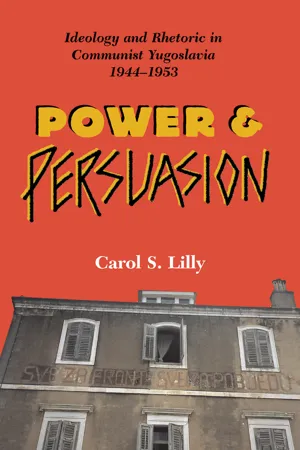
Power And Persuasion
Ideology And Rhetoric In Communist Yugoslavia, 1944-1953
- 288 pages
- English
- ePUB (mobile friendly)
- Available on iOS & Android
eBook - ePub
About this book
When the Communist Party of Yugoslavia (CPY) took power after the Second World War, it had a vision for a new and better society in which all humans would live together in peace and prosperity and in which their mutual exploitation would be eliminated. That vision required changes not only in the country's political and economic structure, but in its citizen's values, morals, goals, aesthetics, and social behavior. Based on extensive archival research, Lilly's study describes the CPY's struggle to realize that social and cultural transformation by means of oral, written, and visual persuasion in the first nine years after the war.Lilly's descriptions of party policies in such media as newspapers, journals, educational curricula, group activities like parades, workplace competitions, and volunteer labor brigades, and the production of both high and popular culture depict the evolving form and content of the party's persuasive rhetoric. Her archival work, moreover, reveals both societal reaction to such rhetoric and the extent to which party leaders adapted their persuasive policies in response to feedback from below. In this respect, Lilly places her work at the intersection of cultural history, cultural studies and politics by discussing how individuals and different groups perceive, digest, and remake culture from above in their own image.Ultimately, then, this study not only modifies current understandings of Yugoslavia's postwar history but informs us about the nature of state-society relations in dictatorial regimes and the complexities of cultural change. Moving beyond an interpretation of Yugoslavia's political and cultural history in the 1940s, it addresses broader questions like: How do dictatorial regimes maintain power and support? How do subject populations express their views and exert influence even under oppressive conditions? When and how does persuasive rhetoric work and what are its limits?
Introduction
When the Communist Party of Yugoslavia (CPY) took power after the Second World War, it had a vision for a new and better society—a society in which all humans would live together in peace and prosperity and in which their mutual exploitation would be eliminated. Based on the ideology of Karl Marx and Friedrich Engels (as amended by Vladimir Lenin), that vision was the party's ultimate goal and main source of legitimacy. Consequently, many party policies sought to achieve the social and cultural transformation inherent in that vision. Yet party leaders also faced innumerable practical and political problems associated first with maintaining power and rebuilding the Yugoslav economy, and later with retaining independence and economic viability in the face of Soviet and Eastern European hostility. Moreover, party leaders in Yugoslavia were not acting in a vacuum but had to take into account the preexisting societies and cultures.1 Indeed, Yugoslav Communists faced a particularly complex task as they confronted not one but a whole series of preexisting cultures based around the country's numerous constituent nations and national minorities. Hence, every attempt at change faced an array of deeply entrenched structures, institutions, values, and behavioral habits. In each case, Yugoslavia's Communists had to decide whether and how to undermine the extant cultures or to adopt and manipulate them for their own purposes. Postwar CPY policies thus reflect the party's struggle to find and hold a balance between its long-term goal of transforming society and culture2 and its immediate political and economic needs, between its revolutionary desire for change and its pragmatic need for security and stability.
In its efforts to attain both political security and social change, the CPY employed a number of tools, including economic incentives, force, and persuasion. While party leaders often counted on the first two to realize political goals, they also saw persuasion as crucial for securing public acceptance of and participation in their political agenda. Persuasion was even more important to the social and cultural transformation required by the party's long-term vision for the future. After all, the party's ultimate goal required changes not only in the country's political and economic structure, but in its citizens—in their values, morals, goals, aesthetics, and social behavior.3 These new citizens would be strong, courageous, and hardworking, but also intelligent, educated, and highly cultured. Most of all, they would be people who recognized that the needs of society as a whole were more important than the needs of any one individual and who were prepared to give their all for that greater good, understanding that in so doing they would also be serving their own best interests. While party leaders did not hesitate to use force to achieve their ends, they believed that the final goal of communism could only be built with the voluntary cooperation and participation of the vast majority of the population. Consequently, persuasion was a vital component of the party's activities and party leaders desperately wanted it to succeed.
This monograph documents the CPY's use of persuasive rhetoric by oral, written, and visual means for both its long-term transformative and short-term political goals in the years between the establishment of Communist power in Yugoslavia with the liberation of Belgrade in October 1944 and the end of the party's first reform era at the June 1953 Second Plenum of the Central Committee of the League of Communists of Yugoslavia (LCY, formerly the CPY). It considers both the intentions and accomplishments of the party's persuasive strategies and shows the evolution of their content and form during the first nine years of Communist rule.
In the process, it modifies existing historiography on early postwar Yugoslavia in several ways. Most historians of Yugoslavia designate the period from 1944 to 1949 as the "Stalinist" era, during which time the Yugoslav Communists were rigid and dogmatic ideologues who unreservedly drew nearly all their policies and institutions directly from Soviet models and imposed them on a helpless and passive population. The June 1948 split between Tito and Stalin, they then explain, brought about the next "reformist" era of Yugoslav history, from late 1949 to the Sixth Party Congress of November 1952. According to traditional views, the split caused a political and economic crisis that forced CPY leaders to renounce their Soviet-based policies and initiate a series of innovative political, social, and economic reforms. These reforms were designed to justify the continued tenure of CPY leaders in power despite Soviet hostility, secure Western economic aid, and pacify an increasingly dissatisfied population.4 These scholars clearly delineated the main events and issues relating to the Soviet-Yugoslav split and have offered many valuable insights into the development of communism in Yugoslavia. Their research established a solid foundation of knowledge on which all future studies of the topic must rely. For a variety of reasons, however (some clearly relating to the availability of sources), nearly all of these earlier scholars concentrated on the Soviet-Yugoslav split and its accompanying political and ideological changes, neglecting in the process the years between 1944 and 1948.5
My research into the 1944-1948 era led me to question many of the assumptions about the so-called Stalinist period. First of all, my study of rhetoric showed that while party leaders unquestionably drew on the Soviet experience, they were fully conscious well before 1948 that not all features of the Soviet example were worthy of emulation or suited to Yugoslavia's needs and conditions. Moreover, the evolving form and content of CPY rhetoric revealed party leaders who, even before the split, were not just ideologues committed to a Marxist-Leninist vision of the future but also very practical power politicians, willing and able to modify their policies in response to unexpected events and reactions from below. Likewise, the populace was more influential and effective than previously assumed. Albeit on an unequal basis and within certain boundaries, ordinary people engaged in a process of negotiation with party leaders, resulting in clearly visible consequences for both the party's rhetoric and its more general policies.
The traditional periodization and depiction of postwar Yugoslav history thus raises a number of questions. After all, if CPY leaders had been blindly dogmatic ideologues, more Stalinist than Stalin himself, up until 1948, their metamorphosis into flexible and innovative reformers by 1950 would seem improbable. The transformation of the passive and impotent populace of the 1940s into dangerous masses that party leaders tried to pacify is equally baffling. It is my contention that while the split was a defining moment in postwar Yugoslav history, its significance and the content of subsequent reforms can be properly understood only in the context of those years preceding the split. Only by combining evidence from the two eras can we devise a portrait of the CPY and Yugoslav society that resolves these dilemmas.
By placing equal emphasis on the years before and after the split, this monograph reveals the line of continuity that joined them and that makes the post-1948 reforms intelligible. In the process, it modifies the significance of 1948, which then ceases to represent a kind of "iron curtain" separating two apparently unconnected regimes. For while many of the changes that took place in CPY policies after 1948 were stimulated by external events, the direction and form that those changes took flowed from the party's previous experiences and internal development. The split created both a crisis and an opportunity that allowed and even required policy changes; yet the nature of those changes was rooted in the party's previous successes and failures. Without denying the significance of the Soviet-Yugoslav split, my study allows us to see another criterion of equal importance for the evolution of the Yugoslav Communist regime—the tension between the party's desire for revolutionary social and cultural change and its concurrent need for political security and stability.
Just as important, my study revises our understanding of the complex and evolving dynamic between the party-state and Yugoslav society in the postwar era. Cold war-era historiography of Communist regimes has tended to perceive them as monolithic behemoths that persistently imposed their policies on helpless and passive subjects. More recent studies, especially those based on newly available archival sources, have begun to modify that perspective, revealing the kinds of pressure from below that various social forces have been able to assert even in clearly dictatorial regimes. My study belongs in that latter category, as it will describe the ways in which the party-state and Yugoslavia's inhabitants responded to and influenced one another. While I do not pretend that the relationship was an equal one, neither was it entirely one-sided. After all, precisely because CPY leaders were committed to their vision for the future, they wished to engage Yugoslavia's citizens in its construction. Yet seeking to ensure their own political security, party leaders also insisted on a degree of social control that served to stifle popular initiative and activism. These simultaneous and contradictory goals competed in party rhetoric and directly influenced the nature of state-society relations.
The party's long-term vision for the future, which involved the transformation of society and culture, required that all Yugoslav citizens learn and adopt Marxist-Leninist ideology as a way of understanding the world, a vision for the future, and a program of action. It also required that they become active participants in the construction of socialism. Rhetorical strategies designed to attain that goal were both motivational and pedagogical. They sought to inspire the populace with the party's vision for the future, but also provide them with the knowledge and skills necessary to achieve that vision. The party's concurrent need for stability required quite a different kind of rhetoric—one that stressed absolute adherence to the program established from above and indeed an absence of alternatives to that program. It offered both positive and negative directions, informing the public not only what it must do but what it must not. It was, most often, supported by the open threat of coercion.
The tension between the opposing goals in CPY rhetoric reflected the party's graduated strategy for the construction of socialism in Yugoslavia. According to that strategy party leaders focused first on securing political power, second on achieving economic stability and only third on transforming society and culture in accordance with Communist values. Although this phased program of action was referred to only rarely in print (and then only after 1948), it clearly dictated what party leaders understood to be their immediate and long-term goals. By referring to that strategy, then, we may better understand why certain policies were implemented, continued, modified, or abolished at particular times.
Reference to that strategy also helps explain changes in the party's persuasive activities. In the first two phases, as party leaders sought to consolidate power and reconstruct the economy on a socialist basis, the glorious future and the importance of Marxist-Leninist ideology remained secondary to the demands of daily politics in party rhetoric. Even then, party leaders could not afford completely to neglect their long-term vision for the future. After all, it represented their main source of legitimacy. Nonetheless, it was only when the party embarked on the third phase of transforming society and culture that Marxist-Leninist ideology began to play a stronger and more public role in CPY rhetoric. Here again, however, party leaders, while giving more emphasis to their long-term goals, could not afford to risk their immediate position in power. And so the balancing act continued.
Yet even while adhering to their strategy, CPY policies and rhetoric were necessarily limited by existing conditions, institutions, and social relations in postwar Yugoslavia as well as by the international constellation of power. Such "internal and external constraints," to use Stephen Lukes's terminology, often forced party leaders to modify their approach and adopt policies contrary to their guiding ideology.6 The most important external force, the Soviet-Yugoslav split, interrupted and delayed the planned transformation of society and culture, while it simultaneously allowed CPY leaders to expand their notions about how to achieve that transformation. Nonetheless, it did not change the basic strategy. Moreover, the direction taken by many reforms in the 1950s was clearly determined by the party's domestic experiences—in particular, its past successes and failures in the field of persuasion.
Public response to party rhetoric also influenced its form and content. When urged to take up the party's vision and help make it happen, some Yugoslav citizens were inspired and acted with enthusiasm and vigor. Yet they did not always do so in an orderly or acceptable manner. Very often, when such citizens heeded the call to "show greater initiative," they made "mistakes." Moreover, the party's calls for engagement sometimes resulted in disagreements over strategy and goals or even open dissent. This kind of activism clearly countered the party's need for political security and stability. Yet when party rhetoric sought to resolve these problems by offering increasingly specific and restrictive instructions about how to participate, it only dampened public interest and enthusiasm; discussion ceased and Yugoslav citizens adopted a strategy of public accommodation and private resistance. That is, they would do precisely as much as they had to and refrain from forbidden activities, but also withdraw from activism into the private sphere and avoid contact with the party-state as much as possible. Obviously, these responses to CPY rhetoric, even while offering greater politi...
Table of contents
- Cover
- Half Title
- Title
- Copyright
- Contents
- Acronyms
- Acknowledgements
- Introduction
- Bibliography
- Index
Trusted by 375,005 students
Access to over 1.5 million titles for a fair monthly price.
Study more efficiently using our study tools.
Frequently asked questions
Yes, you can cancel anytime from the Subscription tab in your account settings on the Perlego website. Your subscription will stay active until the end of your current billing period. Learn how to cancel your subscription
No, books cannot be downloaded as external files, such as PDFs, for use outside of Perlego. However, you can download books within the Perlego app for offline reading on mobile or tablet. Learn how to download books offline
Perlego offers two plans: Essential and Complete
- Essential is ideal for learners and professionals who enjoy exploring a wide range of subjects. Access the Essential Library with 800,000+ trusted titles and best-sellers across business, personal growth, and the humanities. Includes unlimited reading time and Standard Read Aloud voice.
- Complete: Perfect for advanced learners and researchers needing full, unrestricted access. Unlock 1.5M+ books across hundreds of subjects, including academic and specialized titles. The Complete Plan also includes advanced features like Premium Read Aloud and Research Assistant.
We are an online textbook subscription service, where you can get access to an entire online library for less than the price of a single book per month. With over 1.5 million books across 990+ topics, we’ve got you covered! Learn about our mission
Look out for the read-aloud symbol on your next book to see if you can listen to it. The read-aloud tool reads text aloud for you, highlighting the text as it is being read. You can pause it, speed it up and slow it down. Learn more about Read Aloud
Yes! You can use the Perlego app on both iOS and Android devices to read anytime, anywhere — even offline. Perfect for commutes or when you’re on the go.
Please note we cannot support devices running on iOS 13 and Android 7 or earlier. Learn more about using the app
Please note we cannot support devices running on iOS 13 and Android 7 or earlier. Learn more about using the app
Yes, you can access Power And Persuasion by Carol S Lilly in PDF and/or ePUB format, as well as other popular books in History & Eastern European History. We have over 1.5 million books available in our catalogue for you to explore.