“Scientists investigate that which already is; engineers create that which never has been.”
Albert Einstein
Loosely paraphrased: “Science is what is... Engineering is what you want it to be.”
Science and Engineering: Two Essential and Related Disciplines
Chemists study matter and its transformation into its different forms, and create new chemicals, including chemicals of great potential value. They also devise ways to synthesize those chemicals; first, they do this in laboratory-scale quantities, often with the help of new catalysts. Then chemists work with others (including chemical engineers and those in related disciplines) to scale up these discoveries to produce commercial-scale quantities using processes that are deemed safe and environmentally and economically viable. Chemists are increasingly seeking to apply principles of “green chemistry” the practice of creating new chemicals and chemical reactions that are benign in terms of their ultimate impact on personnel and the environment.
By contrast, chemical engineers play an integral role in taking promising chemistry-related discoveries and devising the necessary engineering, safety, and control systems to produce them on a commercial scale, both safely and economically, with minimal impact to the environment. Such professionals use the full range of chemical engineering principles to design, build, and manage industrial-scale process plants that are needed to safely and sustainably produce the needed quantities of useful chemicals and related products for society with minimum impact on the environment. Figure 1.1 shows several chemical plants on the coast of the Netherlands.
Figure 1.1This aerial view shows several chemical process plants in the Netherlands. Chemical engineers and biomolecular engineers find a diverse array of employment opportunities at these types of facilities, which rely on all aspects of these technical disciplines to transform raw materials into finished products in a safe, efficient and economical way. (Source: Shutterstock ID 717938881, 7 August 2017, Moerdijk, Holland. Aerial view of industrial area with Shell Chemicals Attero and Essent. On the clear horizon a sky with clouds and river Hollands Diep)
Chemical engineers often work closely with chemists to take promising breakthroughs and produce commercial-scale quantities of the new products and processes.
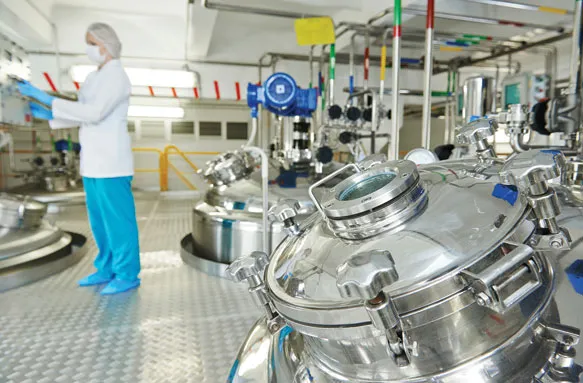
Similarly, biochemists, microbiologists, and other life scientists study how living organisms synthesize and metabolize biochemicals; they also study ways to create useful biochemicals at laboratory scale and then work with biomolecular engineers to devise ways to produce useful bioproducts safely, economically, sustainably, and at commercial scale. Figure 1.2 shows a pharmaceutical manufacturing facility.
Figure 1.2Pharmaceutical manufacturing facilities place a high premium on ensuring high standards of purity when manufacturing active pharmaceutical ingredients and final pharmaceutical products. (Source: Shutterstock ID 214256035, pharmaceutical factory equipment mixing tank on production line in pharmacy industry manufacture factory)
Benefits of Chemical and Biomolecular Engineering
Have you ridden in a car recently? If so, you can thank chemical engineers for the gasoline, rubber for the tires, plastic for the steering wheel and interior, safety glass for the windows, for the microchips, the catalytic converter to minimize air pollution, and many other components.
Chemical engineers are now creating fuel cells to power cars using cleaner-burning hydrogen produced by other chemical engineers. Would you like to become one of those chemical engineers? Or would you like to become a chemical engineer working on new batteries that would extend the range of electric cars and reduce the risk of fire?
When you take medicine, you can thank chemical and biomolecular engineers for devising ways to manufacture the various medications (in pill form, as an injection, or via an intravenous drip) in ultra-pure, ultra-clean (aseptic) facilities, at a production scale that is sufficient to be both practical and economical. These highly trained technical experts continue to ensure high purity in pharmaceutical products by devising highly specialized packaging and administration routes (intravenous and injection systems, blister packs for pills and capsules, and more). Biomolecular engineers are also helping to discover new antibiotics, new cancer medications, treatments for rare diseases, and so much more, and then to produce them, purify them, and package them—all on an industrial scale.
Chemical and biomolecular engineers routinely make enormous contributions to society, in many different industrial segments (Table 1.1).
Table 1.1Some Great Achievements of Chemical Engineers Semiconductor fabrication |
Medicine |
Environmental protection |
Crude oil (petroleum) processing |
Plastics |
Synthetic fibers |
Synthetic rubber |
Gases from air |
Food |
Antibiotics |
Separation and use of Isotopes |
Chemical and Biomolecular Engineering Defined
Chemical engineers work with chemicals such as ethylene and polyethylene; biomolecular engineers work with (bio)chemicals of biological origin, such as insulin and penicillin.
The professions of chemical engineering and biomolecular engineering are very similar; they use many of the same processing methods to create industrial- or commercial-scale quantities of new chemicals, biochemicals, medicines, fuels, specialty materials, and more. In fact, some believe that the name “chemical engineering” covers all types of materials. We will maintain the distinction between chemical engineering and biomolecular engineering because there are a few important differences in the processes employed across these two disciplines. Figure 1.3 is a photo of two engineers reviewing plans in a process plant.
Figure 1.3Chemical engineers often pursue satisfying technical and managerial careers working in facilities that produce petrochemicals, plastics, and related products. When such facilities use biological processes to carry out the desired chemical conversions or to treat waste streams, biomolecular engineers are also in demand. (Source: Shutterstock ID 143754721, chemical engineering manager and senior worker at petrochemical plant)
Chemical engineering. This discipline applies chemistry, physics, mathematics, and unique chemical engineering principles to create and manage industrial processes that transform raw materials into useful products safely in a sustainable way. These transformations typically involve changes in the physical state, chemical composition, and other characteristics.
Biomolecular engineering. In addition to using many of the chemical engineering processes, biomolecular engineering also employs biological and biochemical sciences to develop processes to produce biomolecular products (such as medicines, fuels, amino acids, and vitamins) using ...