eBook - ePub
Cosmeceuticals and Active Cosmetics
- 472 pages
- English
- ePUB (mobile friendly)
- Available on iOS & Android
eBook - ePub
Cosmeceuticals and Active Cosmetics
About this book
Cosmeceuticals and Active Cosmetics discusses the science of nearly two dozen cosmeceuticals used today. This third edition provides ample evidence on specific cosmeceutical substances, their classes of use, skin conditions for which they are used, and points of interest arising from other considerations, such as toxicology and manufacturing. The b
Information
Chapter 1
Bakuchiol: A Retinol-Like Functional Compound, Modulating Multiple Retinol and Non-Retinol Targets
Ratan K. Chaudhuri
Background
Bakuchiol (Figure 1.1; Phenol, 4-[1E, 3S]-3-ethenyl-3, 7-dimethyl-1, 6-octadienyl) was first isolated by Mehta et al. from the Psoralea corylifolia seed in 1973.1 Absolute configuration of bakuchiol was established in the same year by Parakasarao et al.2 Bakuchiol has one asymmetric center and is shown to possess (S)-chirality.3 Mechanistically, both the 4-hydroxystyryl and terpenic moieties of the compound seem to be important for its bioactivity. Total synthesis was also accomplished in 1973.4 Banerji and Chintalwar reported the biosynthesis of bakuchiol and established the pathway by using phenylalanine and mevalonic acid as substrates.5,6
Figure 1.1
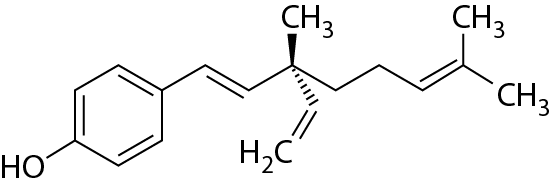
Structure of bakuchiol.
Bakuchiol is mainly obtained from the seeds of the plant Psoralea corylifolia, which is widely used in Indian as well as in Chinese medicine to treat a variety of diseases.7 Traditional medicine practitioners in India and China have utilized the plant for centuries. Psoralea corylifolia is known by a wide variety of names, suggesting its widespread use. For example, babchi, baguchi, babachi, Bakchi in Hindi and by many other names depending on the Indian languages; Ravoli in Sri Lanka; Boh-gol zhee in Korea; Buguzhi in Chinese.7 A recent chapter on P. corylifolia describes its botany, phytochemistry, and ethnopharmacology, along with the various pharmacological activities of the plant.8 Bakuchiol has also been isolated from other plants, such as P. grandulosa,9,10 P. drupaceae,11 Ulmus davidiana,12 Otholobium pubescens,13 Piper longum,14 and Aerva sangulnolenta Blum.15
Structurally, bakuchiol (Figure 1.1) belongs to the family of meroterpenes. Meroterpenes are terpenes having an aromatic ring in the chemical structure. The term meroterpenoid was first applied by Cornforth, in 1968, to describe natural products of mixed biosynthetic origin which are partially derived from terpenoids.16 They are typically derived from higher plants though they have also been obtained from fungi17 as well as having been produce...
Table of contents
- Preface
- Contributors
- Chapter 1 - Bakuchiol: A Retinol-Like Functional Compound, Modulating Multiple Retinol and Non-Retinol Targets
- Chapter 2 - Cutaneous Applications of Caffeine
- Chapter 3 - Curcumin in Cosmetics: Biochemical Basis for Skin Repair with Use of Topical Curcumin
- Chapter 4 - The Cosmetic and Therapeutic Uses for Epicatechin-3-Gallate (EGCG)
- Chapter 5 - Ellagic Acid
- Chapter 6 - Gamma-Linolenic Acid–Containing Vegetable Oils
- Chapter 7 - Hexylresorcinol: Providing Skin Benefits by Modulating Multiple Molecular Targets
- Chapter 8 - Hydroxyacids
- Chapter 9 - Kinetin
- Chapter 10 - Topical Resveratrol
- Chapter 11 - Impact of Rhodiola rosea on Skin
- Chapter 12 - Silymarin
- Chapter 13 - Topical Niacinamide
- Chapter 14 - Anti-Aging Topical Peptides and Proteins
- Chapter 15 - Amino Acids and Derivatives
- Chapter 16 - Antioxidants
- Chapter 17 - Decorative Cosmetics
- Chapter 18 - Hair Cosmetics and Cosmeceuticals
- Chapter 19 - Moisturizers: Treatment of Dry Skin Syndrome and Barrier Defects
- Chapter 20 - Cosmeceutical Treatments of the Nail
- Chapter 21 - Botanicals and Cosmeceuticals for Sun Protection
- Chapter 22 - UV Care
- Chapter 23 - Topical Vitamins E, C, and Ferulic Acid and Topical L-Selenomethionine
- Chapter 24 - The Use of Cosmeceuticals in Rosacea
- Chapter 25 - Cosmeceutical Treatments for Androgenetic Alopecia
- Chapter 26 - Eczema, Xerosis, and Cutaneous Barrier Repair
- Chapter 27 - Melasma and Depigmentation Agents
- Chapter 28 - The Use of Cosmeceuticals for Oily Skin, Seborrhea, and Seborrheic Dermatitis
- Chapter 29 - Cosmeceutical Treatments for Purpura
- Chapter 30 - Vitiligo (Repigmentation Agents)
- Chapter 31 - Botanical Extracts
- Chapter 32 - Biomarine Actives
- Chapter 33 - Analytical Chemistry of Botanical Extracts
- Chapter 34 - Legal Distinction in the United States between a Cosmetic and a Drug
Trusted by 375,005 students
Access to over 1.5 million titles for a fair monthly price.
Study more efficiently using our study tools.
Frequently asked questions
Yes, you can cancel anytime from the Subscription tab in your account settings on the Perlego website. Your subscription will stay active until the end of your current billing period. Learn how to cancel your subscription
No, books cannot be downloaded as external files, such as PDFs, for use outside of Perlego. However, you can download books within the Perlego app for offline reading on mobile or tablet. Learn how to download books offline
Perlego offers two plans: Essential and Complete
- Essential is ideal for learners and professionals who enjoy exploring a wide range of subjects. Access the Essential Library with 800,000+ trusted titles and best-sellers across business, personal growth, and the humanities. Includes unlimited reading time and Standard Read Aloud voice.
- Complete: Perfect for advanced learners and researchers needing full, unrestricted access. Unlock 1.5M+ books across hundreds of subjects, including academic and specialized titles. The Complete Plan also includes advanced features like Premium Read Aloud and Research Assistant.
We are an online textbook subscription service, where you can get access to an entire online library for less than the price of a single book per month. With over 1.5 million books across 990+ topics, we’ve got you covered! Learn about our mission
Look out for the read-aloud symbol on your next book to see if you can listen to it. The read-aloud tool reads text aloud for you, highlighting the text as it is being read. You can pause it, speed it up and slow it down. Learn more about Read Aloud
Yes! You can use the Perlego app on both iOS and Android devices to read anytime, anywhere — even offline. Perfect for commutes or when you’re on the go.
Please note we cannot support devices running on iOS 13 and Android 7 or earlier. Learn more about using the app
Please note we cannot support devices running on iOS 13 and Android 7 or earlier. Learn more about using the app
Yes, you can access Cosmeceuticals and Active Cosmetics by Raja Sivamani, Jared R. Jagdeo, Peter Elsner, Howard I. Maibach, Raja Sivamani,Jared R. Jagdeo,Peter Elsner,Howard I. Maibach in PDF and/or ePUB format, as well as other popular books in Medicina & Dermatologia. We have over 1.5 million books available in our catalogue for you to explore.