Brand Management: Mastering Research, Theory and Practice is a valuable resource for those looking to understand how a brand can be conceptualized and thus managed in all its complexity. Going beyond the 'quick fixes' of branding, it offers a comprehensive overview of brand management theories from the last 35 years.
A highly regarded textbook, this fully updated third edition brings fresh perspectives on the latest research in, and analysis of, the various approaches to brand management. More than 1,000 academic sources have been carefully divided into a taxonomy with eight schools of thought – offering depth, breadth and precision to one of the most elusive management disciplines of our time.
Perfectly marrying theory with practice, this comprehensive text is particularly useful for advanced undergraduate and postgraduate students of brand management, strategy and marketing.
Brands are interesting commercial and pop-cultural phenomena, can be understood from many different perspectives, and change as time, culture and consumers do: ‘As markets change, marketing theories must also change to accommodate them’ (Kozinets et al. 2010 p. 71). Often, the most innovative brands seem to be condensates of complex changes in time and culture.
Corporations spend millions planning and implementing brand activities. New research is published and frameworks are developed on a daily basis in the attempt to find the holy grail of brand management. Since the mid-’80s, in particular, researchers and practitioners alike have explored the domain, scope and potential of the brand. Many different concepts, theoretical frameworks and ideas have seen the light of day and, as a result, a wide spectrum of different perspectives on how a brand ought to be conceptualized and managed is in play today. Therefore, to obtain an overview of the field of brand management is an overwhelming task.
This book provides a complete overview of brand management by taking you through eight brand approaches. These eight ‘schools of thought’ represent fundamentally different perceptions of the brand, the nature of the brand–consumer exchange and how brand equity is created and managed. Understanding the eight brand approaches separately provides a deep insight into the strengths and weaknesses of each approach and hence the potential of brand management as a whole. This comprehensive understanding will enable the reader to create customized brand strategies matching the unique challenges and possibilities facing a brand at any time.
The eight approaches are:
The economic approach: the brand as part of the traditional marketing mix
The identity approach: the brand as linked to corporate identity
The consumer-based approach: the brand as linked to consumer associations
The personality approach: the brand as a human-like character
The relational approach: the brand as a viable relationship partner
The community approach: the brand as the pivotal point of social interaction
The cultural approach: the brand as part of the broader cultural fabric
The sensory approach: the brand as experienced through our senses
The identification of the eight approaches is based on an extensive analysis of the most influential brand research articles published between 1985 and 2019 (650+ articles from Journal of Marketing, Journal of Marketing Research, Journal of Consumer Research, Harvard Business Review and European Journal of Marketing). This body of literature is supplemented with key non-research literature that has shaped the field of brand management since the mid-1980s. The analysis has been conducted using a methodology uncovering the development of scientific knowledge. The methodology is based on a theory developed by American philosopher of science Thomas Kuhn (Bjerre et al. 2008) (read more about the methodology in Chapter 3). Since (scientific) knowledge is in constant development, new brand approaches most likely will emerge in the future. In the first two editions of this textbook, our dataset provided us with seven brand approaches. It was not until we prepared this (third) edition, that the most recent approach – the sensory approach – emerged. The methodology of this book has proven to be very precise in uncovering how scientific knowledge develops. Knowledge develops all the time within each approach, which is why we have added overviews of the academic evolution at the end of each approach chapter. And sometimes – once in a while – new approaches emerge and the academic field of brand management thus expands.
Traditionally, brand management textbooks offer an introduction to main concepts and the wide array of theories, but often fail to discriminate between how different approaches result in very different outcomes and why. It is important for us to stress that the aim of this book is to deconstruct brand management to enhance understanding and reflection on the differences. The different approaches to brand management draw on many different scientific traditions such as economics, strategic management, organizational behavior, consumer research, psychology and anthropology just to mention a few; understanding these and the consequences, we believe, will better equip students and practitioners with a reflected brand management understanding and toolbox. A complete overview of brand management hence requires multidimensional thinking. Most textbooks take on this multidimensionality through integration of several perspectives in all-encompassing frameworks. If you look at the list of brand approaches, you will most likely recognize many of the brand elements (e.g. personality, relation and consumer) that are encompassed in the classical textbook models (e.g. see Aaker’s brand identity model, Kapferer’s brand prism and Keller’s customer-based brand equity pyramid). The integrated frameworks are, however, not necessarily ideal when it comes to understanding and getting an overview of the field of brand management. Integration tends to blur the differences and similarities between different approaches in brand management and leave the reader rather confused. Still, the integrated frameworks have the advantage that a strategist can take into consideration all relevant aspects without losing oneself in details.
This book can be read in two ways: either as a stand-alone textbook or as a supplement to the textbooks by the earlier-mentioned authors. Read as a supplement, the book offers the inquiring reader the opportunity to understand the components of the traditional models in depth. Read alone, the book offers the opportunity to evaluate the most important schools of thought in brand management and create his or her brand management model featuring the components that are most relevant for the challenge at hand. Furthermore, it provides a chronological account of 35 years of brand management and marketing theory.
Resting on a comprehensive analysis of brand management as a scientific discipline, Brand Management: Research, Theory and Practice offers the reader a scientifically grounded overview of the main schools/approaches in brand management – and of their managerial implications. Brand Management: Research, Theory and Practice presents each approach separately and as an ‘ideal type’ based on the conviction that understanding the exact content of each approach and its origin will better equip the reader to combine different approaches, when in an educational or a managerial setting.
The four layers of an approach
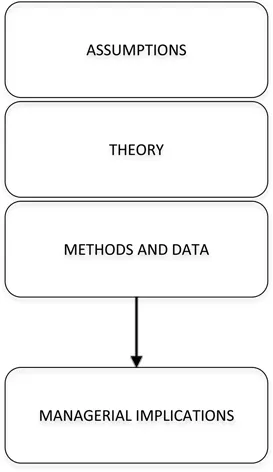
The eight ‘schools of thought’ are ‘clusters’ of literature sharing distinct brand perceptions. In each cluster, there is coherence between assumptions, theories and methods/data. The three ‘scientific layers’ (assumptions, theories and methods/data) add up to managerial implications. The structure of the eight approach chapters is guided by this coherence between assumptions, theories, methods/data and managerial implications (Figure 1.1).
Assumptions are not to be understood in a high-flung sense of the word. Each approach holds its own implicit view of the nature of the brand and the premise of the brand–consumer exchange. Clarifying these assumptions facilitates the understanding of the theories, methods and managerial implications of each approach. Assumptions also illuminate the intangibles inherent in the nature of the brand.
The ‘theory’ layer represents the concepts, models and figures that are key to the understanding of each brand approach. The third layer of ‘methods and data’ provides insight into what data to look for and how to collect them when researching the content of a specific brand strategy. These three scientific layers add up to managerial implications guiding how the assumptions, theories and methods of each approach can be converted into a brand management strategy. The four layers comprising an approach are thus closely interconnected. The scientific clarification and the practical implications of the approaches will enable the reader to reflect on the compatibility of different elements of brand management strategies and ensure the creation of more accurate brand management.
Figure 1.1 The logic of the approach chapters
True to its objective, Brand Management: Research, Theory and Practice does not provide one ‘how to’ solution meaning that we refrain from being normative when it comes to the overall management of a brand. Still, we are normative within each approach and leave it to the reader to reflect upon how different situations and circumstances require different means of action. It is our hope that this book will equip readers with an overview and a deeper understanding that will enable them to create splendid customized brand management strategies and that this somewhat different approach to the communication of brand management will provide a sound platform for anyone interested in the field.
It is our hope that this book will provide its readers with a critical as well as creative s...
Table of contents
Cover
Half Title
Title
Copyright
Contents
List of figures
List of tables
List of boxes
Acknowledgements
Preface
Part I Setting the scene
Part II Eight brand approaches
Part III Other perspectives
Index
Trusted by 375,005 students
Access to over 1.5 million titles for a fair monthly price.
Study more efficiently using our study tools.
Frequently asked questions
Yes, you can cancel anytime from the Subscription tab in your account settings on the Perlego website. Your subscription will stay active until the end of your current billing period. Learn how to cancel your subscription
No, books cannot be downloaded as external files, such as PDFs, for use outside of Perlego. However, you can download books within the Perlego app for offline reading on mobile or tablet. Learn how to download books offline
Perlego offers two plans: Essential and Complete
Essential is ideal for learners and professionals who enjoy exploring a wide range of subjects. Access the Essential Library with 800,000+ trusted titles and best-sellers across business, personal growth, and the humanities. Includes unlimited reading time and Standard Read Aloud voice.
Complete: Perfect for advanced learners and researchers needing full, unrestricted access. Unlock 1.5M+ books across hundreds of subjects, including academic and specialized titles. The Complete Plan also includes advanced features like Premium Read Aloud and Research Assistant.
Both plans are available with monthly, semester, or annual billing cycles.
We are an online textbook subscription service, where you can get access to an entire online library for less than the price of a single book per month. With over 1.5 million books across 990+ topics, we’ve got you covered! Learn about our mission
Look out for the read-aloud symbol on your next book to see if you can listen to it. The read-aloud tool reads text aloud for you, highlighting the text as it is being read. You can pause it, speed it up and slow it down. Learn more about Read Aloud
Yes! You can use the Perlego app on both iOS and Android devices to read anytime, anywhere — even offline. Perfect for commutes or when you’re on the go. Please note we cannot support devices running on iOS 13 and Android 7 or earlier. Learn more about using the app
Yes, you can access Brand Management by Tilde Heding,Charlotte F. Knudtzen,Mogens Bjerre in PDF and/or ePUB format, as well as other popular books in Business & Business General. We have over 1.5 million books available in our catalogue for you to explore.