![]()
1
Introduction to Gesture
Drills and Study Questions
References
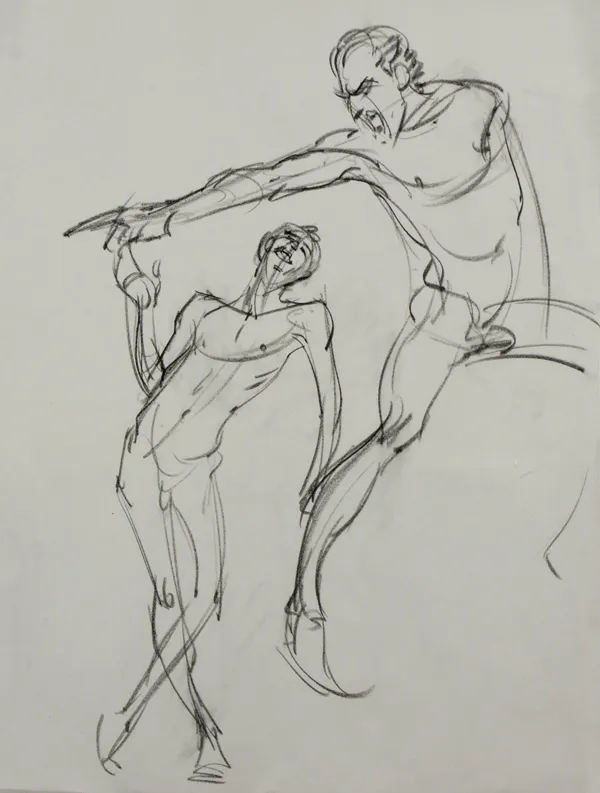
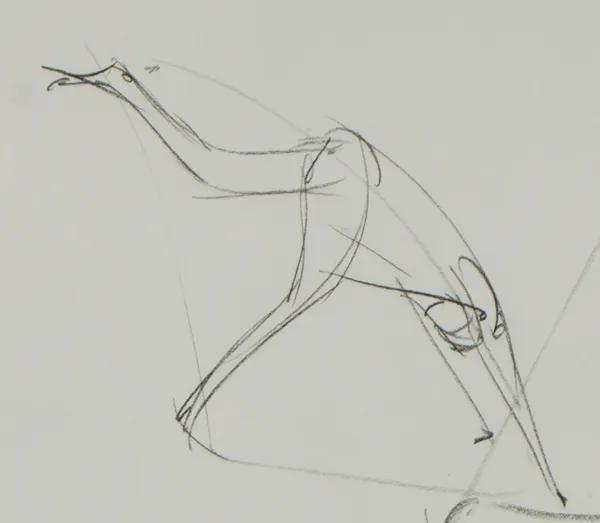
What is gesture drawing? In its common definition, it is the spontaneous capture of a moment in time, usually drawn from life or an alternate means of direct observation. One may choose to develop a gesture drawing from a live model in a life-drawing class, draw from animals at the zoo, develop a still life, or sit at a coffee shop or other public space and study the constant movement of forms and shapes. One may also choose to utilize gesture drawing as a way of warming up the eye, mind, and arm before work or use it for understanding characters and how we act and react to each other as living creatures. The lay-in of a finished work may also be described as a gesture drawing, in this case acting as the life force of the architecture that will become the finished work. Indeed, the uses and applications of gesture drawing are numerous, and potentially endless. We can use gesture drawings in the following ways: as studies of the mechanics of motion of volumetric forms in space (see Figure 1.1); as studies of acting and expressions; to develop the characterization of character archetypes; to develop a thesaurus of body types and styles of motion; and as a lay-in for a more finished work (see Figure 1.2). Depending on the nature or goal of the intended use of the gesture drawing, we can further decide what kind of gesture drawing: a quick sketch that explicitly explores specific concepts or a slightly longer drawing that captures more finite ideas for ease of communication in a finished work. Gesture drawings are typically spontaneous in nature and relatively short in duration (depending upon the nature of the application or development).
Figure 1.1
A quick-sketch/short-pose gesture drawing.
Figure 1.2
A simple quick sketch. A lay-in of a longer drawing may also resemble this.
Whatever the method of study, whatever the location, and regardless of the application, gesture drawing is simply the study of capturing the essence of life and imbuing the artist’s own work with that energy. This life energy is critical in the development of storytelling; without it, our stories are unappealing and unrelatable. In visual storytelling, the goal of the artist is to efficiently communicate either a simple or an abstract concept as universally as possible and to guide the eye in such a way that the audience not only comprehends what they’re being shown but will also feel the emotional resonance of the story being told. It is this emotional resonance that we study and attempt to capture when drawing from life; that resonance is what causes us as the audience to connect with what we’re looking at and feel the life force of an artist’s work. The goal of this book is to provide the artist—whether a student or a professional—with a study guide that can be used to explore the fundamentals of gesture drawing and develop work full of story, life, vivacity, and passion. One may choose to utilize this book in conjunction with a life-drawing or gesture-drawing class, use the exercises contained within to supplement the reader’s workflow, or simply use the drills for warm-ups. This book is in no way meant to be self-contained, and the readers are encouraged to add to, subtract from, or otherwise manipulate both the breakdown described herein and the drills and exercises included to their liking or skill level. The readers are also encouraged to develop an inquisitive, autodidactic mindset. The craft of drawing and the study of visual storytelling are lifelong endeavors, and as such the readers should not feel overwhelmed by such an intensive study; rather they are encouraged to practice patience, carefully observe the world and its inhabitants, and find inspiration in the life around them.
Before we begin, we must define the common terms usually associated with life drawing and—more specifically—gesture drawing. The terms most commonly used in classes are the following:
- Line of action
- Rhythm
- Harmony
- Flow
- Axes and shoulder line/hip line; center front and center back
- S curves, C curves, straight lines
- Exaggeration
- Action and acting
Additionally, we will define the term microgestures, as it is one we will see throughout this study guide. It is a concept that I have not yet heard outside of my own classes but describes a very specific idea. The reader may or may not already be aware of such an idea as it exists under a different name.
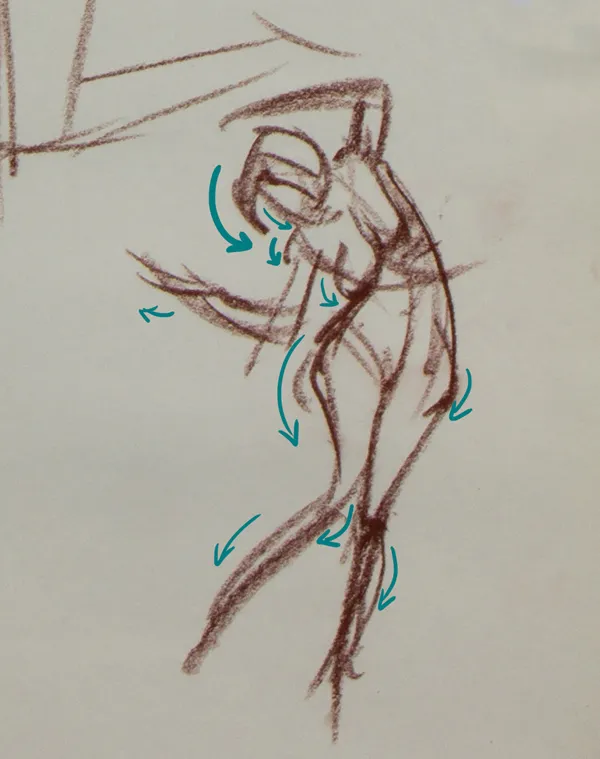
Microgestures: Smaller lines of action that describe the inherent flow of energy of shapes and forms. For example, a microgesture might be a finger or part of a finger that, while not ultimately important when compared to larger ideas, might contain a particular beauty or other quality that the artist deems as necessary to incorporate into a drawing (see Figure 1.3). These microgestures can also be found in the face, where we see a plethora of different form and shape configurations, which further contort when activated for expression. Being aware of the relationships between these so-called microgestures and the larger overlying rhythms of the whole figure aids the artist in creating harmony between larger ideas and smaller ideas. We can think of gesture almost as a fractal of sorts—albeit with variation to keep our drawings dynamic and visually interesting: we see the overlying rhythm in the silhouette, and from there can continue to break down smaller and smaller rhythms until we’ve created a song with multiple voices, each gesture being an individual voice that must harmonize with the rest of the choir of gestures in order to produce a powerful impact. Alternately, we can use this same idea to intentionally create discord if desired.
Figure 1.3
Bounce is created within this drawing by paying attention to the “microgestures” repeated down and through the figure.
We will also be using the concepts of:
- Tone (we will be using its definition from writing and literature)
- Mood
While most of these terms have commonly accepted definitions and are used by countless artists, we will define them for the scope of this book.
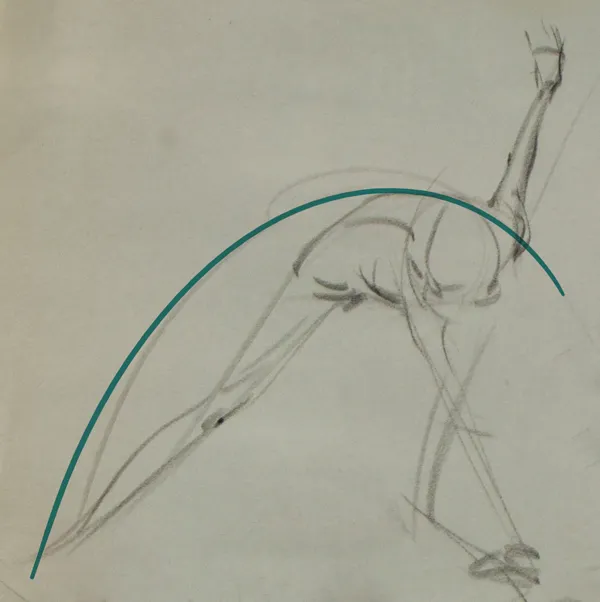
Line of action: Typically, it refers to the directional force an object tends to follow, or the flow of energy and movement present in a living body. One may interpret this visually as the longest uninterrupted line they see in the body of any particular object moving in space; or one may interpret it as the flow of energy moving through any particular body (see Figure 1.4).
Figure 1.4
Primary line of action.
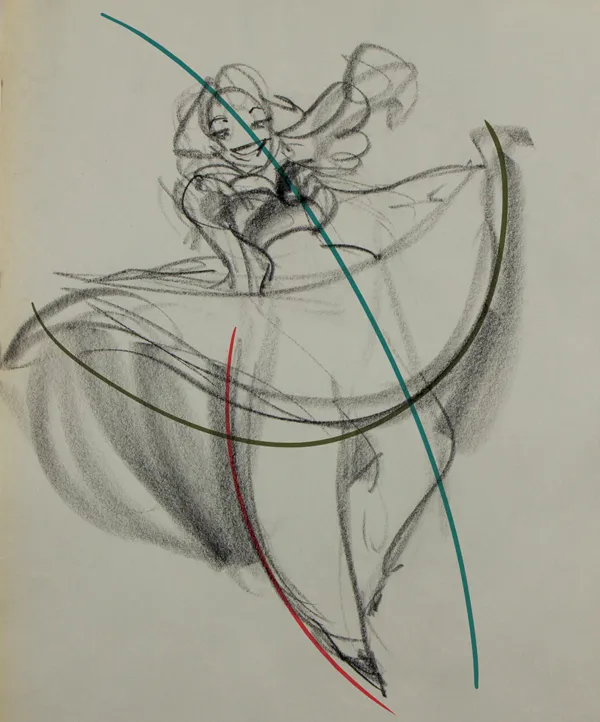
Within the scope of this book, we will be using the common definition: finding the directional force or flow of energy in any particular body moving in space. Taking this concept one step further, we will be using more than one line of action: in addition to looking for a strong primary line of action—a thesis statement, if you will—we will also be aware of the supporting lines of action that define the individual parts of the body, so that we may work from big to small, simple to complex, relating the whole to the pieces. I will often refer to them as secondary, tertiary, or simply supporting lines of action, referring to the strongest major force present as the primary line of action (see Figure 1.5). In this way, we will be constructing a visual story with a hierarchy of information that includes a thesis statement and supporting ideas in order to achieve visual clarity with consistency. When referring to the singularly strongest line of action, we will be using both the terms primary line of action and dominant directional force line (depending on context), as well as denoting major and minor ideas.
Figure 1.5
Primary line of action in blue, supporting lines of action in olive green and red.
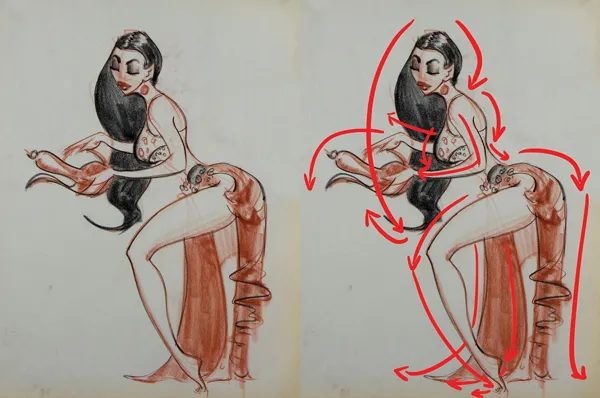
Rhythm may be defined in a variety of ways, but we will be using it here to provide a musical quality in our work. One may define it as tempo, or the underlying bounce we see in a drawing, picture, or painting (see Figure 1.6).
Figure 1.6
The rhythms of the figure are further complemented by those found and embellished in props and costume.
We may further define rhythm as the repetition of a particular sound (such as in music) or movement (such as in dance or other kinesthetic activities). We can apply this definition to our work, albeit with a visual interpretation. Using rhythm in the construction of a drawing accentuates and embellishes the life force we are attempting to capture and conveys information in a way that is visually interesting. Furthermore, it allows us to find microgestures and to develop any idiosyncrasies of the models we draw. By using cross-disciplinary and multisensory concepts in our work, we can attain a more sophisticated level of emotional resonance. The concept of rhythm is often associated with the ideas of S and C curves.
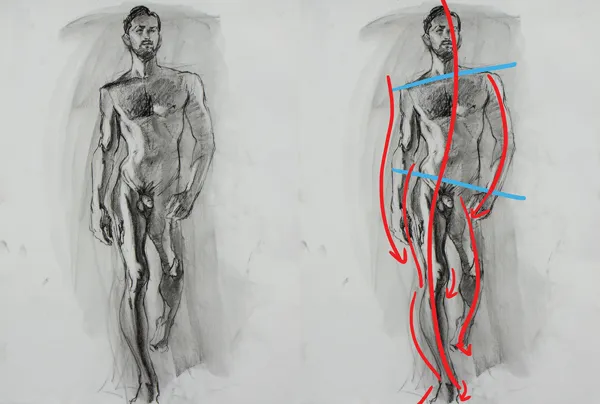
Harmony often refers to the flow in which disparate parts move together to create a unified whole (see Figure 1.7). We hear the term commonly used in relation to color theory: color harmony. We also use the term in music when parts of a song or composition work together to communicate a singular concept or theme, or any other intended idea, whether literal or abstract, whether it be so much or so little as a general mood or tone.
Figure 1.7
Shoulder and hip axes in blue; “S” and “C” curves are in red.
Flow: This term may be used to describe the rhythms present within the line(s) of action, the directional force present within the figure, ...