![]()
Part One
The Changed Notion of Brand Management
![]()
A Balanced Perspective on Brands
Summary
The purpose of this chapter is to introduce the reader to the concept of brands from both external and internal perspectives. It opens by showing that brands are valuable to both organisations and customers. In essence, brands are clusters of functional and emotional values that enable promises to be made about unique and welcomed experiences. Traditionally, brand management has taken an external focus, concentrating on meeting customers’ needs. With the growth of the services sector, the advent of the experience economy and the greater interaction between customers and staff, this chapter argues for a more balanced perspective on brand management, in particular aligning employees’ values with the brand values so that they are able and committed to deliver the brand’s values. A unifying definition of the brand is advanced and explained. Finally, the move to team-based brand management is explored.
Why the Interest in Brands?
If this business were to be split up, I would be glad to take the brands, trademarks and goodwill and you could have all the bricks and mortar – and I would fare better than you.
John Stuart, former Chairman of Quarter Oats Ltd.
This quotation is an apt way of opening a book about brand building since it makes the point that brands are valuable assets and if they are well managed they can provide a guaranteed stream of future income.
One method of recognising the way that nurturing brands results in greater financial value is to consider the following. Each year Interbrand publishes a listing of the world’s most valuable brands and Madden, Fehle and Fournier (2006) in a paper focused upon those brands. Between August 1994 and December 2000, there were 111 companies whose brands were listed in Interbrand’s most valuable brands. To investigate whether successful brand management yields higher shareholder value, they compared the returns a shareholder received between 1994 and 2000 investing in these 111 companies awarded and the returns from the rest of the companies listed on the major American stock exchanges. Were someone to have invested $1000 in August 1994 in the rest of the companies listed on the major American stock exchanges, this would have grown to $3195 by December 2000. By contrast, investing $1000 in the strong-brand companies would have yielded $4525 by December 2000. This research showed that investing in strong brand companies gave a gain of $1330 over the other companies, demonstrating that wise brand management creates even higher shareholder value.
This is but one empirical example of the value of good brand management. As Interbrand (Perrier, 1997) showed there are three types of assets that provide sources of earnings, i.e. tangible assets, brands and other intangible assets (e.g. for an airline this could be landing rights at particular airports). According to Brand Finance (2005), 78% of the market value of the Fortune 500 companies is attributable to intangibles, of which brands are the key.
Well-managed brands drive respected reputations, and as Fombrun and van Riel (2004) have documented, favourable reputations result in higher financial returns. Stakeholders grow to respect strong brands. In a time pressured society, if a brand has consistently delivered satisfaction, its customers are likely to become confident that they can minimise their search activity, abdicating choice to a low cluster of brands per category. In part this explains why Ed Burke, former CEO of Johnson & Johnson was quoted as saying ‘‘A brand is the net present value of the cumulative trust that the owners’ past marketing efforts have earned from consumers.’’
Activity 1.1
Pause for a moment to consider which of the following investment decisions you would select. The scenario is that you have two investment options. The first (option A) is to invest in a portfolio with a volatile historical performance. The probability of a successful outcome is uncertain, however, if the outcome is favourable this option could yield significant rewards (and if unfavourable the outcome may be a significant loss). The second option (option B) is to invest in a portfolio that has a known outcome probability, however, the rewards will not be as great as option A. Which option would you follow?
Discussion
People tend to gravitate to option B, in other words they put more importance on knowing the probability of an outcome, rather than the size of the outcome. From this analogy it can be seen that brands could be considered as trustmarks. Over time, if properly managed, they consistently deliver respected results. While some consumers will switch to new brands that have tempting offers (option B), others continue to buy their regular brand since they have confidence in the brand’s ability to consistently deliver its promise.
Through well-conceived and effectively managed brands, firms are able to build favourable reputations which enhance the confidence of staff, buyers and users. Reflecting this, the Market Leadership Council reports that 79% of investors state that their assessments of corporations are influenced by brand and marketing messages and 51% are influenced by corporate culture. Well-conceived brand strategies engender trust and the resulting corporate culture is the one which supports the brand promise and is respected by external stakeholders.
The problem is that some corporations overlook the value of a brand’s reputation, failing to realise that trust takes time to build and needs to be managed. Customer confidence results from repeated brand interactions characterised by consistency and a perception that the brand cares for the customer. Brands earn trust when they are honest, have authentic relationships and are responsive to changing stakeholder needs and contexts. With the financial crisis of 2008/2009, trust in brands came under attack, particularly when some corporations lost sight of the fact that people care about what is behind brands. Each year Readers Digest undertakes the Trusted Brands survey. In this they report that the most trusted brands are those whose behaviour is consistent with their brand values. In 2006, Cadbury recalled chocolate products after a contamination problem and was criticised for the way it managed this problem. After making notable changes, it became evident that sticking to the values of integrity, honesty and striving to do the right things helped to repair the loss of confidence such that in the 2009 Readers Digest survey, Cadbury was regarded as the most trusted chocolate brand.
Brands do not just command respect because of their value to corporations. They do so because they add to the quality of life. Think about the type of clothes you wear, the car you drive, the address of your home or your private Internet service provider. These are making non-verbal statements about you as a person. People choose brands, not just because of their utility, but they are also influenced by the extent to which their values match those of competing brands. Think back to when you wandered through a museum and how seeing particular brands helped you recall characteristics of that period of society. For example, the way that in the 1950s the Hoover vacuum cleaner started to lift the burden of house cleaning, the way that the Mini added a sparkle of excitement to car driving in the 1960s, the Filofax added a new twist to diary management during the 1980s, the Apple Mac made a statement about users’ creativity in the 1990s, eBay changed the rules of buying and selling and Google redefined the way we seek information in the new millennium.
Consider how brands help people to perpetuate their particular beliefs. When people give donations to specific charities it is not just to appease their feelings of sorrow or even guilt. They give to particular charities because they believe more strongly in the values of that charity rather than competing charities. Think about how brands help people feel more at ease with others through the cultural norms they reinforce. For example, giving Moet et Chandon Champagne at a celebration party. Also think about the way that brands act as pressure groups (e.g. Greenpeace, Co-op Bank) helping people to push for a better environment through their ‘‘economic voting behaviour’’. Anholt and van Gelder (2003) show how brands can contribute to a better society through improved working conditions for employees and investing in local communities.
A Balanced Perspective on Brands
The theory of brand building is couched within marketing theory. It has been argued by Vargo and Lusch (2004) that a new dominant logic for marketing has emerged, shifting the focus from tangible to intangible resources, from frozen value to cocreated value and from transactions to relationships.
While there are many global hotel groups, one of the key drivers for the success of the Ritz-Carlton brand, as Michelli (2008) shows, is the intangible asset of a unique corporate culture. An organisation’s culture, as will be explained further in Chapter 5, is underpinned by a cluster of values, and in turn this culture helps to shape the brand’s values. The considerable effort the Ritz-Carlton Hotel Company puts into sustaining its brand through its corporate culture is noted by the way their employees deliver a unique brand experience. One of the contributors to the success of this brand is through enabling staff to appreciate the desired brand experience through their brand credo, i.e.:
The Ritz-Carlton is a place where the genuine care and comfort of our guests is our highest mission.
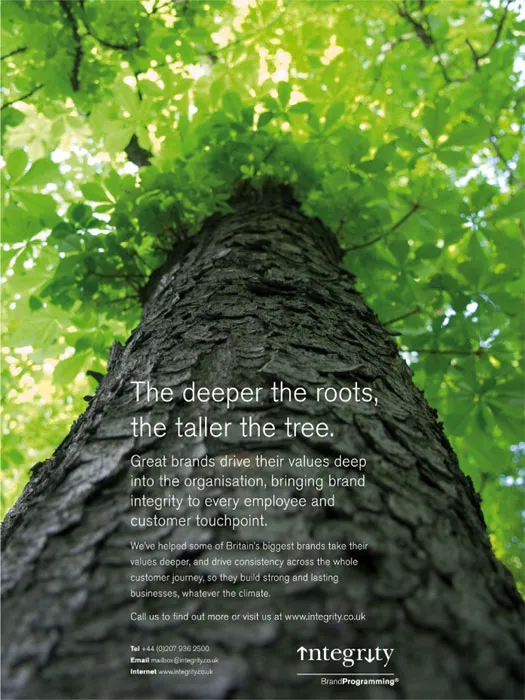
Integrity advert ‘‘Enabling staff to appreciate brand values should increase the likelihood of them better delivering the brand’’.
We pledge to provide the finest personal service and facilities for our guests who will always enjoy a warm, relaxed, yet refined ambience.
The Ritz-Carlton experience enlivens the senses, instils well-being, and fulfils the unexpressed wishes and needs of our guests.
(Michelli, 2008, p. 23).
There are many furniture store brands globally, each of which has value frozen into their brand since, amongst other reasons, there are few suggestions as to how the furniture can be tailored in terms of contexts to reflect consumers’ home aspirations. By contrast IKEA is about a concept in living. Its numerous and varied displays help inspire new ideas for furniture in the home. Using the self-assembly packs, the consumer is further empowered to shape their home environment. Value is being cocreated as consumers are no longer passive recipients of brand, but rather through their interactions they are co-creating value.
It is not difficult to recall different book store brands, yet Amazon.com sets itself apart from many by using memories of interactions with consumers to build respected relationships. A significant number of book stores look to facilitate transactions, but Amazon.com regularly analyses its users’ reading patterns to make suggestions about new books. This knowledge-based relationship engenders a stronger commitment between consumers and Amazon.com.
Brands are powerful entities because they blend functional, rationally assessed performance-based values with emotional values. So, while the Jaguar may compete with other brands of cars on the rationally evaluated performance value, it may be bought because of the emotional value of prestige. When a newly appointed Director was asked wh...