Policy informatics is addressing governance challenges and their consequences, which span the seeming inability of governments to solve complex problems and the disaffection of people from their governments. Policy informatics seeks approaches that enable our governance systems to address increasingly complex challenges and to meet the rising expectations of people to be full participants in their communities. This book approaches these challenges by applying a combination of the latest American and European approaches in applying complex systems modeling, crowdsourcing, participatory platforms and citizen science to explore complex governance challenges in domains that include education, environment, and health.
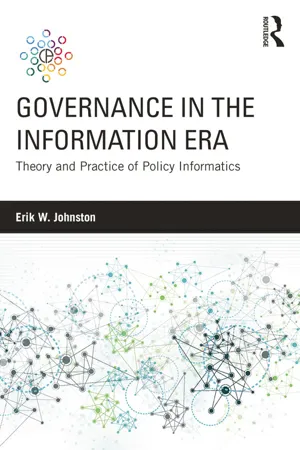
eBook - ePub
Governance in the Information Era
Theory and Practice of Policy Informatics
- 374 pages
- English
- ePUB (mobile friendly)
- Available on iOS & Android
eBook - ePub
About this book
Information
Introduction
1
Conceptualizing Policy Informatics
Policy informatics is the study of how computation and communication technology is leveraged to understand and address complex public policy and administration problems and realize innovations in governance processes and institutions. Policy informatics takes a systemic approach to addressing governance challenges and their consequences, which span the seeming inability of governments to solve complex problems to the disaffection of people from their governments. The objective of the field is to respond to these governance challenges in any domain by applying a combination of computational thinking, complex systems modeling, data analytics, and participatory science. The goal of this book is to present the perspectives of a collection of policy informatics scholars, illustrating various elements of what policy informatics means in theory and in practice in the information era.
A key element of the policy informatics approach is to apply responses in the appropriate context. This must include a robust understanding of how governance is currently manifest and how it is changing. The traditional norms of hierarchical government, expert-driven decision-making, institutional control, and centralization have begun to fade as the capacities of computation and communication technologies have increased, the costs of community engagement have declined, data have become increasingly available and accessible, and digital literacy and analytical skills have expanded. Further, stakeholders and publics are becoming more diverse, unequal, vocal, and polarized. The rapid advance of technology and its widespread diffusion in everyday use have transformed who creates and has access to information and how we leverage information toward constructing knowledge and acting on evidence. Against this backdrop, policy informatics seeks to enable public values to flourish by promoting new forms of effective governance and exploring the changes necessary in technology, processes, institutional capacity, and social norms to realize future innovations.
Consequently, the near-term objective of the policy informatics movement is to leverage technology to engage expertise wherever it exists, taking a broad view of what constitutes expertise. Success will be measured by how effective the platforms, interventions, and decision environments developed are in facilitating broad-based action and responsible distributed governance. The field’s approach is applied, system-based, and participatory, moving beyond problem identification to solution generation, implementation, and administration. In the long term, the objective is to create proven mechanisms that incorporate expertise regardless of discipline, institution, or community into governance to provide effective support for social decision-making and collective action, while ensuring the legitimacy of widespread public participation. Presented in this book are a number of proof-of-concept projects that exemplify innovative governance approaches (e.g., participatory platforms, citizen sourcing advice, community engagement, knowledge incubation), explore the drivers of collaborative failure (e.g., power disparities, complexity, uncertainty, conflicting goals), and leverage computational and communication approaches (e.g., agent-based modeling, system dynamics, interactive simulations, participatory modeling, personal health sensors, information visualization) to enhance collaborative, evidence-based decision-making and facilitate good governance.
This introductory chapter has a few simple aims. First, to outline what general societal trends are driving the need for policy informatics. Second, to differentiate clusters of research that have already begun to emerge from various disciplines. And finally, to preview how the contributions of the chapters in this book reveal the different dimensions of this growing community of practice.
Trends Driving the Emergence of Policy Informatics
The ability to interact meaningfully with each other on the Internet is rapidly being diffused among all members of society, driven by the decreased cost of communication technologies and their increased power. According to Pew Research, in 2014 cell phone ownership exceeded 90 percent in such diverse countries as China, Jordan, Russia, Chile, and South Africa (Pew Research, 2014). A report from the United States Census Bureau (File, 2013) shows that in 2011 over 75 percent of American households had a computer and almost 72 percent had Internet access from home, and a recent Pew Research report on the 25th anniversary of the World Wide Web estimated that 81 percent of Americans use Internet-connected laptop and desktop computers daily (Fox & Rainie, 2014). The rapid expansion of Internet connectivity using mobile devices such as smart phones continues to increase basic access, although a small but persistent ‘digital divide’ remains (United States, 2013). Dispersed access to communication technology enables people to connect and coordinate their personal and professional lives in ways that collapse the traditional geographic boundaries imposed by time and distance and gives rise to a globalized network society (Castells, 2011; Malone, 2004). As we become more interconnected, the challenges that face governmental institutions and public decision-makers are increasingly information-intensive, diverse, complex, interdependent, and resource-constrained.
In response, over the last few years, we have seen positive developments in the commitment of public agencies to leverage the power of technology and information to address social issues. On his first full day in office, President Barack Obama signed and issued a Transparency and Open Government memorandum to the heads of the executive offices (White House, 2009). This memo directed that government should operate in a transparent, participatory, and collaborative fashion by liberating data and information and engaging the public in addressing shared challenges.
When data is considered a public good it affords an opportunity to develop technologies that leverage information to address problems through processes that are more effective, legitimate, and efficient. Governance institutions, public networks, government agency actors, private institutions, and nonprofit and social organizations are available components of a complex system that can be mobilized to collectively address public issues in a manner that is more organic, innovative, precise, and democratic. With the erosion of fixed traditional roles and the increase of permeable organizational boundaries, public and non-governmental organizations are no longer simply passive recipients of technology, data, public problems, and policy solutions distributed top-down by experts and elites. They are increasingly co-creators of knowledge, co-makers of decisions, and co-deliverers of solutions.
Designing advanced communication and computation technology to create a communicative nexus between government and citizens enables the collaborative blending of data, expertise, and experience concerning public problems. This can manifest in the form of more innovative public institutions, policy solutions, and public actions that more legitimately, effectively, and efficiently govern society. Today, we are witnessing the emergence of platforms in the public sector that seek to take advantage of crowdsourcing through mobile apps and platforms. However, the traditional structures, processes, and tools of government characterized by bureaucracy, centralization, hierarchy, formalization, and specializations were not designed with the flexibility required to meet the changing reality of how society interacts. Consequently, they are inadequate in the face of increasingly complex and dynamic public problems, and inflexible in accommodating innovative solutions to long-standing public problems. Government can no longer effectively and legitimately serve the public as the sole proprietor of public information, expertise, and decision-making power.
Managing a growing interconnected population in a diverse society is significantly more challenging than if we had to contend with a smaller, more homogenous population. Iceland’s experiment with crowdsourcing its new constitution was ultimately unsuccessful, although it was at least possible because of its specific context; adopting such a model in a setting with a more diverse population might prove quite challenging although not impossible (Landemore, 2014). The same type of social media that was leveraged in the Arab Spring movement to organize political protests was used in the United States to engage youth and others in connecting with and electing President Barack Obama in 2008. However, adaptable and scalable governance institutions and processes can be designed to better address public issues. Thus we are presented with the unique opportunity to overcome these hurdles and advance society by designing institutions and processes that leverage communication and computation technology. Doing so will engage, inform, connect, and empower the diversity of public institutions, non-governmental organizations, and citizens with one another in dynamic, strategic, and innovative ways. This can promote a multi-directional process of sharing, capturing, aggregating, analyzing, and understanding complex problems and dynamic information in new ways, on different platforms, and in immersive environments to develop viable solutions and collaborative actions that address shared public challenges.
Essential Elements of Policy Informatics
Policy informatics is built on the fundamental premise that information can be efficiently and effectively mobilized to enable evidence-driven policy design, implementation, and analysis in a legitimate governance environment. Although a relatively new concept, three distinct research clusters are emerging: analysis, administration, and governance infrastructures. Analysis focuses on (1) harvesting information reservoirs to generate evidence and insights, (2) visualizing information and relationships between heterogeneous information sets to make sense of problem spaces, and (3) simulating and modeling complex environments to understand the efficacy of policy interventions under various scenarios and their associated outcomes. Administration focuses on (1) understanding how the infusion of technology changes policy processes at the individual and group levels, (2) providing information in and around participatory administrative processes, and (3) leveraging the power of networks through technologies that support collaborative governance. Governance infrastructures is a concept that focuses on (1) building the next generation of public organizations, (2) designing open, collaborative, distributed, and public governance frameworks and platforms, and (3) advancing the innovative capacity of public institutions using technology.
Each of the foregoing research strands has at its core an appreciation for the fact that we must navigate complex systems and systems of systems (Miller & Page, 2007). This perspective is central to how a policy informatics approach is distinct from more linear approaches to policy analysis. Furnas (2000) asserts that we must think in terms of adaptive systems, including individuals, organizations, communities, markets, and cultures as a whole. He articulates a Mosaic of Responsive Adaptive Systems (MoRAS) that consist of systems within systems, coupled together in an interdependent network where they can interact and adapt to changes in any one system. In other words, systems are embedded within a larger collection of systems; each system is complex in and of itself. As such, it is no longer sufficient to think of problems and opportunities from a linear or singular perspective of an individual agency, as an isolated problem, a one-dimensional challenge, or even a singular system. We must now think in terms of complex adaptive systems of systems. Those who work with public institutional design, management processes, and analytical tools must be equipped to understand and address multi-dimensional public challenges through associated networks that are dynamic and constantly evolving.
In the past, these types of problems might have been categorized as wicked and simply dismissed as too difficult to approach. However, by embracing the perspective of complex systems and harnessing technological and methodological advances, we can: (1) model systems to study both the intended and unintended consequences of policy interventions, (2) redesign governance processes and institutions to take advantage of the affordances of new technologies and information environments, and (3) take a more comprehensive approach when including stakeholders in the design process, providing them with tools to contribute actively in the shaping of our public institutions and policies.
Analysis
Solving complex public policy problems in a networked society requires deliberate and sophisticated information analysis. Faced with conflicting proposed solutions to complex problems, policy makers must test their assumptions, interventions, and resolutions. As such, it is critical to have an information-rich interactive environment that most accurately represents the situational-contingent reality of public problems.
Advances in computation and communication technology; the abundance, availability, and distributed nature of information, knowledge, and expertise in a network society; and the new tools and approaches that have emerged to analyze data have enabled policy makers to answer old questions in new ways as well as asking new types of questions. Consequently, these approaches are opening up new lines of science and inquiry, enabling policy makers to examine problems and their underlying governing dynamics in a more rigorous manner than previously possible by simulating, modeling, and visualizing complex systems. We can now examine phenomena at a much finer level of granularity, with greater precision, and with more accurate and relevant data. To address the changing dynamics in the policy-making process, we also need additional perspectives to ameliorate the potential for structural groupthink created by dependence on any particular research methods to the exclusion of others.
Our institutions and the environments in which they operate are also increasing in complexity. Thankfully, over the last few years, we have witnessed the emergence of a science charged with examining complex adaptive systems. Although the field goes by many names (complex systems, emergence, system dynamics), its central premise is shared: by examining the behavior of individual components, we can uncover the emergent dynamics of the aggregation of their interactions in complex environmental systems. Today, the term generative science represents the collection of modeling methods that focus on heterogeneous individual actors, their decision-making capacities, decision outcomes under conditions of incomplete information and uncertainty, and the resulting interactions that emerge between sets of actors and their environment that give rise to emergent stable and predictable patterns within systems (Epstein, 2011). The objective is to arrive at explanations for the emergent phenomenon in complex environmental systems, rather than simply producing a descriptive or predictive explanation of its state (Axtell, Axelrod, Epstein, & Cohen, 1996). Put another way, the computational approaches commonly used in generative science, like system dynamics simulations or agent-based modeling, are about illuminating trends, probabilities, and trajectories that are emergent from social phenomena within a particular system, rather than on set point predictions.
Generative science has an important role to play in the context of public administration and policy informatics. First, use of its methods allows us to arrive at counterintuitive hypotheses and to ask new questions about systems (Axelrod, 1997; Forrester, 1971). Second, we can engage in theory stressing (Davis, Eisenhardt, & Bingham, 2007) by taking an existing theory and pushing its boundaries and underlying assumptions. By altering assumptions on individual variables (e.g., individual decision and behavioral probabilities, temporal horizons, number of participants, and system conditions) and interacting with them through simulation models, we can test the robustness of hypotheses that validate existing theories. Third, simulation models allow us to uncover unintended effects of policy intervention and why systems are policy-resistant (Ghaffarzadegan, Lyneis, & Richardson, 2011; Sterman, 2001).
Whereas this section has so far emphasized improving the analytic capabilities of policy makers, public administrators, and professional stakeholders, there is growing evidence that increasing the analytic capacity of the public—also known as digital literacy—is a source of untapped potential. For instance, in 2008 Chicago had a significant digital divide, where broadband use in low-income communities was at 38 percent compared to 61 percent across the city (Mossberger, Tolbert, & Anderson, 2014a). However, a Smarter Communities program was targeted for increasing digital literacy and the result of a neighborhood level analysis found that communities affected by the program significantly increased their online activities, including accessing information about jobs, health, and mass transit (Mossberger, Tolbert, & Anderson, 2014b). The public has also shown that they will develop tools and resources to analyze, make sense of, and act in response to government data about public concerns. Some of the most innovative uses of technology to increase transparency and civic engagement through public data oc...
Table of contents
- Cover
- Title
- Copyright
- Dedication
- Contents
- List of Figures, Tables, and Boxes
- Foreword
- Acknowledgments
- Part I Introduction
- Part II The Basics
- Part III Analysis
- Part IV Administration
- Part V Governance Infrastructure
- Part VI Conclusion
- Contributors
- Index
Trusted by 375,005 students
Access to over 1.5 million titles for a fair monthly price.
Study more efficiently using our study tools.
Frequently asked questions
Yes, you can cancel anytime from the Subscription tab in your account settings on the Perlego website. Your subscription will stay active until the end of your current billing period. Learn how to cancel your subscription
No, books cannot be downloaded as external files, such as PDFs, for use outside of Perlego. However, you can download books within the Perlego app for offline reading on mobile or tablet. Learn how to download books offline
Perlego offers two plans: Essential and Complete
- Essential is ideal for learners and professionals who enjoy exploring a wide range of subjects. Access the Essential Library with 800,000+ trusted titles and best-sellers across business, personal growth, and the humanities. Includes unlimited reading time and Standard Read Aloud voice.
- Complete: Perfect for advanced learners and researchers needing full, unrestricted access. Unlock 1.5M+ books across hundreds of subjects, including academic and specialized titles. The Complete Plan also includes advanced features like Premium Read Aloud and Research Assistant.
We are an online textbook subscription service, where you can get access to an entire online library for less than the price of a single book per month. With over 1.5 million books across 990+ topics, we’ve got you covered! Learn about our mission
Look out for the read-aloud symbol on your next book to see if you can listen to it. The read-aloud tool reads text aloud for you, highlighting the text as it is being read. You can pause it, speed it up and slow it down. Learn more about Read Aloud
Yes! You can use the Perlego app on both iOS and Android devices to read anytime, anywhere — even offline. Perfect for commutes or when you’re on the go.
Please note we cannot support devices running on iOS 13 and Android 7 or earlier. Learn more about using the app
Please note we cannot support devices running on iOS 13 and Android 7 or earlier. Learn more about using the app
Yes, you can access Governance in the Information Era by Erik W. Johnston in PDF and/or ePUB format, as well as other popular books in Politics & International Relations & Computer Science General. We have over 1.5 million books available in our catalogue for you to explore.