There are many lessons to be learned about work-family interaction. It is clear that some people have learned how to combine work and family in ways that are mutually supporting--at least much of the time--and some employers have created work environments and policies that make positive interdependence of these two spheres more likely to occur. This book discusses measures of work-family, conflict, policies designed to reduce conflict, comparisons with other industrialized nations, and reasons why family-friendly work-policies have not been adopted with enthusiasm. The purpose is to consider a broad range of topics that pertain to work and family with the goal of helping employers and working families understand the work-life options that are available so they can make choices that offer returns-on-investments to employers, families, and society at large that are consistent with personal and societal values.
This book brings together a superb panel of experts from different disciplines to look at work and family issues and the way they interact. Part I is an overview--with a brief discussion by a psychologist, economist, and a political scientist--each of whom provide their own interpretation of how their discipline views this hybrid field. Part II considers the business case of the question of why employers should invest in family-friendly work policies, followed by a section on the employer response to work family interactions. Families are the focus of the Part IV, followed by a look at children--many of whom are at the heart of work and family interaction.
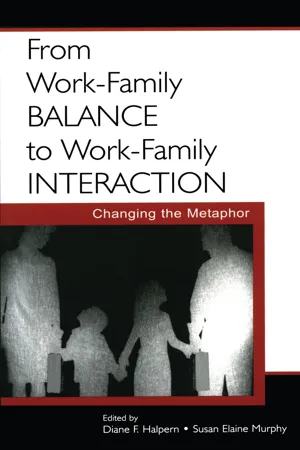
eBook - ePub
From Work-Family Balance to Work-Family Interaction
Changing the Metaphor
- 304 pages
- English
- ePUB (mobile friendly)
- Available on iOS & Android
eBook - ePub
From Work-Family Balance to Work-Family Interaction
Changing the Metaphor
About this book
Information
Part I
INTEGRATING THE DEMANDS OF WORK AND FAMILY
Chapter 1
From Balance to Interaction: Why the Metaphor Is Important
We have all seen the images of the modern and harried adult, racing from work to home. If there is ever a still moment, the androgynous pant-suited (or overall-covered) adult is at the fulcrum of a large balance beam seemingly burdened with children and a spouse on one side and work-related paraphernalia, usually a briefcase and computer, on the other. The balance is delicate and any false movement to one side will start the items on the other side in a downward slide. The message in this balance metaphor is clear—spend too much time at work and your family will suffer and vice versa. There are similar other metaphors that offer similar dire outcomes. There is the juggler—similarly dressed, usually androgynous in appearance, but now with a baby, computer, spouse, client, and other work and family “balls” in the air. If this harried worker/family juggler holds on to any one of these objects too long the others will crash. It is like juggling a bowling ball, chain saw, and penknife at the same time. The juggler had better pay close attention or she or he will be crushed/slashed/stabbed. These metaphors are not only anxiety provoking; the message that they send is wrong. Work and family are not a zero-sum game. Although there are reasonable limits to all activities, there are many benefits that accrue to people who both work and have families and other out-of-work life activities. It is time to change the metaphor.
Work–Family Interaction: From Zero-Sum Game to Win–Win Interactions
The idea of an interaction comes from statistical models where two effects combine to provide something that is greater than would have been predicted from either one alone. In the example of positive work–family interactions, think about a household task—like shopping for a new lawn rake (not very exciting for most people) and spending a rainy afternoon indoors with a preschool child. When they are combined in a way that makes the most of both, the excitement of a child’s trip to a hardware or lawn store can make the mundane task much more enjoyable and the afternoon with the preschool child can be fun and productive as you both explore lawn tools and share a glass of milk at the lunch counter while discussing other topics. This is an example of a “win–win” situation. Numerous other examples are provided in a study of business school graduates who managed to make work and family either allies or enemies, depending on how they arranged work schedules, priorities, employment-related resources, and had access to behavioral and emotional support from others (Friedman & Greenhaus, 2000).
It may seem that stay-at-home moms have it best because they have the least stress, but the research does not support this supposition. It is interesting to note that, in general, women who work outside the home are both happier and healthier than those who do not. In Barnett and Rivers’ (1996) review of the literature, they conclude that working women are less depressed and report better physical health than women who are not employed. In their review of the Framingham heart study (a large study of precipitating factors for cardiac-related illness), they conclude that the only group of working women that shows an employment-related increase in heart disease is women in low-paid jobs, with high work demands and little control over their work, with several children at home, and little support to help with the children. The entry of large numbers of mothers into the workforce has not reduced life expectancies for women as some had predicted. The gap in life expectancy between women and men is narrowing, but the narrowing is more likely caused by increases in male life expectancy, and the narrowing between life expectancies for women and men has not been found for African-Americans in the United States, so it is not related to work status per se.
The Good Old Days
There are many people who express nostalgia for the “Good Old Days,” when there were stay-at-home moms who greeted children with warm cookies and milk after school, but the nostalgia is for a time that existed only in the black-and-white world of television land, or for the precious few real children who had two parents with sufficient incomes to live a middle-class life, insurance to protect against financial disaster, and none of the other tragedies such as illness, crime, alcoholism, and array of family problems that are far more common than any sitcom television viewer would believe. The idyllic life where tragedies were touched with humor and neatly solved by a wise father who “always knew best” within their televised time slot was, we are sorry to say, as much a fiction as the cookie monster.
Poor women always worked and rich women always had nannies and other child care and household help. Prior to the development of our industrialized society, both men and women worked long and hard, often in close proximity—on the farm, tending stores or other businesses in or near their homes, and watching children die at young ages to an assortment of diseases we rarely think about today. Poor children worked long hours in coal mines, on farms, on ships, hauling heavy bundles, and as hired help in homes and small businesses. During World War II, women went to work in large numbers as the popular press touted the benefits to children who were sent to preschools and to women who worked outside the home. Perusal of “women’s magazines” from World War II shows strong women who reap the benefits of working outside the home and happy children who advanced because of early education and socialization. It is only during that short “blip” in modern history after World War II when middle-class women stayed at home to raise families and their men, returning from war, took back their jobs from the women. Yet, this period is often idealized as the norm.
Time Is an Important Variable
The idea that time is finite and working families are starved for time has an intuitive appeal, so it is not surprising that a default notion is that working parents are depriving their children of the time they need with their parents. Unfortunately, like many intuitively appealing notions, and despite the fact that many people report that they wish they had more time, the underlying concept can rarely be reduced to black-or-white. Working parents are, indeed, stressed, and often tired, but so are stay-at-home parents and working adults without children or other care responsibilities. We all want more time, but does this mean that children with two working parents are not getting enough time with their parents for healthy development?
For most working families (and most everyone else)—it’s about time. On average, men are spending more time than women at work (an average of 48 hours a week for men—includes some commuting time and 46 hours a week for women—although estimates vary among surveys). Men are also spending more time on child care and household chores than their own fathers did, but still less than their wives—a condition that virtually defines conflict. These data are described in more detail in the chapters by Galinsky and Barnett in this volume. On average, working mothers spend an additional 25 hours a week on child care and household tasks while working fathers are spending an average of 15 hours a week on child care and household tasks. Mothers and fathers are tired, but this seems to be universal and not restricted to parental status. There is a need for quality part-time jobs, especially at the professional level where there is a stigma associated with part-time employment and remuneration is not proportional to the full-time rate. There is still much that needs to be done to make work and family more compatible and to close the motherhood wage gap for part-time work.
Gender Is Also an Important Variable
Because most job categories are segregated by gender, it is difficult to consider any work and family interaction without also discussing the roles of males and females in society. There is a large increase in the proportion of managerial jobs going to women in the last decade and women are now receiving the majority of undergraduate degrees and master’s degrees, although they still tend to be overrepresented in the helping professions such as teaching, nursing, and social work. By contrast, men are still in the majority in physics, engineering, and chemistry, with other job categories such as medicine, law, and journalism approaching equality.
Similarly, household chores and childcare tasks tend to be gender-segregated, but in ways that differ from a generation ago. Fathers are spending more time with their children, especially when their spouse is employed outside the home. One in every five single-parent households is headed by a father, and noncustodial fathers pay child support when they understand their importance in children’s lives. Children with involved fathers have better outcomes—they become more compassionate adults (according to a 26-year longitudinal study), have higher IQ scores (controlling for other variables), and fewer behavioral problems.
PAID EMPLOYMENT IS RARELY OPTIONAL
Few families can afford “luxuries” like health insurance, mortgage payments, and grocery bills on one salary (Warren & Tyagi, 2003). The two-parent, single wage-earner family is going the way of the dodo bird. In a careful study of bankruptcy in America, Warren and Tyagi found that few families with children can afford to own a home with only one wage earner, and even with two incomes, most families are living so close to the edge of financial collapse that an extended illness or loss of a job begins a rapid financial free-fall that ends with bankruptcy. Far from the fiction of affluent families who are spending frivolously on fancy clothing and food, most two-income families with children are barely making it. The second income is being used to pay for a home in a neighborhood with “good schools”—the classic dream of good education for one’s children—not logos on overpriced clothes.
Going It Alone
If it is difficult to make it financially with children in dual-income households, it is even harder for those who are supporting children alone. Children in single-parent homes are more likely to live in poverty and suffer negative outcomes associated with poverty, but these risks can be reduced when parents are provided with supportive services, such as parenting classes, job training, psychological services, and assistance with child care. Yet, U.S. labor law permits workers to be fired if they refuse to work overtime, but many parents cannot work overtime because they cannot find or cannot afford child care for long hours when they have to work extra shifts. Child care and, increasingly, elder care, is the central issue for working families. Low-wage workers cannot afford quality child care unless it is subsidized.
The minimum wage in the United States is $5.15 an hour, and many families rely on workers at or near minimum wage! Numerous groups including the NOW Legal Defense Fund (2003, June) have calculated the savings to society for programs, such as wraparound school where the school hours actually coincide with the hours most adults work, the school year matches the work year, and child and elder care is available for working families. The savings to society occur in several ways: Caregivers are absent from work less frequently and suffer less illness of their own, sick children and adults are not sent to school and the workplace to spread illness, illnesses are treated sooner so fewer hospitalizations are required and treatments for chronic illnesses are shorter, fewer people lose their jobs because of absences and then need to go on public assistance, reduced use of health benefits should reduce health insurance, and more. We know of no study that has incorporated all of these potential savings into the “costs” of paid family medical leave or other leave programs.
IT’S EVERYONE’S BUSINESS
Work, family, and children are primary concerns to every policymaker, employer, and family member. Everyone has parents, and workers without nuclear families have friends and neighbors who function as family and will, at some time, need others to care for them. Sound policies can be consistent with our values and our bottom line, and these are the reasons for this book—the reasons why we brought together a superb panel of experts from different disciplines to look at work and family issues and the way they interact. The book is divided into five sections. Part I is an overview, with a brief discussion by a psychologist, an economist, and a political scientist, each of whom provide their own interpretation of how their discipline views this hybrid field that none exclusively “owns.”
In Part II, we consider the business case or the question of why employers should invest in family-friendly work policies. This is probably the question that is asked most frequently. How can employers afford to offer family-friendly policies and remain competitive? Given the competition for talent, the changing nature of the workforce, and the savings to employers who meet worker needs, a better question might be how they can afford not to. In chapter 3, Susan Murphy and David Zagorski offer a management view of work–family interaction. In chapter 4, Wayne Cascio and Clifford Young analyze the financial outcomes of the top family-friendly companies in America and answer the important question of whether it pays dividends to be good to employees.
The employer response to work–family interactions is the focus of Part III. Paul Orfalea, whose red curly hair inspired the name “Kinko’s,” the large chain of stores that have become home and haven for college students and businesses of all sizes, sums it up well. Do you want to bite the hand that opens the cash register? In his own short but to-the-point style, Orfalea shows the wisdom of being good to one’s employees. In chapter 6, four corporate insiders tell what it is like to be sitting at the corporate table when the decisions are made and how they help to influence work–family policies in good and bad financial times. Bruce Bell and Walter Schumm (chap. 7) write about the special needs of being the employer that just won’t take “no” for an answer—the military. They tell about the support services for families that help the military succeed at its unique work. The final chapter in this section describes “burnout,” the psychological phenomenon that hurts workers and their work. Christina Maslach, who is best known for her work in this area, provides insights into the variables that create burnout and what employers can do to prevent it.
Families are the focus of Part IV. Gail Thompson (chap. 9) shows how African Americans face many barriers starting with poor education that make later transitions to higher education and good jobs even more difficult to achieve. On the other end of the family spectrum is Maggie Jackson’s chapter 10, where she shows how technology has brought work and family together in ways that can be both beneficial and harmful, depending on the choices we make for how we work and live. Families are more in touch, but so are our bosses and coworkers. Even with the added time constraints of dual-earner families, children are spending as much time with parents or more as children did in single-earner families a generation ago, as Barnett explains in chapter 11, showing that dual-earner families are caring well for their children.
In many ways, the children are at the heart of work and family interaction—the topic of Part V. How does having working parents affect adolescent and young adult expectations for their own ability to handle work and family? Heidi Riggio and Stephan Desrochers answer these and other questions about the expectations of young adults. The effects of childcare on the children are overall positive, according to an extensive review by Adele Gottfried who shares some of the results of multiyear longitudinal studies. And the children themselves, they also believe that they are doing well, according to data reported by Ellen Galinsky, who asked the children about their own well-being.
There are many lessons to be learned about work–family interaction from these experts. It is clear that some people have learned how to combine work and family in ways that are mutually supporting, at least much of the time, and some employers have created work environments and policies that make positive interdependence of these two spheres more likely to occur. What is obvious is that work and family are not two independent spheres of life, especially as technology is increasingly blurring the lines between them, the theme of Jackson’s chapter in this volume. The purpose of this book is to consider a broad range of topics that pertain to work and family with the goal of helping employers and working families understand the work-life options that are available so they can make choices that offer returns-on-investments to employers, families, and society at large that are consistent with personal and societal values—a lofty, but an achievable goal. We have only to look around to realize that many wonderful people are building a richer and fuller life by integrating work and family in positive and healthy ways.
REFERENCES
Barnett, R. C., & Rivers, C. (1996). She works/he works: How two income families are happier, healthier, and better off. San Francisco: Harper.
Friedman, S. D., & Greenhaus, J. H. (2000). Work...
Table of contents
- Cover
- Halftitle
- Title
- Copyright
- Contents
- Preface
- About the Authors
- Part I: Integrating the Demands of Work and Family
- Part II: The Business Case or “Why should My Firm Invest in Family-Friendly Work Policies?”
- Part III: How Employers Respond to the Challenge of Work-Family Demands
- Part IV: Working Families: How Well are they Working?
- Part V: The Children: How are they Doing?
- Author Index
- Subject Index
Trusted by 375,005 students
Access to over 1.5 million titles for a fair monthly price.
Study more efficiently using our study tools.
Frequently asked questions
Yes, you can cancel anytime from the Subscription tab in your account settings on the Perlego website. Your subscription will stay active until the end of your current billing period. Learn how to cancel your subscription
No, books cannot be downloaded as external files, such as PDFs, for use outside of Perlego. However, you can download books within the Perlego app for offline reading on mobile or tablet. Learn how to download books offline
We are an online textbook subscription service, where you can get access to an entire online library for less than the price of a single book per month. With over 1.5 million books across 990+ topics, we’ve got you covered! Learn about our mission
Look out for the read-aloud symbol on your next book to see if you can listen to it. The read-aloud tool reads text aloud for you, highlighting the text as it is being read. You can pause it, speed it up and slow it down. Learn more about Read Aloud
Yes! You can use the Perlego app on both iOS and Android devices to read anytime, anywhere — even offline. Perfect for commutes or when you’re on the go.
Please note we cannot support devices running on iOS 13 and Android 7 or earlier. Learn more about using the app
Please note we cannot support devices running on iOS 13 and Android 7 or earlier. Learn more about using the app
Yes, you can access From Work-Family Balance to Work-Family Interaction by Diane F. Halpern, Susan Elaine Murphy, Diane F. Halpern,Susan Elaine Murphy in PDF and/or ePUB format, as well as other popular books in Psychology & Industrial & Organizational Psychology. We have over 1.5 million books available in our catalogue for you to explore.