The totality of features and characteristics of a product or service that bear on its ability to satisfy stated or implied needs
But why is the word ‘quality’ (although an everyday word), often misused, misquoted and misunderstood? Probably this is because, when most people talk about the quality of an object or service, they are normally talking about its excellence, perfection or value. In reality, of course, they should be talking about how much it meets its designed purpose and satisfies the original requirements.
Case study
Take, for example, a £80,000 Mercedes and a £19,000 Ford. It would be very unfair to suggest that the Mercedes is a better quality car simply because it costs more! Being realistic, both cars meet their predetermined quality requirements because they have been built to exacting standards and are therefore equally acceptable as ‘quality’ vehicles. It is simply that the design purpose and original quality requirements (i.e. the level of quality) differ.
In other words, quality is based on consumer satisfaction. So in the case of the Mercedes and the Ford, purchasers of Mercedes will be satisfied only if they get leather seats, a totally interactive navigational system and surround sound, whereas the Ford driver is happy with crushed velour and a CD player. Their required levels of quality differ, but each is satisfied with his or her purchase. The characteristics of each car satisfy customer requirements.
Consumers, however, are not just interested in the level of quality intended by the designer, manufacturer or supplier; they are far more interested in the delivery of a product or service that is consistently of the same quality. They also want an assurance that what they are buying truly meets the quality standard that was initially offered and/or recommended.
Products and services that are of a consistent quality mean that repeat purchases are more likely – something that any car driver appreciates when considering whether to stay with a preferred make and model,
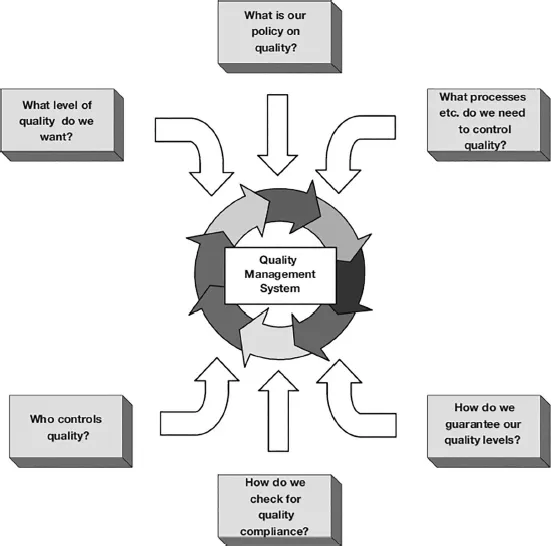
This consumer requirement has meant that manufacturers and suppliers (especially larger organisations) have now had to pay far more attention to the quality of their products and services than was previously necessary. Organisations have had to set up proper Quality Management Systems in order to control and monitor all stages of the product or service process, and they have had to provide proof to the potential customer that these will have the guaranteed – and, in some cases, certified – quality required by the customer. In other words, the manufacturer or supplier has had to work within a Quality Management System (QMS) to produce their products or deliver their service. (See Figure 1.1)
Unfortunately, with the current trend towards micro-miniaturisation and the use of advanced materials and technology, most modern-day products and services have now become extremely complex assemblies compared to those that were available just a few years ago. This has meant that many more people are involved in the manufacture and/or supply of a relatively simple object, and this has increased the likelihood of a design fault occurring.
Similarly, the responsibility for the quality of a products and services has also been spread over an increasing number of people, which has meant that the manufacturer’s and/or supplier’s guarantee of quality has, unfortunately, become less precise.
Figure 1.1Some of the questions answered by a Quality Management System
The growing demand for an assurance of quality before a contract is awarded has reinforced the already accepted adage that quality products and services play an important role in securing new markets as well as in retaining existing markets. Without doubt, in these days of competitive world markets, Quality Assurance has never been more relevant, and no longer can suppliers rely on their reputation alone!
Thus the drive towards more quality-controlled products and services now means that today’s major purchasers are not just expecting that they are of sufficient quality but are also demanding proof that an organisation is constantly capable of continually producing quality products or providing quality services. The provision of this proof normally takes the form of an independent third-party certification, and this is possibly the single most important requirement for a manufacturer, organisation or supplier.
Until the early 1980s, however, no viable third-party certification schemes were available. But with an increased demand for Quality Assurance during all stages of the manufacturing processes came the requirement for manufacturers to work to recognised standards, and this is why the first, truly international, Management System Standard (ISO 9001) was introduced, and it is the basis of this standard, which is now used throughout the world by manufacturers, suppliers and end users.
So in summary, quality is:
- a standard that can be accepted by both the supplier and the customer;
- giving complete satisfaction to the customer;
- complying consistently to an agreed level of specification;
- providing products and services at an acceptable cost;
- providing products and services that have auditable proof that they are ‘fit for the purpose’;
- the totality of features or characteristics of a product or service that bear on its ability to satisfy a given need.
Quality is not about:
- complying with a specification (as it is possible that the specification may be wrong!);
- being the best (since achieving this ideal may be very costly and could exceed the price the customer is prepared to pay);
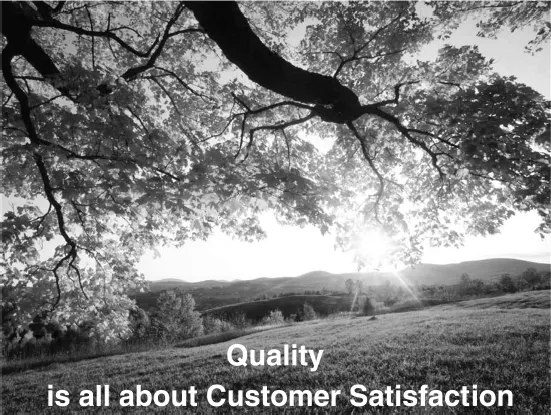
- producing products and services that are fit for the purpose at the point of delivery (as that ‘purpose ‘may be completely different to the customers’ actual needs!). (See Figure 1.2)
Figure 1.2Achieving customer satisfaction
Author’s Hint
One question I am constantly asked is, ‘What is the difference between a product and a service’?’
Well, in the words of ISO (the international standard-setting body promoting worldwide proprietary, industrial and commercial standards):
- Product is an output that is the result of a process that does not include activities that are performed at the interface between the supplier (provider) and the customer.
- Service is the result of a process that includes at least one activity that is ca...