This book aims to explain air power to both military and civilian audiences in an accessible manner, approaching the topic in a balanced and systematic way.
The past 100 years illustrates that air power is an inevitable feature of any type of modern warfare. It has a key role to play in any of the three main operational environments: conventional (inter-state) wars, peace-support operations, and counterinsurgencies. This book examines the strengths and challenges of using air power in these situations, and each type of operation is explained using modern and historical examples, with an emphasis on the relevant lessons for the contemporary and future use of air power.
The book also looks into the complexity of media coverage of air warfare and changes in the public perception of air power in recent years. The specifics of structuring national air forces is also discussed, along with the future of air power based on current trends. One of the enduring themes in the book is the necessity of inter-service and cross-domain integration, emphasizing the increasingly important role of cyber and space domains in the future of network-centric warfare.
This book will be essential reading for students of air power and air warfare, and recommended reading for students of international security, strategic studies, defence studies, and foreign policy.
Every fortress and every fortification begins with a cornerstone. Similarly, every phenomenon should be explained by starting with basic notions and principles. Accordingly, this chapter sets the scene for the contemporary use of air power by examining what it is and where it fits among other means of achieving national political objectives. It begins by making a distinction between policy, strategy, and military force. It explains the diverse definitions of air power, its four roles, its attributes, and its functions. In addition, it identifies the concept of fighting power and the resultant three pillars of building air power. Questions of ownership and inter-service relations, carrier-based air power, single-purpose and multi-role platforms, and jointness are also addressed here. Finally, this chapter explains the definition of space power, the role of air forces as custodians of space power, as well as recent trends in the establishment of an independent space force.
The relationship between policy, strategy, and military force
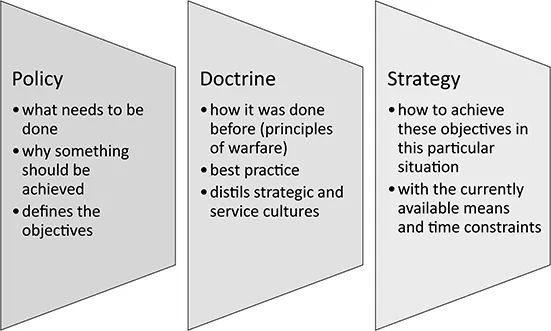
In order to understand any aspect of strategic studies or warfare, it is essential to distinguish between policy, strategy, and military means or capabilities. Political and strategic objectives, military actions, and their subordination to policy often engender confusion. It is important to identify the relationship between these elements to gain a sufficient understanding of military force and its use in different situations. The primary purpose of policy is to define the objectives that must be achieved in order to fulfil the national interest.1 These objectives can be enduring or ad hoc depending on the circumstances. For instance, building a partnership with a neighbouring country is a long-term political objective, because the geographical position of the two countries remains relatively unchanged. On the other hand, a regional crisis would require an immediate response, reflected in a rather situational political solution, that is, a political decision made at the time when the conflict or crisis occurred. In both cases, policy would be driven by national interests and a set of political objectives or tasks would be developed. In other words, policy suggests what needs to be achieved.
Decision-makers have various means of achieving these objectives in their toolkit, with the use of military force representing the last resort. States can use their political influence, diplomacy, economic pressure, and cultural influence to achieve these objectives. Hence, they can use their soft power, that is, less forceful means of realizing the objectives posed. Alternatively, states might consider using more coercive tools such as economic sanctions and military force to achieve their desired outcomes, or what is termed hard power. The successful mixing of the two in executing one’s policy is what Joseph Nye calls smart power.2 On the other hand, military means might be the only option when rapid involvement in a conflict or an immediate response is required. Depending on the circumstances, available time, objectives, and public opinion, policymakers may decide to use different types of military force: armies, navies, air forces, special operation forces (SOF), space, or cyber capabilities. The scale and degree of the kinetic or non-kinetic use of such military force varies from case to case. Each strategy is uniquely crafted to achieve a specific objective with the means available at the given time. In other words, strategy can be defined as a means of linking political objectives with military capabilities.3 Strategy refers to precisely how, at what time, and using which military means and resources available these objectives can be achieved. Although in theory strategy can be enduring, a change in the political environment at home and a consequent alteration in political objectives would require an adjustment of strategy. Similarly, changes in the operational theatre would require an adjustment in strategy.
Figure 1.1 Correlation between policy, doctrine, and strategy
Components of fighting power/air power
Fighting power is another important term that can be used to understand the military. It describes the effectiveness of a military service in the operating environment.4 It consists of three interrelated components: conceptual, physical, and moral. The majority of military doctrines and training manuals emphasize the importance of balancing these components in order to ensure optimal effectiveness in the battlespace:
• The conceptual component is the thought process regarding how to fight contemporary wars, taking into account new challenges, national specifics, and scarce resources. Such knowledge is based on the assessment of previous operational lessons and the identification of best practice, linking it to contemporary threats and the requirements of the operating environment. This component is largely determined by organizational culture and ethos. It should always exist in a state of revision, self-reflection, and adaptation in order to remain relevant and up to date to what can be rapid changes in operating and strategic environments. It includes the principles of war, doctrines, conceptual innovation, and an understanding of conflict and context. The principles of war constitute distilled lessons on how to fight wars in various environments. They are derived from two millennia of warfare and illustrate the enduring nature of war despite the domain of its conduct. In contrast, military doctrine refers to the ‘fundamental principles by which military forces guide their actions in support of objectives’.5 It is more nation- and environment-specific. Finally, as a thought process, a conceptual component would be partial without looking into the future of the service and exploring new ways of employing military force. Hence, conceptual innovation is essential in order for an organization to adapt to the new requirements of the time.6
• The physical component refers to means of fighting, including manpower, equipment, training, education, sustainment (maintenance), and resources in order to achieve the necessary level of readiness and consequent enduring quality of performance in the battlespace. Thus, armed forces must recruit and retain the right people with the right set of skills for a specific job in the right numbers and at the time when they are needed. They rely on equipment that corresponds to the requirements of the operating environment of the time. Training is crucial for the development and unification of all three components of fighting power. It brings together the cumulative experience of previous generations of the service and the requirements of the contemporary operating environment. Military education is aimed at improving individuals’ knowledge and skills to strengthen their adaptability, improvisation, and critical and innovative thinking. Sustainability is essential at every stage from preparation to deployment and covers every aspect of the maintenance of individuals, groups, infrastructure, and training spaces. All of the aforementioned segments of the physical component and all other components require funding in order to be successfully organized and employed. Indeed, insufficient funds can substantially undermine fighting power.7
• The moral component refers to the human aspect and includes interdependent elements of morale and leadership as well as the ethical, moral, and legal foundations that drive military actions. Morale is an individual or group confidence, discipline, and eagerness to fulfil a task at a particular time. It rests upon fighting spirit, moral cohesion (the feeling of shared identity), discipline, comradeship, pride, confidence, and trust in one’s equipment and spiritual foundation (belief in a cause). Army doctrine defines leadership as ‘a combination of character, knowledge and action that inspires others to succeed’.8 It is essential across all ranks and organizational structures, because leaders are both responsible for their subordinates and inspire them to do and achieve more. Ethical, moral, and legal foundations should be at the heart of military practice and reflect the values of one’s society. If military actions contradict or are perceived as contradicting these foundations, the legitimacy of the campaign might be undermined, jeopardizing the overall achievement of the political objectives posed.9
Air power
Definitions of air power
Explaining definitions can be a product of different environments and may carry certain features of organizational cultures. Traditionally, two approaches have been used to define air power. In 1946, General Henry H. Arnold wrote about air power as follows:
Air Power includes a nation’s ability to deliver cargo, people, destructive missiles, and war-making potential through the air to the desired destination to accomplish the desired goal. Air power is not composed alone of the war-making components of aviation. It is the total aviation activity – civilian and military, commercial and private, potential as well as existing.10
A wider approach to air power provides relevant insights into the interconnections between civilian and military aviation in building a nation’s present and future air potential. However, today air power is more often used in its narrow meaning, referring to military aviation. In this textbook, the narrow definition is used.
As regards the narrow sense, Air Vice-Marshal Tony Mason introduced one of the first definitions of air power in the 1980s: ‘Air power is the ability to project military force by or from a platform in the third dimension above the surface of the earth.’11 With a few further modifications, this definition was used in the United Kingdom Royal Air Force’s (RAF) formal doctrines in the 1990s. Although this definition established that air forces operate in a distinctive third environment of warfare – the aerial environment – and require specific if not unique aerial technologies in order to project milita...
Table of contents
Cover
Half Title
Title Page
Copyright Page
Dedication
Table of Contents
List of illustrations
List of text boxes
Abbreviations
Acknowledgements
Introduction
1 What is air power?
2 Evolution of air power theory and thinking on air power
3 Defining the factors for successful air power: people, technology, and political will
4 Air power in different operations: conventional warfare
5 Air power in different operations: counterinsurgencies
6 Air power in different operations: PSO and R2P
7 Civil–military relationship: public and media perspectives on air power
8 National air forces
9 Future trends in air power
Conclusion: what will the future success of air power depend on?
Bibliography
Index
Trusted by 375,005 students
Access to over 1.5 million titles for a fair monthly price.
Study more efficiently using our study tools.
Frequently asked questions
Yes, you can cancel anytime from the Subscription tab in your account settings on the Perlego website. Your subscription will stay active until the end of your current billing period. Learn how to cancel your subscription
No, books cannot be downloaded as external files, such as PDFs, for use outside of Perlego. However, you can download books within the Perlego app for offline reading on mobile or tablet. Learn how to download books offline
Perlego offers two plans: Essential and Complete
Essential is ideal for learners and professionals who enjoy exploring a wide range of subjects. Access the Essential Library with 800,000+ trusted titles and best-sellers across business, personal growth, and the humanities. Includes unlimited reading time and Standard Read Aloud voice.
Complete: Perfect for advanced learners and researchers needing full, unrestricted access. Unlock 1.5M+ books across hundreds of subjects, including academic and specialized titles. The Complete Plan also includes advanced features like Premium Read Aloud and Research Assistant.
Both plans are available with monthly, semester, or annual billing cycles.
We are an online textbook subscription service, where you can get access to an entire online library for less than the price of a single book per month. With over 1.5 million books across 990+ topics, we’ve got you covered! Learn about our mission
Look out for the read-aloud symbol on your next book to see if you can listen to it. The read-aloud tool reads text aloud for you, highlighting the text as it is being read. You can pause it, speed it up and slow it down. Learn more about Read Aloud
Yes! You can use the Perlego app on both iOS and Android devices to read anytime, anywhere — even offline. Perfect for commutes or when you’re on the go. Please note we cannot support devices running on iOS 13 and Android 7 or earlier. Learn more about using the app
Yes, you can access Understanding Contemporary Air Power by Viktoriya Fedorchak in PDF and/or ePUB format, as well as other popular books in History & Military & Maritime History. We have over 1.5 million books available in our catalogue for you to explore.