eBook - ePub
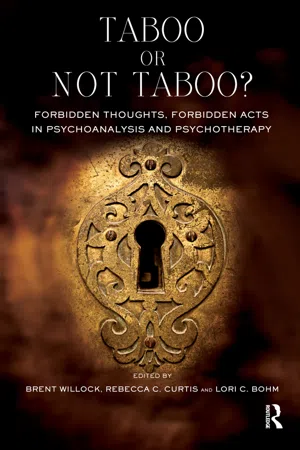
Taboo or Not Taboo?
Forbidden Thoughts, Forbidden Acts in Psychoanalysis and Psychotherapy
- 404 pages
- English
- ePUB (mobile friendly)
- Available on iOS & Android
eBook - ePub
Taboo or Not Taboo?
Forbidden Thoughts, Forbidden Acts in Psychoanalysis and Psychotherapy
About this book
'Psychoanalysis has, from its inception, been a discipline concerned with overcoming the ill effects of certain social taboos. Given this focus, it might be assumed that psychoanalysis and its practitioners are free of the constraints imposed by restrictive taboos. This book challenges this idea by examining a sampling of the taboos that are rife in the field. It is not intended to offer a complete summary of all of the forbidden ideas, clinical procedures, behaviors and institutional practices in psychoanalysis, but rather to raise consciousness about the fact that even within a field which encourages freedom of expression, many issues remain difficult to fully discuss both in the consulting room and in professional discourse. The book provides a refreshing, thoughtful, honest look at many of the taboos present in psychoanalysis, even at this moment of greatly improved communication between the various theoretical schools in the field. Reading it provides a sense of freedom for the reader, as speaking of forbidden thoughts always does.
Information
Part I
On Taboo
Chapter One
Taboo: its origins and its current echoes
James S. Grotstein
Introduction
Totem and Taboo (1912–1913) was one of Freud’s most scholarly and profound works. The scholarship that went into it was exceptional. He filled in the missing links left over by notable anthropologists, such as James Frazer (1910, 1922), the author of Totem and Exogamy and The Golden Bough, who gave us the most detailed findings about the customs, relationships, and social practices of savage societies that had yet been garnered.
Freud was able to use what Bion (1970), following Poincaré (1952), termed the “selected fact” which, like the “strange attractor” of chaos theory, gives coherence and definition to what hitherto would have been called random or disconnected data. Freud analysed the anthropological customs of savages and was able to see a symmetry between the social psychology of taboos and the individual suffering from a psychoneurosis, particularly an obsessive–compulsive neurosis. The “selected facts” that gave coherence to these anthropological findings were Freud’s theories of infantile sexuality, repression, talion law, and, especially, instinctual drives and their vicissitudes.
When one reads this monumental text from across the almost hundred years since its publication, one begins to realize how much psychoanalytic theory has changed. I found myself to be sentimental for this now arcane way of looking at phenomena. Classical ego psychology and its reactive descendants have opted to replace infantile sexuality, autoerotism, and the like for a more environmental–object focus. Kleinian theory comes closest to being the inheritor of Freud’s original theories, but even modern Kleinians, especially in London, seem to be pulling away from its moorings in infantile mental life, particularly in technique. When one reads Freud, one can only weep about this change, one that was all too pragmatic, but apparently necessary in the course of time and its inexorable dialectical challenges.
In the small Midwestern town of my childhood, we had a general practitioner who went to Vienna to become analysed by Freud. When he returned, he told my family how happy he had been with his analysis. He also related how much Freud hated Americans, whom he believed were superficial, pragmatic, and too optimistic. Freud feared for the future of psychoanalysis in the USA, the doctor stated, because he felt Americans did not really understand the unconscious.
Notes on the origin of taboo
I shall not review Freud’s work in detail, but I shall list a few of his comments about the subject of taboo. Taboo, along with totemism, seems to have been the organizing principle that governed and mediated primitive tribal cultures. The power they wielded was due to the animism (soul transfer) that characterized them. Animism, which Freud discussed at great length in Totem and Taboo, seems to have been neglected by modern scholars as the potent force behind primitive mental mechanisms, particularly projective identification. I must confess that I myself, who have written so extensively on that subject, never realized the importance of the ingredient of animism. Kleinians approach it with the idea of omnipotence, but animism far transcends omnipotence in its awesome, eerie, and preternatural phenomenology.
The practice of taboo originated from external sources in primitive societies so as to regulate their living arrangements. While the principal taboo had always been erected against incest (with descendants of the primordial totem), taboos also emerged against contact with tribal leaders, slain enemies, and dead relatives.
Whereas totemism emerged, according to Freud, as the social aspect of religion, taboo seems to have preceded the advent of religion to constitute the first group conscience. Freud and Wundt (whose work on taboo Freud reviewed at length) agreed that the custom of taboo is not religious; in fact, it may be pre-religious. (The non- and pre-religious nature of taboo reminds one of the premoral, autoerotic stage of infant development cited both by Abraham [1924] and Fairbairn [1940].) Taboo is older than religion and older than the gods, according to Freud. (But not according to Jaynes [1976] who, in his concept of the “bicameral mind”, asserts that “gods” existed from the very beginning in human and individual histories.)
Taboo also represents the oldest penal system and,
The strangest fact seems to be that anyone who has transgressed one of these prohibitions himself acquires the characteristic of being prohibited—as though the whole of the dangerous charge had been transferred over to him. [Freud, 1912–1913, p. 22].
Freud related the “contagious power” of taboo to the temptation to imitate others. He then stated that recollection (memory) and temptation come together. That is why, in the case of dead relatives, for example, the name of the dead one must not be enunciated, so as not to be recollected.
In these passages, which are representative of many others in Freud’s text, one can see that Freud’s thinking prefigured Klein’s later concept of projective identification. It also strongly suggested the organizing importance of envy, another concept Klein was later to explicate. Freud frequently referred to Bachofen’s idea of the prevalence of matriarchy before the time of patriarchy in human pre-history. Klein later took Freud’s patriarchal Oedipus complex back to its matriarchal roots (Grotstein, 2000). It is of great interest to observe these, and other, prefigurations of Klein’s work in Freud’s essay.
Another conclusion one reaches from Freud’s essay concerns binary oppositions (Lévi-Strauss, 1962): the idea that opposing impulses, such as love and hate, or murder and sparing, belong together. They become organized as reciprocally mutual oppositions, encountered as wishes and countermeasures. The latter are instituted in order to ward off activation of talion law.
While ascribing a demonic power to taboo, Freud cited the underlying common denominator of ambivalence, characterizing such opposing qualities as veneration and horror, as in the case of the taboo of touching leaders or royalty. Freud then stated,
The most ancient and important taboo prohibitions are the two basic laws of totemism: not to kill the totem animal and to avoid sexual intercourse with members of the totem clan of the opposite sex ... These, then, must be the oldest and most powerful of human desires. [pp. 31–32]
Thus, incest and parricide underlie taboo.
It is of some interest to review other objects of taboo in ancient cultures, e.g., childbirth, the dead, enemies, image-making, menstruation, proper names, names of the dead, pregnancy, sexual intercourse, touching, use of a god’s name, and virginity. Jews are reminded of taboo in at least two areas: (a) their kosher laws which mediate between sacred (kosher) and unclean (traif), and (b) their prohibition in enunciating the name of their God.
Freud went to great length to demonstrate the intimate connection between the characteristics of taboo and the nature of obsessive–compulsive neurosis, not the least of which is ambivalence. In fact, one of the inescapable conclusions from Freud’s venture into anthropology is that neuroses in general, and the obsessive–compulsive neurosis in particular, ontogenetically retrace the phylogenetic history of culture. To put it in another way, neuroses may be viewed as arrested racial memories: the phenomenon of taboo is the veritable origin of conscience and character in the individual and the code of justice in society.
Taboos in psychoanalytic practice
When Freud published Totem and Taboo (1912–1913), one can only wonder if an emotional subtext were operant in him in regard to another level of taboo—his belief that his followers (Jung, Rank, Adler) had committed the “taboo” of differing with him, thereby challenging his (oedipal) authority. It would be a while before Ferenczi would perform an “experiment perilous” in which he exchanged roles with one of his analysands and became an analysand himself. During these early decades of psychoanalysis, there was a lack of sanctioned opportunity to experiment, not only with changes in technique, but even with different theoretical formulations. We are all aware of what happened not only with Ferenczi, but also with Jung, Adler, Rank, Alexander, Reich, Klein, Horney, and others.
Today, it is much more permissible for analysts to expand, extend, alter, or replace aspects of psychoanalytic theories, but changes in technique are frowned upon. For his deviations from the standard procedures, Ferenczi (1920) was severely criticized by Freud and other colleagues; understandably so, but how can a profession grow without experimentation? Further, what would constitute acceptable boundaries for experimentation?
Psychoanalysis is an institution that deals with sacred (and also, paradoxically, thought-to-be profane) aspects of individuals. As such, it is subject to protective, regulative procedures reminiscent of taboos. Sexual, or even friendly, relationships with analysands are among these taboos. The sexual taboo, while certainly understandable and valid, touches on an infrequently addressed point: the tantalization that analytic technique provokes in the analysand who then, understandably, counter-tantalizes the analyst, who then may abrogate the taboo because of his/her guilt in being the “tantalizer of the first part”. This is not to condone any acting-out of temptation, but to put a complex and sensitive issue in perspective.
One would hope the analyst would already have analysed his guilt about conducting the one-sided analytic procedure. In my experience, few analysts truly understand the rationale (a) of the transference regression that inescapably occurs when two individuals convene to discuss the subjectivity of only one of them, and (b) why it is necessary for the analysand to bear his/her ancient as well as current longings without being reciprocated. The goal of repeating one’s past is insufficient. More airing of this problem is in order.
One of the basic taboos of psychoanalytic technique, other than the sexual, is the notion of gratifying the analysand’s impulses or wishes, rather than purposely, though not sadistically, frustrating them, so that the impulse can have the opportunity to become conscious, harnessed to words. Perhaps a different perspective on this taboo is in order. Many of the rules of psychoanalytic technique can be alternatively understood to correspond to acting technique (Stanislavski, 1933), especially the idea of being disciplined in remaining in character with the role being performed. One may consider psychoanalysis as an improvizational passion play, one in which a hidden theme will emerge if the actors remain loyal to their respective roles.
Deviant psychoanalytic theories as taboo
There seems to be an evolutionary trend in the Zeitgeist in which developing “received wisdom” seems imperceptibly to “vote in” new ideas. Here, I refer to self psychology, intersubjectivity, the two-person relationship, alteration of our understanding about gender identification, etc. In contrast, within my lifetime, I was a participant in a “holy war” in Los Angeles in which, after a series of site visits, the American Psychoanalytic Association threatened the Los Angeles Psychoanalytic Society/Institute (LAPSI) with suspension if they did not get rid of their Kleinian training analysts! Being Kleinian, then, was taboo. I recall Bion’s witty statement at the time, “Klein is like witchcraft—to be disavowed in public and practised only in privacy.”
Susanna Isaacs-Elmhirst, a Fellow of the Royal College of Physicians, replaced Donald Winnicott as Chief Child Psychiatrist at Paddington Green in London. Her husband, Alec Isaacs, was a contender for the Nobel Prize for having discovered Interferon, but died before the final choices were made. Dr Isaacs-Elmhirst emigrated from London and applied for membership at LAPSI. Freud’s last analysand, one of the senior members there, declared he would not want to belong to a society that included Kleinians! Her application was thereupon overwhelmingly rejected.
The Kleinian taboo at LAPSI had been exported by Anna Freud to the USA when she learnt that Wilfred Bion and Albert Mason had left London for Los Angeles, allegedly for “colonization”. Yet, that taboo was in itself a red herring. The subtext for the harsh verdict of the site visits had to do, in my opinion, with what was felt to be LAPSI’s impertinence in democratizing the choices of training analysts. Hitherto, LAPSI had followed the practice then standard in all North American institutes of having a training analysts’ committee that arbitrarily selected individuals whom they favoured to be training analysts. One could not apply for the position. One had to be chosen. LAPSI had also discontinued the traditional requirement of a written paper that the candidate had to present in order to graduate. The site visit committees on three separate occasions judged these innovations to be departures from acceptable standards and attributed their origin to the deterioration of LAPSI’s standards occasioned by the influx of Kleinians. (One can read further about these matters in Douglas Kirsner’s [2000] Unfree Associations.)
This experience taught me that, at any given moment, new ideas were unsafe to contemplate or put into practice. I had become more aware than ever that the teaching institutions of psychoanalysis operate all too similarly to religious institutions, like the Sanhedrin, the Holy See, the Lutheran Synod, etc. The events that took place between the American Psychoanalytic Association and LAPSI were all too reminiscent of the Councils of Nicea and Trent.
The taboo of "O" and of God in psychoanalysis
London Kleinians had their own issues in regard to taboo. When one reads their modern works, the bibliographical references reveal a remarkable absence of catholicity. Winnicott, Fairbairn, and North and South American and continental contributors are not often referenced. One gets the impression of a closed, hermetic system of thought.
Another taboo they demonstrate is quite remarkable. Wilfred Bion, Melanie Klein’s most outstanding analysand and follower, seems to have achieved a position of uneasy and divisive acclaim amongst his fellow London Kleinians. His contributions to the study and treatment of psychosis are highly thought of by them, as are his later contributions about container–contained, reverie, alpha-function, beta elements, L, H, and K linkages, etc. His theory of transformations is another matter (Bion, 1965, 1970). No London Kleinian discusses “transformations in O”. One of the synonyms Bion assigned to O was “godhead”. He also spoke of the “religious instinct”. These ideas were taboo.
Bion became a pariah in his native land. It seems to be received wisdom there, moreover, that his sojourn in Los Angeles—where he wrote the three-part, quasi-autobiographical, quasi-imaginative Memoirs of the Future (1975, 1977, 1979)—was one in which he showed evidence of psychosis. Bion’s later works are in a state of taboo vis à vis London Kleinians and the curriculum of the British Psychoanalytic Institute.
The hidden order of taboo
When Freud explicated the concept of taboo, citing especially the anthropological studies of Sir James Frazer, he found that the hidden order of taboo, in primitive as well as cultured societies, was the issue of incest. Much of the thinking that has gone into the setting up of the rules for psychoanalytic treatment derive from the incest taboo. For psychoanalytic treatment to take place, there must be a covenant between analyst and analysand to keep the frame and boundaries inviolable so that the analysand’s unconscious phantasies can arise and evolve in safety, especially because the analytic atmosphere is so highly conducive to the emergence of transference and countertransference desires. Thus, the incest taboo in psychoanalysis is quite understandable.
There is, however, another problem in regard to the incest taboo that warrants discussion. By virtue of the fact that all analysts seem to respect the sanctity of the psychoanalytic process and also are so aware of temptation on both sides of the couch, it is my belief that a group process takes place in which analysts are so keen to guard the innocence of the analysand against the endangerment of temptation that they collectively project their own unresolved temptations into putatively “deviant” members of their own society, as well as more apparently deviant individuals outside the society. It is as if they are saying, “It’s hard enough for me to remain pure. How then can I be sure of you?”
Behind the incest taboo in psychoanalytic practice lies a deeper stratum, the domain of the sacredness and innocence of the vulnerable infant and our need to protect it from our own sadism. Just...
Table of contents
- Cover
- Half Title
- Title
- Copyright
- Contents
- ACKNOWLEDGEMENTS
- ABOUT THE EDITORS AND CONTRIBUTORS
- FOREWORD
- INTRODUCTION
- Dedication
- PART I: ON TABOO
- PART II: EXPRESSIONS OF EROS
- PART III: TRANSCENDING TRADITIONAL THOUGHT: BUDDHISM AND SPIRITUALITY
- PART IV: FINANCIAL AFFAIRS
- PART V: CONFIDENTIALITY: TOO MUCH OR TOO LITTLE?
- PART VI: FACING REAL WORLD ISSUES
- PART VII: SELF-DISCLOSURE: TO DO OR NOT TO DO?
- PART VIII: PROSCRIBED INTERVENTIONS
- PART IX: REFLECTIONS
- INDEX
Trusted by 375,005 students
Access to over 1.5 million titles for a fair monthly price.
Study more efficiently using our study tools.
Frequently asked questions
Yes, you can cancel anytime from the Subscription tab in your account settings on the Perlego website. Your subscription will stay active until the end of your current billing period. Learn how to cancel your subscription
No, books cannot be downloaded as external files, such as PDFs, for use outside of Perlego. However, you can download books within the Perlego app for offline reading on mobile or tablet. Learn how to download books offline
Perlego offers two plans: Essential and Complete
- Essential is ideal for learners and professionals who enjoy exploring a wide range of subjects. Access the Essential Library with 800,000+ trusted titles and best-sellers across business, personal growth, and the humanities. Includes unlimited reading time and Standard Read Aloud voice.
- Complete: Perfect for advanced learners and researchers needing full, unrestricted access. Unlock 1.5M+ books across hundreds of subjects, including academic and specialized titles. The Complete Plan also includes advanced features like Premium Read Aloud and Research Assistant.
We are an online textbook subscription service, where you can get access to an entire online library for less than the price of a single book per month. With over 1.5 million books across 990+ topics, we’ve got you covered! Learn about our mission
Look out for the read-aloud symbol on your next book to see if you can listen to it. The read-aloud tool reads text aloud for you, highlighting the text as it is being read. You can pause it, speed it up and slow it down. Learn more about Read Aloud
Yes! You can use the Perlego app on both iOS and Android devices to read anytime, anywhere — even offline. Perfect for commutes or when you’re on the go.
Please note we cannot support devices running on iOS 13 and Android 7 or earlier. Learn more about using the app
Please note we cannot support devices running on iOS 13 and Android 7 or earlier. Learn more about using the app
Yes, you can access Taboo or Not Taboo? by Lori C. Bohm in PDF and/or ePUB format, as well as other popular books in Psychology & History & Theory in Psychology. We have over 1.5 million books available in our catalogue for you to explore.