- 288 pages
- English
- ePUB (mobile friendly)
- Available on iOS & Android
eBook - ePub
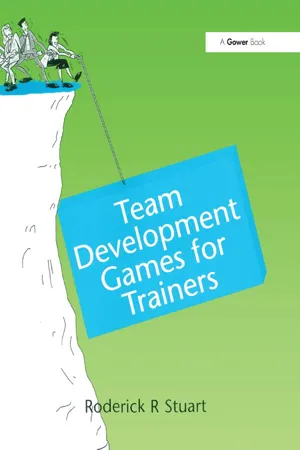
Team Development Games for Trainers
About this book
If you're involved in designing or delivering interpersonal skills training you will know that there are two perennial problems. The first is finding material that matches your objectives. The second is finding material that will be unfamiliar to the participants. The 59 games in Roderick Stuart's collection have not appeared in print before. Based on the author's experience with a wide range of organizations and participants, they cover the entire gamut of skills associated with team development, including assertiveness, communication, creativity, decision making, influencing, listening, planning, problem solving and time management. Each game is presented in a standard format, with an indication of objectives, timing and group size, detailed step-by-step guidance for the trainer or team leader, and ready-to-copy masters for all participants' material. An index of objectives makes it easy to select the most suitable items for your training needs and to compile complete workshops or more extensive programmes. In addition the author provides a four-stage model that relates learning to the requirements of the workplace, and a set of checklists for facilitating the learning process.
1
Introduction:
The role of the team at work
For most people, the work environment requires us to interact with others, so that we do our jobs effectively and in a way which is satisfying from a personal point of view. We share resources, work objectives, facilities, terms of service, special usage or forms of language, style of dress or uniform, and so forth. Hence, we are part of a group which has a shared set of goals and values, and as such we are well on the way to becoming part of a team.
However, when we as trainers are asked to design training and development events, the first and very important part of the process is to identify specifically where the team has a role to play, and where individuals can make the most valuable contribution. For there are certainly many work-related activities that are carried out by individuals working on their own, and it would clearly be a waste of time and resources to design team development courses in such circumstances.
Moreover, many workers do not see themselves initially as part of a team. Thus when the need to develop teams has been identified and appropriate courses designed, it is necessary for us to take time at the onset with participants on workshops and courses to clarify the different characteristics of work groups and teams. Equally, we must address the issues of managing team boundaries, those grey areas of responsibility which lie outside the remit of any one team, but which contribute directly to the success of all teams.
Phases of team development
When involved in the design of team development programmes, it is worth considering the following basic questions to help achieve a logical, realistic and relevant programme:
● Do individuals have the necessary team skills?
● How can we develop any further skills that may be required?
● How can we review the effectiveness of the solutions?
In this book I have considered these questions in four phases: diagnostic, development, practice, and application to work (these phases are considered in greater detail on pp. 269–271). Here it is sufficient to say that the diagnostic phase covers the analysis of the development needs of individuals, as well as determining whether or not the work-related activities are inter dependent and the people therefore need to work as a team. The development phase concerns the evolution of the team, the practice phase comprises the rehearsal of team skills, while the application phase is the stage at which teams apply their acquired skills (most probably within a work context). This final stage is most important since it enables the effectiveness of the training to be reviewed, monitored and evaluated, and provides the link between the trainer and other parts of the organization.
People are people
Over the past twenty-five years I have been involved in helping to develop the skills and abilities of people in many different organizations. I have been struck by the common threads which run through diverse types of organization, and the common issues which they face in their working environment. Naturally, there are differing norms of behaviour, language, codes of dress and so on, but it seems to me these are eventually discounted as everyone within a specific culture accommodates to a special mixture of influences. They then seek to achieve goals and objectives that are remarkably similar to those in other cultures.
The development of the games and activities
I have used the terms “games” and “activities” to describe the contents of the book. These terms are intended to be largely synonymous, because you can make the games or activities competitive or collaborative depending on the objectives you are seeking to achieve. However, there are occasions when the purpose of the learning experience is associated directly with the work environment, in which case it would not be accurate to use the term “game”.
A further dimension which you will need to be aware of is that teams can form from occupational groups, or from any other work-related or social interaction (e.g. a shared project in a personal development programme), and participants on your courses may therefore have met prior to taking part in a particular game. In which case, they will know each other and have some knowledge of each other’s relative strengths, weaknesses, personalities, preferred methods of working, and so forth. In the book I have used the phrase, “those who have worked together”, as a descriptor to cover such circumstances, and have placed this in the notes for certain of the games where it would be advantageous – but not essential – to select teams in this way. Where I have referred to “work teams”, I am referring to occupational teams.
The activities set out in this book have been used in many different cultures, including the military, financial services, higher education, secondary schools, nurses, teachers, IT specialists, pharmaceutical managers, and so on. A number of professional trainers have used them, and have suggested changes to some activities which have increased their effectiveness. I see the games and activities as a series of vehicles through which people can enjoy a common experience and then explore, discuss and resolve issues that have arisen, at the end of the process applying what they have learnt to their work. The common experience enables an individual to develop his or her own repertoire of capability and confidence. For you as a trainer, the games and activities provide opportunities to develop a wide variety of skills and abilities through concentrating attention both on your particular objectives and on the needs of individuals within the groups. My suggestions about which objectives can be achieved from the games are a result of my own experience with them – you will no doubt find other equally relevant and enjoyable uses.
Objectives
As you will see, I have provided a number of objectives for each game (they are supplemented by the material in the design framework on pp. 269–271). Most of these objectives are self-explanatory. The exceptions are perhaps assertiveness and influencing, which both refer to forms of interpersonal behaviour. In my view, there is an essential difference: influencing is directional in the sense that the individual seeks to persuade others to act, whereas an assertive person may decide that he or she does not wish to influence others, and may even decline to play any active role in what is going on. Both forms of behaviour are however, relevant and important within a team.
Relevance to the individuals
On completion of a game, individuals must be able to make a positive link between the outcomes of the game and any actions that can be taken to improve the effectiveness of team members in their own chosen environment. This is important for two reasons: first, so that participants can apply the skills they have learned to their own environment (probably linked to their work situation); and secondly, in order that the training can be seen as directly relevant and worthwhile in terms of its costs to the organization.
With this point in mind, most of the games include a final stage where teams can plan future actions. This plan can be reviewed and evaluated formally or informally at some point in the future and helps to embed the training into the continuous development and improvement of people over time. From the training designer’s perspective, this review data provides the starting point of another cycle.
Adults as learners
When we are involved in the development of adults, we need to recognize that every person in the team or group brings to the training event a wealth of experience. During my own experience of developing individuals I have come to appreciate that the learning which takes place is a combination of the content, the context and a set of uniquely individual characteristics that adults invest in the learning situation, as follows:
● their own reasons for wanting to learn;
● their previous learning history, including positive and negative learning experiences;
● their self-confidence, self-esteem, self-image;
● their learning style and pace of learning;
● their physical and emotional state, together with any learning impairments;
● their personality;
● their view of the world; and
● a strong need to play an active part in the learning process.
Facilitating team development activities
The role of the trainer is a very important factor in the success or otherwise of team development activities. It can vary from a didactic model where specific factual knowledge or skill is being taught (i.e. where the trainer’s role is that of an instructor) to a free-flowing facilitative model where personal and interpersonal skills are being developed. At this latter end of the spectrum the role becomes that of an observer, reviewer and feedback of behaviour – rather like a mirror to reflect back to individuals their own behaviour. In this mode, the individuals are given freedom to be themselves, to act in a natural and comfortable way, and to take from this experience whatever learning they recognize as being relevant and valuable.
Individual needs versus team needs
Individuals will take from the learning experience what they choose, and they will certainly want to explore their own agenda. As the trainer, however, you also have an agreed agenda and learning outcomes based on the published programme. Most of the objectives of the team development programme are best satisfied when groups interact naturally. As I see it, therefore, there are inherent tensions in trying to meet the needs of individuals at the same time as those of the group. These tensions require constant monitoring and awareness if both sets of needs are to be satisfied.
There is a constant question in my mind when I launch teams into an activity: “When do I stand back and let all hell break loose as they go through what I would term ‘the black hole to enlightenment’, and when do I step in and direct them back to the objectives and outcomes I want to achieve?” One example springs to mind. I was running a negotiation skills game. Two of the three teams decided they did not want to negotiate, and instead secretly made a deal. These two teams appeared to get what they wanted, while the third team were extremely annoyed that they had been denied the opportunity to learn more about negotiating. I was obliged to review the learning experience for all involved, especially myself!
There is no single solution to this problem. I have learned, however, that whatever emerges in the review stages as important learning for individuals and teams must not be lost, ignored or glossed over simply to achieve – or appear to achieve – the trainer’s objectives.
Forming teams to take part in games
I have also remarked over the years on the complexity of the issues involved in forming teams from groups. In the book you will find that the first requirement for any game is that you form teams. This bald statement can hide many potential pitfalls as you seek to put it into practice!
Often there are hidden reasons why individuals do or do not want to work with other people, which can cause tension. It may, for example, be an initial reaction as they meet for the first time, it may be a memory from past experiences, or it may be because there are others in the room they particularly want to share experiences with. To resolve this situation, I have found that using a random system of selecting teams – for example, alphabetic order of names, home towns, departments in the organization, and so forth – works quite well. Where teams have to be formed from certain departments, your selection process is of course restricted, as it is when you are developing skills such as the team leader role. However, in such cases I have also used another method of team selection, whereby you ask everyone in the group to form a line, with each individual taking up a position which reflects their own view of how much they know about the competencies being considered (e.g. leadership, communications, feedback, influencing, listening skills). Once the line is established, you have some indication of how confident each individual feels with regard to the competencies. You can therefore now form teams in a number of ways (e.g. from team members with similar levels of confidence, or from those with extremes of confidence), or select a team leader from the more confident end of the line.
The emotional impact of games
Taking part in games which are competitive raises the adrenaline level in many people, and the outcomes – where there are so-called winners and losers – can also increase the emotional state. Sharing such an experience within teams can be valuable both for the team and for the individuals concerned: for example, when they see a new facet of a colleague’s personality, or observe the powerful impact of “group think”. Faced with the likelihood of an emotional outcome...
Table of contents
- Cover
- Half Title
- Dedication
- Title Page
- Copyright Page
- Table of Contents
- Preface
- Acknowledgements
- 1 Introduction
- 2 The games
- Index of games by objectives
- Check lists for use in facilitating team development
- A design framework for team development programmes
Trusted by 375,005 students
Access to over 1.5 million titles for a fair monthly price.
Study more efficiently using our study tools.
Frequently asked questions
Yes, you can cancel anytime from the Subscription tab in your account settings on the Perlego website. Your subscription will stay active until the end of your current billing period. Learn how to cancel your subscription
No, books cannot be downloaded as external files, such as PDFs, for use outside of Perlego. However, you can download books within the Perlego app for offline reading on mobile or tablet. Learn how to download books offline
Perlego offers two plans: Essential and Complete
- Essential is ideal for learners and professionals who enjoy exploring a wide range of subjects. Access the Essential Library with 800,000+ trusted titles and best-sellers across business, personal growth, and the humanities. Includes unlimited reading time and Standard Read Aloud voice.
- Complete: Perfect for advanced learners and researchers needing full, unrestricted access. Unlock 1.5M+ books across hundreds of subjects, including academic and specialized titles. The Complete Plan also includes advanced features like Premium Read Aloud and Research Assistant.
We are an online textbook subscription service, where you can get access to an entire online library for less than the price of a single book per month. With over 1.5 million books across 990+ topics, we’ve got you covered! Learn about our mission
Look out for the read-aloud symbol on your next book to see if you can listen to it. The read-aloud tool reads text aloud for you, highlighting the text as it is being read. You can pause it, speed it up and slow it down. Learn more about Read Aloud
Yes! You can use the Perlego app on both iOS and Android devices to read anytime, anywhere — even offline. Perfect for commutes or when you’re on the go.
Please note we cannot support devices running on iOS 13 and Android 7 or earlier. Learn more about using the app
Please note we cannot support devices running on iOS 13 and Android 7 or earlier. Learn more about using the app
Yes, you can access Team Development Games for Trainers by Roderick R. Stuart in PDF and/or ePUB format, as well as other popular books in Business & Business General. We have over 1.5 million books available in our catalogue for you to explore.