eBook - ePub
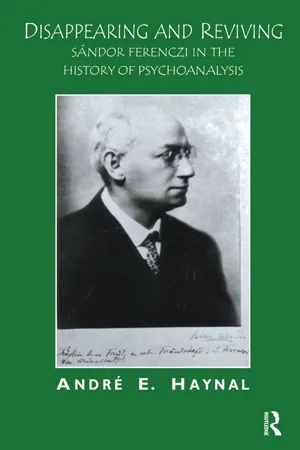
Disappearing and Reviving
Sandor Ferenczi in the History of Psychoanalysis
- 168 pages
- English
- ePUB (mobile friendly)
- Available on iOS & Android
eBook - ePub
About this book
This book is an indispensable work for anyone interested in the pioneering psychoanalyst Sandor Ferenczi. As the supervisor of the recently published correspondence between Freud and Ferenczi, Haynal brings to the present volume an elegant scholarship sensitive to Ferenczi's time and intellectual milieu. This is not solely a study in the history of psychoanalysis, in that Haynal sets himself the aim of entering into a 'dialogue' with Ferenzi, 'the founder of all relationship-based psychoanalysis and the explorer of traumatisms, counter transference and other problems present even in contemporary psychoanalysis'. Expressed in a lucid and eloquent style, each chapter explores with an intimate incisiveness, not only Ferenczi's complex and difficult relationship with Freud, but the emergence and elaboration of original ideas anticipatory of subsequent developments within the psychoanalytic movement.
Trusted by 375,005 students
Access to over 1.5 million titles for a fair monthly price.
Study more efficiently using our study tools.
Information
Subtopic
History & Theory in PsychologyIndex
PsychologyCHAPTER ONE
Ferenczi:
a “pre”-psychoanalyst?
Aconvenient distinction: everything in Ferenczi’s career before he met Freud in 1908 was prepsychoanalytic, and everything that came after was … psychoanalytic. Three months after the first conversation between the two men, Ferenczi was addressing the Salzburg Congress. Had he become a psychoanalyst in three months? That would be a record even for Ferenczi! The truth is plainly more complex.
The epic history of the Ferenczi family is typical of that of a particular section of the Budapest intelligentsia. The father, Baruch Fraenkel, was born in Cracow in 1830; he emigrated from Galicia, a province in the Austrian part of the Austro–Hungarian Empire, to northern Hungary and settled in Miskolc. Caught up in the early-nineteenth-century liberal–nationalist movement, he became so involved in this that he had his name Magyarized to Bernát (Bernard) Ferenczi when Sándor was six years old. He owned a bookshop and a publishing house. After the 1848 liberal and nationalist revolution, which broke over Hungary as it did over most of the countries of Europe, and its subsequent defeat he became the printer for an entire vein of Hungarian progressive literature. Interestingly, the works issuing from his press included those of a Protestant pastor from a nearby village, Mihály Tompa. During the years of repression pending the reconciliation between the House of Habsburg and the Hungarian nation in 1867, Ferenczi the elder was one of those who kept these cultural ideals aloft.
Sándor’s mother, Roza Eibenschütz, had been brought up in Vienna (in German), so that the family was bilingual, if not indeed multilingual (speaking German, Hungarian, Polish, and possibly Yiddish).
Ferenczi himself, the eighth of eleven children growing up in this middle-class setting, was an early developer who “played” with hypnosis while still at the “Gymnasium” [high school]. As a student at the Vienna Medical School, he was exposed to influences such as the Darwinism of his teacher, Claus, the physiology of Brücke, the philosophy of Mach, and the sexology of Krafft-Ebing—the seething mass of cultures that burst onto the scene—so inexplicably, from our present-day vantage point—in the dying days of the nineteenth century in Vienna, and which Ferenczi was to rediscover shortly afterwards in Budapest, where he moved on completing his studies.
Hungary’s capital city of Budapest was created in 1872 with the union of Buda—the district of the Royal Palace—and Pest, a town of merchants, small craftsmen, the university, and broad boulevards with those famous cafés where ideas and influences were exchanged between intellectuals, journalists, poets, and novelists—circles in which Ferenczi, too, moved. These twin towns were to share second and third place in the Austro–Hungarian Empire after Prague. That intelligentsia, which was as remote from provincial Hungary as Paris’s Left Bank is from rural France, consisted largely of émigrés from the different lands of the monarchy: German-speakers from the relevant regions of the Empire; Jews from western Poland, and Hungarian-speakers from distant provinces such as the Principality of Transylvania (now Western Romania). The prevailing mixture of languages and cultures was typically Central European. The philosopher Georg Lukács, later to become a Marxist, and Béla Balázs, the librettist of two of Bartók’s most famous works (The Wooden Prince and Bluebeard’s Castle), are good examples: Lukács wrote most of his works in German, whereas for Balázs the language was now German, now Hungarian. Sándor Ferenczi set down his Clinical Diary in German! Even if the nationalists ultimately caused the Empire to burst asunder—through the Treaty of Versailles after the First World War—the cosmopolitan culture of the major cities of central Europe was to impress its stamp deeply on twentieth-century culture in general, through its expatriate geniuses and talents such as—to name but a few—Freud in London, Wittgenstein in Cambridge, and Schoenberg in California.
After his studies in Vienna, Ferenczi settled in Budapest, which subsequently proved particularly fertile soil for psychoanalysis to take root in. It may be that this culture had less affinity for highly abstract thought—specifically, philosophy—than for fields such as music, painting, and, by virtue of its links with the Vienna Medical School, therapeutic action (e.g. Semmelweis). As it happens, the Budapest Medical School worked closely together with its Viennese counterpart, which, we may recall, was at the time itself vying with those of Paris, London, and some of the fast-expanding German universities. It practised new methods of auscultation and percussion, an anatomical pathology (Rokitansky), and a modern physiology (whose leading light was Brücke, a member of Helmholtz’s famous circle, which sought to place physiology on a physical and chemical basis). Darwinian thought was represented there through Claus; and it was the seat of nascent sciences such as sexology and psychiatry.
Occultism
Back in Budapest after his Viennese training in 1899, Ferenczi worked first as an extern at one of Budapest’s oldest hospitals, Rókus-Kórház—one of those venerable institutions (to be more precise, the hospital was in Pest, the town of merchants and the middle classes, as opposed to Buda, the right-bank district, containing the Royal Palace and bourgeois villas). He then practised in a clinic for the poor of the city called Erzsébet Szegényház, and later in an insurance outpatient clinic for blue-collar workers. Lastly, he worked in the same Rókus-Kórház for a very authoritative and malignant Chief—“a hard-hearted man”, as Ferenczi described him (Ferenczi, 1917 [199], p. 288)—who had Ferenczi take care of the prostitutes instead of letting him devote his time to the study of psychic phenomena. In the absence of other material, he attempted psychology experiments on himself by the method of “automatic writing” (Ferenczi, 1917 [199], p. 288)—that is, free associations in writing, quite widely used at this time, and of which spiritualists often spoke. It was already a kind of auto-analysis. At the same time, in Vienna, what has come to be known as Freud’s “self-analysis” was taking place; this too, it will be recalled, involved the writing down of dreams and their associations (Mahony, 1993). Much later, as it happens, in a letter to her father dated 7 August 1921, Anna Freud was to comment: “Now at last I also believe you when you say that dream analyses, if made by oneself, can only be done in writing” [“Jetzt endlich glaube ich Dir auch, daß man die Traumanalysen, wenn man sie allein macht, nur schriftlich machen kann”—Grubrich-Simitis, 1993, p. 79, n. 13].
Just as Freud had had his friend Fliess, so Ferenczi’s friendship with Freud was preceded by his association with Miksa Schächter, a distinguished and cultivated physician and editor of the famous Hungarian progressive medical journal Gyógyászat [Therapy]. Schächter was a kind of paternal friend: here Ferenczi can already be seen seeking an idealized father as an interlocutor for his self-analysis, the same role that he later expected Freud to fulfil: “I wanted to enjoy the man, not the scholar, in close friendship” (Fer/F, 3.10.1910).
By the turn of the century, Ferenczi had already read Freud and Breuer’s paper “On the Psychical Mechanism of Hysterical Phenomena” [“Über den psychischen Mechanismus hysterischer Phänomene”, 1893h, which had been published in the Wiener medizinische Presse]; he commented that it had at the time appeared to him “improbable and artificial”, and subsequently he blamed himself for not having “honour[ed] it with a closer scrutiny” (Ferenczi, 1908 [60], p. 31). As a medical student in Vienna, he had already attended the courses given by Krafft-Ebing, author of the celebrated Psychopathia Sexualis (1886) and father of the terms “sadism” and “masochism”, who had, as it happened, annoyed him with his ironic remarks about hypnosis. Ferenczi had, of course, spent his student years in the Vienna of Klimt, the great artist of erotism, of Schnitzler, who wrote about problems of sexuality, illusion, and reality, of Rilke, and of Hofmannsthal, before returning in 1897 to the Budapest of Ignotus, Dezsö Kosztolányi, and Géza Csáth. The passion for exploring the secrets of the human psyche by free association, then very much in vogue in psychology, belonged to the common cultural background of the two men who shared the initials S.F. Coupled with Ferenczi’s reading of The Interpretation of Dreams at the beginning of the century, this research led him to approach Jung. After a brief visit to Vienna in March 1907—where he met Freud on the 3rd and participated in a meeting of the “Wednesday Society” on the 6th—Jung spent a few days in Budapest with Ferenczi’s friend and colleague, Dr Fülöp Stein, who was in touch with Jung on account of their common interest in alcoholism and the temperance movement. It was on this occasion that they met for the first time. Later that year, still pushed by his interests for the word-association method, Ferenczi spent a short period at the Burghölzli Clinic in Zurich (unpublished letter from Jung to Ferenczi dated 1.10.1907; cf. Freud/Ferenczi, 1993, p. 2, n. 4). Everyone around him was subjected to experiments in which he used a stopwatch to measure the time elapsing between the stimulus word and the response; not even the lavatory attendant at the Café Royal, where he was a regular, was spared (Balint, 1964g). (In fact, Jung had written Studies in Word Association, published between 1904 and 1907, one chapter of which, “Psychoanalysis and Association Experiments”, he sent to Freud with a view to making contact with him.)
Whereas Freud saw himself as belonging within the line of descent begun with mesmerism in France, which became the hypnotism of Charcot and Bernheim, Ferenczi was in addition, close to another cultural tradition of the mysterious—namely, occultism. Characteristically, he mentions this in connection with automatic writing (“about which the spiritualists have much to say”—Ferenczi, 1917 [199], p. 288). And it was spiritualism that led to his own initial discovery of the unconscious and of the existence of splits in the psyche. While this may not be particularly surprising at a time when hysteria and multiple personalities were all the rage, the link forged by Ferenczi is highly original: “What we know today proves beyond a shadow of doubt that there are many unconscious [öntudatlan] and semiconscious elements in psychic functioning.” He therefore considered it “probable that most of the phenomena of spiritualism are based on the division of the psychic functions into two or more parts, only one of which is placed at the focus of the convex mirror of consciousness, whereas the others operate autonomously outside consciousness [öntudat nélkül]. That perhaps explains how a medium can conduct [his experiments] outside of his consciousness and not intentionally” (Ferenczi, 1899, p. 478).
The achievement of a better understanding of one of the last secrets of human communication, nicely expressed through the word “occult”, was long to remain an object of Ferenczi’s burning curiosity, and eventually he was to draw Freud into his wake. Both men later hoped that the countertransference would give up its secrets through thought transmission. The introduction to the first volume of the Freud–Ferenczi correspondence (Haynal, 1992a, in particular p. xxvii ff) tells part of this story and gives an account of the journey that Freud, Ferenczi, and Jung made to America in August 1909. Note that this trip came within less than a year of Ferenczi’s making Freud’s acquaintance through Jung—that is to say, very shortly after “Ferenczi the psychoanalyst” first took the stage. The Correspondence (Freud/Ferenczi, 1993—for example: Fer/F, 5.10.1909, Fer/F, 20.11.1909, and, in particular, F/Fer, 6.10.1909; F/Fer, 11.10.1909; F/Fer, 22.10.1909; F/Fer, 10.11.1909) bears witness to the intensity of the exchanges between Ferenczi and his master on this subject, as well as to the fact that Ferenczi was also experimenting with his patients; furthermore it illustrates the role of Freud’s enthusiasm here: “The transference of your thoughts in incomprehensible ways is the strange thing” (emphasis in original); then follows the characteristic comment: “Keep quiet about it for the time being” (F/Fer, 6.10.1909). Here the lines of transfer merge with those of mysteries of occultism, still in the hope that “Gedankenübertragung” [thought-transference] would shed light on the “Übertragung” [transference]. Ferenczi, zealous as always, chased clairvoyants and pythonesses across Europe. Freud participated in these experiences, played mediums in turn, and continued this game for many more years. As late as 1925, Freud wrote to Abraham that Anna had a “telepathic sensitivity” (F/Abr, 9.7.1925). The aim of all this for Freud was “to shatter the doubts about the existence of thought transference … that is where the doubt ends.” However, “preserving the secret long enough” was also an important consideration (F/Fer, 20.8.1910).
Freud, as it happens, never completely lost interest in this subject. At the famous meeting of the “Secret Committee” in the Harz Mountains in 1921, he divulged his ideas on psychoanalysis and telepathy (cf. Freud, 1941d [1921]) to his closest circle of initiates. A year later he was supposed to address the Vienna Psychoanalytic Society on the subject of dreams and telepathy, but for some mysterious reason the lecture was never delivered, although its text was published in Imago (Freud, 1922a). Again, in 1922, he wrote to Eitingon that there were two “themes that always perplexed him to distraction” (13.11.1922, quoted by Jones, 1957, p. 419): one was occultism and the other … the true identity of the author of Shakespeare’s works.
It is hardly necessary to point out that, through the caricature of occultism, Freud and Ferenczi were studying problems that manifestly had to do with relationship and intersubjectivity, of which the prepsychoanalytic Ferenczi was already a master. It is no coincidence that he succeeded, as early as in 1909, in linking the transference to introjection (Ferenczi, 1909 [67]), the latter being understood in a sense that anticipated the projective identification of Melanie Klein (1946a): “I project the stimulus words Ucs., he introjects them” (Fer/F, 17.8.1910, emphasis in original).
* * *
In 1906 Freud was grappling with the affective implications of the analytic process and the associated transference and countertransference problems. He wrote Jung on 6 December: “Essentially, one might say, the cure is effected by love.” A month later, on 30 January 1907, a similar statement appears in the Minutes of the Vienna Psychoanalytic Society: “Our cures are cures of love” (Nunberg & Federn, 1962, p. 101).
He was greatly fired up by this subject. He had already written up the case history of Dora (Freud, 1905e [1901]), set down in one continuous burst of impassioned enthusiasm between 10 and 25 January, interrupting his work on The Psychopathology of Everyday Life (Freud, 1901b) for the purpose. At the Salzburg Congress held at Easter, 1908, the first such meeting attended by Ferenczi, Freud was inspired by a similar flame as he presented the analysis of the Rat Man (Freud, 1909d). He spoke without a break for nearly five hours, impelled by the need to express himself and spurred on by the eager demands of his audience. He manifestly needed to free himself, as he disclosed to Abraham three years later, on 3 July 1912: “I have to recuperate from psycho-analysis by working, otherwise I should not be able to stand it” (F/Abr, 3.7.1912); he made a similar comment to Ferenczi at about the same time: “I was depressed the whole time and anesthetized myself with writing—writing—writing” (F/Fer, 2.1.1912).
The inevitable affective involvement of the analyst was becoming obvious, and it was the subject of close scrutiny in the Freud–Jung correspondence after Jung’s “affair” with Sabina Spielrein: “To be slandered and scorched by the love with which we operate—such are the perils of our trade, which we are certainly not going to abandon on their account.” Again: “In league with the Devil and yet you fear fire?” (F/Ju, 9.3.1909). And, once more, to Jung: “Such experiences, though painful, are necessary and hard to avoid…. I myself have never been taken in quite so badly, but I have come very close to it a number of times and had a narrow escape…. But no lasting harm is done. They help us to develop the thick skin we need to dominate ‘countertransference’…; they teach us to displace our own affects to best advantage. They are a blessing in disguise” (F/Ju, 7.6.1909; both italicized phrases in English in original).
At this stage, Freud and Ferenczi were working together to a much greater extent than is generally realized. For instance, when Freud was writing Totem and Taboo (1912–13a), Ferenczi reacted immediately (Fer/F, 23.6.1913) by taking...
Table of contents
- Cover
- Half Title
- Title Page
- Copyright Page
- Dedication
- Table of Contents
- Acknowledgements
- Preface
- Abbreviations
- Chapter One Ferenczi: a “pre”-psychoanalyst?
- Chapter Two “Healing through love”? A unique dialogue in the history of psychoanalysis
- Chapter Three Problems of psychoanalytic practice in the 1920s
- Chapter Four The history of the concept of trauma: Ferenczi at the end of the 1920s
- Chapter Five The countertransference in the work of Ferenczi
- Chapter Six Slaying the dragons of the past or cooking the hare in the present: a historical view on affects in the psychoanalytic encounter
- Chapter Seven The Correspondence
- Chapter Eight Ferenczi—dissident
- Chapter Nine Freud and Ferenczi: a difficult friendship or a tragic love affair?
- Chapter Ten Ferenczi’s legacy
- References
- Index
Frequently asked questions
Yes, you can cancel anytime from the Subscription tab in your account settings on the Perlego website. Your subscription will stay active until the end of your current billing period. Learn how to cancel your subscription
No, books cannot be downloaded as external files, such as PDFs, for use outside of Perlego. However, you can download books within the Perlego app for offline reading on mobile or tablet. Learn how to download books offline
Perlego offers two plans: Essential and Complete
- Essential is ideal for learners and professionals who enjoy exploring a wide range of subjects. Access the Essential Library with 800,000+ trusted titles and best-sellers across business, personal growth, and the humanities. Includes unlimited reading time and Standard Read Aloud voice.
- Complete: Perfect for advanced learners and researchers needing full, unrestricted access. Unlock 1.5M+ books across hundreds of subjects, including academic and specialized titles. The Complete Plan also includes advanced features like Premium Read Aloud and Research Assistant.
We are an online textbook subscription service, where you can get access to an entire online library for less than the price of a single book per month. With over 1.5 million books across 990+ topics, we’ve got you covered! Learn about our mission
Look out for the read-aloud symbol on your next book to see if you can listen to it. The read-aloud tool reads text aloud for you, highlighting the text as it is being read. You can pause it, speed it up and slow it down. Learn more about Read Aloud
Yes! You can use the Perlego app on both iOS and Android devices to read anytime, anywhere — even offline. Perfect for commutes or when you’re on the go.
Please note we cannot support devices running on iOS 13 and Android 7 or earlier. Learn more about using the app
Please note we cannot support devices running on iOS 13 and Android 7 or earlier. Learn more about using the app
Yes, you can access Disappearing and Reviving by Andre E. Haynal in PDF and/or ePUB format, as well as other popular books in Psychology & History & Theory in Psychology. We have over 1.5 million books available in our catalogue for you to explore.