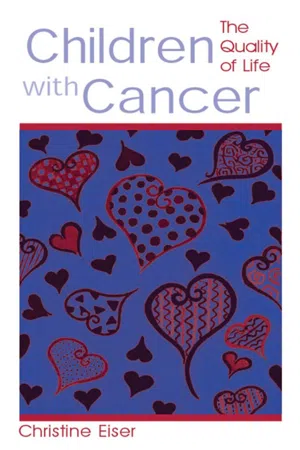
Cancer is a very rare disease in children. There have been impressive gains in survival in recent years, and these have been achieved through the use of chemotherapy and national and international clinical trials. The diagnosis of cancer in a child imposes considerable stress on the whole family. In the immediate time after diagnosis, parents must learn about the disease and its treatment, explain what is happening to the child, and make arrangements for the care of other children in the family. For the child, treatment is associated with many side effects depending on the specific drugs used. In addition, the child is prone to infection and therefore is likely to miss a lot of school and other activities.
For all these reasons, physicians and families have become aware that cancer has huge implications for the quality of the child's life. This book is an attempt to describe how quality of life is affected at different stages of the disease process. Comprehensive reviews are provided of the impact on the child's physical activity, social life, and school and educational achievements. Special consideration is given to children with leukemia (one of the more common cancers) and brain tumors.
Cancer does not just affect the child but every member of the family. Consequently there is coverage of the effects on parents and also healthy brothers and sisters. To the extent that improvements in survival have been achieved by national and international collaboration between clinicians, it is concluded that efforts to improve the quality of these children's lives is dependent on collaboration between clinicians, nurses, and behavioral scientists at national and international levels. This book should provide an impetus for such collaboration.
- 368 pages
- English
- ePUB (mobile friendly)
- Available on iOS & Android
eBook - ePub
About this book
Information
References
Aaronson, N. K., Meyeravitz, B. E., Bard, M., Bloom, J. R., Fauzy, F. I., Feldstein, M., Fink, D., Holland, J. C., Johnson, J. E., Lowman, J. T., Patterson, B., & Ware, J. E. (1991). Quality of life research in oncology: Past achievements and future priorities. Cancer, 67, 839–843.
Abidin, R. R., Jenkins, L. L., & McGaughey, M. C. (1992). The relationship of early family variables to children’s subsequent behavioral adjustment. Journal of Clinical Child Psychology, 21, 60–69.
Absolom, K., Eiser, C., Greco, V., & Davies, H. (2003). Health promotion for survivors of childhood cancer: A minimal intervention. Patient Education and Counselling (in press).
Achenbach, T. M. (1991). Manual for the Child Behavior Checklist/4–18 and 1991 profile. Burlington: University of Vermont, Department of Psychiatry.
Achenbach, T. M., & Edelbrock, C. S. (1979). The child behavior profile: II. Boys aged 12–16 and girls aged 6–11 and 12–16. Journal of Consulting and Clinical Psychology, 47, 223–233.
Achenbach, T. M., & Edelbrock, C. (1983). Manual for the Child Behavior Checklist and revised child behavior profile. Burlington, VT: Queen City Printers.
Achenbach, T. M., & Edelbrock, C. (1987). Manual for the youth self-report form. Burlington: University of Vermont Press.
Acheson Report. (1998). Independent inquiry into inequalities in health report. London: The Stationery Office.
Adamoli, L., Deasy-Spinetta, P., Corbetta, A., Jankovik, M., Lia, R., Locati, A., Fraschini, D., Masera, G., & Spinetta, J. J. (1997). School functioning for the child with leukemia in continuous first remission: Screening high risk children. Pediatric Hematology and Oncology, 14, 121–131.
Ahlfield, J. E., Soler, N. G., & Marcus, S. D. (1983). Adolescent diabetes mellitus: parent/child perspectives of the effect of the disease on family and social interactions. Diabetes Care, 6, 393–398.
Allen, R., Newman, S. P., & Souhami, R. L. (1997). Anxiety and depression in adolescent cancer: Findings in patients and parents at the time of diagnosis. European Journal of Cancer, 33, 1250–1255.
Altschuler, J. (1997). Working with chronic illness. London: Macmillan.
American Cancer Society. (1997). Cancer facts and figures. Atlanta, GA.
American Psychiatric Association. (1994). Diagnostic and statistical manual of mental disorders (4th ed.). Washington, DC: Author.
Anderson, B. J. (1990). Diabetes and adaptations in family systems. In C. S. Holmes (Ed.), Neuropsychological and behavioural aspects of diabetes (pp. 85–101). New York: Springer- Verlag.
Anderson, V., Smibert, E., Ekert, H., & Godber, T. (1994). Intellectual, educational, and behavioural sequelae after cranial irradiation and chemotherapy. Archives of Disease in Childhood, 70, 476–483.
Anholt, U. V., Fritz, G. K., & Keener, M. (1993). Self-concept in survivors of childhood and adolescent cancer. Journal of Psychosocial Oncology, 11, 1–16.
Armor, D. A., & Taylor, S. E. (1998). Situated optimism: Specific outcome expectancies and self-regulation. In M. P. Zanna (Eds.), Advances in experimental social psychology (pp. 309–379). New York: Academic Press.
Armstrong, F. D., & Horn, M. (1995). Educational issues in childhood cancer. School Psychology Quarterly, 10, 292–304.
Armstrong, F. D., Toledano, S. R., Miloslavich, K., Lackman-Zeman, L., Levy, J. D., Gay, C. L., Schuman, W. B., & Fishkin, P. E. (1999). The Miami Pediatric Quality of Life Questionnaire: Parent Scale. International Journal of Cancer, Supplement 12, 11–17.
Armstrong, G. D., Wirt, R. D., Nesbit, M. E., & Martinson, I. M. (1982). Multidimensional assessment of psychological problems in children with cancer. Research in Nursing and Health, 5, 205–211.
Asher, S., & Coie, J. (1990). Peer rejection in childhood. Cambridge, England: Cambridge University Press.
Asher, S. R., Hymel, S., & Renshaw, P. D. (1984). Loneliness in children. Child Development, 55, 1456–1464.
Aur, R. J., Simone, J., Hustu, H. O., Walters, T., Borella, L., Pratt, C., & Pinkel, D. (1971). Central nervous system therapy and combination chemotherapy of childhood lymphocytic leukemia. Blood, 37, 272–281.
Balen, R., Fielding, D., & Lewis, I. (1996). Activity camps for children with cancer. Children and Society, 10, 317–323.
Bandura, A. (1977). Social learning theory. Englewood Cliffs, NJ: Prentice-Hall.
Bannister, M., Stewart, S. M., Kennard, B. D., Benser, M., Andrews, W. S., & Moore, P. E. (1995). Developmental and physical growth status of pediatric liver transplantation patients at least 5 years after surgery. Paper presented at the meeting of the Joint Congress on Liver Transplantation, London.
Barakat, L., Kazak, A. E., Meadows, A., Casey, R., Meeske, K., & Stuber, M. L. (1997). Families surviving childhood cancer: A comparison of posttraumatic stress symptoms with families of healthy children. Journal of Pediatric Psychology, 22, 6843–6859.
Barbarin, O. A., Sargent, J. R., Sahler, O. J., & Carpenter, P. J. (1995). Sibling adaptation of childhood cancer collaborative study: Parental views of pre- and post diagnosis adjustment of siblings of children with cancer. Journal of Psychosocial Oncology, 13, 1–20.
Barr, R. D., Chalmers, D., DePauw, S., Furlong, W., Weitzman, S., & Feeny, D. (2000). Healthrelated quality of life in survivors of Wilms’ tumor and advanced neuroblastoma: A cross-sectional study. Journal of Clinical Oncology, 18, 3280–3287.
Barr, R. D., Petrie, C., Furlong, W., Rothney, M., & Feeny, D. (1997). Health-related quality of life during post-induction chemotherapy in children with acute lymphoblastic leukemia in remission: An influence of corticosteroid therapy. International Journal of Oncology, 11, 333–339.
Barr, R. D., Simpson, T., Whitton, A., Rush, B., Furlong, W., & Feeny, D. H. (1999). Healthrelated quality of life in survivors of tumors of the central nervous system in childhood— A preference-based approach to measurement in a cross-sectional study. European Journal of Cancer, 35, 248–255.
Baysinger, M., Heiney, S. P., Creed, J. M., & Ettinger, R. S. (1993). A trajectory approach for education of the child/adolescent with cancer. Journal of Pediatric Oncology Nursing, 10, 133–138.
Bearison, D. J., & Pacifici, C. (1989). Children’s event knowledge of cancer treatment. Journal of Applied Developmental Psychology, 10, 469–486.
Bearison, D. J., Sadow, A. J., Granowetter, L., & Winkel, G. (1993). Patients’ and parents’ causal attributions for childhood cancer. Journal of Psychosocial Oncology, 11, 47–61.
Beck, A. T., Ward, C. H., Mendelson, M., Mock, J., & Erbaugh, J. (1961). An inventory for measuring depression. Archives of General Psychiatry, 4, 561–571.
Bennett, D. S. (1994). Depression among children with chronic medical problems: a metaanalysis. Journal of Pediatric Psychology, 19, 149–169.
Benton, A. L., Varney, N. R., & Hamsher, K. D. (1978). Visuospatial judgement. A clinical test. Archives of Neurology, 35, 364–367.
Ben-Tovim, D. I., & Walker, M. K. (1995). Body image, disfigurement and disability. Journal of Psychosomatic Research, 39, 283–291.
Bergner, M. (1989). Quality of life, health status and clinical research. Medical Care, 27, S148–S156.
Bernstein, A. C., & Cowan, P. A. (1981). Children’s conceptions of birth and sexuality. In R. Bibace & M. E. Walsh (Eds.), New directions for child development: No. 14. Children’s conceptions of health, illness and bodily functions (pp. 9–30). San Francisco: Jossey Bass.
Bernstein, J. H. (2000). Developmental neuropsychological assessment. In K. O. Yeates, M. D. Ris, & H. D. Taylor (Eds.), Pediatric neuropsychology: Research, theory and practice (pp. 405–438). New York: Guilford.
Bhatia, S., Jenney, M. E. M., Bogue, M. K., Rockwood, T. H., Feusner, J. H., Friedman, D. L., Robison, L. L., & Kane, R. L. (2002). The Minneapolis-Manchester Quality of Life instrument: Reliability and validity of the adolescent form. Journal of Clinical Oncology, 29, 4692–4698.
Bibace, R., & Walsh, M. E. (1979). Developmental stages in children’s conceptions of illness. In G. C. Stone, F. Cohen, & N. E. Adler (Eds.), Health psychology (pp. 285–301). San Francisco: Jossey-Bass.
Bibace, R., & Walsh, M. E. (1981). Children’s conceptions of illness. In R. Bibace & M. E. Walsh (Eds.), New directions for child development: Children’s conceptions of health, illness and bodily functions. New Directions in Developmental Psychology Series (pp. 312–348). San Fransisco: Jossey-Bass.
Billson, A. L., & Walker, D. A. (1994). Assessment of health status in survivors of cancer. Archives of Disease in Childhood, 70, 200–204.
Birenbaum, L. K., & Robinson, M. A. (1991). Family relationships in two types of terminal care. International Conference on Community Nursing. Social Science and Medicine, 32, 95–102.
Birenbaum, L. K., Stewart, B. J., & Phipps, D. S. (1996). Health status of bereaved parents. Nursing Research, 45, 105–109.
Blacklay, A., Eiser, C., & Ellis, A. (1998). Development and evaluation of an information booklet for adult survivors of cancer in childhood. Archives of Disease in Childhood, 78, 1–6.
Bleyer, W. A. (1988). Central nervous system leukemia. Pediatric Clinics of North America, 35, 789–814.
Bleyer, W. A., Fallavollita, J., Robison, L., Balsom, W., Meadows, A., Heyn, R., Sitarz, A., Ortega, J., Miller, D., Constine, L., Nesbit, M., Sather, H., & Hammond, D. (1990). Influence of age, sex, and concurrent intrathecal methotrexate therapy on intellectual function after cranial irradiation during childhood: A report from the Children’s Cancer Study Group. Pediatric Hematology and Oncology, 7, 329–338.
Block, J. H. (1965). The Child-Rearing Practices Report (CRPR): A set of Q items for the description of parental socialization attitudes and values. Unpublished manual, University of California, Institute of Human Development, Berkeley.
Blotcky, A. D., Raczynski, J. M., Gurwitch, R., & Smith, K. (1985). Family influences on hopelessness among children early in the cancer experience. Journal of Pediatric Psychology, 10, 479–493.
Blount, R. I., Landolf-Fritsche, B., Powers, S. W., & Sturges, J. W. (1991). Differences between high and low coping children and between parent and staff behaviors during painful medical procedures. Journal of Pediatric Psychology, 16, 795–809.
Blount, R. L., Corbin, S. M., Sturges, J. W., Wolfe, V. V., Prater, J. M., & James, L. D. (1989). The relationship between adults’ behaviour and child coping and distress during BMA/ LP procedures: a sequential analysis. Behavior Therapy, 20, 585–601.
Bluebond-Langner, M., Perkel, D., Goertzel, T., Nelson, K., & McGeary, J. (1990). Children’s knowledge of cancer and its treatment: Impact of an oncology camp experience. Journal of Pediatrics, 116, 207–272.
Bolton, A. (1997). Losing the thread: Pupils’ and parents’ voices about education for sick children. London: NAESC/PRESENT.
Boogerd, W. (1995). Neurological complications of chemotherapy. In F. A. de Wolff (Ed.), Handbook of clinical neurology: Vol. 21. Intoxications of the nervous system, Part II (pp. 527–546). Amsterdam: Elsevier Science.
Bowlby, J. (1969). Attachment and loss. New York: Basic Books.
Boyle, M. H., Offord, D. R., Racine, Y. A., Szatmari, P., Fleming, J. E., & Links, P. S. (1992). Predicting substance use in later adolescence: Results from the Ontario Health Study follow- up. American Journal of Psychiatry, 149, 761–767.
Bradlyn, A. S., Harris, C. V., Warner, J. E., Ritchey, A. K., & Zaboy, K. (1993). An investigation of the validity of the quality of Well-Being Scale with pediatric oncology patients. Health Psycholo...
Table of contents
- Cover Page
- Title Page
- Copyright Page
- List of Figures and Tables
- Acknowledgments
- Glossary
- I The Holistic Care of the Child
- II Children on Treatment
- III The Wider Family
- IV Surviving Childhood Cancer
- V Survival and Quality of Life
- References
Trusted by 375,005 students
Access to over 1.5 million titles for a fair monthly price.
Study more efficiently using our study tools.
Frequently asked questions
Yes, you can cancel anytime from the Subscription tab in your account settings on the Perlego website. Your subscription will stay active until the end of your current billing period. Learn how to cancel your subscription
No, books cannot be downloaded as external files, such as PDFs, for use outside of Perlego. However, you can download books within the Perlego app for offline reading on mobile or tablet. Learn how to download books offline
Perlego offers two plans: Essential and Complete
- Essential is ideal for learners and professionals who enjoy exploring a wide range of subjects. Access the Essential Library with 800,000+ trusted titles and best-sellers across business, personal growth, and the humanities. Includes unlimited reading time and Standard Read Aloud voice.
- Complete: Perfect for advanced learners and researchers needing full, unrestricted access. Unlock 1.5M+ books across hundreds of subjects, including academic and specialized titles. The Complete Plan also includes advanced features like Premium Read Aloud and Research Assistant.
We are an online textbook subscription service, where you can get access to an entire online library for less than the price of a single book per month. With over 1.5 million books across 990+ topics, we’ve got you covered! Learn about our mission
Look out for the read-aloud symbol on your next book to see if you can listen to it. The read-aloud tool reads text aloud for you, highlighting the text as it is being read. You can pause it, speed it up and slow it down. Learn more about Read Aloud
Yes! You can use the Perlego app on both iOS and Android devices to read anytime, anywhere — even offline. Perfect for commutes or when you’re on the go.
Please note we cannot support devices running on iOS 13 and Android 7 or earlier. Learn more about using the app
Please note we cannot support devices running on iOS 13 and Android 7 or earlier. Learn more about using the app
Yes, you can access Children With Cancer by Christine Eiser in PDF and/or ePUB format, as well as other popular books in Psychology & Clinical Psychology. We have over 1.5 million books available in our catalogue for you to explore.