- 276 pages
- English
- ePUB (mobile friendly)
- Available on iOS & Android
eBook - ePub
About this book
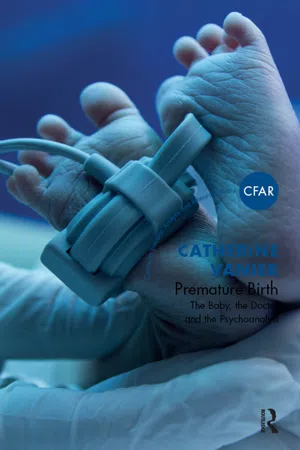
If advances in medical technology now allow babies to be born earlier and survive premature birth, what of the psychical impact of this emergence into the world? What consequences can premature birth have for babies, for their families, and for the medical staff around them? In this exciting and inspiring study, the author describes the work she has undertaken over the past twenty years in a neonatal intensive care unit. She shows how a sensitivity to the subjective experience of all concerned can have dramatic effects, and how a psychoanalytic ear can allow us to understand both the problems and the progress of prematurely born babies in a new way.
Information
CHAPTER ONE
Psychoanalysis and neonatal resuscitation
Neonatology: a recent specialism
Since the dawn of time, human beings have tried to resuscitate newborn babies; yet neonatology as a medical specialism is relatively recent. The main elements of its history were broadly outlined in the paper given by François Duchatel at the Société française d’histoire de la médécine in 1979 (Duchatel, 1926), and are as follows.
He observed that the first reference to resuscitation of a child (in this case an older child) can be found in the Old Testament, in the Second Book of Kings, chapter IV, verses 32 to 35:
And when Elisha was come into the house, behold, the child was dead, and laid upon his bed.
He went in therefore, and shut the door upon them twain, and prayed unto the Lord.
And he went up, and lay upon the child, and put his mouth upon his mouth, and his eyes upon his eyes, and his hands upon his hands: and he stretched himself upon the child; and the flesh of the child waxed warm.
Then he returned, and walked in the house to and fro; and went up, and stretched himself upon him; and the child sneezed seven times, and the child opened his eyes.
Other methods of resuscitation followed, some of them rather original. In 1601, Louyse Bourgeois (1563–1636), a midwife and pupil of Ambroise Paré, who attended the childbed of Marie de Médicis, wrote a treatise (Bourgeois, 1926) on the birth of the future king Louis XIII. After a long labour of twenty-two hours, the baby was born in a state of considerable weakness and there was a risk he would not survive, so she put some wine in her mouth and blew it into the baby’s mouth: “At that very moment,” she wrote, “he rallied and savoured the wine I had given him.”
After that, many other methods were invented for starting a baby’s breathing. In the 1880s, newborns were manipulated in all possible ways, pressed and compressed, to provoke a forced inhalation and exhalation. They were held upside-down by their ankles and shaken, and smacked on the bottom a few times in order to bring them to life (and this method was used for quite a few years!).
It was soon observed that premature babies (who were referred to as “sickly” infants1 at this time) were at risk from the cold, and so those caring for them came up with the idea of wrapping them in cotton wool, and surrounding the cradle with hot water bottles. In the 1890s, it was the incubators used for hatching chicks at the zoological gardens that gave doctors the idea of putting premature babies into warm glass boxes (Tarnier, Chantreuil, & Budin, 1886–1901). At first the boxes were shared, and later individual (unlike those used for chicks), and were warmed by paraffin lamps. During this era there were also numerous precursors to artificial respiration, “insufflators”, and other methods of mechanical breathing.
But real progress in neonatal resuscitation came with advances in medical research. There was certainly a need for better understanding of physiological mechanisms, and for more sophisticated equipment. It was only in the early 1900s that endotracheal intubation for adults was invented, and not until about 1950 that it was used in neonatal resuscitation. We just had to wait. Wait, for example until J. F. Kennedy’s premature son died in Boston in 1963 at thirty-four weeks and 2.1 kg, of hyaline membrane disease.2 Wait for progress in the resuscitation of adults—until finally, in 1965, the techniques of intubation and ventilation could be applied in neonatology.
Neonatal resuscitation, then, is a very recent discipline. It was Professor Alexandre Minkowski who opened the first major centre for premature babies in France in 1967 at Port-Royal. Premature babies in life-threatening distress are routinely taken to Port-Royal. And whereas before 1970, eighty per cent of newborns weighing less than 1.1 kg would die, after 1980, eighty per cent survived (Bétrémieux, 2010).
Between 1980 and 2000, considerable progress was made. Corticotherapy even before birth, surfactants,3 and sophisticated ventilation techniques became available. Extraordinary machines were perfected and enabled the limits of what was possible to be pushed further and further. Attempts were made to resuscitate ever-smaller babies. In 2000, it was reported that a baby weighing only 350 grams had been resuscitated in Texas. But some doctors started to worry, concerned about the consequences of such extreme resuscitations, and wondering if they might risk leaving these children disabled for life. At this point, ethics committees were set up. In France, in 2002 the Kouchner law and in 2005, the Leonetti law, raised new questions for those responsible for the care of very low birth weight babies. Just how far should they go? Is it possible to know how resuscitation will affect a baby? And even if the baby survives, will there be psychiatric or psychological sequelae as he grows up?
It was necessary to wait again, and take a step back, to observe the development of older children who had been born prematurely, so that the scientific community could engage in research on the psychological outcomes for these babies. Studies were undertaken focusing on the development of children who had not suffered obvious neurosensory or neuromotor sequelae. Their findings included social, emotional, and cognitive disturbances, behavioural difficulties, and problems in keeping up with their contemporaries at school that were significantly more severe than in the non-premature population. In order to keep such iatrogenic effects to a minimum, proposals were put forward for programmes of “developmental care”, the best known of which nowadays is NIDCAP (Neonatal Individual Developmental Care and Assessment Program).4 Developed in 1986 by Heidelise Als, a behavioural psychologist and lecturer at Harvard, who also worked in the Boston Children’s Hospital, the programme aims to put in place an environmental and behavioural strategy, to facilitate the children’s development by minimising stress on them when they are babies. Its fundamental hypothesis is: children are the main agents of their own development. Among other things, the programme involves a series of observations at regular intervals—every seven to ten days—in order to work out a programme tailored to each baby, which will take into account the baby’s reactions and behaviour before, during, and after an intervention. The particular manner of the caregiver can thus be modified for each individual child in order to reduce any stress to a minimum, in relation to the child’s capacity to adapt and degree of sensitivity. The environment can be modified, and stimulations—sound and light levels—can be reduced.
The incubators themselves are made opaque, using a cover that is only removed when interventions are made, or when the parents visit. Interventions can be reorganised, and periods of rest are respected. The way the babies are positioned in the incubator ensures a natural, flexed posture. Swaddling, gripping, and nonnutritive sucking are all enabled as much as possible. The baby’s behaviour is explained to the parents, and contact with them, especially skin-to-skin (“kangaroo care”), is encouraged and strongly recommended during their visits. On the other hand, the caregivers are not involved, beyond imparting these fundamental principles, in the child’s development. Their task is limited to helping to avoid unpleasant overstimulation.
There is no denying that the changes proposed by NIDCAP are important. Limiting aggressive interventions as far as possible, taking the babies’ reactions into consideration, ensuring their general comfort and taking care over their positioning in the incubator, encouraging the parents to have physical contact with them—all seem like common sense, and in our view are absolutely essential when working with newborns.
By themselves, however, they are not sufficient. Behavioural methods and observations, however refined, miss the point unless another type of support is offered concurrently. How can you resuscitate babies without taking their history into account, and that of their parents, and the babies’ desire to live? How can you engage in this process without taking into account the elements that might make it possible for something “subjective” to emerge inside the incubators? Over the years in our unit we have certainly tried to think about developmental care, but in a different way.
Saint-Denis: the neonatology service of the Hôpital Delafontaine
In order to follow the development of this work in progress, we need to look back at the way things were when I joined the neonatal resuscitation unit of the Hôpital Delafontaine, towards the end of the 1980s.
I was in a meeting in the paediatric psychiatry service (within which I still work)5 when the phone rang. Dr. Abram Coen, the head of service at the time, told us that the head of neonatology of our hospital was asking if a psychiatrist could go to see a mother who was being treated in his service, and was “really not at all well”. But that morning, all the psychiatrists were busy, and so I was asked to go. When I arrived, the doctors explained to me that this woman’s reaction had thrown the service into complete disarray. She had just refused to take her baby home.
By telling this mother that her baby was recovered, cured of prematurity, and with no apparent risk of further problems related to prematurity—this fine baby, such a success for the unit—the doctors were hoping to cure her of the symptoms she had complained of from the day the baby was born. She suffered from insomnia, anxiety attacks, dark thoughts. When the baby came out of hospital, they were absolutely certain, she would dry her tears, and the baby would cure his mother of her depressive state. But now there she was saying she didn’t want anything more to do with her baby: “You keep him,” she had said. Assuming she was mad, they had searched the hospital telephone list for the extension where they might hope to find a psychiatrist—paediatric psychiatry, since our hospital does not have an adult psychiatry department. But instead of the psychiatrist they were expecting, on that occasion a psychoanalyst turned up. That is how I began my work in neonatology. The team took me into their service under the aegis of liaison psychiatry, so that I would make this woman see reason, and get her to rejoice in the birth of her baby and be grateful for the good care that had been given to him. And indeed, after a few sessions, she did agree to take him home.
From time to time over the next few months, there were further calls from neonatology: other mothers in difficulty. These sessions taught me how difficult it was for all these women to have any sort of relation with their babies in a neonatal resuscitation unit. From them I learnt of the trauma that the premature birth represents, and the violent shock of receiving the prognosis: “We can’t tell you yet whether your baby is going to live or die.” Suddenly I was aware of the radical difference between the point of view of the mothers and that of the doctors.
Babies born looking as if they are dead, or in danger of death, immediately trigger a protocol of action for the intensive care doctors. The doctors have to make an immediate assessment, according to certain very precise criteria, of whether a child can be “saved”. What a doctor decodes as a series of signs necessitating a certain number of well-rehearsed interventions according to that protocol, is decoded by the parents in quite another way. They have just brought a baby into the world who may not live. Sometimes, they overhear that their child “appears to be dead”. In all cases, what immediately “appears” to the parents is the signifier “dead”.
Now the family drama is in the foreground, and straight away the little inert body takes its place in a scenario where each individual has his or her role to play. The roles are already inscribed in the family history, and sometimes have been that way for generations.
The baby becomes the locus of all their projections; guilt is the prime mover, and all the fantasies we hear expressed at this time only feed into it: “You gave him his life”, said this mother, who wasn’t mad at all, “you keep him. All I could give him was death, I’m a danger to him.” This mother whom the team deemed to be “bad” was in fact a good mother, who was concerned to protect her baby. It was only by allowing her, as the sessions progressed, to speak about her history and about the family drama that had made a prisoner of her, that this mother had eventually been able to allow herself to take her child home.
Listening to these mothers, I was rapidly coming to the conclusion that everything happened as if treating a case of prematurity was equivalent to responding at the level of the symptom, leaving aside any problematic of the family in relation to life and death, which at this juncture is centred on the newborn. Babies do not “speak” to their parents in the same way as they “speak” to the doctors—luckily for the babies, who would otherwise be firmly caught up in the progress of medicine! Sickness does not represent the same thing for the doctors as it does for the families; we can say that they do not even perceive the same sickness. And neither does the treatment have the same significance for the caregivers as it does for the parents. Lacan spoke of this in a lecture he gave to a group of doctors: “When the patient is sent to the doctor, or when he approaches him, you cannot say that he is just expecting purely and simply to be cured. He puts the doctor to the test, seeing if the latter can get him out of his state of being a patient—and that is quite different, because it can involve the fact that he may be absolutely attached to the idea of remaining in that state” (Lacan, 2003, p. 302 [translated for this edition]). On the basis of this observation, we can see how a dialogue of the deaf can ensue between doctor and patient on the subject of a possible recovery, and the profundity of deafness is far greater than in any ordinary dialogue. This is one reason why doctors complain that in spite of their efforts to explain, the parents do not seem to understand what they are saying. Indeed, more often than not they do not understand.
So there I was at the beginning, an unsettling sorceress, situated outside the service, where my role could be summed up as dealing with the parents. The parents, and above all, the mothers: they seemed to be the ones who caused the most problems. The ones who were referred to me were those who did not behave as the team expected a “good mother” to behave. They needed treatment, and if necessary, would have to be referred to a psychoanalyst if no psychiatrist was available. But whereas, at first, the members of the team expected me to make the mothers see reason, they gradually realised that these women were not just questioning them, but medicine as a whole. It is quite understandable that doctors who had worked so fervently to “repair” a newborn baby would be astonished and disappointed if the mother no longer wanted anything to do with the baby; this would raise the question of whether their efforts had any point at all. It would certainly have been easier, or at least more comfortable, to consider these women mad; but psychoanalysis, as we know, has never really favoured easy or soothing answers.
So now another reading of the situation was put to the team. While these mothers were not insane, we had to admit that during the long months of hospitalisation, they had found themselves unable to invest emotionally in their babies. If the team recognised that they were not mad, then they also had to question what had been going on during this separation. Even if the baby had been “saved” physically, it was clear that something had been missed in another dimension, as when you miss a train and find yourself stuck on the platform at a railway station. Thanks to what I had learned from the mothers for whom I had been brought in, I was soon able to propose to the team a quite different way of working.
It was no longer a question of rushing to the aid of the caregivers each time a baby or a baby’s family were having problems, but of meeting each baby and his parents, as soon as the baby arrived in the service. So now it was not a case of piecemeal “treatment” of mothers made ill by the separation from their babies, or of babies made ill by the separation from their mothers, but rather of working together on a common project which would enable the babies’ lives to be saved “differently”. In order to do this, I had to understand how the process of resuscitation worked in the unit. I had to meet not only with the mothers at the time of their discharge from hospital after the birth, but also with the fathers, throughout the entire period of the admission. To bring this project to fruition, it would be necessary to be near the babies, listening to them, and at the same time to help the doctors understand what was going on in their own minds while dealing with these difficult cases.
The analyst, then, was no longer there just to repair the damage that might be caused by long admissions, but to work alongside the resuscitation team in a different register; it was no longer just a case of being called in when things were going wrong in the family, when the parents were unhappy or aggressive and the doctors’ work was suffering as a consequence. If that had been the case, we would have been there not to help the patients, but to help medicine itself.
It was a project that needed the full support of the entire team in order to be implemented.
And it was accepted by the unit.
Léa
Léa was a little girl born at thirty weeks and who weighed only 950 grams. Her mother came in to the service the very next day. The doctors could not say whether the baby would survive; they needed time to see how she would develop. They were neither optimistic nor pessimistic; they were just waiting. But the mother was not waiting. She did not need to wait to know that Léa was going to die, and she told everyone about it. But the caregivers were amazed: “How can you be so sure, when we’re not?” The fact that she was so sure, and so obsessively determined, really unsettled the team. “How can she possibly not hope that her daughter will live? Does she really love her child?” they would ask.
But this mother was not asking the question in quite those terms. As far as she was concerned, the die was cast; it was as if she were laying claim to her child’s condemnation to death. With a combination of prescience and reconstruction, mothers can sometimes pinpoint a fundamental truth linked to desire, in whatever it is that their child’s body represents for them.
Indeed, death is inscribed in certain cases as the fatal end-result of the realisation of a desire. This is precisely what is so difficult for doctors to understand, and may lead them to call in liaison psychiatry.
We have to look beyond the trauma of the actual child. The baby, lying in the bottom of the incubator, plugged in to machines, is reduced to a little piece of the Real, an object of science, and becomes the privileged locus of inscriptions of the discourse of the Other.6 These signifiers can sometimes be picked up in the mother’s discourse, but also in that of the doctors. I proposed to the team that we should base our approach on this clinic of the...
Table of contents
- Cover
- Half Title
- Title Page
- Copyright Page
- Dedication
- Table of Contents
- ACKNOWLEDGEMENTS
- ABOUT THE AUTHOR
- ACRONYMS
- TRANSLATOR’S NOTE
- INTRODUCTION On being premature: babies, their doctors, and their psychoanalysts
- CHAPTER ONE Psychoanalysis and neonatal resuscitation
- CHAPTER TWO Working with families
- CHAPTER THREE Babies who “walk the tightrope”
- CHAPTER FOUR Working with the team
- CHAPTER FIVE Former premature babies
- CHAPTER SIX A place for the psychoanalyst?
- REFERENCES
- INDEX
Trusted by 375,005 students
Access to over 1.5 million titles for a fair monthly price.
Study more efficiently using our study tools.
Frequently asked questions
Yes, you can cancel anytime from the Subscription tab in your account settings on the Perlego website. Your subscription will stay active until the end of your current billing period. Learn how to cancel your subscription
No, books cannot be downloaded as external files, such as PDFs, for use outside of Perlego. However, you can download books within the Perlego app for offline reading on mobile or tablet. Learn how to download books offline
Perlego offers two plans: Essential and Complete
- Essential is ideal for learners and professionals who enjoy exploring a wide range of subjects. Access the Essential Library with 800,000+ trusted titles and best-sellers across business, personal growth, and the humanities. Includes unlimited reading time and Standard Read Aloud voice.
- Complete: Perfect for advanced learners and researchers needing full, unrestricted access. Unlock 1.5M+ books across hundreds of subjects, including academic and specialized titles. The Complete Plan also includes advanced features like Premium Read Aloud and Research Assistant.
We are an online textbook subscription service, where you can get access to an entire online library for less than the price of a single book per month. With over 1.5 million books across 990+ topics, we’ve got you covered! Learn about our mission
Look out for the read-aloud symbol on your next book to see if you can listen to it. The read-aloud tool reads text aloud for you, highlighting the text as it is being read. You can pause it, speed it up and slow it down. Learn more about Read Aloud
Yes! You can use the Perlego app on both iOS and Android devices to read anytime, anywhere — even offline. Perfect for commutes or when you’re on the go.
Please note we cannot support devices running on iOS 13 and Android 7 or earlier. Learn more about using the app
Please note we cannot support devices running on iOS 13 and Android 7 or earlier. Learn more about using the app
Yes, you can access Premature Birth by Catherine Vanier in PDF and/or ePUB format, as well as other popular books in Psychology & Perinatology & Neonatology. We have over 1.5 million books available in our catalogue for you to explore.