1 “Two Chinas” and Japan regains independence
Early postwar map of East Asia
The end of World War II brought about major revisions to the map of East Asia. But it was in the mid-1950s after the Korean War that national borders were shaped roughly as they are today. These events also meant that the Cold War had spread to East Asia; it was in this region that the Cold War exhibited armed clashes and other “hot war” conditions. Japan rejoined international society as a member of the Western bloc and concluded the Japan–U.S. Security Treaty at the start of the 1950s. The United States also concluded security pacts with the Republic of China (Taiwan), the Republic of Korea (ROK or South Korea), the Philippines, and other countries, thereby constructing the “hub & spoke” alliance system. Except for Japan, which was then under democratic rule, the other countries listed were founded as anti-Communist authoritarian regimes and received U.S. economic and military aid. Within the Eastern bloc, countries such as China, the Democratic People’s Republic of Korea (DPRK or North Korea), and North Vietnam undertook socialist construction on the economic and military fronts under the heavy influence of the Soviet Union and stood in opposition to the West.
From a global perspective, East-West confrontation underwent a relative moderation in the mid-1950s, even as small-scale conflict continued in East Asia in the Taiwan Strait and on the Korean Peninsula. This did not mean that there were no interactions whatsoever between the two blocs: each side carried out influence operations on the enemy camp’s population to emphasize its own legitimacy and sought to expand economic ties. Yet relations generally were unstable (Shimotomai 2004). Moreover, there were instances of peoples being divided between the East and West blocs, as in Hong Kong and Macao (between the PRC and the ROC).
As well, the 1950s can be called the period when the patterns of international politics in modern East Asia were formed. This is the case for Japan–China relations, as Japan commenced its ties with the two Chinese governments, the Republic of China and the People’s Republic of China. These relationships stood at the center of the overlap of complex international relations, including Japan–U.S.–PRC, Japan–PRC–ROC, and Japan–U.S.–USSR–PRC.
Founding of the People’s Republic of China and continuation of the Chinese Civil War
The People’s Republic of China was established in Beijing on October 1, 1949. Communist victory in the Chinese Civil War derived not just from the CCP’s military superiority backed by Soviet support. The CCP also garnered popular support through propaganda efforts casting it as more ably embodying “democracy” and “liberty” and by attempts to break up vested interests, such as by proclaiming land reform and redistribution in agricultural villages. Thus, in the early construction of the country, the CCP was not a one-party dictatorship but a coalition government comprised of various democratic parties.
Around the time of the PRC’s founding, the Nationalist government moved constantly throughout China’s south and west, opposing the CCP. But by December, the Nationalists had shifted their base from Chengdu, Sichuan Province to Taipei, Taiwan. By representing the Allied Powers, the Nationalists had already claimed Taiwan from Japan, which had relinquished it after accepting the terms of the Potsdam Declaration. It is generally said that the Chinese Civil War ended on October 1, but the KMT clinched a victory in the Battle of Guningtou at Kinmen (Jinmen; widely known in English as Quemoy) Island, Fujian Province that began on October 25, 1949. Thereafter, the two sides fought for legitimacy, and the civil war continued until the early 1990s.
As a consequence of this political struggle between the Beijing and Taipei governments, every country in the world, at the moment it officially recognized China, confronted the issue of Chinese right of representation, that is, whether to view Beijing or Taipei as the sole legitimate government to represent China (Ishii 1985). Founded as a socialist country, the PRC was recognized by the USSR and the Eastern bloc, moreover gathering the support of African and Asian countries, such as India. Even in the Western bloc, Britain—from the viewpoint of maintaining its Hong Kong colony, which bordered on the PRC’s Guangdong Province— recognized the PRC government in January 1950 and dispatched a chargé d’affaires ad interim to Beijing. It also maintained consular relations with Taiwan. Japan, too, would later be confronted with the issue of Chinese representation at the UN; at the time of the PRC’s founding, it was not an independent nation, but under the occupation of the United States and the Allied nations. Nevertheless, efforts were made to maintain some sort of official relations with the Beijing government since there existed within Japanese society a strong sympathy for socialism and communism as well as deep-rooted economic expectations for China, with its enormous population.
In the meantime, the Sino-Soviet Treaty of Friendship, Alliance, and Mutual Assistance concluded in February 1950 between China and the USSR designated Japan as the hypothetical enemy and had the objective of “prevent[ing] a repetition of aggression or breach of the peace by Japan or any other state which might directly or indirectly join with Japan in acts of aggression.” This, of course, had the United States in mind as the “other state which might … join with Japan.”
BOX 1.1 RESTART OF POSTWAR HONG KONG AND HONG KONG INFORMATION
Though occupied by Japan with the outbreak of the Second Sino-Japanese War, Hong Kong was again ruled by Britain after the war. To maintain its Hong Kong colony, Britain recognized the People’s Republic of China, which ruled the neighboring Guangdong Province, in 1950.
Because a socialist country was founded in China, capitalists in Shanghai and elsewhere on the mainland shifted their capital to Hong Kong, and artists and authors, intellectuals, and leading figures in the political and financial communities moved to Hong Kong to live. Hong Kong especially became a base of activity for various democratic parties during the Chinese Civil War and even after the PRC’s founding.
Hong Kong, which had been Britain’s trading base even before the war, seized a new opportunity for development with the influx of this kind of human and financial capital. There were also times when the control of the border between Hong Kong and China was relaxed and many Chinese immigrants from Guangdong and other parts flowed into Hong Kong. Hong Kong was also a seaport on China’s southern hinterlands.
In terms of transportation, Hong Kong became a transit hub connecting the Eastern and Western blocs in East Asia, as there were no direct flights between the two blocs. This was also true for the antagonistic governments in Beijing and Taipei. Hong Kong became the front line for obtaining information on China, hidden behind the “bamboo curtain,” because of the concentration of much human talent and capital owing to its strategic position in transportation. BBC Hong Kong had the role of monitoring Chinese domestic transmissions, in addition to its broadcasting function. Japan’s Hong Kong Consulate-General, too, had an information collection function and Hong Kong information became important intelligence. As observable in its cinema, Hong Kong also became a base for propaganda from the West targeting the Chinese community, including the diaspora in Southeast Asia.
Postwar Hong Kong successfully developed as a financial center because of Shanghai capital and British investment, but this happened in the political and cultural context of it being a key node for both Eastern and Western blocs.
Furthermore, with the establishment of two Chinese governments, overseas Chinese in Japan found themselves pressured to choose the nationality of one or the other. Complicating the situation, there were some people born in Taiwan who chose PRC nationality.
Outbreak of the Korean War
On the Korean Peninsula, Japanese colonial rule ended on August 15, 1945, the Soviets advanced into the area north of the 38th parallel, and the Americans advanced into the south. The Democratic People’s Republic of Korea, with Kim Il-sung as its leader, and the Republic of Korea, with Rhee Syngman as its leader, were founded in 1948.
And yet, the United States had not yet made the decision to prevent, even by the use of force, the liberation of Taiwan by the Chinese People’s Liberation Army (PLA); around the time of the PRC’s founding, the United States had a harsher view of the KMT administration. In other words, one could think that the United States would have accepted the CCP’s liberation of Taiwan. The “defense perimeter” that Secretary of State Dean Acheson outlined in January 1950—the line connecting the Aleutian Islands, Japan, Okinawa under U.S. military administration, and the Philippines—was the defense perimeter for the United States, and the 38th parallel and Taiwan Strait were not mentioned in this “Acheson Line.”
However, the Korean War broke out on June 25, 1950 when DPRK forces crossed the 38th parallel and went south. It is even said that Acheson’s declared defense perimeter invited North Korean aggression. Yet, two days later, on June 27, President Truman issued a “Statement on the Situation in Korea,” in which he said “the occupation of Formosa by Communist forces would be a direct threat to the security of the Pacific area and to the United States forces performing their lawful and necessary functions in that area.” The United States dispatched the Seventh Fleet to the Taiwan Strait, effectively neutralizing it.
As for the war situation, North Korea was winning even after the UN forces, with U.S. forces playing the largest role, landed on the Korean peninsula. But the situation changed completely after MacArthur’s Incheon landing, and North Korea lost its advantage. But, when UN forces reached the Yalu (Amnok) River at the end of October, the PRC sent the Chinese People’s Volunteer Army into Korea to assist the DPRK army, which had become numerically inferior. The direct standoff between the United States and the People’s Republic of China, beginning with the neutralization of the Taiwan Strait, clarified the boundaries of the Cold War in East Asia. One reason for China’s entry into the war, it is thought, was its attempt to gain Soviet assistance for the liberation of Taiwan (Gyu 2007; Shu 2004).
In the course of the Korean War, Japan was tied ever firmer to America’s Western bloc. U.S.-administered Okinawa and the Japanese main islands that based the U.S. military became front-line bases for American forces in the Korean War. At the same time, the Japanese economy, which had been in a slump owing to the Dodge Line (contractionary financial and monetary policies under the direction of Joseph Dodge), faced increased production for textiles, machinery, and metals and began to heat up from the special demand from the Korean War. Further, to fill the vacuum made by the movement of U.S. troops based in Japan to the war front, the Japanese Coast Guard was strengthened, a National Police Reserve was established, and de facto remilitarization had begun. The immediate postwar policies of demilitarization and restraining economic growth were revised (the so-called reverse course), and the National Police Reserve became the National Safety Forces in 1952.
With the Korean War, the Cold War had fully arrived in East Asia. Unlike the Cold War in Europe where nuclear weapons loomed in the background but no actual combat took place, the conditions in East Asia should be called a hot war, involving actual combat.
San Francisco Peace Conference
Peace with Japan was a matter of great interest, even for China, one of the Big Four allied powers. However, because of the developments of the Chinese Civil War and the Korean War that followed, there were difficulties actualizing the postwar structure that had been envisioned before the war ended, which could be called the Yalta system. The United States tried to advance peace with Japan through the Far Eastern Commission, composed of the Big Four (United States, Britain, Soviet Union, and China) as well as the Netherlands, Australia, New Zealand, France, the Philippines, and India. The Soviet Union, though, proposed making decisions through the Council of Foreign Ministers of the Big Four. Taking a pro-Soviet policy already, the PRC government supported the USSR proposal, at least until the Korean War. Of course, the Beijing government insisted that it be the one to represent China, not the Taipei government. Within the Western bloc, opinion was divided between the United States, which supported the Taipei government’s participation in the peace talks, and Britain which supported the Beijing government’s. On the issue of Taiwan’s affiliation, too, Britain sought to clarify that it belonged to China, whereas the United States decided to leave the matter as it was expressed in Japan’s renunciation. But John Foster Dulles, then a consultant to the U.S. State Department responsible for the Japan peace treaty issue, had talks with British Foreign Secretary Herbert Morrison in June 1951, and the United States and Britain decided not to invite either the Beijing or Taipei governments to the peace conference and to let Japan, itself, determine its relations with China (the recognition issue). PRC Foreign Minister Zhou Enlai protested this move on August 15, saying that it “was dividing the allied nations that fought against Japan and creating a new aggression bloc in the Far East.”
In Japan, there were two opposing arguments: a separate peace, which prioritized peace with the countries in the Western bloc, and a comprehensive peace, which held that Japan must make peace with all the belligerent countries. The third Yoshida Shigeru cabinet chose the separate peace argument (Watanabe and Miyazato 1986).
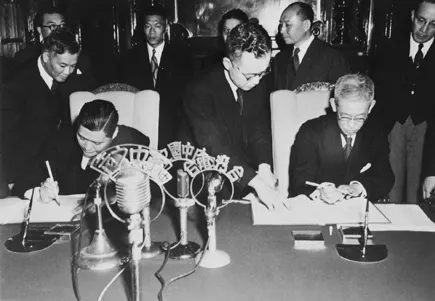
The Peace Conference was held in San Francisco in September 1951, in the midst of the Korean War. Not only did the two governments of China and North and South Korea not attend, neither did India nor any other Asian country. Furthermore, the USSR and Eastern Europeans (Czechoslovakia and Poland) did attend but did not sign the treaty. Under Article 2 of the treaty, Japan renounced claims on Formosa (Taiwan), the Pescadores (Penghu) Islands, Spratly (Nansha) Islands, and Paracel (Xisha) Islands. Regarding the reparations issue, Japan’s obligations were discharged with Article 14(b), but several exception provisions were prepared. China reserved the right to seek reparations in Articles 10 and 14(a2). Forty-nine countries including Japan signed the treaty, and once it entered into force on April 28, 1952, Japan recovered its sovereignty and regained its independence.
B...