eBook - ePub
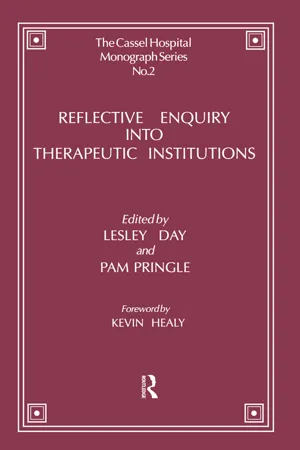
Reflective Enquiry into Therapeutic Institutions
- 128 pages
- English
- ePUB (mobile friendly)
- Available on iOS & Android
eBook - ePub
Reflective Enquiry into Therapeutic Institutions
About this book
Therapeutic practice needs constant examination to ensure that it remains responsive and dynamic. Living organisms must communicate with their environment if they are to survive, and institutions are no different. This monograph, the second of the Cassell Hospital series, explores this concept further. By reading it, ideas and thinking will be sparked off that will help other organisations promote their own culture of enquiry.- Kevin Healy, Director of the Cassel Hospital, from his Foreword. The contemporary Cassel Hospital was developed by Tom Main to create a self-exploratory institution. Main argued that, in order for the hospital to be therapeutic, it needs a "culture of enquiry". The individual and the institution might be seduced into ritualised working practices that no longer serve the needs of patients or staff. It is these "lapses from the continual enquiry" that are considered by this collection. It describes the mostly unconscious manoeuvres that inhibit reflection, and how the inappropriate use of psychoanalytic ideas can close off enquiry within a therapeutic community.
Information
Chapter One
Knowledge, learning, and freedom from thought
This chapter discusses the acquisition of knowledge by one generation from another, and the problems inherent in the process. The difficulties are seen as falling into three areas: (i) the difficulty of understanding the knowledge itself; (ii) the difficulty that a fact or a theory becomes an internal object subject to all the vicissitudes of object relations; and (Hi) the difficulty of finding a training method that will enable the learner to assimilate knowledge and use it judiciously rather than to swallow it an uncomprehending way. Examples are drawn from the history of ideas in generaland from the author’s experience of therapeutic communities, particularly the Cassel Hospital. The danger of allowing a body of knowledge to become, in its passage from one person to another, a mere set of never-to-be-questioned beliefs is illustrated. The common frailties of both trainers and trainees are discussed and methods suggested for understanding and overcoming them.
The developments of knowledge, concepts, theories, and techniques represents man’s attempts at mental mastery of his environment by ego processes. Ego mastery gives a certain kind of pleasure which comes, in part, from the replacement of feelings of helplessness in the face of a mysterious reality by feelings of power over it and competence at dealing with it; in part, also from narcissistic admiration at the achievements of the ego, through the successful exercise of its skills and strengths. The new knowledge itself is valued not only because it gives the ego a tool for dealing with immediate reality, but also because it gives hope—promise of future usefulness as an aid for mastering later situations.
But new knowledge, concepts, facts, and skills can also give pain, for they sometimes demand the abandoning or modification of old beliefs and practices that have been long cherished as familiar possessions, and now the enforced loss of favourite ideas and techniques will give rise to the protest, rage, and despair of mourning processes and to sad or resentful, nostalgic wishes for the good old days and the good old ideas.
It is well known in the history of science that the more it upsets an old-established order the more hotly new knowledge is resisted, but however true this may be as a generalization, we know that individuals vary much in their receptiveness to new ideas and in their loyalty to old ones. This is certainly a matter of individual character (which we can examine later), but the characteristic often varies with age. Notoriously, the young are eager to welcome the latest, one may say the youngest, ideas, partly because they are identified with them, whereas the old, who have much more to lose, are in general more loyal to old ideas. Moreover, whole cultures can vary in receptiveness and loyalty to ideas. Western society in the Middle Ages was characterized by stable adherence to the established order of things, by worship and dutiful repetition of what was known, by anger at dissidence, by punishment of heretics, and by the regular proscription of scepticism, free thought, and new knowledge. By contrast, in the last half-century, new knowledge rather than old has been eagerly valued. In a number of young revolutionary countries (such as the United States), ideas and techniques, if old, have been in general little worshipped, merely taken for granted; but, if new, have been delighted in, rapidly circulated, and eagerly used in the further mastery of the material world. For many people in such cultures, if a finding is modem it is also, apart from its usefulness, somehow a triumph, a victory not only over ignorance and helplessness but over the older order, as if this were mere ancestral dominance.
The reception of new knowledge thus often involves loving or aggressive impulses, feelings as well as the intellect. The complications so created seem to influence the uses to which knowledge is put, the fashions in knowledge, and all learning processes; however, before inquiring into them we must note the existence of mental energy that is neither loving nor aggressive, but, by fusion of these two extremes, is neutralized. An idea charged with neutralized mental energy will give no offence to, nor triumph over, existing understandings and will be greeted by sincere, sober thoughtfulness simply because it solves existing areas of shared puzzlement and offers the general pleasure of increased ego-mastery. We remember, however, that under states of frustration neutralized energy may defuse and revert to its original aggressive and loving components, or, in clinical terms, that sober assessment of fact tends under frustration to deteriorate into passions of love and hatred, that viewpoints and objectivity are then liable to be at their mercy, that new knowledge may become the stuff of politics and factions, and that the truths of an age may merely be its crushing majority vote.
Ideas indeed are psychological objects and are responded to—as are all psychological objects—by the whole mind. Perception is never a mentally isolated act, and it seems pointless to conduct experiments as if it were; for whatever else may happen to the perceived object, its mental fate will be much decided by the feelings it will always arouse—curiosity, distaste, guilt, liking, etc. A new idea may be recognized by the intellect as unmistakably to be reckoned with, but thereafter it is liable to suffer the same fate as any other—and to be used for emotional purposes.
This is the occasion not for a dissertation on object relations but for a mere reminder of how they concern the transmuting of body modes of primary experience into mental modes of experience. Any object may be scotomized—or have a blind eye turned to it—because of the subject’s preoccupation with other matters; or, because its existence is frightening, it can be mentally denied, so to speak, with tight-shut eyes. If the object is forcibly fed into the mind, it may be internalized in a particular oral way, mentally swallowed whole, thereafter to lie as an unassimilated foreign body, disturbing and preoccupying the mind, later perhaps to be mentally vomited, evacuated, or digested with more or less pain. The starved learner in particular may swallow an idea with eager undiscriminating delight and thereafter be preoccupied with it, in windy indigestion, to the exclusion of all other interest. Mental food may be used to create idle mental fat, or great energy and activity, or to whet the appetite for more. Pre-digested mental goods given in steady, dosed amounts may create a contented, well-fed, and placid taker, whereas the appetitive learner, who will not wait idly, but who quests for knowledge, seeks variety, and uses initiative and originality in the getting, seems to be created by more adventurous diets. New knowledge may be chewed over appreciatively or suspiciously for its nourishing or dangerous implications, or it may, with nihilism and contempt, have its usefulness destroyed, denigrated, or belittled, so that it quickly becomes a load of faeces—to use a neutral Latin word.
But there are more than intestinal modes of relating to objects. An idea may become a useful servant or a dominating master to be served devotedly and humbly for ever, a neglected orphan to be protected from others’ criticism, an ideal to fight and die for, a tyrant to be placated with insincere lip-service or to be fought all one’s life. It may be a friend, an ally against enemies, or a persecutor to be hated, a precise tool to be used along with others, proudly and skilfully, or it may become a ball-and-chain to be dragged into all situations. The possibilities are endless—because the possibilities of man’s relations to his psychological objects, with various degrees and conformations of love and hatred, and various patterns of body-ego modes, are themselves endless. But they are also inevitable—and this is why the whole gamut of the feeling of which man is capable, from curiosity to loathing, from evangelism to competitiveness, always greets or becomes attached to ideas, areas of knowledge, theories, practices, and new facts. The conflict-free areas of the ego and their supplies of neutral energies are none too numerous, and although in any encounter with new ideas we can rely on some use of the reality-testing and synthetic functions of the ego, we can always reckon also on the ego as a whole remaining under its usual duress: from the unceasing operation of unconscious primitive moralities and the search for primitive satisfactions. We can expect the ego always to be in danger of seduction by the pleasure principle, away from the reality principle, and we can be sure that knowledge will always be in danger of being put to perverse use, in the services now of the id and now of the superego.
The fate of knowledge inside the mental apparatus is thus not at all ensured by its truthfulness or its usefulness in reality. An assiduous teaching of theories and facts, an honest sharing of discoveries, and a liberal training in skills give no guarantee that any will be learned and used appropriately. Even when they are well learned, there can be no certainty that the student will understand them in the manner intended by the trainer, still less that he or she will use them in the service of further thought. We can never be sure whether knowledge will form the basis of later initiative in thinking, learning, and the growth of techniques, or whether thorough training, far from equipping the individual for independent work, will only increase dependence on the trainer and his or her appetite for further passive experience, and thus inhibit his or her own thinking. Teaching can thus lead to an enrichment by knowledge or a crippling of the thinking capacity, and the phrase “well taught” can have sinister as well as satisfactory overtones. The trainer’s hell is, of course, always paved with good intentions!
Difficulties in the learning process seem to lie in three areas. The difficulty of understanding the knowledge itself (because it may require considerable intellectual effort by the ego) is the first and the one most recognized by almost everybody. The difficulty that a fact or a theory becomes an internal object, subject to all the vicissitudes of object relations and of defused energies, is the second and is rarely studied by anybody except psychoanalysts. The third difficulty is that of training methods, which are well studied only by educationists. Hæ communications we offer to our patients, to our colleagues in our writings and lectures, to our juniors in their training, and to our staffs in institutions may all fail to have the effects we intended because of one or other of these three types of difficulties. I now confine myself to some aspects of the third difficulty, that of the training method, which of course includes the trainer-trainee relationship, and I will discuss in some detail a single socio-clinical example.
The promotion of an idea
At the Cassel Hospital, groups of nurses, doctors, and neurotic patients met over a long period to examine the existing roles of patients and staff, and their relevance for therapy. It soon emerged that many hospital roles and their emergent procedures had little relevance to, and some seemed actually to be at variance with, our declared aims: of freeing the ego from unconscious enslavement and promoting mental integration.
These discussions were strainful but enjoyable. Our findings were many and led us to new minor theories upon which we decided to base various experiments with hospital techniques and procedures. Like all theories, ours were tentative, and as we could not be certain of the outcome of our experiments we were prepared to abandon or alter any new procedures that did not work well. For my present purpose, I will select one simple emergent procedure: patients should be enabled to go home for the weekend if they so wish. This stemmed from our clinical findings that some patients became acculturated for hospital life only, unfitted for any other. It had become clear that by arranging severance of patients’ important relationships with home and work we had been blindly colluding with, rather than tolerantly examining, our patients’ wishes for social regression. Making hospital life an all-or-none matter had prevented us and them from learning anything about the anxieties or resentments that underlay their acceptance of the abnormal way of life of seven-days-a-week hospitalization. We were aware that such a regression was important for some and perhaps should be catered for, but we had to recognize that our hospital system was unthinkingly imposing, upon all, automatic childlike roles of obedient passivity or rebellious invalidism at the expense of initiative and responsibleness. Now we sought to create conditions where patients could use the hospital for as many or as few nights a week as they wished, and staff could become students of this behaviour rather than controllers of it.
We therefore made it easy for patients to go home for the weekend (as well as on other days). They simply decided for themselves, made their own arrangements, and asked no permission of anybody, but as in any household told the patient’s catering committee what meals they would be away for and when they drought they would be back. Those who did not wish to go home were free to stay in hospital.
I do not wish to discuss whether all this was wise or unwise, but only to emphasize that it was a new idea for us. It required all of us to give up our older safe procedures, but we did so (with more or less resistance) because it promised in its own small way to make more sense of our work, in that it would allow behaviour to be based more on ego choices of patients and less on staff-based disciplines.
For some years thereafter, all went smoothly and unremark-ably. We were able to recognize more the problems of those who in hospital hid from life. We continued to cater for massive regression, but we no longer imposed invalidism on all. Many patients never lost adult contact with their homes and work places; dehabilitation was avoided, and rehabilitation was less of a problem on discharge.
We were satisfied with our small experiment, and when new staff joined us they too joined in the thinking and helped to make the idea work. In turn, as the years passed, they showed later generations of staff how things were and would speak happily, even proudly, about the theory and the practice.
Several years later, most of the patients were still going home at weekends, but now it had become the thing to do, and a kind of moralism had crept into the procedures. Patients who were too distressed to go home had somehow become cultural oddities, and the climate around them was vaguely disapproving. Fewer nurses were needed at weekends now, and weekend duty for nurses had become a nuisance. There were subtle but recognizable pressures on all patients to go home at weekends. Something was not quite right.
The officialese of the hospital was still about patients being free to choose about their weekends, but these words were now mere relics of an idea and no longer representative of a living truth. What had originally been a useful idea and a break from thoughtless discipline was itself becoming a new kind of thoughtless discipline.
My awareness of all this is the result only of hindsight, for I woke up to the situation late, and only after hearing a careless remark of a fairly new nurse. In casual conversation, she talked of a difficult patient whom she had tried to persuade to go home. When asked about this, she said confidently that it would be good for the patient and later that it was good for all patients to go home. It became clear that her patients were quite free to choose only what she wanted. This nurse’s pronouncement was not typical of all our nurses, but, for her at least, a blanket prejudgment was being used where a readiness to think out the uniqueness of each case had been aimed at. A fixed procedure had emerged out of a flexible technique, and an idea had become a morality. What had begun as a free ego-choice had grown into a fixed discipline. It was no longer that a particular choice could be relevant, characteristic, singular, useful, or interesting; it had become either good or bad, a matter for conformance and not thought, an affair of the nurse’s superego and not her ego.
This one example shows how an idea, passed from one person to another by teaching, can change its mental residence, moving from the experimental and thinking areas of the ego of one generation into the fixed-morality areas, the ego-ideal and the superego, of the next. I will call this the hierarchical promotion of ideas between the generations, and I must interrupt my clinical example to draw attention to its social importance and frequency.
Hierarchical promotion is a fate that threatens all knowledge. From their early regard as interesting mental tools to be taken up or discarded skilfully according to their usefulness for the task in hand, ideas are liable to become, in their passage from one person to another, mere beliefs, sets of never-to-be-questioned, always tobe-believed rules, which now handicap further thought.
The movement between the generations from the pleasure or neutral areas of the ego into the fixed-control areas is insidious and difficult to detect. It is tempting to leaders to be pleased with their acolytes for believing their ideas, and it is not a simple matter to suspect one’s most ardent followers of having little capacity for thought or understanding. It is not at all easy to distinguish those who possess an idea from those who are possessed by it, to distinguish thought from belief, and yet, recognizably often, good disciples are merely compulsive practitioners of knowledge as a morality rather than thinkers and users of it.
The danger of becoming culture-bound, of being enmeshed unthinkingly in moral beliefs and beloved practices that were once reality-oriented ideas and techniques, is of course feared and fought in those organizations where efficiency over a task can be measured. In industries where profits measure social efficiency, industrial consultants are regularly called in to avert this danger, and some of their functions are similar to those of the psychotherapist. They set out to study the ways archaic modes of operating persist beyond their usefulness and not only bind up large amounts of energy in non-productive activities, but lead to blind rules of practice which hamper free thinking and creativity. I do not need to emphasize the storms of difficulty that arise in some instances when workers or management are asked to give up their old beloved ways in favour of new ones.
This difficulty, of transmitting knowledge from one generation to another as a set of tools for skilled use and skilled amendment rather than as sets of restricting disciplines, is not therefore peculiar to the refreshment of psychiatry. The clinging to the forms rather than to the purposes is a regular well-known human activity in all areas of knowledge. It accounts for the slow accretions of currently meaningless traditions and for the increase in decadent (i.e. non-functional) activities, which eventually overtake all societies and even whole civilizations. The danger for organized societies is that the knowledge and skill that go towards their creation may through the generations cease to be used for ego-mastery and instead be used for ego-restrictions through the practice or worshipped beliefs and procedures that were once ideas and techniques. In contrast to Freud’s therapeutic hopes that where id was ego shall be, the danger of the process for all knowledge and for all training is that where ego was superego shall be.
But what influences hierarchical promotion between the generations? How does it happen? I return to my example in the hope that it can help. I shall, of course, ignore the contributions of medical staff to the events in question and concentrate on the nursing staff’s difficulties. This is in the usual psychiatric hospital tradition, is easier, and hurts doctors less.
All the new nurses were postgraduates, from general or psychiatri...
Table of contents
- Cover
- Half Title
- Title
- Copyright
- CONTENTS
- CONTRIBUTORS
- FOREWORD
- INTRODUCTION
- CHAPTER ONE Knowledge, learning, and freedom from thought
- CHAPTER TWO Enquiring into a culture of enquiry
- CHAPTER THREE Internal and external reality: enquiring into their interplay in an inpatient setting
- CHAPTER FOUR Reflective space and group processes
- CHAPTER FIVE Reflections on a supervisory relationship
- REFERENCES
- INDEX
Trusted by 375,005 students
Access to over 1.5 million titles for a fair monthly price.
Study more efficiently using our study tools.
Frequently asked questions
Yes, you can cancel anytime from the Subscription tab in your account settings on the Perlego website. Your subscription will stay active until the end of your current billing period. Learn how to cancel your subscription
No, books cannot be downloaded as external files, such as PDFs, for use outside of Perlego. However, you can download books within the Perlego app for offline reading on mobile or tablet. Learn how to download books offline
Perlego offers two plans: Essential and Complete
- Essential is ideal for learners and professionals who enjoy exploring a wide range of subjects. Access the Essential Library with 800,000+ trusted titles and best-sellers across business, personal growth, and the humanities. Includes unlimited reading time and Standard Read Aloud voice.
- Complete: Perfect for advanced learners and researchers needing full, unrestricted access. Unlock 1.5M+ books across hundreds of subjects, including academic and specialized titles. The Complete Plan also includes advanced features like Premium Read Aloud and Research Assistant.
We are an online textbook subscription service, where you can get access to an entire online library for less than the price of a single book per month. With over 1.5 million books across 990+ topics, we’ve got you covered! Learn about our mission
Look out for the read-aloud symbol on your next book to see if you can listen to it. The read-aloud tool reads text aloud for you, highlighting the text as it is being read. You can pause it, speed it up and slow it down. Learn more about Read Aloud
Yes! You can use the Perlego app on both iOS and Android devices to read anytime, anywhere — even offline. Perfect for commutes or when you’re on the go.
Please note we cannot support devices running on iOS 13 and Android 7 or earlier. Learn more about using the app
Please note we cannot support devices running on iOS 13 and Android 7 or earlier. Learn more about using the app
Yes, you can access Reflective Enquiry into Therapeutic Institutions by Lesley Day, Pam Pringle, Lesley Day,Pam Pringle in PDF and/or ePUB format, as well as other popular books in Psychology & Education in Psychology. We have over 1.5 million books available in our catalogue for you to explore.