- 224 pages
- English
- ePUB (mobile friendly)
- Available on iOS & Android
eBook - ePub
About this book
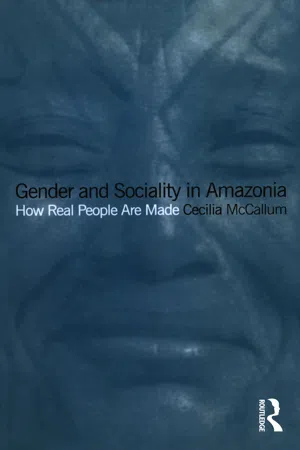
This is the first book to focus directly on gender in Amazonia for nearly thirty years. Research on gender and sexual identity has become central to social science during that time, but studies have concentrated on other places and people, leaving the gendered experiences of indigenous Amazonians relatively unexplored. McCallum explores little-known aspects of the day-to-day lives of Amazonian peoples in Brazil and Peru. Taking a closer look at the lives of the Cashinahua people, the book provides fascinating insights into conception, pregnancy and birth; naming rituals and initiation ceremonies; concepts of space and time; community and leadership; exchange and production practices; and the philosophy of daily life itself. Through this prism it shows that in fact gender is not merely an aspect of Amazonian social life, but its central axis and driving force. Gender does not just affect personal identity, but has implications for the whole of community life and social organization. The author illustrates how gender is continually created and maintained, and how social forms emerge from the practices of gendered persons in interaction. Throughout their lives, people are 'being made' in this part of the Amazon, and the whole of social organization is predicated on this conception. The author reveals the complex inter-relationships that link gender distinctions with the body, systems of exchange and politics. In so doing, she develops a specific theoretical model of gender and sociality that reshapes our understanding of Amazonian social processes. Building on the key works from past decades, this book challenges and extends current understandings of gender, society and the indigenous people of Amazonia.
Information
1
Kinship and the Child
DOI: 10.4324/9781003085454-2
Making kin, through procreation, childbirth and childcare, is for the Cashinahua the archetypal process whereby real people are made. As babies are conceived and raised by their parents and other kin, the multiple acts that give them form, substance, strength and knowledge progressively imbue them with personhood and gender. This chapter and the next describe these processes and the structure within which they take place.
Procreation and Pregnancy
The Cashinahua term for making a child is ba va, ‘to make be created or be born’. Ba on its own may be translated as either ‘to be born’ or ‘to be cooked’ and this range of meaning is not coincidental, as will become clear in this chapter and the next. Men and women make babies together, by means of the repetitive interaction of the male organ of procreation (the penis) and the female organ (the womb). Thus, if a person is describing a relationship to a half-sibling, s/he might say ‘hina betsa, xankin habias’ (another penis, same uterus). For a long time I was puzzled about Cashinahua opinion on the formation and growth of a foetus. Some people told me it was made of blood and others said that God made it, but all concurred on two points, namely that babies are formed through repeated intercourse, and that any man that makes love to the mother whilst she is carrying a child will also be the father of that child. The Yaminahua say that babies are made out of blood and that semen is male blood (Townsley 1988). The Cashinahua also consider semen and blood to be similar, a view that dates back at least to the early twentieth century, as the following section of a myth recorded by Abreu bears witness: ‘When the new moon came out two days later, all the women bled. When they had stopped, they became pregnant. The blood coagulated and when the child was born, its body was dark, they say. When the semen coagulated, the child was born white’ (Abreu 1941:5402).
Blood (himi) is associated with physical energy and strength, qualities that diminish as a person expends this vital fluid in work, sex, or illness. Blood can be a dangerous substance and should never be eaten. If food is undercooked people exclaim ‘Himiki!’ - ‘It’s bloody!’, and refuse it. A man cannot make love to his menstruating wife lest he lose his luck in hunting, nor may any man see a woman other than his wife give birth, for the same reason. A pregnant woman should not see copious quantities of blood, in case she begin to bleed herself. The smell of body fluids is disgusting and in the wrong circumstances dangerous. Parents scold their young children for masturbating, since both semen and vaginal fluids are offensive. ‘Itsaki!’ (it stinks), they will say. Thus, men and women should wash well after making love. Traditionally, women made a special ceramic bowl for this purpose.
This does not diminish the Cashinahua appetite for making babies. Isaias told me:
One has to work a lot, otherwise it takes a long time [for the foetus] to grow. The man who will produce, who wants to make a baby, he drank a lot of caissuma. He can only do it after the woman menstruates, before that it’s no use. Yes, there is a mixture of blood and semen. One has to take care, one cannot spoil the ‘milk’ (i.e. semen).1
This description brings out several aspects of Cashinahua conception theory that struck me time and again. Firstly, the act of making a baby involves repetitive work. Frequent intercourse makes the vital fluids clot and grow fast. Sex is itself work, making the body hot and sweaty, draining it of energy, and ultimately transforming seemingly inert matter into life itself. Both men and women do this work; there was never any suggestion that female participation in either the sexual act or in procreation is passive, whilst male participation is active. Indeed the standard word for making love is chutaname. Chuta- means to fornicate, and -name is the reciprocal participle. The idea is conveyed that men and women make love to each other reciprocally. This emphasis on mutuality is also found in beliefs about the way that sex can deplete or strengthen a person. I was told that a woman can grow fat and sleek from sex, while a man who has too much sex grows thin and weak. Later on the woman will get worn out from sex and the man will grow strong. There is an ‘exchange’, a troca(P).
Menstruation is desirable because it means that afterwards the woman may become pregnant. The blood is a sign of her fertility. People told me ‘She is menstruating as a preparation for becoming pregnant’-Himi ikiki, bake bikatsi. (Bake signifies ‘a child’, bi- means ‘to get’, and here the particle -katsi can be glossed as either ‘in preparation for’ or as ‘desiring’.) Women who never bleed are infertile. It is said that their wombs are dry, and that sex is painful for them. In a similar vein, women who never have sex suffer from hard, dry wombs, so that lovemaking is a kind of ‘servicing’ for women. Although men may abstain from sex for long periods, women should not do without except when they are recovering from birth or menstruating. Such abstinence is unhealthy. But sex during the woman’s menstruation would cause too much bleeding, so abstinence at this time is mutually beneficial. Sex not only stimulates the production of semen, it also stimulates the production of blood. Men are thought to open women up with their penises and in the past husbands stimulated first menses in their prepubescent wives. On the other hand, of course, sex also prevents menstruation, and as the blood and semen clot, forming a foetus, continued sex makes the little ball (tunku) grow whilst shaping it into human form. In short, sex not only stimulates the production of life-filled substance, it also shapes that substance.
While sex causes the growth and shaping of the foetus, Diusun (God) gives life (after Deus (P.) or Dios (Sp.)). Imbuing life and giving form are closely connected. The process of forming the foetus is called dami va-, which means ‘to transform’, for example in myths where people are ‘transformed’ into animals and vice versa, or when men take hallucinogens and their visions are ‘transformed’ one into the other (Kensinger 1973, 1995). The verb dami- means ‘to transform oneself, for example a caterpillar metamorphosing into a butterfly. The substantive dami denotes a drawing or a doll. Consequently, dami va- could be taken to mean ‘to make an image or representation’, an interpretation that substantiates the idea that the transforming work of sex includes shaping the substances that are produced by male and female bodies in interaction. The origin of life itself is other-worldly. But blood and semen are not conceptually opposed to Diusun ‘s participation in the process of conception. As amongst the Bororo (Crocker 1985), other-worldly power is an aspect of the vital substances at play, and not an addition to them.
The fluid and permeable separation between living persons and supernatural entities means that sex with spirits in corporeal form may also result in conception, though these babies are malformed or born as twins (yuxin bake, ‘spirit children’). Deformations can also be produced by eating the wrong kinds of food and by not eating enough of the right kinds of food. Food, like sex, both makes and unmakes bodies. As the informant quoted above explained, a man should drink plenty of caissuma, the thick, pale drink made by women from corn, or corn and peanuts, that ideally accornpanies every meal. Sweet manioc may also be transformed into a foetus, but the child will be weaker than children formed out of a diet including plenty of caissuma (Lagrou 1998). So it is clear that the substances that are taken in orally by both parents are ultimately transformed into the foetus, apparently affecting the quality of the vital fluids that will be so transformed. (Hence the warning to take care lest the ‘milk’ be spoilt.) Yet more is at stake than ‘quality’. Both corn and peanuts are yuxin (spirits) and long to be transformed (dami-) into human form (Lagrou 1998). The actions of men and women in planting, weeding, harvesting, cooking and consuming these spirit crops make possible the realization of this desire. Matter, including substances such as semen, corn seeds, cooked foods, or human flesh and bones, is inherently transformable. A description of these processes of transformation throws into stark relief the profound integration between the supernatural and material aspects of these substances.
Mutuality between men and women extends to the processes that eventually result in the production of male or female vital fluids. Corn is harvested and caissuma is made by women; so men’s semen is best produced by female food, as is also the case amongst the Mehinaku (Gregor 1985). Conversely, women’s menstrual blood is produced by male agency and by ‘male food’ (the semen of their partners).
In the early twentieth century the Cashinahua practised extensive dietary restrictions during pregnancy and after childbirth (Abreu 1941). Years of outsiders’ criticisms of such restrictions have resulted in a lack of willingness to talk about them, but do not seem to have affected the resilience of associated beliefs. My friends were sometimes willing to tell me about dietary restrictions, however, and I, like other ethnographers, can confirm that they are practised, even if in modified form. It is held that the qualities of certain animals might pass on to the unborn children, whose bodies corne to resemble the creatures consumed by their parents (Abreu 1941; Kensinger 1981, 1995; Deshayes and Keifenheim 1982). The restrictions and potential dangers to the child extend into the period of couvade, as elsewhere in Amazonia (Rivière 1974). Crocker emphasizes, in the Bororo case, that the dietary and other postpartum restrictions ‘stress, over and over, the direct, mechanical, metonymic danger of these substances and actions for the infant’s own delicate raka (blood) (1985:67). Rivière argued that dietary prohibitions did not refer to bonds of physical substance between the parent and child, but rather impinged on bonds of a spiritual nature. In the Cashinahua case, such an antinomy between spirit and matter would not apply. A young child is vulnerable to spirit attack from certain animals that its father or another close relative bas killed or its mother has eaten. Whilst in the mother’s womb such spirit attack deforms the baby, who comes to resemble the animal consumed, rather than its human parent. After birth it will make it fall ill.
Few writers on such matters have stressed the importance of safe foods like caissuma, preferring to concentrate on the dangers of restricted game and fish. As a result the value of roots, grains and nuts, often dismissed as ‘non-prestige’ or ‘mere staples’, has been understated. Every diet that the Cashinahua undertake, whether for hunting, first menstruation, illness, or couvade, is based on the same ingredients: boiled sweet manioc, banana, corn and peanuts, all foods associated with female gender.
In sum, it is believed that a child is made of both semen and female menstrual blood, substances imbued with vital force that are moulded by the work of sex in a process described as ‘transformation’ or the creation of shape. The shape of the child is determined by the nature of the blood that goes into its manufacture, and this in turn is determined by the actions of the parents and the kinds of food that they consume before and after birth. Corn Spirit’s desire to become human is harnessed to the procreative process. The process is indeed a mechanical one, since substance is made from substance. Yet there is more to it than this, in the sense that supernatural beings are thought to play a part in the production of life itself.
Birth and Growth
Women give birth inside their own houses, in the privacy of their mosquito-nets, with the help of at least one other woman, usually the mother or any close female friend. The woman’s husband plays a crucial role. He stands behind her, supporting her under the arms, as she squats (supported by a hammock) or stands whilst delivering the child. This form of delivery emphasizes the dual male-female nature of parenthood. No man other than the father may see the genitals of the mother, or the blood. If he did, she would be ashamed (dake-) and the man would be made yupa, unlucky in the hunt. After delivery, the cord is cut, the placenta is disposed of on the outskirts of the village and water is heated for washing the baby and the mother. They lie together in the hammock for several days after birth, hidden from public view. Then visitors are permitted to see the child and the mother begins to move around the house. She may not bathe for several weeks, as this would bring illness to her and the child.
In the early twentieth century women gave birth outside the maloca, in a walled shelter built on the patio. Once they were cleaned up, they would be taken into the maloca to rest for five days. After this:
… the woman gets out of her hammock. She paints herself with genipapo, so as not to have fever, and so does her husband, and the child is painted too, so as not to have fever. The mother does not stray very far. Once the child is darkened [with genipapo] they always become happy. Once the child is born, the woman does not sleep with her husband any more. Only when the child stands and w...
Table of contents
- Cover
- Half Title
- Title Page
- Copyright Page
- Contents
- Acknowledgements
- List of Figures and Tables
- A Note on Orthography
- Introduction
- 1 Kinship And The Child
- 2 Creating Gender
- 3 Producing Sociality
- 4 Consumptive Production
- 5 Making Community
- 6 Ritual and Regeneration
- 7 Gender and Sociality
- References
- Glossary
- Index
Trusted by 375,005 students
Access to over 1.5 million titles for a fair monthly price.
Study more efficiently using our study tools.
Frequently asked questions
Yes, you can cancel anytime from the Subscription tab in your account settings on the Perlego website. Your subscription will stay active until the end of your current billing period. Learn how to cancel your subscription
No, books cannot be downloaded as external files, such as PDFs, for use outside of Perlego. However, you can download books within the Perlego app for offline reading on mobile or tablet. Learn how to download books offline
Perlego offers two plans: Essential and Complete
- Essential is ideal for learners and professionals who enjoy exploring a wide range of subjects. Access the Essential Library with 800,000+ trusted titles and best-sellers across business, personal growth, and the humanities. Includes unlimited reading time and Standard Read Aloud voice.
- Complete: Perfect for advanced learners and researchers needing full, unrestricted access. Unlock 1.5M+ books across hundreds of subjects, including academic and specialized titles. The Complete Plan also includes advanced features like Premium Read Aloud and Research Assistant.
We are an online textbook subscription service, where you can get access to an entire online library for less than the price of a single book per month. With over 1.5 million books across 990+ topics, we’ve got you covered! Learn about our mission
Look out for the read-aloud symbol on your next book to see if you can listen to it. The read-aloud tool reads text aloud for you, highlighting the text as it is being read. You can pause it, speed it up and slow it down. Learn more about Read Aloud
Yes! You can use the Perlego app on both iOS and Android devices to read anytime, anywhere — even offline. Perfect for commutes or when you’re on the go.
Please note we cannot support devices running on iOS 13 and Android 7 or earlier. Learn more about using the app
Please note we cannot support devices running on iOS 13 and Android 7 or earlier. Learn more about using the app
Yes, you can access Gender and Sociality in Amazonia by Cecilia McCallum in PDF and/or ePUB format, as well as other popular books in Social Sciences & Women in Business. We have over 1.5 million books available in our catalogue for you to explore.