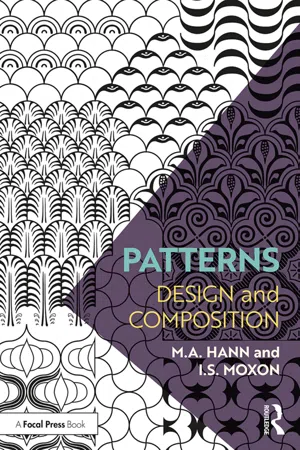
In Patterns: Design and Composition, M. A. Hann and I. S. Moxon present guidelines for the original design and composition of regular patterns alongside an understanding of the inherent structures of these patterns. Starting with the compositional elements, Hann and Moxon take the reader through patterns in the environment, early forms of patterns and aspects of classification based on circles, squares, triangles and symmetry. With 250 images sourced from past examples as well as student work, this essential read for design students and researchers demonstrates how simplicity begets complexity in the design and composition of regular patterns.
- 276 pages
- English
- ePUB (mobile friendly)
- Available on iOS & Android
eBook - ePub
About this book
Information
1
Introduction
Patterns act as reference points and help us to understand our environment. As human beings, we seek patterns continually, for patterns give order to our world, and it is through detecting these that understanding is possible. A pattern shows the repetition of actions, physical entities, feelings, measures or appearances. Thus, a pattern is deemed to have developed if repetition of an event (or other entity) is evident. To sighted individuals, obvious forms of pattern are visual, and understanding of these will be the principal focus of this book; but patterns may also be detected through other human senses: patterns of sound, texture, taste and temperature come to mind. Morse code is a pattern. Egyptian and Mayan hieroglyphs and Mesopotamian cuneiform are patterns. A sentence in any language is a pattern, and using and understanding that language depend on recognising various patterns, including rules of grammar and vocabulary. Patterns of relevance to the physical world are often expressed as numerical relationships (such as woven textiles, for example, where a structure can be converted to a numerical grouping).
As stated above, the principal focus of this book is on visual patterns and their understanding. Visual patterns can be found in both the natural and manufactured environments. Manufactured patterns, whether from industrial or craft sources, will be the principal focus here. In this book, the word ‘pattern’ (or ‘patterns’) will be used in the widest sense to refer to the visually creative ‘…imaginings’ (Petrie, 1990: 3) of cultures historically and in modern times, and the phrase ‘regular patterns’ (or ‘regularly repeating patterns’) reserved to refer to a sub-category of two-dimensional designs which exhibit a strict repetition of a component (which retains its content, size, orientation and colour). At the same time, the fundamental compositional aspects of all visual arts will be considered, as it is believed that knowledge of these can inform the designer of regular patterns, particularly when making decisions relating to the format of individual repeating units.
Bosomworth (1995) provided an encyclopaedic collection of line drawings of motifs and regular patterns, making references to items sourced in Europe, Asia, Africa, North, Central and South America, and Australia as well as Oceania. Andersen and Salomon (2010) recognised the universal applicability of regular patterns in the early twenty-first century and presented an innovative consideration of regular patterns focused mainly on architectural uses. The all-embracing nature of regular patterns and their power as sources of inspiration were recognised by Murray and Winteringham (2015).
In this present book, the nature of many regular-pattern types is explored and several developments and achievements are reviewed. Fundamental geometrical components are identified and discussed, and systems of regular-pattern classification, derived from insights associated with crystallographers, are explained. It is proposed that various grid forms, derived from well-known brick- and window-lattice arrangements, be used to assist with regular-pattern construction. Overall, formal mathematical content is kept to a minimum. For readers wishing to explore the role of patterns in the transmission of mathematical knowledge, it is worth referring to Bier (2004), but the tendency to consider mathematical aspects of patterns directly will be avoided in this book.
Insights into the design and composition of regular patterns provided in relatively modern times (late twentieth and early twenty-first centuries) are recognised and, further to this, reference is made to work from an earlier period, as it is felt that observers such as Day (1999 [1903]), Fenn (1993 [1930]) and Christie (1969 [1910]), though long forgotten in the early twenty-first century, provided insights of value to the modern digital age.
In many of the treatises concerned with regular patterns published in the nineteenth and early twentieth centuries, the use of words such as ‘decoration’ or ‘ornament’ was common. By the late twentieth century, however, these terms had acquired derogatory undertones, confirmed by the use of phrases such as ‘it is only decoration’ or ‘it is only ornament’. Also, it was common to describe the visual arts of ‘other’ (mainly non-European) cultures and civilisations as ‘decoration’ or ‘ornament’, with a seeming lack of awareness of the possibility that the relevant ‘decoration’ may have had a deeper, more intellectually inspired intention. Because of the implications mentioned, the use of terms such as ‘ornament’ and ‘decoration’ will be avoided where possible and, as noted in the second paragraph to this Introduction, the term ‘regular pattern’ (or ‘regularly repeating pattern’) will be used where appropriate; in the wider context, the term ‘visual arts and design’ will be used inclusively to cover all areas previously grouped under titles such as ‘fine arts and architecture’, ‘applied’, ‘decorative’ or ‘ornamental’ arts, including ‘patterns’ which lack regular repetition.
Chapter 2 identifies and describes categories of regular patterns and motifs, as well as common themes and structures, and explains the importance of size and coverage. Important early twentieth-century publications which outline the nature of fundamentals are identified and discussed. A wide range of themes is identified, explained and discussed, and structural aspects of patterns are introduced.
Chapter 3 considers the fundamental elements associated with all visual arts and design (including regular-pattern design), invariably listed as: point, line, plane (including shapes), texture and colour. Attention is focused also on the nature of ‘regularity’ (a term used here to denote systematic repetition of one or more component parts), ‘modularity’ (a term used to refer to the ways in which the component parts of a design can be re-arranged to give a different visual effect), as well as ‘composition’ (a term used to refer to the relative positions of elements in a visual arrangement). The nature of ‘shape grammar’ is explained and the influence of traditional Japanese visual composition on developments in Europe and North America is recognised. The applicability of various Gestalt principles to the visual arts in general is debated and relevant principles outlined and illustrated.
Chapter 4 identifies and illustrates various early forms of regular patterns. The nature of spirals, scrolls, arabesques, meanders, and key, step, counter-change and checkerboard designs is explained.
Chapter 5 introduces common regular-pattern varieties, including spots and medallions, stripes, checks and diaper patterns. The importance of networks (or grids) as structural guidelines is explained also.
Chapter 6 is concerned with square, rectangular and related figures, used often as measuring devices of great importance to regular-pattern construction, both historically and in relatively modern times. It is also explained how squares form the basis of numerous further constructions (such as golden-ratio and root rectangles) deemed by many observers to be of value to the visual arts in general. This chapter introduces various brick arrangements (or bonds) and argues that these could be helpful as frameworks to assist pattern design and composition.
Chapter 7 is concerned with various polygonal grids, including those based on triangles of various kinds, pentagons and hexagons. The importance of each is explained in the context of regular-pattern construction, both as unit cells in compositional grids as well as in providing a geometric structure for some motifs (the fundamental building blocks of many patterns).
Chapter 8 considers circles, arcs, curves and related structures (including ogee and scale forms). The nature of circles and circular forms in the visual arts is discussed and attention is focused on their application to regular-pattern construction.
Chapter 9 is concerned with a substantial group of designs known as ‘tilings’, which exhibit geometric or symmetry characteristics like regular patterns. Often, regular tilings, when depicted visually, are shown in a ‘skeleton’ state as grids with unit cells of enclosed polygons which cover the plane without gap or overlap. Meanwhile, regular patterns invariably have a thematic content, and are depicted often (though not always) with a foreground and background. This chapter introduces the reader to various forms of grid-like arrangements known as lattices, and it is argued that such structures can be of value in regular-pattern design and composition.
Chapter 10 is concerned with symmetry, a feature which dominates the visual arts in general and can be used in the classification and analysis of regular patterns. Definitions are numerou...
Table of contents
- Cover
- Half Title
- Title Page
- Copyright Page
- Dedication
- Contents
- List of Figures
- Preface
- Acknowledgements
- 1 Introduction
- 2 Categories
- 3 Components
- 4 Early Forms
- 5 Varieties
- 6 Square, Rectangular and Related Grids
- 7 Other Polygonal Grids
- 8 Circles and Circular Designs
- 9 Tilings and Similar Arrangements
- 10 Symmetry
- 11 Compositional Grids
- 12 Conclusion
- Appendix: Sample Exercises and Assignments
- Index
Trusted by 375,005 students
Access to over 1.5 million titles for a fair monthly price.
Study more efficiently using our study tools.
Frequently asked questions
Yes, you can cancel anytime from the Subscription tab in your account settings on the Perlego website. Your subscription will stay active until the end of your current billing period. Learn how to cancel your subscription
No, books cannot be downloaded as external files, such as PDFs, for use outside of Perlego. However, you can download books within the Perlego app for offline reading on mobile or tablet. Learn how to download books offline
Perlego offers two plans: Essential and Complete
- Essential is ideal for learners and professionals who enjoy exploring a wide range of subjects. Access the Essential Library with 800,000+ trusted titles and best-sellers across business, personal growth, and the humanities. Includes unlimited reading time and Standard Read Aloud voice.
- Complete: Perfect for advanced learners and researchers needing full, unrestricted access. Unlock 1.5M+ books across hundreds of subjects, including academic and specialized titles. The Complete Plan also includes advanced features like Premium Read Aloud and Research Assistant.
We are an online textbook subscription service, where you can get access to an entire online library for less than the price of a single book per month. With over 1.5 million books across 990+ topics, we’ve got you covered! Learn about our mission
Look out for the read-aloud symbol on your next book to see if you can listen to it. The read-aloud tool reads text aloud for you, highlighting the text as it is being read. You can pause it, speed it up and slow it down. Learn more about Read Aloud
Yes! You can use the Perlego app on both iOS and Android devices to read anytime, anywhere — even offline. Perfect for commutes or when you’re on the go.
Please note we cannot support devices running on iOS 13 and Android 7 or earlier. Learn more about using the app
Please note we cannot support devices running on iOS 13 and Android 7 or earlier. Learn more about using the app
Yes, you can access Patterns by M.A Hann,I.S. Moxon in PDF and/or ePUB format, as well as other popular books in Design & Decorative Arts. We have over 1.5 million books available in our catalogue for you to explore.