- 204 pages
- English
- ePUB (mobile friendly)
- Available on iOS & Android
eBook - ePub
About this book
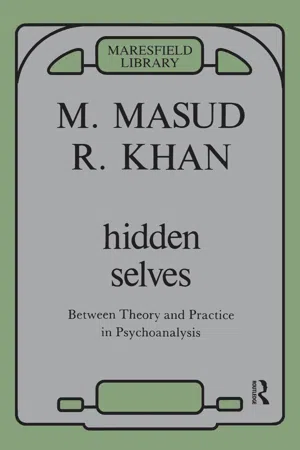
The 'hidden selves' that Masud Khan reveals to us in this third volume of his psychoanalytic writings are to be understood in two ways. Primarily, they are those aspects of the self which are inherent in, but unsuspected by, the individual concerned, and which need to be identified if that individual is to achieve a full and healthy self-awareness. More broadly, they are the ingredients of human nature which may not be evident on the surface but which can be brought out through literature or art, for example, or through the insights gained in psychoanalysis. In analysis, and over a period of time, both analyst and patient discover parts of their personality that were unknown to each other at the start. The person is not just a single 'self' but a collage of hidden selves; and one of the goals of psychoanalysis is to find out how this collage functions for the individual concerned - whether through symptomatology or through introspection.
Information
1
Freud and the Crises of Psychotherapeutic Responsibility
‘… self exiled in upon his ego …’
JOYCE, Finnegans Wake
In most evaluations of Freud’s work it is customary to trace his debt to the tradition and methods of medicine, psychiatry and neurology at the end of the nineteenth century. My argument here is that Freud arrived at a critical point in the evolution of Modernism in European cultures. Trilling (1955) has pertinently remarked:
The first thing that occurs to me to say about literature, as I consider it in the relation in which Freud stands to it, is that literature is dedicated to the conception of the self … In almost every developed society, literature is able to conceive of the self, and the selfhood of others, far more intensely than the general culture ever can.
Since Freud was to concern himself almost exclusively with the fate of self-experience in the individual, he was by the very nature and material of his researches, clinical as well as metapsychological, enmeshed in the tradition of Modernism in European cultures.
Modernism is a historical process that took more than three centuries to crystallize its identity towards the end of the nineteenth century.
T.S. Eliot, in his famous essay, ‘The Metaphysical Poets’ (1921), has argued: ‘In the seventeenth century a dissociation of sensibility set in, from which we have never recovered.’
Foucault (1970), the French historian-philosopher, concludes his book on the epistemology of ‘the subject’:
One thing in any case is certain: man is neither the oldest nor the most constant problem that has been posed for human knowledge. Taking a relatively short chronological sample within a restricted geographical area – European culture since the sixteenth century – one can be certain that man is a recent invention within it.
Trilling launches his book Sincerity and Authenticity (1972) with the assertion:
at a certain point in its history the moral life of Europe added to itself a new element, the state or quality of the self which we call sincerity. The word as we now use it refers primarily to a congruence between avowal and actual feeling.
I have quoted from the above authors to establish the fact that a radical change has taken place in the European man’s epistemology of self-experience. None can date its exact beginnings: sometime in the sixteenth century the process of Modernism starts. What factors lead to its inception are equally unclear: no two scholars agree on that score. The complexity, as well as the ambiguity, of the myriad forces culturally at work compel each of us to attempt his own abstraction of the crucial elements involved.
Since the beginning of the human cultures, so far as we know, man has always experienced, known and felt his own being through the other. This other was always non-human: a fetish (as in the primitive African cultures); an idol (Buddha is the supreme example); anthropomorphic supra-human presences (the gods of the Greeks abundantly testify to that) or God, that unique invention of the monotheistic religions (Judaism, Christianity and Islam). Sometime in the sixteenth century all this began to change (cf. Gay 1966).
The most revolutionary characteristic of Modernism is the European man’s decision to be his own sole witness and exclude God, more and more, from his private relation to himself and his personal relation with others. Nietzsche (1882), in his parable of The Madman, epitomized the end-product of this process:
Have you ever heard of the madman who on a bright morning lighted a lantern and ran to the market-place calling out unceasingly: ‘I seek God! I seek God!’ As there were many people standing about who did not believe in God, he caused a great deal of amusement. Why! is he lost? said one. Has he strayed away like a child? said another. Or does he keep himself hidden? Is he afraid of us? Has he taken a sea-voyage? Has he emigrated? – the people cried out laughingly, all in a hubbub. The insane man jumped into their midst and transfixed them with his glances. ‘Where is God gone?’ he called out. ‘I mean to tell you! We have killed him – you and I! We are all his murderers!’
Parallel with the European man’s rejection of God another process starts to gain momentum: his idolization of the machine. By the end of the nineteenth century machines were not only running the lives of men, but the machine itself had become the model in terms of which man was going to explain, understand and regulate his own nature and character. Two consequences of the omnipresence of technics in the affairs of men determine the character of Modernism. The first is the dissociation of words from spoken and shared discourse into printed matter (cf. McLuhan 1962). The second is the invention of the new photographic image. This in time disrupted the humanistic tradition of pictorial arts in Europe and, with the advent of cinematic technics, created an appetite for visual experiences that are as hallucinatory as they are asyntactic (cf. Ortega y Gasset 1948).
So far I have indicated the cultural processes that shape Modernism. Now I shall discuss three persons who have given Modernism its peculiar and specific bias as well as character: Montaigne, Descartes and Rousseau.
Michel de Montaigne (1533–92)
The Essays (1580–88) of Montaigne establish a revolutionary departure in European man’s attempt to study and know himself. Their uniqueness rests in the fact that Montaigne stakes his right to be his own exclusive witness, both in his privacy with himself and his relationship with others: ‘There is no sure witness except each man to himself.’ And what is even more important, Montaigne does not seek after either an absolute knowledge or an ideal experience of man. He concludes one of his last essays, ‘Of Vanity’, where he accounts his need to have written the essays and to witness his life:
If others examined themselves attentively, as I do, they would find themselves, as I do, full of inanity and nonsense. Get rid of it I cannot without getting rid of myself. We are all steeped in it, one as much as another; but those who are aware of it are a little better off – though I don’t know.
To have shifted the emphasis from wisdom to awareness lent an empirical direction to the epistemology of self-experience. Montaigne, in the same essay, sees through all the contrariness that wisdom entails for us:
Human wisdom has never yet come up to the duties that she prescribed for herself; and if she ever did come up to them, she would prescribe herself others beyond, to which she would aim and aspire, so hostile to consistency is our condition. Man ordains that he himself shall be necessarily at fault.
For Montaigne awareness is of the lived experience, the instrument of self-study is judgement, and the aim is good ordinary living. He does not idealize his vocation as a writer either:
Whatever I may be, I want to be elsewhere than on paper. My art and my industry have been employed in making myself good for something; my studies, in teaching me to do, not to write. I have put all my efforts into forming my life. That is my trade and my work. I am less a maker of books than of anything else.
And for Montaigne awareness is based on psychology and not morality, since the aim of awareness is to strive after happiness, that is, freedom from pain, but not through repression or denial of the seamy side of human nature. He states this explicitly in his ‘Apology for Raymond Sebond’:
I am glad not to be sick; but if I am, I want to know I am; and if they cauterize or incise me, I want to feel it. In truth, he who would eradicate the knowledge of evil would at the same time extirpate the knowledge of pleasure, and in fine would annihilate man.
I shall discuss later how Freud was to come to the same conclusion in psychotherapeutics.
I hope these quotations will have given some idea of Montaigne’s basic thinking. But there are a few circumstances of his life that need to be mentioned because they are inherent in the evolution of his thought.
Montaigne was reared by a loving father in an affluent feudal home in Bordeaux. The most fateful relationship of his life was with his friend Étienne de la Boétie, who was some three years older than him. They had probably met in 1559 when Montaigne had entered the Bordeaux parlement, and their friendship was as short-lived as it was intense and mutual. La Boétie died suddenly, very young, in 1563. It was this friendship that was to be the lasting presence in Montaigne’s life. I have discussed the role of this crucial friendship in the genesis of The Essays elsewhere (Khan 1970a). Frame (1965) is quite justified in his assertion, ‘there is much to show that The Essays themselves are – among other things – a compensation for the loss of La Boétie.’ Some eight years after the death of his friend, in 1571, Montaigne, ‘long weary of the servitude of the court and of public employments, while still entire, retired to the bosom of the learned Virgins’ in his ancestral home, Chateau de Montaigne. He was barely thirty-eight years of age.
These two facts of his experience deserve special attention, namely, the internalization of a lost human relationship that had been mutual and lived, as well as the establishment of a secular space in which to relate to and reflect upon himself. It would be mistaken to think of Montaigne as if he were a sage living in a retreat. His act had little mystical or spiritual motivation. To the end of his life, while he wrote his Essays, he kept up a full-blooded interest in life and others. Luther (1483–1546) and Calvin (1509–64) had already placed the European Christian man in direct private relationship with God, without the mediation of the church (cf. Bainton 1967). Montaigne took this a step further and made man his own witness, in privacy with himself and the other humans. In this respect Montaigne in his Essays offers us the first private and personal record of self-experience which has no other referents but the lived human life. Montaigne rendered the human condition the exclusive concern of human beings. As Erich Auerbach (1946) has pertinently remarked: ‘The obligatory basis of Montaigne’s method is the random life one happens to have.’ Montaigne, in his essay, ‘Of Repentance’, had stated his own method incisively:
Others form man; I describe him, and portray a particular one, very ill-formed, whom I should really make very different from what he is if I had to fashion him over again. But now it is done … I do not portray being: I portray passing. Not the passing from one age to another, or, as the people say, from seven years to seventy years, but from day to day, from minute to minute…. If my mind could gain a firm footing, I would not make essays, I would make decisions; but it is always in apprenticeship and on trial.
I set forth a humble and inglorious life; that does not matter. You can tie up all moral philosophy with a common and private life just as well as with a life of richer stuff. Each man bears the entire form of man’s estate (l’humaine condition).
Authors communicate with the people by some special extrinsic mark; I am the first to do so by my entire being, as Michel de Montaigne, not as grammarian or a poet or a jurist. If the world complains that I speak too much of myself, I complain that it does not even think of itself.
What Montaigne achieved for man’s conscious self-awareness, Freud, some three centuries later, was to reclaim from man’s unconscious. Montaigne not only epitomized in his person the European man of the Renaissance but he also prefigured the existentialist man of today, in all his natural flux, veracity and absurdity (cf. Krailsheimer 1971). Hence the acumen of Sainte-Beuve’s (1849) remark: ‘Il y a un Pascal dans chaque Chrétien, de même qu’il y a un Montaigne dans chaque homme purement naturel.’
The genius of Montaigne’s style in The Essays is its capacity to sustain an enigmatic undecidedness in the myriad contradictions of self-experience (cf. Olney 1972). Montaigne’s Que sais-je? is neither doubt nor scepticism; it is the process of self-perception. It is this process that The Essays witness and describe. Thus, in Auerbach’s phrase, Montaigne ‘writes the first work of lay introspection’. Montaigne himself had claimed for his Essays:
I dare not only to speak of myself, but to speak only of myself; I go astray when I write of anything else, and get away from my subject. I do not love myself so indiscriminately, nor am I so attached and wedded to myself, that I cannot distinguish and consider myself apart, as I do a neighbour or a tree. It is as great a fault not to see how far our worth extends, as to say more about it than we see. We owe more love to God than to ourselves and we know him less, and yet we speak our fill of him.
Voltaire, that gnomic high priest of the Enlightenment, in a letter from Paris to Comte de Tressan (21 August 1746), summed up the virtues of Montaigne:
He bases his thoughts on those of the celebrated figures of antiquity; he weighs them up; he wrestles with them. He converses with them, with his reader and with himself. Always original in the presentation of his objects, always full of imagination, always a painter and what appeals to me is that he was always capable of doubt.
René Descartes (1596–1650)
Some fifty years separate the publication of Montaigne’s Essays from Descartes’ Discourse on Method (1637). It is not my intention to discuss the Cartesian philosophy. I wish merely to indicate how, though sharing a certain tradition of scepticism and lay introspection with Montaigne, Descartes splintered that wholeness of the individual self-experience that was the high purpose of the Renaissance man (cf. Wade 1971). Discourse is written in an autobiographical style, like The Essays. In ‘Discourse 1’, Descartes tells us:
the only profit I appeared to have drawn from trying to become educated, was progressively to have discovered my ignorance … I took to be tantamount to false everything which was merely probable … This is why, as soon as I reached an age which allowed me to emerge from the tutelage of my teachers, I abandoned the study of letters altogether, and resolving to study no other science than that which I could find within myself or else in the great book of the world, I spent the rest of my youth in travelling.
One immediately gets an uncanny feeling that Descartes already knows what he is going to find out. This is not the random and multifarious self-awareness of Montaigne. It has a distinctly intent quality to it. In ‘Discourse 2’, Descartes announces: ‘My plan has never gone beyond trying to reform my own thoughts and to build on a foundation which is wholly my own.’ Then he tells us the four rules that he has resolved never to fail to observe:
The first was never to accept anything as true that I did not know to be evidently so: that is to say, carefully to avoid precipitancy and prejudice, and to include in my judgements nothing more than what presented itself so clearly and so distinctly to my mind that I might have no occasion to place it in doubt.
The second, to divide each of the difficulties that I was examining into as many parts as might be possible and necessary in order best to solve it.
The third, to conduct my thoughts in an orderly way, beginning with the simplest objects and the easiest to know, in order to climb gradually, as by degrees, as far as the knowledge of the most complex, and even supposing some order among those objects which do not precede each other naturally.
And the last, everywhere to make such complete enumerations and such general reviews that I would be sure to have omitted nothing.
Here we have the first schema of that obsession with dissecting facts into their component parts for examination, quantification and generalization that was to be the practice of scientific thinking and research for the centuries to follow. And this leads Descartes to postulate: ‘as there is only one truth to each thing, whoever finds it knows as much about the thing as there is to be known.’ So all things are knowable in an absolute quantitative way. In ‘Discourse 3’, Descartes informs us that he has formed ‘a provisional moral code which consisted of only three or four maxims….’ The third maxim deserves special notice:
My third maxim was to try always to conquer myself rather than fortune, and to change my desires rather than the order of the world, and generally to accustom myself to believing that there is nothing entirely in our power except our thoughts, so that after we have done our best regarding things external to us, everything is for us absolutely impossible.
The irony here rests in the fact that this most humble aim of Descartes was in time to lead to the most militant type of materialism when, with the Industrial Revolution, man as a ‘thinking thing’ took charge of the total environment for its conquest, ‘making ourselves, as it were, masters and possessors of nature’.
It is in ‘Discourse 4’ that all the basic tenets of Cartesian logic and method are laid down:
… reject as being absolutely false everything in which I could suppose the slightest reason for doubt, in order to see if there did not remain after that anything in my belief which was entirely indubitable … But immediately afterward I became aware that, while I decided thus to think that everything was false, it followed necessarily that ‘I’ who thought thus must be something; and observing that this truth: I think, therefore I am, was so certain and so evident that all the most extravagant suppositions of the sceptics were not capable of shaking it, I judged that I could accept it without scruple as the first principle of the philosophy I was seeking…. I thereby concluded that I was a substance, of which the whole essence or nature consists in thinking, and which, in order to exist, needs no place and depends on no material thing; so that this ‘I’, that is to say, the mind, by which I am what I am, is entirely distinct from the body, and moreover, that even if the body were not, it would not cease to be all that it is…. Following this, reflecting on the fact that I had doubts, and that consequently my being was not completely perfect, for I saw clearly that it was a greater perfection to know than to...
Table of contents
- Cover
- Half Title
- Title Page
- Copyright Page
- Dedication Page
- Contents
- Acknowledgements
- Preface
- 1. Freud and the Crises of Psychotherapeutic Responsibility
- 2. Beyond the Dreaming Experience
- 3. Grudge and the Hysteric
- 4. None Can Speak His/Her Folly
- 5. From Secretiveness to Shared Living
- 6. Secret as Potential Space
- 7. The Empty-Headed
- 8. The Evil Hand
- 9. Infancy, Aloneness and Madness
- 10. On Lying Fallow
- Chronological Bibliography
- Bibliography
- Index
Trusted by 375,005 students
Access to over 1.5 million titles for a fair monthly price.
Study more efficiently using our study tools.
Frequently asked questions
Yes, you can cancel anytime from the Subscription tab in your account settings on the Perlego website. Your subscription will stay active until the end of your current billing period. Learn how to cancel your subscription
No, books cannot be downloaded as external files, such as PDFs, for use outside of Perlego. However, you can download books within the Perlego app for offline reading on mobile or tablet. Learn how to download books offline
Perlego offers two plans: Essential and Complete
- Essential is ideal for learners and professionals who enjoy exploring a wide range of subjects. Access the Essential Library with 800,000+ trusted titles and best-sellers across business, personal growth, and the humanities. Includes unlimited reading time and Standard Read Aloud voice.
- Complete: Perfect for advanced learners and researchers needing full, unrestricted access. Unlock 1.5M+ books across hundreds of subjects, including academic and specialized titles. The Complete Plan also includes advanced features like Premium Read Aloud and Research Assistant.
We are an online textbook subscription service, where you can get access to an entire online library for less than the price of a single book per month. With over 1.5 million books across 990+ topics, we’ve got you covered! Learn about our mission
Look out for the read-aloud symbol on your next book to see if you can listen to it. The read-aloud tool reads text aloud for you, highlighting the text as it is being read. You can pause it, speed it up and slow it down. Learn more about Read Aloud
Yes! You can use the Perlego app on both iOS and Android devices to read anytime, anywhere — even offline. Perfect for commutes or when you’re on the go.
Please note we cannot support devices running on iOS 13 and Android 7 or earlier. Learn more about using the app
Please note we cannot support devices running on iOS 13 and Android 7 or earlier. Learn more about using the app
Yes, you can access Hidden Selves by Masud Khan in PDF and/or ePUB format, as well as other popular books in Psychology & History & Theory in Psychology. We have over 1.5 million books available in our catalogue for you to explore.